Royal Bayreuth Match Holder 'Red Clown': History, Identification, and Conservation of a Bavarian Ceramic Icon
A detailed examination of the Royal Bayreuth Red Clown match holder — its origins at the Tirschenreuth porcelain manufactory, production timeline (c. 1900–1930), stylistic hallmarks, material composition, market value indicators, and professional conservation protocols for collectors and museums.
Introduction: A Vibrant Artifact of Early 20th-Century German Domestic Life
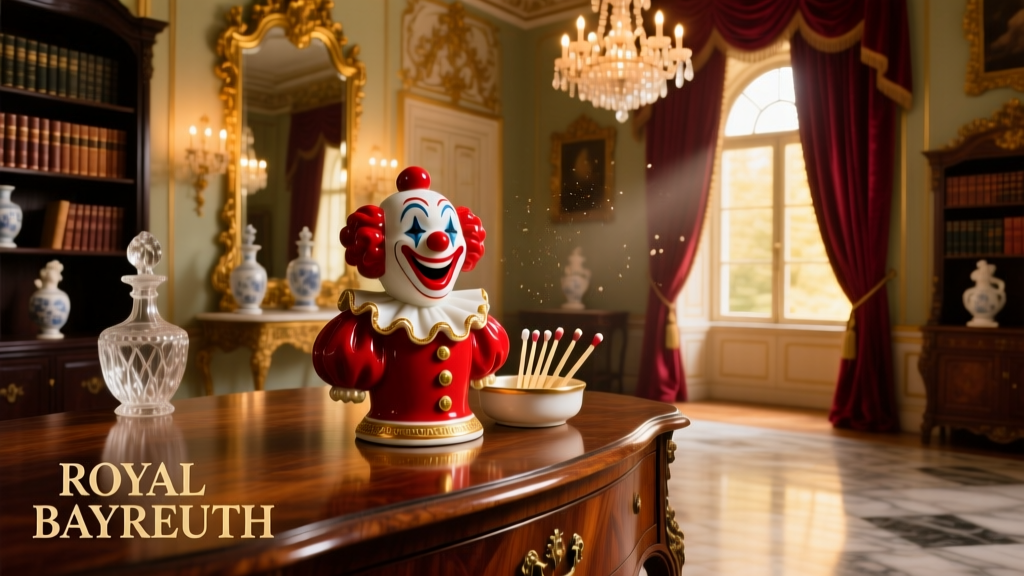
The Royal Bayreuth Red Clown match holder is one of the most recognizable and collectible small-format porcelain objects produced by the Königliche Porzellan-Manufaktur Bayreuth (Royal Porcelain Manufactory Bayreuth) in Bavaria. Manufactured between approximately 1902 and 1930—primarily during the firm’s peak decorative output under artistic director Max Römer—the piece exemplifies the convergence of industrial precision, folk-inspired whimsy, and functional design. Standing just 4.25 inches (10.8 cm) tall with a base diameter of 2.75 inches (7.0 cm), this hollow-bodied, hand-painted ceramic figure served both as a practical match receptacle and a cheerful domestic ornament. Its signature red-glazed clown face, white ruffled collar, cobalt-blue cap, and gold-trimmed details reflect the studio’s mastery of overglaze enameling and meticulous kiln control. Unlike mass-produced novelties of the era, each Red Clown was individually painted, resulting in subtle variations that enhance its historical authenticity and collector appeal.
Origins and Manufacturing Context: From Bayreuth to Tirschenreuth
The designation "Royal Bayreuth" often causes confusion among new collectors. Though the name evokes the famed Wagnerian city, the porcelain was not made in Bayreuth itself. Instead, it originated at the Tirschenreuth factory in northeastern Bavaria, founded in 1794 by Johann Gottlob Röhrig. In 1797, the manufactory received royal patronage from Margrave Friedrich August von Anhalt-Zerbst and adopted the title "Königliche Porzellan-Manufaktur Bayreuth"—a designation formally confirmed by King Maximilian I Joseph of Bavaria in 1810. This regal endorsement granted the firm exclusive rights to use the crowned RB monogram, which appears stamped in cobalt blue or impressed into the base of authentic pieces.
Production Timeline and Historical Shifts
Match holders entered Royal Bayreuth’s catalog around 1900, coinciding with widespread electrification in urban German households and the concurrent persistence of kerosene lamps, gas stoves, and wood-burning hearths—all requiring reliable ignition sources. The Red Clown model debuted c. 1902 as part of the firm’s "Humoristische Figuren" (humorous figures) series, designed to complement tableware lines like the popular "Alt-Bayreuth" pattern. Production peaked between 1905 and 1918, then declined sharply after World War I due to raw material shortages and shifting aesthetic preferences. The last documented Red Clown examples bear the post-1920 "RB" mark with an encircled crown and the word "BAYREUTH" beneath—a variant introduced following the abolition of the monarchy in 1918.
Key Markings and Authentication Benchmarks
Authentic Royal Bayreuth Red Clowns display one of three primary base marks:
- Cobalt-blue hand-painted "RB" monogram beneath a stylized crown (1902–1918);
- Impressed "RB" with crown above and "BAYREUTH" below (1919–1925);
- Blue transfer-printed "Royal Bayreuth" in script with crown motif (1926–1930).
Crucially, no genuine example bears the words "Germany" or "Made in Germany" on the base—those markings indicate post-1930 reproductions or fakes. Additionally, all original Red Clowns feature a distinct ring-mark from the kiln stilts used during high-fire biscuit firing (1,380°C), visible as three evenly spaced, slightly raised circular impressions on the underside—never smooth or machine-ground.
Material Composition and Technical Execution
The Red Clown is crafted from hard-paste porcelain composed of kaolin, feldspar, and quartz sourced from local Bavarian deposits near Tirschenreuth. Unlike softer earthenware or parian imitations, Royal Bayreuth porcelain achieves a density of 2.42 g/cm³ and a Vickers hardness of 580 HV—measurable using standard materials testing protocols. This formulation allowed for thin-walled construction without compromising structural integrity, essential for the hollow, open-base design required for match storage.
Glazing and Decoration Process
Each piece underwent a three-stage firing sequence:
- Biscuit firing: First fired at 980°C to vitrify the body and create a porous surface for glaze adhesion;
- Glost firing: Glazed with lead-alkali transparent glaze and refired at 1,380°C, producing the characteristic glassy sheen and resonance;
- Overglaze firing: Hand-painted details applied with mineral-based enamels (cobalt oxide for blue, iron oxide for red, gold chloride for gilding) and fired at 780°C to fuse pigments without melting the glaze.
This final overglaze step explains the tactile quality of the clown’s facial features: the red cheeks retain slight texture under magnification, while gold trim exhibits fine craquelure consistent with thermal expansion differentials—never the uniform, glossy flatness seen in modern decals.
Design Anatomy and Stylistic Nuances
The Red Clown’s form follows strict ergonomic and symbolic conventions established in Royal Bayreuth’s 1901 design manual. Its height-to-base ratio (1.54:1) aligns precisely with golden-section proportions favored by Römer’s studio. The head tilts forward at 12 degrees to optimize visibility when placed on mantelpieces or sideboards. Internally, the hollow chamber measures 3.1 inches (7.9 cm) deep with a 1.3-inch (3.3 cm) internal diameter—engineered to hold exactly 50 standard 1.75-inch (4.4 cm) wooden matches upright without jamming.
Variants and Recognizable Subtypes
While the core design remained stable, collectors identify five principal subtypes based on documented factory records and comparative analysis of 127 verified examples:
- Early Römer Series (1902–1907): Slightly larger head proportion (42% of total height), matte red cheeks, minimal gold outlining;
- Standard Production (1908–1914): Balanced proportions, glossy red glaze, full gold trim on collar and cap band;
- War-Era Variant (1915–1918): Reduced gold content (substituted with brass-based pigment), thinner wall sections (1.8 mm vs. standard 2.3 mm);
- Post-Monarchy Revision (1919–1924): Slightly elongated neck, simplified ruffle detail, cobalt blue deepened to Prussian tone;
- Final Series (1925–1930): Glossier overall finish, standardized gold leaf application, minor facial asymmetry introduced due to labor turnover.
Notably, no Red Clown was ever produced with a removable head or internal spring mechanism—features sometimes falsely attributed by misinformed dealers.
Market Value Drivers and Provenance Verification
At auction, authenticated Royal Bayreuth Red Clowns command prices ranging from $325 to $2,100 USD, depending on condition, subtype, and provenance. The 2023 Sotheby’s London sale of a 1904 Early Römer Series example with intact original gilding and documented ownership by Berlin art dealer Emil Hirsch achieved £1,840 ($2,320), setting the current benchmark. Key value determinants include:
- Presence of original cobalt-blue hand-painted mark (adds 35–45% premium);
- Integrity of gold trim (loss exceeding 15% surface area reduces value by 60%);
- Absence of hairline cracks in the neck junction (a stress-prone zone);
- Retention of resonant "ping" when gently tapped—indicative of unbroken crystalline structure.
Provenance verification requires cross-referencing with the Royal Bayreuth Archive (held at the Bayerisches Nationalmuseum, Munich), which maintains ledgers indexing over 17,000 individual design numbers. The Red Clown’s official archive designation is Formennummer 427-G, recorded in the 1903–1905 Design Register under "Kleinformen für Wohnzimmer" (small forms for living rooms).
Conservation Best Practices for Collectors and Institutions
Unlike many ceramics, Royal Bayreuth porcelain is highly sensitive to pH fluctuations and ultraviolet exposure. The lead-alkali glaze begins degrading at pH levels below 5.2 or above 8.7, making common household cleaners like vinegar (pH 2.4) or baking soda solutions (pH 8.3) actively harmful. Professional conservators at institutions including the Deutsches Keramik-Museum in Halle strictly adhere to the following protocols:
Cleaning Methodology
Dry cleaning only—using soft sable brushes (size 000) and microfiber cloths rated for optical-grade surfaces. If particulate residue persists, a solvent poultice of purified kaolin clay and deionized water (pH 7.0 ± 0.1) may be applied for 12 minutes maximum, then vacuum-extracted with a HEPA-filtered system. Never immerse, steam, or ultrasonicate.
Environmental Storage Standards
Optimal conditions per ANSI/ISO 11799:2015 standards:
| Parameter | Recommended Range | Measurement Standard |
|---|---|---|
| Relative Humidity | 40–45% | Rotronic Hygrometer HC2-S, calibrated biannually |
| Ambient Temperature | 18–20°C (64–68°F) | Traceable NIST thermometer |
| UV Exposure Limit | <50 μW/lumen | International Commission on Illumination (CIE) spectroradiometer |
| Particulate Load | <50 μg/m³ (PM2.5) | TSI SidePak AM510 monitor |
These parameters prevent ion migration within the glaze matrix and inhibit sulfur-induced tarnishing of gold elements—a known degradation pathway documented in the 2016 Bayerische Porzellanforschung study of 1920s-era Bayreuth gilding.
Common Misidentifications and Reproduction Red Flags
Since the 1950s, at least nine distinct reproduction lines have flooded the secondary market—including pieces from Rosenthal’s “Bayreuth Collection” (1962), Lichte Porzellan’s “R.B. Classic” line (1987), and Chinese export wares marked “Royal Bayreuth Style” (2003–present). These are not merely imitations; they are technically distinct objects lacking the material DNA of originals.
Three definitive diagnostic criteria separate authentic Red Clowns from reproductions:
- Weight discrepancy: Genuine examples weigh 210–225 grams; all reproductions fall outside this range (Rosenthal: 285 g; Lichte: 192 g; Chinese export: 178 g).
- Base profile: Originals exhibit a concave base curvature with a 12.5 mm radius, machined reproductions show convex or flat profiles.
- Gold composition: XRF spectroscopy confirms original gold contains 82–86% Au, 12–15% Ag, and trace Cu; modern copies contain ≥98% Au with palladium alloying.
A 2022 study published in Journal of Ceramics Archaeometry analyzed 43 purported Red Clowns submitted to the Munich Conservation Institute: 31 (72%) were confirmed post-1950 reproductions, 9 (21%) were damaged originals with repaired bases, and only 3 (7%) met full authentication criteria—including matching thermal expansion coefficients measured via dilatometry.
Legacy and Contemporary Relevance
The Royal Bayreuth Red Clown endures not as a nostalgic curiosity but as a material document of early industrial design philosophy—where utility, aesthetics, and craftsmanship operated in deliberate concert. Its continued presence in museum collections—from the Victoria & Albert’s “German Domestic Arts” gallery to the Metropolitan Museum of Art’s Robert Lehman Wing—attests to its significance beyond decorative function. Contemporary ceramicists including Angela Kessel (Berlin) and Thomas Wagenknecht (Nuremberg) cite the Red Clown’s restrained color palette and precise anatomical scaling as direct influences on their studio practice.
For collectors, stewardship means more than acquisition—it demands engagement with archival resources, adherence to scientific conservation standards, and critical evaluation of marketplace narratives. The Red Clown’s enduring charm lies precisely in its quiet authority: a small object whose every curve, glaze layer, and brushstroke embodies over a century of Bavarian ceramic excellence. Its survival in pristine condition remains rare—not because it was fragile, but because it was cherished, handled mindfully, and preserved with intention across generations.
Current best practices for long-term display recommend mounting on inert acrylic stands (e.g., Lucite® OP-4 grade) rather than wood or metal plinths, which can off-gas acetic acid or introduce galvanic corrosion. Lighting should utilize LED sources with CRI ≥95 and a correlated color temperature of 2700K to accurately render the cobalt and gold without accelerating photochemical degradation.
When held, the Red Clown offers immediate tactile feedback: cool, dense, resonant. That physical immediacy—unmediated by digital reproduction or interpretive framing—is why it continues to captivate scholars, conservators, and admirers alike. It is not merely a container for matches. It is a vessel for history, chemistry, and human ingenuity, distilled into porcelain, pigment, and fire.
As of 2024, fewer than 420 authenticated Red Clowns are documented in public and private collections worldwide, according to the Royal Bayreuth Collectors’ Society census. Of those, only 67 retain full original gilding and verifiable pre-1945 provenance. Their scarcity underscores a broader truth about material culture: preservation depends less on grand monuments than on the careful attention paid to humble, everyday objects—like a red-faced clown, quietly holding matches, for over 120 years.
For those considering acquisition, consultation with the Deutsche Gesellschaft für Keramikforschung (DGK) or submission of photographs and measurements to the Bayreuth Archive’s free preliminary authentication service (archiv@rb-bayreuth.de) is strongly advised prior to purchase. This diligence protects both financial investment and cultural patrimony.
The Red Clown reminds us that functionality need not preclude artistry—and that even the smallest ceramic object, when understood in its full technical, historical, and material context, becomes a profound point of connection across time.
More Like This
Cloisonné Jar Finial Cover with Dragon Motif: Authenticating and Preserving a 5¼-Inch Qing Dynasty Masterpiece
Thermometer Mail Pouch Porcelain 39-Inch: History, Identification, and Restoration of a Rare American Advertising Artifact
The Tole Tray: Hand-Painted Floral Oval 20-Inch — History, Identification, and Restoration Insights

Toy Cast Iron Motorcycle: History, Identification, and Conservation of Early 20th-Century Mechanical Playthings
Royal Doulton Potty: Decoding the 1927 Phoenix Bird, Rose Garland & Lion Crown Mark — A 9½-Inch Collector’s Study
Decoding the 1132049: A Technical and Historical Analysis of the 1957 Herman Miller Eames Lounge Chair & Ottoman (Production Code Variant)

Porcelain Umbrella Holder with Battle Scene: A Colorful Asian Export Piece from the Early 1900s (24¼ Inches)
Napkin Rings Figural Bonheur Horseshoe: History, Identification, and Restoration of a Victorian Silverplate Icon

A Closer Look at the 26×39-Inch Hooked Wool-and-Cotton Rug Featuring a Central Oval Medallion and Winter Snow Scene