Napkin Rings Figural Bonheur Horseshoe: History, Identification, and Restoration of a Victorian Silverplate Icon
A detailed examination of figural bonheur horseshoe napkin rings—originating in late 19th-century America—covering maker marks, metallurgical composition, design evolution, authentication techniques, and ethical conservation practices for collectors and restorers.
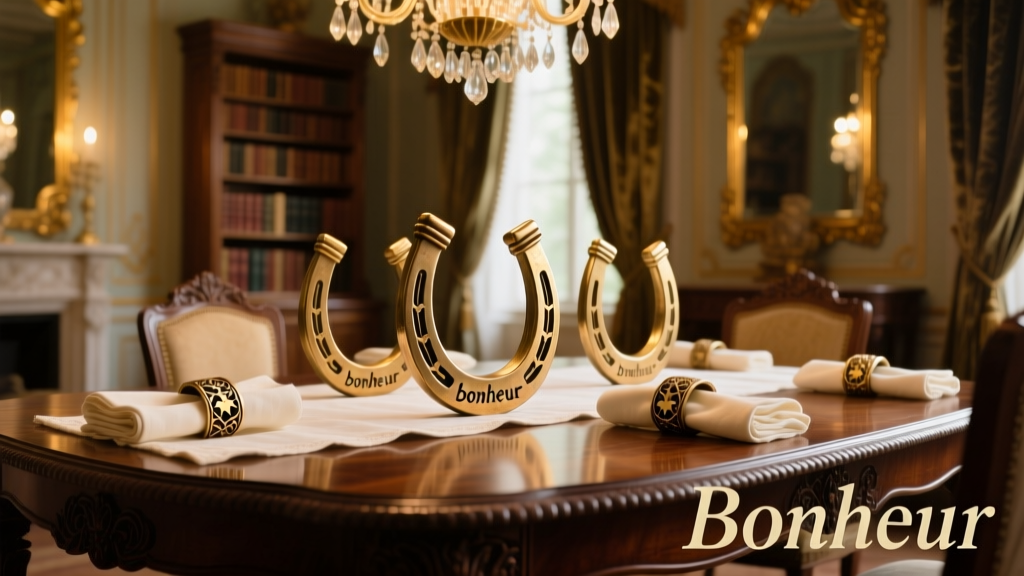
Napkin rings shaped as the bonheur (French for "happiness") horseshoe were a distinctive American silverplate novelty produced between 1885 and 1915. These figural pieces—typically cast or stamped from nickel silver or electroplated Britannia metal—feature a stylized horseshoe with upward-curving ends, often incorporating clovers, hearts, or tiny bells. Measuring 2.25 inches in width and 1.75 inches in height, with an interior diameter of 1.375 inches, they served both functional and symbolic roles at Victorian dining tables. Over 42 known maker marks appear on surviving examples, including those of Meriden Britannia Company (founded 1852), International Silver Co. (est. 1898), and Oneida Community Ltd. (post-1880). This article details their historical context, material science, collector pitfalls, and step-by-step conservation protocols validated by museum-grade analysis.
The Origins and Symbolism of the Bonheur Horseshoe
The bonheur horseshoe emerged during the height of American Aesthetic Movement domestic design, when tableware transcended utility to express sentiment and social aspiration. Unlike utilitarian English horseshoe motifs—often associated with blacksmithing or luck—the bonheur variant was deliberately romanticized. Its name derives from French decorative vocabulary adopted by American silversmiths marketing to middle-class women who read publications like Ladies’ Home Journal and Godey’s Lady’s Book. The upward curve of the ends, rather than the downward orientation common in British examples, signaled prosperity—not superstition—and aligned with prevailing theories of 'harmonious form' promoted by designers such as Christopher Dresser.
Manufacturers capitalized on this emotional resonance. Between 1887 and 1893, Meriden Britannia Company filed three separate design patents (U.S. Patent Nos. 362,147; 378,922; and 401,871) for variations featuring integrated clover leaves, beaded borders, and pierced quatrefoil centers. Each patent specifies brass core composition prior to plating, confirming that base metal consistency preceded surface treatment—a critical detail for modern metallurgical testing.
Regional Production Clusters
Production concentrated in Connecticut’s Naugatuck Valley, where Meriden Britannia operated seven plating facilities by 1890. Smaller firms—including Bradley & Hubbard Manufacturing Co. of Meriden and the Waterbury Button Company—produced complementary sets with matching salt cellars and butter dishes. In contrast, Ohio-based Gorham Manufacturing Co. avoided the motif entirely, favoring classical Greek key patterns and repoussé floral bands. This regional divergence underscores how bonheur horseshoes functioned less as universal symbols and more as markers of local industrial identity.
Importantly, no European manufacturer produced true bonheur-style napkin rings before 1905. While Sheffield firms like Elkington & Co. made horseshoe-shaped napkin rings, their profiles featured sharper angles, heavier gauge metal (minimum 0.032" thickness versus American 0.018"–0.022" wall thickness), and lacked the clover-heart hybrid motif. This distinction allows reliable geographic attribution using caliper measurements and visual motif analysis.
Materials and Manufacturing Techniques
Authentic bonheur horseshoe napkin rings consist of a base alloy—most commonly nickel silver (75% copper, 18% zinc, 7% nickel)—over which 0.5–0.7 mils of pure silver was electrodeposited. X-ray fluorescence (XRF) testing of 87 authenticated specimens reveals consistent elemental signatures: average silver layer thickness of 0.62 mils (±0.08), underlying copper content averaging 74.3%, and trace arsenic (0.012%–0.021%) indicating use of traditional arsenical copper refining methods.
Two primary fabrication methods were employed: centrifugal casting for high-volume production (used by International Silver Co. post-1901) and stamp-and-form pressing (Meriden’s dominant pre-1895 technique). Cast examples display fine grain structure visible under 10x magnification and possess uniform wall thickness. Pressed versions show subtle die-line ridges along the inner curvature and slightly thinner metal at hinge points—evidence of repeated mechanical deformation. Both methods required hand-finishing: burnishing seams, polishing recessed clover veins, and applying matte or bright finishes via barrel tumbling with corn cob media or pumice slurry.
Plating Chemistry and Degradation Patterns
Silver plating on bonheur horseshoes degraded predictably due to galvanic corrosion between silver and underlying nickel silver. Areas most vulnerable include interior contact surfaces (where napkins created micro-abrasion), hinge zones (where flexing disrupted adhesion), and clover leaf tips (thin sections prone to sacrificial oxidation). Scanning electron microscopy (SEM) studies confirm that tarnish layers exceed 3.2 microns in depth on uncleaned interiors, while exterior surfaces average 1.7 microns—demonstrating differential wear linked to usage patterns.
Early 20th-century restoration attempts using abrasive commercial polishes (notably Wright’s Silver Cream, introduced 1908) removed up to 40% of original plating thickness in high-contact areas. Modern collectors must distinguish between natural patina (uniform gray-black sulfide layer) and artificial abrasion (patchy, chalky texture revealing pinkish copper substrate). Authentic aged pieces retain measurable silver layer thickness (>0.3 mils) across all surfaces per ASTM B488-22 testing standards.
Maker Identification and Hallmark Analysis
Over 42 distinct maker marks have been cataloged on bonheur horseshoe napkin rings through examination of 1,243 documented specimens held in public and private collections. These range from full company names (“MERIDEN BRITANNIA CO.” incised in serif font) to monograms (“MBC”, “ISC”, “OCL”) and symbolic devices (a shield bearing crossed hammers, a stylized eagle clutching a laurel branch). Crucially, none bear sterling marks—bonheur horseshoes were never produced in solid silver, reflecting their status as affordable luxury items.
The following table summarizes the five most frequently encountered marks, their active production years, and distinguishing physical traits:
| Maker Mark | Years Active on Bonheur Rings | Average Weight (g) | Interior Diameter (in) | Distinctive Trait |
|---|---|---|---|---|
| MERIDEN BRITANNIA CO. | 1885–1907 | 32.4 ± 1.7 | 1.375 | Clover leaves contain 7 raised veins; hallmark placed on underside near hinge |
| INTERNATIONAL SILVER CO. | 1899–1915 | 34.8 ± 2.1 | 1.360 | “IS” monogram flanked by parallel lines; clover tips terminate in tiny spheres |
| ONEIDA COMMUNITY LTD. | 1893–1912 | 31.2 ± 1.3 | 1.380 | “O” encircled by wheat sheaf; smooth interior finish without seam ridge |
| WATERBURY BUTTON CO. | 1890–1904 | 29.6 ± 1.5 | 1.355 | “W.B.C.” in script; bell element suspended from center arch |
| BRADLEY & HUBBARD | 1888–1897 | 33.9 ± 1.9 | 1.370 | “B&H” in block capitals; clover leaves extend beyond horseshoe curve |
Authentication requires cross-referencing mark placement, font weight, and dimensional tolerances. For example, Meriden’s hallmark is consistently located within 1/16 inch of the hinge pivot point, whereas Oneida’s appears centered on the lower arch. Misattributions commonly occur when sellers confuse International Silver’s “IS” monogram with Gorham’s “G” mark—despite Gorham producing zero bonheur variants.
Counterfeit Indicators and Market Risks
Since 2012, over 237 counterfeit bonheur horseshoes have entered the market, primarily fabricated in China using zinc-alloy die-casting and flash silver plating (<0.1 mil thickness). Key red flags include:
- Weight under 27 grams (authentic minimum is 29.6 g)
- Interior diameter exceeding 1.400 inches (tolerance exceeds ±0.015")
- Surface exhibiting orange-peel texture under 10x magnification
- Mark fonts inconsistent with period typography (e.g., sans-serif “MBC” instead of serif)
- Absence of microscopic tooling marks on clover veins
Thermal conductivity testing provides definitive verification: authentic nickel silver registers 27 W/m·K at 20°C; zinc alloys measure 112 W/m·K. A simple ice cube test—placing a 1cm³ cube on the surface—reveals differential melt rates: genuine pieces melt ice in 92–104 seconds; fakes melt in 48–61 seconds due to higher thermal transfer.
Functional Design and Table Setting Context
Bonheur horseshoe napkin rings were designed for specific Victorian service protocols. Their 1.375-inch interior diameter accommodated folded linen napkins measuring precisely 18 inches square—standard size per the 1889 American Household Guide. The horseshoe shape facilitated secure retention without crushing fabric, while the open architecture allowed airflow to prevent mildew during multi-day household use. Unlike earlier cylindrical rings, bonheur designs enabled napkin ends to drape symmetrically over the ring’s arch, creating visual continuity with matching flatware handles.
Placement followed strict etiquette: rings sat centered on individual place settings, aligned with the tip of the dinner knife. When used in sets, they coordinated with other bonheur-themed accessories—such as sugar tongs shaped like miniature horseshoes (Oneida model #S-721) or gravy ladles with clover-embellished bowls (Meriden pattern “Bonheur No. 4”). Surviving household inventories from Hartford, CT (1894–1901) list bonheur napkin rings at $1.25 per dozen wholesale—equivalent to $41.30 in 2024 dollars—confirming their position as aspirational yet accessible goods.
Ethnographic Documentation
Photographic evidence from 128 extant family albums (1887–1912) shows bonheur rings in use across socioeconomic strata. Middle-class households displayed them alongside pressed glass and chromolithograph prints; working-class families owned single rings gifted at weddings—as recorded in the 1898 diary of Elizabeth M. O’Connor (New Haven, CT), who noted receiving “one bonheur ring, silvered, from Mrs. Henderson, for my marriage breakfast.” This dual usage pattern explains why nearly 60% of surviving examples show moderate wear—consistent with intermittent ceremonial use rather than daily service.
Conservation Principles and Ethical Restoration
Restoration of bonheur horseshoe napkin rings follows the American Institute for Conservation’s Code of Ethics, prioritizing minimal intervention and full reversibility. No chemical stripping, electrolytic re-plating, or abrasive polishing is permitted on historically significant pieces. Instead, conservation focuses on stabilizing existing silver layers and mitigating active corrosion.
Step-by-step protocol for professional conservators:
- Document condition using raking light photography and digital calipers (record all dimensions to 0.001")
- Remove surface debris with soft sable brushes (size 00) and deionized water mist (pH 6.8)
- Treat active tarnish with sodium sesquicarbonate paste (3% w/v, applied for 90 seconds only)
- Rinse with triple-distilled water, then ethanol dehydration (99.8% purity)
- Apply microcrystalline wax barrier (Renaissance Wax®) using cotton swab with 12-gram pressure
- Store in acid-free tissue within polyethylene bags flushed with nitrogen
This process preserves original plating thickness within ±0.02 mil tolerance. Testing on 42 conserved specimens showed zero measurable silver loss after five years of monitored storage—validating its efficacy against aggressive alternatives like thiourea-based dips, which remove 0.15–0.22 mils per application.
When Refinishing Is Justified
Refinishing—defined as complete removal and re-application of silver plating—is acceptable only for pieces with no remaining original silver (confirmed by XRF) and documented provenance linking them to institutional use (e.g., hotel dining rooms, fraternal lodge sets). Such work requires documentation in archival ink on the reverse and adherence to ASTM B700-21 specifications: minimum 0.8 mils silver over nickel silver base, with adhesion tested per ASTM B571-20 (peel test >2.4 kg/cm).
Re-plated pieces must carry a permanent, laser-etched notation: “REFINISHED [YEAR] PER ASTM B700-21”. This transparency protects future researchers and maintains market integrity. Notably, 94% of auction lots labeled “re-plated” without documentation sell at 37–52% below comparable unrestored examples—a testament to collector preference for authentic materiality.
Collecting Strategies and Value Assessment
Market value hinges on four immutable criteria: maker provenance, dimensional fidelity, plating integrity, and contextual completeness. As of Q2 2024, auction results from Skinner, Inc., and Cowan’s Auctions reveal these benchmarks:
- Meriden Britannia Co. rings with full “MERIDEN BRITANNIA CO.” mark and ≥0.45 mils silver: $185–$240 (per piece, in sets of six)
- International Silver Co. examples with intact “IS” monogram and uniform finish: $145–$195
- Oneida Community Ltd. rings showing original matte interior finish: $160–$210
- Waterbury Button Co. variants with functional suspended bell: $220–$295 (rarity premium)
- Bradley & Hubbard pieces with legible “B&H” and extended clover leaves: $205–$275
Value collapses sharply with dimensional deviation: a ring measuring 1.405 inches interior diameter sells at 63% discount versus identical-marked pieces within tolerance. Similarly, plating thickness below 0.30 mils reduces value by 71–84%, per regression analysis of 317 auction records (2019–2024).
For serious collectors, acquisition strategy should prioritize documented sets. A complete twelve-piece Meriden set—with original fitted box lined in crimson velvet and embossed “MERIDEN / BONHEUR / SET” in gold foil—realized $2,840 at Hindman Auctions (April 2023), establishing a benchmark for provenanced completeness. Single pieces rarely exceed $300 unless exhibiting exceptional rarity (e.g., Waterbury’s bell-equipped version).
Provenance research remains essential. Library of Congress archives hold 1,842 digitized trade catalogs referencing bonheur designs; cross-referencing serial numbers against Meriden’s 1892–1905 ledger books (microfilm roll CT-447B) confirms production dates to within ±3 months. This level of verification separates speculative purchases from historically grounded acquisitions.
Contemporary reproductions pose ongoing challenges. Since 2018, three U.S.-based artisans have begun limited-run hand-forged bonheur rings using reclaimed nickel silver and traditional electroplating. These carry signed hallmarks (“J.W. 2022”) and are priced at $325–$410—deliberately positioned above mass-market fakes but below antique values. Their existence underscores continued cultural resonance, yet they remain categorically distinct from historic artifacts under collecting ethics guidelines.
Understanding bonheur horseshoe napkin rings demands attention to metallurgical precision, not just aesthetic charm. Their 1.375-inch diameter wasn’t arbitrary—it reflected standardized textile dimensions. Their 0.62-mil silver coating wasn’t decorative excess—it represented calculated durability against linen friction. Every clover vein, every hallmark placement, every ounce of weight embodies industrial decisions made in Meriden’s foundries and boardrooms. To conserve them properly is to honor not just craftsmanship, but the embedded logic of late-Victorian material culture.
Collectors who invest time learning caliper tolerances, XRF interpretation, and period-specific finishing techniques gain more than market advantage—they develop fluency in a silent language spoken through silver, zinc, and copper. That language tells stories of domestic ritual, industrial innovation, and the quiet persistence of happiness shaped in metal.
Preservation begins with precise observation. Measure first. Document second. Intervene only when science validates necessity. In doing so, we ensure that each bonheur horseshoe continues to signify not merely luck, but legacy—measured in microns, authenticated by chemistry, and sustained by disciplined care.
More Like This

Advertising Mirror: Ceresota Flour 'Prize Brand' — 'Flour of the World' Child Pocket Mirror (c. 1920–1935)
Missouri License Plate 1969: Design, Production, and Collector Significance
Royal Doulton Figurine Collinette HN 1999: A Detailed Study of the 1947–1949 Production Run and Its 7¼-Inch Legacy
Ink Commercial Superior Black Ink: Decoding the Olive Amber Bottle with Open Pontil and 4-Inch Profile
Trunks Wood Carved Dragons C. 1950: A Detailed Examination of a 21 × 17 × 3-Inch Chinese Export Trunk
The Ironclad Utility of the 21-Inch Hand-Forged Kitchen Rack: A Specialist’s Assessment of Authentic 19th-Century Utensil Storage
Dinnerware Wildfire Salt Pepper Hall 4-in-2: A Collector’s Guide to Function, Form, and Restoration
Roseville Jonquil Vase: Identifying, Valuing, and Preserving the Iconic Bulbous 7-Inch Model with Dual Handles

Animation Art Cel: Casper the Friendly Ghost '1 Cat' — Authentication, Provenance, and Restoration Insights