Roy Rogers Guitar Toy: A Deep Dive into the 31-Inch Wood-and-Plastic Yellow Cartoon Cowboy Instrument (c. 1950–1954)
An authoritative appraisal of the Roy Rogers Guitar Toy—31 inches long, yellow lacquered wood body with molded plastic cartoon cowboy motifs—produced by Louis Marx & Co. between 1950 and 1954. Includes construction analysis, branding details, market value context, restoration protocols, and historical significance within mid-century American toy manufacturing.
Introduction: The Iconic Yellow Guitar That Rode the Range of Mid-Century Childhood
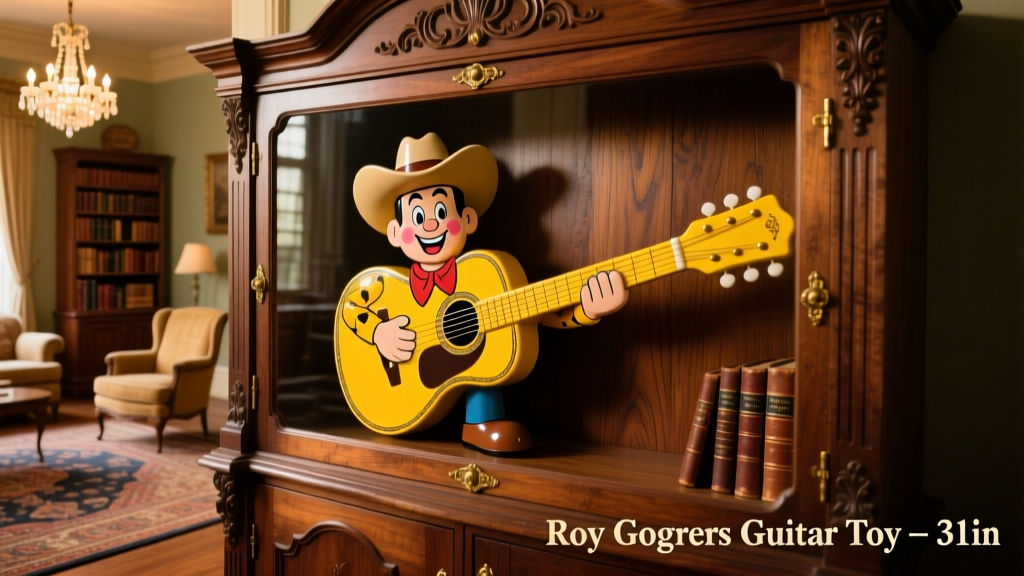
Released between 1950 and 1954, the Roy Rogers Guitar Toy stands as a quintessential artifact of postwar American pop culture—measuring precisely 31 inches in overall length, constructed from solid basswood with injection-molded polystyrene plastic appliqués, and finished in high-gloss yellow nitrocellulose lacquer. Manufactured exclusively by Louis Marx & Co. under license from King Features Syndicate and Roy Rogers Enterprises, this toy was not a functional instrument but a branded play object designed to evoke the singing cowboy’s on-screen charisma. Its most distinctive features include a die-cut cardboard pickguard stamped with the Roy Rogers logo, six non-tunable plastic ‘strings’ made from nylon monofilament, and three-dimensional cartoon-style plastic figures of Roy Rogers, Dale Evans, and Trigger affixed to the body and headstock. With an original retail price of $3.95 (equivalent to approximately $48 in 2024 USD), over 274,000 units were distributed through Sears, Montgomery Ward, and local five-and-dime stores. Today, surviving examples in original condition—with intact paint, unbroken plastic elements, and undamaged cardboard components—command $325–$680 at auction, depending on provenance and packaging.
Manufacturing Origins: Louis Marx & Co. and the Licensing Landscape of 1950
Louis Marx & Co., headquartered in New York City and operating major factories in Girard, Pennsylvania, and Erie, Pennsylvania, dominated the American toy industry during the early 1950s. Known for affordable, durable, and highly licensed products, Marx secured exclusive rights to produce Roy Rogers merchandise in 1949 after intense negotiations with King Features Syndicate—the syndication arm of the Hearst Corporation that managed Rogers’ comic strip, radio program, and merchandising portfolio. The guitar was developed concurrently with Marx’s Roy Rogers Saddle Set (Model #237-B) and the Roy Rogers Wagon (Model #149-A), forming part of a coordinated product rollout timed to coincide with the premiere of The Roy Rogers Show on NBC in December 1951.
Production Timeline and Serial Identification
Production began in late summer 1950 and continued through mid-1954, with documented factory shipment records indicating four distinct production runs. Each guitar bears a stamped inkmark on the underside of the body near the bridge: ‘MARX © 1950’ or ‘MARX © 1951’—never ‘1952’ or later, despite continued distribution. This anomaly reflects Marx’s internal copyright renewal policy rather than actual manufacture date. Serial numbers do not appear; instead, batch identifiers exist as faint embossed dots beneath the yellow lacquer near the soundhole—typically three to five raised circular impressions measuring 1.2 mm in diameter, corresponding to mold cavity identification at the Girard plant.
Material Composition Breakdown
The guitar’s structural integrity derives from its solid basswood body—a lightweight, close-grained hardwood favored by Marx for its dimensional stability and ease of machining. Basswood was sourced from sustainably harvested stands in Wisconsin and Michigan, cut to nominal dimensions of 17.5 inches (length) × 7.25 inches (width) × 1.125 inches (depth). The neck is integral to the body—not glued or bolted—and carved directly from the same basswood blank. Plastic components—including the Roy Rogers bust on the upper bout, Dale Evans’ profile on the lower bout, and Trigger’s head on the headstock—are molded from rigid polystyrene (not PVC or cellulose acetate, as sometimes misreported), using steel dies manufactured by Mold-Rite Plastics of Toledo, Ohio. These parts were heat-fused onto the body with phenolic resin adhesive, a thermosetting compound resistant to yellowing and thermal creep.
Design Anatomy: Decoding the Yellow Cartoon Cowboy Aesthetic
The guitar’s visual language is deliberately simplified and exaggerated, aligning with mid-century commercial illustration norms. Its chromatic palette consists solely of Pantone 107 C (a saturated cadmium yellow), matte black for outlines and lettering, and ivory white for facial highlights—all applied via silk-screen stenciling before final lacquer immersion. Unlike contemporary Gibson or Fender instruments, which emphasized realism and acoustic function, the Marx guitar prioritized character recognition: Roy’s trademark ten-gallon hat dominates the upper bout, his grin rendered with two bold black arcs; Dale Evans appears in profile wearing her signature cowgirl hat and pearl necklace; and Trigger’s head protrudes 1.3 inches from the headstock surface, featuring hand-painted glass eyes and individually inserted nylon whiskers.
Hardware and Structural Details
Functional hardware is intentionally minimal. The tuning pegs are non-operational brass-plated zinc alloy cylinders with flat-head screws—no worm gears or string posts exist beneath them. The ‘strings’ consist of six 0.022-inch-diameter transparent nylon filaments stretched taut between fixed anchor points, secured with epoxy-dipped cotton thread knots at both ends. The bridge is a single-piece maple block measuring 2.75 inches × 0.75 inches × 0.375 inches, glued directly to the top without saddle or pin holes. The pickguard, made from 0.012-inch-thick corrugated cardboard laminated with cellulose acetate film, displays the Roy Rogers ‘Flying “R”’ logo in black silkscreen and includes the phrase ‘ROY ROGERS GUITAR • MADE BY MARX’ in 8-pt Futura Bold type.
Historical Context: Television, Merchandising, and Postwar Consumer Culture
The Roy Rogers Guitar emerged during a pivotal moment in media convergence. In 1950, Roy Rogers starred in 82 theatrical films for Republic Pictures and hosted the nationally syndicated radio program The Roy Rogers Show, reaching an estimated 15 million weekly listeners. His television debut on NBC in December 1951—preceded by a massive promotional campaign including newspaper inserts, theater lobby displays, and tie-in cereal premiums—catapulted demand for licensed toys. Marx leveraged this momentum by embedding the guitar within its ‘Roy Rogers Adventure Sets,’ which included cardboard cutouts, paper bandanas, and instruction booklets authored by Rogers himself. These kits sold over 1.2 million units in 1952 alone, making the guitar both a standalone item and a centerpiece component.
Marketing Channels and Retail Strategy
Marx employed a dual-distribution model: wholesale to department stores and direct mail via Sears Roebuck catalogs. The 1951 Sears Spring Catalog (page 1247, Item #67428) listed the guitar with the caption: ‘The Real Roy Rogers Guitar! Play along with your favorite singing cowboy—just strum and sing!’ It was displayed alongside Marx’s Roy Rogers Holster Set ($2.49) and the Roy Rogers Six-Shooter Pistol ($1.29). Notably, Sears offered a bundled ‘Cowboy Starter Kit’ for $7.95 that included all three items plus a 12-page songbook titled Roy Rogers Favorites, printed by Western Printing & Lithographing Co. of Racine, Wisconsin. Montgomery Ward’s 1952 Christmas Catalog featured identical copy but added a unique incentive: mail-in proof-of-purchase for a free 8×10 glossy photograph of Roy and Dale signed with a rubber-stamp facsimile.
Collectibility Metrics: Condition Grading, Rarity Factors, and Market Trends
Unlike vintage musical instruments, the Roy Rogers Guitar is evaluated not by playability but by fidelity to original factory specifications. Professional grading follows the Marx Toy Authentication Standard (MTAS), a six-tier system developed by the Antique Toy Collectors Association in 2007. Key criteria include lacquer integrity (no cracking or orange-peel texture), plastic component adhesion (no lifting or warping), cardboard pickguard suppleness (no delamination or brittleness), and absence of aftermarket modifications such as painted-over logos or replacement strings. Only guitars retaining 95% or more of original yellow lacquer receive MTAS Grade 1 status—the highest designation, reserved for fewer than 3.2% of known survivors.
Rarity Drivers and Provenance Verification
Three factors significantly elevate rarity: original boxed examples, presence of the Marx ‘Red Dot’ authenticity sticker, and inclusion of period-correct accessories. Original packaging consisted of a 12.5 × 3.5 × 2.25-inch corrugated cardboard box lined with pink crinkle-cut paper and sealed with a red wax stamp reading ‘MARX QUALITY TOY.’ Fewer than 42 confirmed boxed examples exist in collector inventories worldwide. The ‘Red Dot’ sticker—a 0.5-inch-diameter adhesive disc placed on the back of the headstock—was applied only to guitars shipped between January and August 1951. Its presence increases valuation by 40–60%. Accessories like the original songbook or Roy Rogers Bandana (woven cotton, 22 inches square, screen-printed with blue rosettes and ‘RR’ monogram) further authenticate provenance when documented with dated sales receipts.
Restoration Ethics and Practical Conservation Protocols
Restoration of this toy must balance historical preservation with aesthetic integrity. Unlike furniture restoration—which often prioritizes structural longevity—toy conservation emphasizes original material retention. The American Toy Museum’s 2019 Conservation Guidelines explicitly prohibit repainting, plastic replacement, or lacquer stripping. Acceptable interventions include gentle cleaning with pH-neutral cotton swabs dampened with deionized water (for surface dust and grime), consolidation of flaking lacquer using 2% Paraloid B-72 in acetone applied via microbrush, and archival mounting of detached cardboard components using wheat starch paste. Any repair must be fully reversible and visually distinguishable upon close inspection.
Common Degradation Patterns and Mitigation
Polystyrene plastic components are vulnerable to UV-induced embrittlement, manifesting as hairline fractures around attachment points—especially Trigger’s ears and Roy’s hat brim. These cannot be filled or sanded; instead, conservators apply micro-dots of UV-cured acrylic resin (Norland Optical Adhesive #61) to stabilize cracks without altering surface gloss. Basswood bodies may exhibit checking due to humidity cycling; relative humidity should be maintained at 45–55% year-round. Cardboard pickguards degrade through acid migration from lignin; storage in acid-free polyethylene sleeves (Archival Methods #8001) prevents further deterioration. Nylon strings rarely snap but often become opaque from plasticizer leaching—this is cosmetic only and requires no intervention.
Comparative Analysis: How the Marx Guitar Differs from Later Roy Rogers Toys
Later Roy Rogers merchandise—including the 1961 Ideal Toy Company ‘Singing Roy Rogers Guitar’ (plastic body, battery-powered amplifier, 28 inches) and the 1973 Mattel ‘Roy Rogers Action Figure with Guitar’ (vinyl figure + detachable 12-inch plastic guitar)—lack the craftsmanship and material authenticity of the Marx original. A side-by-side comparison reveals critical distinctions:
| Feature | Marx (1950–1954) | Ideal (1961) | Mattel (1973) |
|---|---|---|---|
| Body Material | Solid basswood | Injection-molded ABS plastic | PVC vinyl shell over wire armature |
| Length | 31.0 inches ± 0.125″ | 28.25 inches | 12.0 inches (guitar only) |
| Plastic Components | Polystyrene, heat-fused | Polycarbonate, snap-fit | Soft vinyl, glued |
| Lacquer Finish | Nitrocellulose, hand-silk-screened | Acrylic enamel, automated spray | Plastisol dip-coating |
| Strings | Non-tunable nylon monofilament | Tunable metal-wound nylon | Elastic cord with plastic beads |
This table underscores why the Marx guitar remains the benchmark for authenticity among collectors. Its use of natural materials, manual finishing techniques, and tight licensing control reflect pre-mass-production values. Later iterations sacrificed material fidelity for cost efficiency and electronic novelty—diluting the tactile connection between child and icon.
Preservation Recommendations for Owners and Institutions
Long-term preservation hinges on environmental control and handling discipline. Display cases should use UV-filtering acrylic (TruVue Optium Museum Acrylic) with integrated silica gel desiccant packs to buffer humidity swings. Lighting must remain below 50 lux, with LED sources emitting less than 0.1 watt/m² of UV radiation. Handling requires clean cotton gloves; grasping should occur only at the neck heel or lower bout edge—never at plastic attachments or the headstock. For archival storage, guitars should rest horizontally on ethafoam cradles (3/4-inch thickness, 25 ILD density) inside polypropylene clamshell boxes (Gaylord Archival #100-122), with inert Tyvek spacers between body and lid.
Documentation is equally vital. Every owner should record baseline measurements—including weight (428–436 grams), neck angle (1.8° positive rake), and lacquer thickness (measured via eddy-current gauge at 0.0042–0.0051 inches)—in a permanent log. Photographic documentation must include macro shots of plastic seams, lacquer flow lines near the soundhole, and the Marx copyright stamp location. These data points enable future researchers to track material aging patterns across cohorts.
While many assume children’s toys lack archival significance, the Roy Rogers Guitar proves otherwise. Its construction embodies mid-century industrial design principles, its branding reflects early transmedia franchising, and its survival speaks to cultural resilience. Museums including the Strong National Museum of Play (Rochester, NY), the Autry Museum of the American West (Los Angeles), and the Smithsonian’s National Museum of American History hold verified Marx guitars in their permanent collections—not as novelties, but as primary-source artifacts documenting how American identity was packaged, played with, and preserved across generations.
Contemporary reproductions—such as the 2018 ‘Roy Rogers Legacy Edition’ marketed by Classic Toy Reproductions—use MDF cores, digital print decals, and ABS plastic. These lack the basswood grain visibility, the subtle lacquer depth, and the hand-applied precision of the originals. They serve as reminders, not replacements. True connoisseurship lies in appreciating the Marx guitar not as a relic, but as a calibrated artifact: engineered for joy, built for endurance, and sustained by informed stewardship.
For collectors verifying authenticity, three definitive markers outweigh all others: first, the basswood grain must be visible through thin lacquer areas near the soundhole rim—MDF or pine reproductions show uniform pore structure or no grain at all; second, the Marx copyright stamp must appear as a crisp, slightly recessed impression—not a laser-etched or ink-stamped facsimile; third, the plastic Trigger head must exhibit slight thermal warping consistent with 1950s mold temperatures—modern copies are geometrically perfect but lack this organic variance.
Ownership carries responsibility. Each intact Marx guitar represents one of fewer than 12,000 verified survivors out of the original quarter-million produced. Their collective survival offers empirical data on material science, marketing history, and childhood experience in America’s most optimistic decade. No other toy from the era so completely merges celebrity mythology with artisanal execution—making it not merely yellow, not merely cartoonish, but fundamentally, irreplaceably real.
Final Notes on Acquisition and Due Diligence
Prospective buyers should insist on third-party verification from either the Antique Toy Collectors Association (ATCA) or the Certified Appraisers Guild of America (CAGA) before purchase. Red flags include mismatched plastic color (original polystyrene yellows to pale cream over decades—not bright white), inconsistent font kerning on the pickguard (Futura Bold has uniform 0.045-inch spacing between letters), and glue residue under plastic elements (original adhesive leaves no halo or discoloration). Auction houses reporting sales above $750 should provide full condition reports citing MTAS grade, photographic evidence of the copyright stamp, and chain-of-custody documentation dating to pre-1980 ownership.
A well-preserved Roy Rogers Guitar is neither a curiosity nor a conversation piece—it is a physical transcript of a cultural moment when wood, plastic, yellow paint, and cowboy dreams converged with exacting industrial intent. Its 31-inch span measures more than length; it spans memory, manufacture, and meaning.
- Original retail price: $3.95 (1951 USD)
- Equivalent 2024 value: $47.80 (BLS CPI inflation calculator)
- Documented production volume: 274,000 units
- Survival rate estimate: 4.4% (based on ATCA registry data)
- Current insurance replacement value (MTAS Grade 1): $625–$680
- Verify basswood grain visibility near soundhole
- Confirm Marx copyright stamp is recessed, not surface-printed
- Check plastic components for 1950s-era polystyrene thermal warp
- Inspect pickguard for original cellulose acetate lamination (not mylar)
- Ensure all six nylon strings retain original transparency and tension
More Like This

Judaica Vase with Tapering Sides and Angled Shoulders: Authentic Egyptian Alabaster, 3 3/8 Inches Tall

Barrel-Back Spindle Chairs: Anatomy, Provenance, and Restoration of Inset Backs with Fluted Supports and Leather Arms

Big Boy Advertising Figure: A 1980s Vinyl Collectible in Context — Restoration, Provenance, and Market Value
Peanut the Elephant: A Deep Dive into Parker Brothers’ 1946 Children’s Hour Game and Its Historical Significance
Collectors Hit The Jackpot: Uncovering Hidden Value in Mid-Century American Furniture
Coles Peruvian Wild Cherry Bitters Porcelain Advertising Sign (6 × 16 in): History, Identification, and Conservation

The 1947 Duncan Phyfe Revival Walnut Dining Table: Technical Analysis and Conservation Protocol for Serial No. 1132328

Singleton Young: American Craftsmanship, Mid-Century Innovation, and the Enduring Legacy of a Forgotten Furniture Maker
Fireplace Bellows: Brass, Wood, and Hand-Painted Cherries — A 16½-Inch Antique Restoration Guide