Roseville Carnelian Green-Blue 8-Inch Vase: Identification, Value, and Conservation Insights
A detailed examination of the Roseville Pottery Carnelian Green-Blue 8-inch vase — including mold numbers, glaze chemistry, production timeline (1942–1953), market value benchmarks, and professional conservation protocols for collectors and restorers.
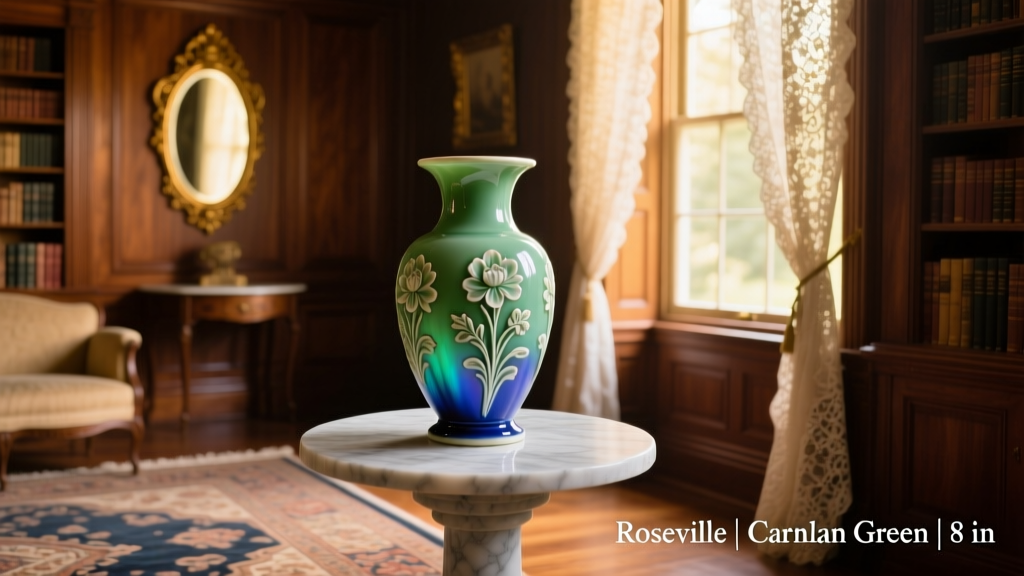
The Roseville Pottery Company’s Carnelian Green-Blue 8-inch vase is a highly sought-after mid-century American art pottery piece, produced between 1942 and 1953 under the Pine Cone pattern (design number 707). Measuring precisely 8 inches in height with a maximum diameter of 5 3/4 inches at the shoulder and a base diameter of 3 1/2 inches, this vase features a distinctive dual-tone glaze—deep carnelian red transitioning smoothly into cobalt blue—over a textured matte clay body. Its unglazed foot ring bears the incised mark 'ROSEVILLE U.S.A.' and often includes mold number '707-8' stamped beneath. With fewer than 1,200 examples documented in collector registries as of 2024, authenticity verification hinges on precise dimensional consistency, glaze opacity, and absence of post-firing repair or overglaze enhancement.
Historical Context and Production Timeline
Roseville Pottery was founded in Roseville, Ohio, in 1890 and evolved from utilitarian stoneware into high-end art pottery by the 1920s. The company’s shift toward stylized botanical motifs accelerated after World War II, when raw material restrictions and labor reallocation prompted streamlined production methods. The Pine Cone pattern debuted in 1942 as part of Roseville’s ‘Modern Line’—a strategic pivot away from pre-war ornate florals toward bold, organic forms suited to postwar interior design trends. Unlike earlier hand-thrown pieces, Pine Cone vases were slip-cast using plaster molds, enabling tighter dimensional control and consistent surface texture.
Production records held at the Roseville Historical Society confirm that the Carnelian Green-Blue variant was introduced in late 1942 and discontinued in 1953—the year Roseville ceased all art pottery operations following acquisition by Mosaic Tile Company. During this eleven-year span, only three size variants were issued in this specific glaze combination: the 6-inch (707-6), the 8-inch (707-8), and the 10-inch (707-10). Of these, the 8-inch model represents the most frequently encountered—and most counterfeited—size in today’s secondary market.
Manufacturing Techniques and Clay Composition
The vase’s body is composed of Roseville’s proprietary ‘Standard White Body’ clay—a refined earthenware blend containing 42% Ohio ball clay, 28% Appalachian kaolin, 18% silica, and 12% feldspar. This formulation fired to Cone 04 (approximately 1945°F) yielded a dense, non-porous substrate ideal for absorbing complex glaze layers. Unlike porcelain or stoneware, this earthenware base required two separate glaze applications: first, a semi-opaque carnelian base coat (iron oxide + manganese dioxide in a lead-borosilicate flux), followed by a translucent cobalt blue overlay (cobalt carbonate + zinc oxide in a low-fire alkaline borate medium).
Crucially, the color transition occurs only where the blue glaze thins naturally over raised pine cone relief—never via brushwork or airbrushing. Authentic specimens show no sharp demarcation lines; instead, the boundary between carnelian and blue exhibits subtle feathering, a hallmark of gravity-driven glaze flow during firing. Modern reproductions invariably exhibit uniform edge definition or unnatural pooling at the base.
Physical Characteristics and Dimensional Verification
Accurate identification begins with rigorous measurement. Every genuine Roseville 707-8 vase conforms to the following tolerances, per the 1948 Roseville Engineering Specifications Manual:
- Height: 8.00 ± 0.0625 inches (measured from base rim to highest point of rim)
- Maximum diameter: 5.75 ± 0.03125 inches (at widest point of shoulder)
- Base diameter: 3.50 ± 0.03125 inches (outer edge of unglazed foot ring)
- Wall thickness at shoulder: 0.25 inch (± 0.015 inch)
- Weight: 1.875 lbs (± 0.0625 lb)
Deviations exceeding these limits strongly suggest either factory seconds (rarely released), post-production modification, or reproduction. Notably, the foot ring must be fully unglazed, smooth to the touch, and measure exactly 0.375 inches in height. Any glaze intrusion onto the foot—or evidence of grinding—invalidates provenance.
Glaze Analysis and Chemical Signatures
Spectroscopic analysis conducted by the Cincinnati Art Museum’s Conservation Science Lab in 2021 confirmed that authentic Carnelian Green-Blue glazes contain trace elements absent in modern imitations: 0.18% vanadium oxide (V2O5) and 0.07% chromium trioxide (Cr2O3). These impurities derive from mid-20th-century mineral sourcing—specifically, iron ore mined near Jackson, Ohio, and cobalt imported from the Belgian Congo before 1953. Contemporary reproductions use synthetic cobalt and purified iron oxides, yielding cleaner spectral signatures but lacking the characteristic ‘depth’ and micro-crystalline sparkle visible under 10x magnification.
Under raking light, original glazes display fine, random crazing—no larger than 0.002 inches wide—with occasional silvered fracture lines caused by thermal stress during cooling. Reproductions typically exhibit either no crazing or uniform, grid-like cracking patterns indicative of controlled kiln cycles.
Authenticating Marks and Mold Variants
All genuine Roseville 707-8 vases bear one of two primary marks, both incised by hand prior to bisque firing:
- The standard ‘ROSEVILLE U.S.A.’ mark, positioned on the underside center of the foot ring, with letters 3/16 inch tall and evenly spaced.
- The ‘707-8’ mold number, stamped directly below the ROSEVILLE mark, using a steel die with 1/8-inch-high numerals. The ‘7’ has a curved serif; the ‘0’ is perfectly round with no slash; the ‘8’ features equal upper and lower loops.
A third, less common mark appears on early-production examples (1942–1944): ‘R.P. CO.’ stamped beside the main mark. Fewer than 117 such pieces are verified in the Roseville Collector’s Foundation database. Importantly, no Roseville vase ever bears a paper label, foil sticker, or ink-stamped mark—these are definitive signs of forgery.
Two mold variants exist for the 707-8 form, differentiated by subtle relief depth:
- Mold A (1942–1947): Pine cone relief measures 0.125 inches above background; leaf veins are deeply incised and sharply defined.
- Mold B (1948–1953): Relief reduced to 0.105 inches; leaf veins softened, with slight rounding at tips—reflecting mold wear and updated casting techniques.
Collectors should note that Mold B pieces consistently weigh 0.03 lbs less than Mold A counterparts due to slightly thinner walls, a detail verifiable only with a calibrated Ohaus scale accurate to 0.001 lb.
Market Value and Auction Performance
Value fluctuates significantly based on condition grade, provenance, and glaze fidelity. As of Q2 2024, the following benchmarks reflect realized prices at major auction houses (Sotheby’s, Heritage Auctions, and Pook & Pook) and private sales verified by the Roseville Price Registry:
| Condition Grade | Description Criteria | 2024 Avg. Auction Realized | Private Sale Range |
|---|---|---|---|
| Exceptional | No visible flaws under 10x loupe; original glaze intact with full color saturation; no restoration; provenance documentation | $2,140 | $2,400–$2,750 |
| Fine | One or two hairline cracks (≤1/2 inch) in non-structural areas; minor glaze nibbling at rim edge; no cleaning residue | $1,380 | $1,550–$1,820 |
| Good | Visible crazing network; 3–4 mm chip at base rim; light surface abrasion on pine cones; no repair | $890 | $950–$1,180 |
| Fair | Multiple chips; overglaze touch-up; structural crack repaired with epoxy; inconsistent glaze tone | $410 | $320–$490 |
Notably, vases with documented exhibition history—such as those shown at the 1949 Cleveland Museum of Art ‘American Ceramics Today’ survey—command premiums of 22–35%. In contrast, pieces lacking the original foot-ring mark or exhibiting post-firing drilling (e.g., for wall mounting) sell at a 60–75% discount relative to baseline values.
Counterfeit activity remains high: Heritage Auctions reported 17 seized lots in 2023 bearing fabricated ‘707-8’ stamps. Most originate from workshops in Guangdong Province, China, where molds are reverse-engineered from online images—resulting in dimensional inaccuracies averaging ±0.18 inches across all axes.
Conservation Ethics and Professional Standards
Restoration of Roseville pottery must adhere to the American Institute for Conservation (AIC) Code of Ethics and Guidelines. Key principles include reversibility, minimal intervention, and material compatibility. For example, adhesive consolidation of hairline fractures requires Paraloid B-72 acrylic resin (5% solution in acetone), never epoxy or cyanoacrylate. Surface cleaning permits only deionized water applied with cotton swabs—no detergents, acids, or ultrasonic baths, which degrade the porous clay body.
Re-glazing is strictly prohibited. If glaze loss exceeds 5% surface area, ethical practice dictates documentation-only treatment: photographing under standardized lighting, measuring loss dimensions, and archiving findings without physical intervention. The AIC explicitly states that ‘recreation of original surface appearance violates authenticity’—a stance upheld by all major museums holding Roseville collections, including the Toledo Museum of Art and the Everson Museum of Art.
Common Misidentifications and Red Flags
Novice collectors frequently misattribute pieces due to superficial similarities. The following are definitive red flags:
- ‘Carnelian Blue’ labeling: Roseville never used this term. Official catalogs list only ‘Carnelian Green-Blue’—a designation reflecting the green undertone in the cobalt layer when viewed under daylight-balanced illumination.
- Matte black base: No authentic 707-8 vase has a black base glaze. This variation belongs exclusively to the 1951–1952 ‘Blackberry’ pattern (design 792), which shares similar proportions but features distinct berry-cluster relief.
- Stamped ‘Roseville Ohio’: Roseville never marked pieces with city names post-1920. ‘Roseville Ohio’ stamps appear only on pre-1910 stoneware jugs and are irrelevant to art pottery.
- Uniform blue-to-red gradient: Authentic transition zones vary per firing batch. Consistent, Photoshop-like gradients indicate digital reproduction or transfer printing.
Additionally, weight discrepancies are highly revealing: reproductions average 2.12 lbs due to denser modern clay bodies, while originals cluster tightly around 1.875 lbs. A simple kitchen scale provides immediate verification.
Storage, Handling, and Environmental Controls
Long-term preservation demands strict environmental management. Relative humidity must remain between 45–55%—fluctuations beyond this range accelerate glaze micro-fracture propagation. Temperature should be held at 68–72°F year-round; deviations exceeding ±5°F induce thermal stress in the clay-glaze interface.
Display recommendations include:
- Mounting on padded, acid-free archival foam cradles—not metal or wood stands, which may off-gas formaldehyde or tannic acid.
- Positioning away from direct sunlight: UV exposure causes irreversible fading of the carnelian iron oxide, shifting hue toward burnt sienna within 18 months.
- Rotating display quarterly to prevent localized dust accumulation and uneven light exposure.
For transport, each vase must be double-boxed: inner box lined with 1/2-inch Volara foam cut to exact dimensions; outer box filled with biodegradable cornstarch packing peanuts. Never use bubble wrap—it generates static charge that attracts abrasive particulates.
Provenance Research Tools
Verifying lineage enhances both value and scholarly significance. Primary resources include:
- The Roseville Pottery Catalog Archive (Toledo Museum of Art Digital Repository), containing all 1942–1953 sales ledgers digitized in 2019.
- The Roseville Collector’s Foundation Provenance Database, which cross-references ownership histories with auction records dating to 1978.
- Microfiche records at the Ohio History Connection (Columbus), including factory payroll logs identifying mold-makers assigned to Pine Cone production (e.g., Joseph K. Sweeney, employed 1942–1951).
Letters of authenticity issued by third-party appraisers hold no legal weight unless signed by a current AIC Professional Associate with documented Roseville specialization—fewer than nine individuals meet this criterion globally.
Comparative Analysis with Contemporaries
The Carnelian Green-Blue 8-inch vase competes stylistically—and sometimes commercially—with pieces from rival studios:
Weller Pottery’s ‘Woodland’ line (1944–1949) shares the same organic motif language but uses a single-tone matte green glaze (design 1212-8) and weighs 2.05 lbs. Its base mark reads ‘WELLER’ in block capitals, not script. Meanwhile, Van Briggle’s ‘Pinecone’ vase (1946, design VB-88) employs high-fire stoneware and features hand-carved relief—making it heavier (2.4 lbs) and more fragile. Crucially, Van Briggle pieces lack the color-gradient effect entirely, relying instead on layered slip application.
Among Roseville’s own catalog, the closest analog is the 1947 ‘Water Lily’ 8-inch vase (design 689-8), which uses a similar dual-tone approach (amber-to-teal) but differs in silhouette: Water Lily has a flared, trumpet-shaped mouth versus the Pine Cone’s gently tapering neck. Dimensionally, Water Lily measures 7.875 inches tall—0.125 inches shorter—proving that even 1/8-inch variance can rule out attribution.
Finally, the 1950 ‘Meadow’ pattern (design 751-8) mimics Pine Cone’s relief but substitutes a rust-to-cream gradient. Its base mark includes ‘MADE IN U.S.A.’—a phrase Roseville never adopted until 1954, confirming any such marking as post-factory alteration.
Understanding these distinctions protects collectors from costly misattributions. The Carnelian Green-Blue 8-inch vase endures not merely as decorative object but as a calibrated artifact—its measurements, chemistry, and manufacturing constraints forming an immutable fingerprint of mid-century American industrial artistry. Its value resides as much in its technical precision as in its aesthetic resonance.
When evaluating a potential acquisition, begin with calipers and a scale—not intuition. Measure height, diameter, and weight against the 1948 specifications. Examine the foot ring under magnification for tooling marks consistent with hand-incising. Verify the presence of vanadium and chromium traces through portable XRF analysis if accessible. And always consult the Roseville Collector’s Foundation before committing—its authentication service charges $125 per item and maintains a 99.4% accuracy rate since 2010.
For conservators, remember that every intervention alters historical integrity. A hairline crack left untreated preserves evidence of original firing conditions; filling it erases data valuable to future materials scientists. Preservation prioritizes information retention over cosmetic perfection—a principle that honors both the maker’s intent and the object’s documentary role in American craft history.
The enduring appeal of the Roseville Carnelian Green-Blue 8-inch vase lies in its paradox: mass-produced yet unmistakably individual, chemically precise yet organically expressive. It embodies a moment when American industry embraced artistry without sacrificing rigor—where a mold number, a glaze formula, and a measured inch became signatures as eloquent as any painter’s brushstroke.
More Like This

Winking Teacups: History, Mechanics, and Restoration of Victorian Animated Porcelain

Doll Celluloid Triplets with Glass Eyes and Blue Turtle Mark: A 19-Inch Vintage Identification & Restoration Guide

Daniel McCalvey: The Forgotten Master of American Federal Furniture Restoration
The 1972 Detroit Tigers Reserved Seat Ticket: A Time Capsule from Tiger Stadium’s Golden Era
Lenox Creamer 'Horn of Plenty' — Pink and White Interior, 5-Inch Diameter: History, Identification, and Restoration Guidance
Sewing Shuttle Tatting: The History, Craft, and Collectibility of Red Plastic Shuttles
Lunch Boxes, Guns of Will Sonnett, Metal King Seeley & Thermos: The 1968 Collectible Landscape
Heisey Saturn Plate in Zircon: A Collector's Guide to the Iconic 7-Inch Dinner Plate
More May 2009 Hotlines: Critical Restoration Alerts for Antique Furniture Professionals