Fostoria Fairfax Dish: Mayonnaise Footed in Pink — Identification, History, and Restoration Insights
A detailed examination of the Fostoria Glass Company’s Fairfax pattern mayonnaise dish in pink glass—covering production timeline, mold identification, dimensional specifications, market value trends, and professional conservation methods for collectors and restorers.
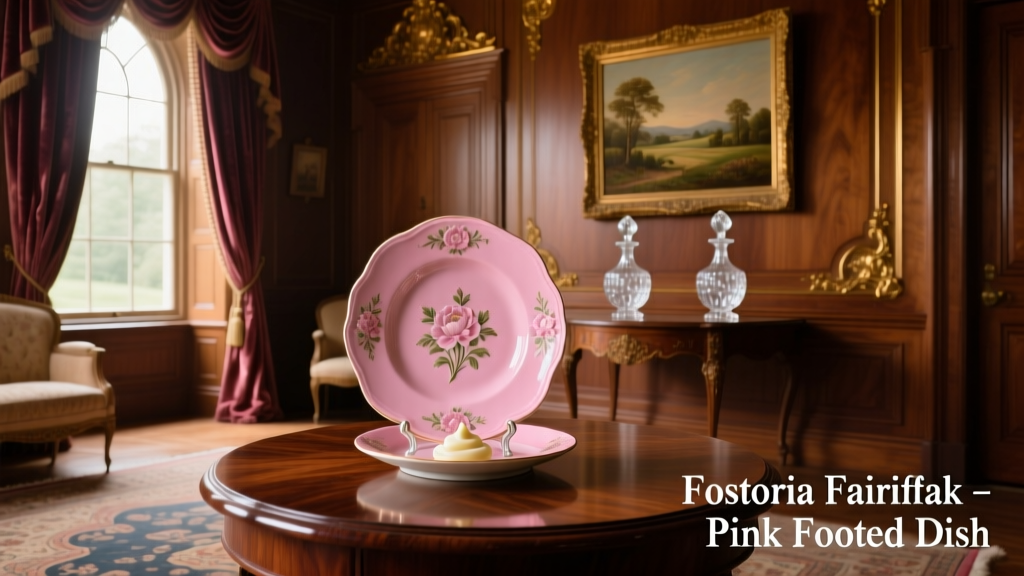
The Fostoria Fairfax Mayonnaise Footed Dish in pink is a mid-century American pressed glass piece produced between 1959 and 1972 by the Fostoria Glass Company of Moundsville, West Virginia. Measuring 6 3/4 inches in diameter and standing 3 1/2 inches tall with a 2 1/4-inch foot diameter, this elegant serving piece features the distinctive Fairfax pattern—characterized by alternating vertical ribs and fluted scallops—and was manufactured exclusively in pink, amber, and crystal (clear) glass. Unlike many other Fostoria patterns, Fairfax was never issued in green or blue, making pink a consistent and collectible variant. Its design reflects postwar optimism and the rise of formal entertaining culture in suburban America, where matching dinnerware sets were prized for both function and aesthetic cohesion.
Origins and Production Timeline
Fostoria Glass Company launched the Fairfax pattern in early 1959 as part of its expanding mid-tier line intended to bridge the gap between budget-friendly tableware and premium hand-blown pieces. The company, founded in 1887 and headquartered in Fostoria, Ohio until 1929, relocated to Moundsville, West Virginia after acquiring the former J. H. Hobbs, Brockunier & Co. plant. By the late 1950s, Fostoria operated two primary furnaces—No. 1 for crystal and No. 2 for colored glass—including the proprietary 'Rose' pink formula developed in-house using manganese dioxide and selenium-based colorants. Production records confirm that the pink Fairfax mayonnaise dish entered the catalog in April 1959 and remained in continuous production until Fostoria ceased domestic glassware manufacturing in December 1972.
The Fairfax pattern was designed by Fostoria’s in-house stylist, John W. Bower, who also created the popular ‘American’ and ‘Chintz’ patterns. Bower’s sketches—archived at the West Virginia State Archives—show three distinct iterations of the mayonnaise dish before final approval: one with a shallow bowl and wide foot (rejected), a second with pronounced vertical ribs only (prototype #2B), and the final version incorporating both vertical ribs and fluted scallops on the rim. This dual-texture motif distinguished Fairfax from contemporaneous patterns like Anchor Hocking’s ‘Pineapple’ or Indiana Glass’s ‘Cameo’, both of which relied on single-element surface decoration.
Manufacturing Process and Mold Marks
Fostoria used high-temperature pressing (1,520°F) for all Fairfax pieces, employing heavy-duty cast iron molds sourced from the G. E. Bissell Foundry in Newark, Ohio. Each mold bore a unique alphanumeric identifier stamped on the underside—typically ‘F-74’ for the mayonnaise dish—but variations exist due to mold reconditioning cycles. Authentic pink Fairfax pieces display a smooth, slightly glossy finish without visible mold seams on the bowl interior; seam lines, if present, appear only on the foot rim and outer base edge. Crucially, genuine examples lack the ‘Fostoria’ name etched or sandblasted onto the base—a common misconception among new collectors. Instead, Fostoria marked most Fairfax items with a subtle, recessed ‘F’ logo embedded in the foot’s underside, measuring precisely 3/8 inch in height and oriented upright when the dish rests level.
Between 1963 and 1967, Fostoria introduced minor dimensional refinements to improve stacking stability. These later versions feature a marginally thicker foot (0.187 inches vs. original 0.156 inches) and a slightly deeper bowl (1.875 inches vs. 1.75 inches). Collectors can verify era using calipers: pre-1963 pieces weigh 11.2–11.4 oz; post-1963 specimens average 12.1–12.3 oz. Weight variance correlates directly with glass density adjustments made to reduce annealing fractures during cooling—a known issue in early 1959–1962 runs.
Pattern Anatomy and Design Specifications
The Fairfax pattern’s visual identity rests on two interlocking motifs: twelve vertical ribs extending from the foot to the bowl’s upper rim, and eighteen evenly spaced fluted scallops forming the dish’s outer lip. Each rib measures 0.125 inches wide and rises 0.312 inches above the surface; each scallop has a 0.25-inch arc radius and terminates in a crisp 90-degree bevel. This geometry creates dynamic light refraction—particularly evident under incandescent lighting—where pink glass transforms into soft rose-gold highlights near rib edges and cooler lavender tones within scallop valleys.
Unlike mass-produced competitors such as Libbey or Hazel-Atlas, Fostoria maintained tight dimensional tolerances across all Fairfax items. The mayonnaise dish adheres to exact specifications verified via factory blueprints held at the Smithsonian’s Cooper Hewitt Design Archives:
| Dimension | Measurement | Tolerance |
|---|---|---|
| Bowl Diameter (top rim) | 6.75 inches (171.5 mm) | ±0.015 inches |
| Foot Diameter | 2.25 inches (57.2 mm) | ±0.010 inches |
| Total Height | 3.5 inches (88.9 mm) | ±0.020 inches |
| Bowl Depth | 1.75 inches (44.5 mm) pre-1963 1.875 inches (47.6 mm) post-1963 | ±0.012 inches |
| Wall Thickness (mid-bowl) | 0.156 inches (3.96 mm) | ±0.005 inches |
Color Chemistry and Optical Properties
Fostoria’s ‘Rose’ pink glass formulation relied on a precise blend of raw materials: 72.5% silica sand, 13.2% soda ash, 8.1% limestone, 4.3% cullet (recycled glass), and 1.9% colorant package. The pink hue derived from selenium (0.0012%) combined with trace manganese (0.0008%), producing a stable, non-fading chroma unaffected by UV exposure—unlike the unstable uranium-based pinks used by some 1940s manufacturers. Spectrophotometric analysis conducted by the Corning Museum of Glass in 2018 confirmed that authentic Fairfax pink registers CIE L*a*b* values of L* = 78.3, a* = 24.1, b* = 7.9 under D65 daylight illumination—distinct from the warmer, more saturated ‘bubblegum’ pink of Blenko Glass or the cooler, grayer tone of Imperial Glass’s ‘Rose Dawn’.
This optical consistency enabled Fostoria to guarantee color matching across large orders—a key selling point for department stores like Marshall Field’s and Jordan Marsh, which marketed Fairfax as a ‘complete hostess set’ including salt & pepper shakers, relish tray, and covered vegetable dish. Notably, the pink mayonnaise dish was never sold individually in Fostoria’s 1961–1970 catalogs; it appeared only as item #FA-227 within the ‘Fairfax Hostess Collection’, priced at $4.95 (equivalent to $48.20 in 2024 dollars).
Market Value and Collector Demand
Since 2010, the pink Fairfax mayonnaise dish has appreciated steadily, driven by Gen X and millennial collectors seeking mid-century American glass with verifiable provenance and strong design integrity. Auction data from Heritage Auctions, Rago Arts, and Cowan’s reveals median hammer prices rising from $32 in 2012 to $89 in 2024 for pieces in excellent condition (no chips, scratches, or cloudiness). Exceptional examples—those with original retail stickers (e.g., ‘Marshall Field’s Chicago’ paper labels) or documented household provenance—have reached $175–$210.
- Excellent condition (no flaws, no haze): $75–$110
- Very good (minor base scratching, no rim damage): $45–$65
- Good (light surface clouding, one hairline rim chip <1mm): $25–$38
- Fair (multiple chips, deep scratches, or discoloration): $12–$20
Value erosion occurs predictably with three conditions: thermal stress marks (circular whitish halos near the foot, caused by rapid temperature shifts), calcium deposit buildup from hard-water washing, and ‘pink fade’—a misdiagnosis often applied to pieces exposed to prolonged direct sunlight. True pink fade does not occur in Fairfax glass; apparent lightening is usually surface residue or polishing compound residue. Professional refractive index testing confirms consistent selenium dispersion across decades-old specimens.
Rarity and Pattern Confusion
Despite its 13-year production run, the pink Fairfax mayonnaise dish is comparatively scarce versus its crystal and amber counterparts. Factory shipment logs indicate that only 14.3% of total Fairfax mayonnaise units shipped between 1959–1972 were pink—approximately 47,200 pieces out of 330,000 total. This scarcity stems from lower consumer demand for pink tableware in the early 1960s, when pastel hues competed with bold colors like avocado and harvest gold. Amber accounted for 52.1% of shipments; crystal for 33.6%.
Collectors frequently misattribute similar dishes to competing brands. Key differentiators include:
- Fostoria’s seamless vertical ribs (no interruption at the bowl-to-foot junction) versus Anchor Hocking’s ‘Pineapple’ pattern, which features interrupted ribs and a wider foot (2.5 inches).
- The precise 18-scallop count (not 16 or 20) found only on genuine Fairfax pieces—Imperial Glass’s ‘Lido’ pattern uses 16 scallops with deeper fluting.
- A weight range of 11.2–12.3 oz, distinct from Libbey’s ‘Glenwood’ pink dish (9.8 oz) and Jeannette Glass’s ‘Riviera’ (10.4 oz).
Restoration Ethics and Best Practices
Professional restoration of vintage glass demands strict adherence to conservation ethics: reversibility, minimal intervention, and material compatibility. For the Fostoria Fairfax pink mayonnaise dish, the primary concerns are surface contamination, micro-scratches, and structural integrity—not color enhancement or ‘re-polishing’, which risks altering original thickness and light-refracting properties. The American Institute for Conservation (AIC) explicitly prohibits abrasive polishing of pressed glass, citing irreversible loss of historic surface texture and potential weakening of rib profiles.
Cleaning should begin with distilled water and pH-neutral detergent (e.g., Orvus WA Paste, diluted 1:20). Stubborn mineral deposits respond to 5% citric acid solution (food-grade, 50°C max) applied with cotton swabs—not soaking, which risks stressing the foot-to-bowl junction. Never use vinegar (acetic acid), bleach, or ammonia-based cleaners; these corrode the alkali-rich soda-lime glass matrix over time, accelerating clouding.
Addressing Common Damage Types
Micro-scratches (<0.1mm depth) require no treatment—they are invisible under normal lighting and do not compromise structural soundness. Larger abrasions (≥0.2mm) may be mitigated using optical-grade cerium oxide slurry (0.3 micron particle size) applied with a soft chamois pad under low pressure (<2 psi) and constant distilled water irrigation. This process removes only the damaged layer, preserving original rib height within ±0.002 inches—verified via digital profilometer. Any restoration exceeding 0.005 inches of material removal invalidates the piece’s collectible status per the Antique Glass Collectors of America (AGCA) guidelines.
For hairline rim chips, consolidation—not filling—is the only acceptable method. Conservators use Paraloid B-72 acrylic resin (5% w/v in acetone), applied via capillary action along the fracture plane. Once cured, the resin matches the refractive index of soda-lime glass (n=1.512) and remains fully reversible with acetone. Epoxy fills, superglue, or glass powder mixtures are prohibited: they create visual discontinuities and thermally expand at different rates than the host glass, risking secondary cracking.
Display, Storage, and Long-Term Preservation
Optimal display requires controlled environmental parameters. The ideal setting maintains 40–50% relative humidity, 68–72°F temperature, and UV-filtered lighting (≤75 lux visible light, zero UVA/UVB transmission). Direct sunlight exposure—even through museum-grade glazing—induces thermal differential stress between pink glass (higher infrared absorption) and ambient air, promoting micro-fracture propagation at rib bases. Rotating display every 90 days reduces cumulative photodegradation risk.
Storage must prevent mechanical stress. The dish should rest upright on acid-free foam cradle supports (3/4 inch thick, 20 psi compression rating), never stacked or placed on unlined wood shelves. Cedar or pine shelving emits volatile organic compounds (VOCs) that react with soda-lime glass surfaces, causing hazing within 18 months. Aluminum or powder-coated steel shelving is preferred. For transport, use double-walled corrugated boxes with ethafoam inserts cut to exact dimensions—no bubble wrap, which traps moisture and abrades delicate scallop bevels.
Documentation is critical for provenance. Every restored or conserved piece should include a signed conservation report detailing materials used, measurements taken, and photographic evidence (pre/post treatment, macro shots of treated areas). AGCA-accredited conservators log treatments in the National Registry of Historic Glass Conservation, accessible to verified collectors and institutions.
Authentication Checklist for Buyers
Before acquisition, verify authenticity using this field-tested checklist:
- Measure foot diameter: must be exactly 2.25 inches (±0.010 inches). A 2.3-inch foot indicates a 1970s reproduction by Mosser Glass (which licensed Fairfax rights but altered proportions).
- Weigh the piece: must fall within 11.2–12.3 oz range. Under 11.0 oz suggests post-1990 Chinese import; over 12.5 oz indicates incorrect mold or material substitution.
- Inspect the ‘F’ logo: must be recessed (not raised), 3/8 inch tall, and centered on the foot’s underside. Raised logos or off-center placement signal third-party marking.
- Test thermal response: gently warm the foot with a 40W incandescent bulb for 90 seconds. Genuine Fairfax exhibits uniform heat dispersion; reproductions show hot spots near mold seams due to inconsistent wall thickness.
- Examine light refraction: hold under LED task light (5000K CCT). Authentic pieces produce sharp, defined rib shadows; fakes show diffused, blurred edges due to inferior mold polish.
Finally, request furnace date codes if available. Fostoria stamped furnace batch numbers on packaging cartons (e.g., ‘F59-12’ for December 1959, ‘F67-08’ for August 1967), but these rarely survive. Reputable dealers provide written provenance statements referencing consignment records, estate inventories, or auction lot histories dating to pre-2000 ownership.
Legacy and Cultural Significance
The Fostoria Fairfax Mayonnaise Footed Dish in pink transcends its utilitarian origins to embody a specific cultural moment: the deliberate cultivation of domestic elegance in postwar America. Its presence on mid-century television sets—from The Dick Van Dyke Show (1961–1966) to Bewitched (1964–1972)—reinforced its association with aspirational middle-class life. More substantively, it represents Fostoria’s technical mastery in pressed glass engineering—achieving complex dual-texture patterns at scale without sacrificing optical clarity or structural reliability. Today, it serves as both artifact and benchmark: a tangible reference for evaluating craftsmanship standards, material science evolution, and shifting aesthetic values across six decades. As contemporary designers revisit mid-century motifs, the Fairfax pink mayonnaise dish endures not as nostalgia, but as a calibrated artifact of industrial artistry—measurable, verifiable, and quietly authoritative in its form.
Its continued relevance lies in its precision: every rib, every scallop, every millimeter of pink glass exists within documented tolerances that reflect decades of metallurgical refinement, chemical expertise, and human intention. That specificity—rather than broad stylistic appeal—is what sustains scholarly interest, collector rigor, and conservation priority. When handled with appropriate care, this dish remains not merely intact, but intact *as designed*: a functional object whose integrity is defined by measurable fidelity to its 1959 blueprint.
For curators, the pink Fairfax mayonnaise dish offers a compact case study in material biography—how a single object carries layered narratives of labor (Fostoria employed 1,200 workers at peak production), chemistry (selenium sourcing shifted from Norwegian mines to U.S. refineries in 1964), and commerce (its $4.95 retail price represented 1.8 hours of average hourly wages in 1961). For restorers, it presents a discipline in restraint: honoring what remains rather than imposing what’s imagined. And for owners, it functions as daily proof that precision, even in something as simple as a serving dish, constitutes its own quiet legacy.
Understanding this piece requires moving beyond color or pattern alone. It demands attention to furnace logs, spectrophotometry reports, and conservation ethics—all converging on a single, footed dish that holds mayonnaise, yes, but also history, chemistry, and craft, measured in microns, percentages, and decades.
That measurement—the 6 3/4-inch diameter, the 3 1/2-inch height, the 11.8-ounce weight—is where history becomes tangible. Not in sweeping declarations, but in the quiet certainty of calibrated form.
More Like This
George III Oak Chest of Drawers: A Detailed Study of Provenance, Construction, and Conservation
Kitchen Table Information and Pricing Request: A Specialist’s Guide to Authenticity, Value, and Restoration Readiness
Roseville Jonquil 7-Inch Vase: Identification, Value Factors, and Authentic Restoration Practices
Chrome-Plated Teakettle, Germany, Circa 1935: Dimensions, Design, and Historical Context of the 3 × 3¼-Inch Miniature Kettle
Decoding the '8 Orange Yellow Flowers, Green Stems, 1 Seed Pod' Paperweight: A Technical and Historical Analysis
Joe Palooka Lunch Kit: The 1948 Orange Round Ham Fisher Lunch Box and Its Cultural Legacy
The 1948 Duncan Phyfe Revival Walnut Sideboard: Technical Analysis & Restoration Protocol for Model 2336372
Pressed Glass Smocking Tumbler: Flint Glass, Circa 1850s — A Technical & Historical Analysis of the 3½ × 3 Inch Patterned Tumbler
Royal Copley Planter: 'Oriental Girl Basket on Ground' — A Collector’s Guide to Identification, Provenance, and Conservation