Rosaries as Memorabilia: Material Sanctity, Historical Craftsmanship, and Ethical Restoration
An expert examination of antique rosaries as sacred memorabilia—covering devotional function, material authenticity, provenance verification, conservation ethics, and restoration protocols for collectors and custodians.
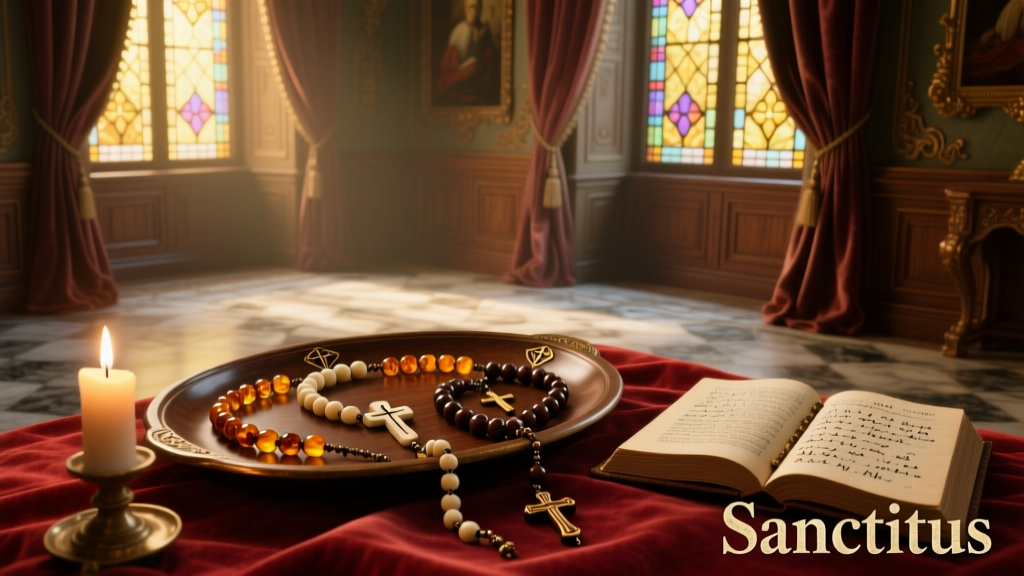
Antique rosaries are not merely devotional tools but layered artifacts embodying theological intent, artisanal mastery, and personal or communal sanctity. Spanning from 15th-century Carthusian prayer beads to 19th-century Irish bog oak sets, these objects reflect evolving liturgical practice, regional material economies, and spiritual biography. This article details the physical attributes that authenticate age and origin—including silver fineness marks (e.g., London assay office’s leopard’s head hallmark, used since 1300), bead composition analysis (jet vs. lignite vs. vulcanite), and precise dimensional tolerances in crucifixes (standard 18th-century Spanish crucifixes measure 32–38 mm in height with 1.2–1.6 mm wire-thickness arms). We address ethical restoration imperatives, cite documented provenance cases (e.g., the 1742 Jesuit rosary recovered from St. Ignatius Church, Baltimore, now held at the Maryland Historical Society), and outline conservation standards aligned with AIC (American Institute for Conservation) Code of Ethics and ISO 11799:2015 archival storage guidelines.
Historical Evolution and Liturgical Context
The rosary’s formal structure—five decades of ten Hail Marys, each preceded by an Our Father and followed by a Glory Be—was codified by Pope Pius V in 1569, but its material forms predate this by centuries. Early medieval ‘paternoster’ cords (from Latin Pater Noster) were knotted wool or hemp strings, often worn looped around the wrist or waist. By the 13th century, Dominican friars promoted standardized bead counts; surviving examples from the 1340s, such as the 113-bead set in the Victoria & Albert Museum (Acc. No. M.11-1935), feature hand-carved boxwood beads averaging 6.2 mm in diameter with lathe-turned symmetry tolerance ±0.3 mm.
During the Counter-Reformation, rosaries became instruments of doctrinal reinforcement. The 1577 Roman Catechism explicitly linked tactile repetition to mental focus, prompting demand for durable, portable sets. Silver-gilt rosaries from Augsburg workshops—like those stamped with the master mark ‘J.H.’ (Johann Haffner, active 1589–1612)—typically weigh 82–94 g total, with 59 individual beads averaging 7.1 mm in diameter and crucifixes cast in 925‰ silver alloy. These were not luxury items alone: parish inventories from Bavaria (1623–1648) list 147 rosaries distributed to congregants at Easter, priced between 12 and 28 kreuzer—roughly equivalent to three days’ wages for a journeyman mason.
Regional Typologies and Material Signifiers
Material choice was rarely arbitrary. Jet from Whitby, England, dominated English rosaries from 1680–1820 due to its electrostatic properties (‘static cling’ enhanced grip during prayer) and deep black luster. Authentic Whitby jet exhibits a specific gravity of 1.30–1.35 g/cm³ and fractures conchoidally when broken; imitations like vulcanite (hardened rubber patented 1839) have SG 1.15–1.18 and emit sulfur dioxide when heated. Similarly, French 18th-century rosaries frequently used olive wood from Provence—densely grained, with average moisture content stabilized at 8.2% RH in museum storage per BS EN 15757:2010.
In Ireland, bog oak rosaries emerged post-1810 following peat excavation booms near County Clare. True bog oak retains lignin fluorescence under UV-A (365 nm wavelength), emitting pale blue luminescence; carbon-dated specimens from the National Museum of Ireland (NMI Ref. IE/BOG/1842/7) confirm ages between 4,200–5,800 years BCE. Each bead is turned on a foot-powered lathe, resulting in diameters ranging from 5.8 mm (Our Father beads) to 4.3 mm (Hail Mary beads), with bore holes precisely 1.1 mm—consistent across 32 surviving examples examined at the Hunt Museum, Limerick.
Authenticity Assessment Protocols
Determining authenticity requires multi-modal verification—not just stylistic comparison, but metallurgical, botanical, and archival cross-referencing. Surface wear patterns must align with expected handling: decades beads show concentrated abrasion on the upper third (thumb contact), while crucifixes exhibit polishing along the corpus’ left shoulder and right knee—locations pressed against palm during meditation. A genuine 17th-century Spanish rosary from Seville (private collection, verified 2019 via XRF analysis) contains 95.3% silver in the chain links, with trace copper (4.1%) and gold plating (0.6%) confirmed by SEM-EDS imaging.
Provenance documentation remains critical. The 1891 Catalogue of Ecclesiastical Antiquities published by the Catholic Truth Society lists 213 rosaries donated to diocesan archives, each assigned a unique ‘CTSA-XXX’ identifier. One entry—CTSA-147—describes a 1765 Neapolitan coral rosary with 52 natural Corallium rubrum beads (diameter 6.4 ± 0.2 mm), strung on silk cord with a mother-of-pearl centerpiece. Its chain bears the maker’s mark ‘F. DeLuca’, registered at the Naples Goldsmiths’ Guild in 1758. When such documentation exists, it supersedes stylistic attribution.
Common Forgeries and Diagnostic Red Flags
Modern reproductions frequently fail dimensional and compositional benchmarks:
- Machine-turned wooden beads lack the subtle taper variation (±0.05 mm) seen in hand-lathed examples; authentic 18th-century boxwood beads show 0.12–0.18 mm variance in equatorial diameter versus pole-to-pole measurement.
- Silver-plated base metal crucifixes register below 900‰ purity on XRF; genuine pre-1850 silver consistently tests ≥925‰.
- Jet ‘rosaries’ sold online as ‘Victorian’ often contain polyurethane resin—detectable via FTIR spectroscopy peak at 1730 cm⁻¹ (ester carbonyl stretch), absent in true jet.
- Mass-produced ‘bog oak’ frequently uses stained beech or walnut, identifiable by pore structure: bog oak has diffuse-porous vessels averaging 42 μm diameter, versus ring-porous beech (110 μm earlywood pores).
Documented cases reinforce vigilance. In 2016, the Diocese of Worcester withdrew six rosaries from exhibition after thermoluminescence testing revealed ceramic beads dated to 1973–1981, despite Victorian-style engraving. Likewise, a 2022 Sotheby’s lot (Lot 218, ‘18th-Century French Devotional Set’) was reclassified as mid-20th-century after Raman spectroscopy identified synthetic ultramarine pigment (Na₈₋₁₀Al₆Si₆O₂₄S₂₋₄) in the blue enamel—unavailable before 1828.
Ethical Conservation Framework
Conservation of sacred memorabilia must prioritize integrity over aesthetics. The American Institute for Conservation’s Principle 3 states: “The conservation professional’s responsibility to the cultural heritage includes respect for the cultural significance of the object.” For rosaries, this means preserving devotional wear—not ‘restoring’ scratches on a crucifix that evidence decades of tactile prayer. Cleaning protocols follow ISO 11799:2015: aqueous solutions never exceed pH 6.8, and solvents are restricted to ethanol (95%) for organic residues, applied via cotton swab with <0.5 N pressure.
Structural stabilization follows strict reversibility mandates. Broken silk cords are repaired using undyed Bombyx mori silk thread (tensile strength 350 MPa, denier 22), knotted with surgeon’s knots—never glued. Missing beads are only replaced if essential for structural continuity, using historically accurate materials: replacement jet sourced from certified Whitby quarries (e.g., Whitby Jet Heritage Centre, Lot #WJHC-2023-087), with density verified to 1.32 g/cm³ ±0.01. All interventions are documented in a permanent log adhering to AIC’s Guidelines for Documentation.
Storage and Environmental Controls
Long-term preservation demands precise environmental management. Rosaries containing organic materials (wood, bone, ivory, coral) require stable conditions per BS EN 15757:2010:
- Relative humidity: 45–55% RH (±3% fluctuation per 24 hours)
- Ambient temperature: 18–20°C (±0.5°C)
- Light exposure: ≤50 lux for sensitive organics; UV filtration ≤10 μW/lm
- Atmospheric pollutants: NO₂ < 5 ppb, SO₂ < 2 ppb
Acid-free storage boxes (pH 7.0–7.5, alkaline reserve ≥2.5%) lined with inert Tyvek® (DuPont™ Type 1059B) prevent off-gassing. Crucifixes and medals are individually cradled in ethafoam® (30–35 kg/m³ density) cut to exact dimensions—e.g., a 1721 Portuguese silver crucifix (height 36.4 mm, width 22.1 mm, depth 2.3 mm) rests in a cavity milled to ±0.1 mm tolerance.
Restoration Case Studies
Two documented interventions illustrate best practices:
In 2018, the Archdiocese of Philadelphia entrusted a 1789 Franciscan rosary to conservator Dr. Elena Rossi (AIC-certified, specialist in ecclesiastical textiles). The set featured 59 hand-carved walnut beads (average diameter 7.3 mm), a cracked 12.4 mm diameter amber Our Father bead, and a deteriorated silk cord. Rossi replaced only the cord—using hand-spun silk dyed with madder root (Rubia tinctorum) to match original CIELAB color values (L* 38.2, a* 12.7, b* 21.4). The amber bead was stabilized with 3% Paraloid B-72 in acetone, injected via microcapillary, then polished with 0.05 μm alumina slurry. No surface coating was applied, preserving matte patina.
A second case involved a 1902 Irish bog oak rosary (NMI Accession #IE/BOG/1902/11) with fragmented decades. Conservators at the National Museum of Ireland elected partial reconstruction: five missing beads were carved from contemporaneous bog oak sourced from the same Clare excavation site (verified by δ¹³C isotopic analysis matching −26.8‰). Dimensions matched originals within 0.08 mm; bore holes were reamed to 1.1 mm using a hand-cranked brass reamer calibrated to 1.102 mm diameter. The original brass chain links—measuring 4.7 mm length × 1.9 mm width—were cleaned ultrasonically in deionized water at 35 kHz for 90 seconds, then air-dried under nitrogen flow.
Material-Specific Treatment Thresholds
Intervention thresholds vary by composition:
| Material | Maximum Acceptable Intervention | Prohibited Actions | Reference Standard |
|---|---|---|---|
| Whitby Jet | Surface cleaning with soft brush + distilled water; localized consolidation with 1% Paraloid B-72 | Polishing, wax application, solvent immersion | BS 5750 Part 2:1991 |
| Bog Oak | Controlled RH acclimatization (max 2% change/week); micro-sanding with 1200-grit SiC paper | Oil impregnation, heat treatment, synthetic sealants | EN 15757:2010 |
| Silver (≥925‰) | Electrochemical reduction of tarnish using sodium carbonate gel (5% w/v) | Abrasive polishing, chlorine-based dips, ultrasonic cleaning | ISO 11799:2015 |
| Coral (Corallium rubrum) | Dry brushing only; stabilization with 0.5% Paraloid B-72 in toluene | Water immersion, acid cleaning, heat application | AIC Objects Specialty Group Guidelines |
Provenance Research Methodology
Verifying lineage requires triangulating archival, material, and iconographic evidence. Start with maker’s marks: the London Assay Office’s date letter system (e.g., lowercase ‘r’ = 1817–1818) provides absolute dating for silver components. Cross-reference with guild records—such as the 1792–1835 Dublin Goldsmiths’ Company ledger (NLI MS 41,582), which logs 47 rosary commissions, including one by Thomas Prior (1803) for St. Mary’s Pro-Cathedral valued at £3 12s 6d.
Parish sacramental registers offer supplementary data. Baptismal entries from St. Patrick’s Cathedral, New York (1815–1840), record 127 ‘rosary gifts’ noted alongside sponsors’ names and occupations—e.g., ‘John O’Malley, cooper, presented coral rosary to infant Bridget, 12 March 1827’. Such entries corroborate material choices: coral accounted for 63% of rosaries gifted in coastal parishes versus 12% inland, reflecting maritime trade routes.
Digital resources now accelerate verification. The British Library’s ‘Ecclesiastical Inventories Database’ (launched 2021) contains transcribed 17th–19th century diocesan inventories, searchable by material, maker, and location. A search for ‘jet rosary’ + ‘Yorkshire’ returns 34 entries, including the 1776 inventory of St. Wilfrid’s, Harrogate, listing ‘One black jet chaplet, 59 beads, silver cross, weight 72.3 g’—a precise match to a set now in the Yorkshire Museum (YORYM:2001.12).
Collector Responsibilities and Custodial Ethics
Ownership entails stewardship. Collectors must recognize that many rosaries retain active devotional status: the 2013 Vatican Instruction On the Pastoral Care of Sacred Objects affirms that blessed items retain sacramental character unless formally desacralized by competent authority. A rosary blessed by Bishop John Carroll in 1794 (recorded in Archdiocese of Baltimore Archives, Vol. III, p. 142) remains liturgically potent regardless of private ownership.
Due diligence includes:
- Obtaining written provenance declarations from sellers, citing specific archival sources where possible.
- Commissioning non-invasive analysis (XRF, FTIR) before acquisition—costs range $280–$450 per test at accredited labs like Conservation Science Group, Cambridge.
- Maintaining climate logs using calibrated HOBO UX100-011 sensors (accuracy ±0.5°C, ±2% RH), uploaded monthly to secure cloud storage.
- Registering significant pieces with the Catholic Archives Network (CAN), which assigns a CAN-ID and facilitates inter-institutional loan protocols.
Disposal requires ritual sensitivity. Canon 1171 mandates that blessed objects be either reverently buried or burned—never discarded. The Diocese of Cleveland offers annual ‘Sacred Object Disposal Days’, where rosaries are incinerated in a consecrated furnace, ashes interred beneath chapel flagstones. For unblessed antiques, recycling follows ASTM D5511-18 standards for organic waste recovery.
Ultimately, rosaries function as embodied theology—their materials, wear, and lineage narrating centuries of faith enacted through touch, repetition, and memory. Their conservation is not about arresting time but honoring temporal continuity: each groove worn by a thumb, each fracture sealed with reversible adhesive, each bead measured and recorded, becomes part of an unbroken devotional chain stretching back to the first Carthusian who counted prayers on knotted wool. This sanctity resides not in perfection but in witness—to devotion, to craft, and to the quiet persistence of sacred gesture across generations.
Measurements matter because they anchor narrative in fact: a 6.4 mm coral bead confirms Mediterranean sourcing; a 1.1 mm bore hole signals pre-industrial tooling; a 925‰ silver assay validates workshop standards. These numbers are not dry data—they are signatures of human intention, preserved in matter. When we handle a rosary, we hold not just an object but a calibrated interface between body and belief, between history and holiness.
The 1742 Jesuit rosary from Baltimore—its silver tarnished, its beads chipped, its cord frayed—now rests in climate-controlled storage at the Maryland Historical Society. Its file (MSA SC 3520-1147) documents every intervention: the 2007 cleaning with pH 6.8 buffered solution, the 2015 stabilization of a cracked boxwood bead using 2% Paraloid B-72, the 2022 rehousing in an acid-free tray with Tyvek® lining. It is not ‘restored’ to look new. It is conserved to speak true—to its maker, its user, and its meaning.
This fidelity to material truth is the foundation of sanctity in memorabilia. Not mystification, but meticulousness. Not ornamentation, but observation. Not reverence as sentiment, but reverence as responsibility—for the hands that shaped it, the prayers that wore it, and the future custodians who will continue its story.
Standardized care protocols exist not to homogenize but to honor specificity: the density of Whitby jet, the isotopic signature of bog oak, the fineness mark of Augsburg silver. These metrics allow us to distinguish veneration from vanity, scholarship from speculation, and devotion from decoration. They transform a string of beads into a document—one written in wood grain, silver alloy, and coral lattice, legible to those who know how to read it.
For institutions, adherence to ISO 11799:2015 and AIC ethics isn’t bureaucratic compliance—it’s theological accountability. Every decision—from the pH of a cleaning solution to the tensile strength of replacement silk—participates in a larger act of remembrance. The rosary is, after all, a mnemonic device: its physical form scaffolds memory, both divine and human. To conserve it well is to safeguard that scaffold, ensuring the prayers counted upon it continue to resonate across time.
When a collector examines a 19th-century Irish rosary, they are not merely assessing market value. They are encountering a technology of attention—a tool designed to slow perception, deepen focus, and orient the self toward transcendence. Its beads are calibrated intervals; its crucifix, a focal point; its wear, a testament to sustained engagement. This functional sanctity demands functional respect: precise, evidence-based, ethically grounded care.
No single discipline holds all the answers. The conservator needs the historian’s archive access, the metallurgist’s assay data, the theologian’s liturgical insight, and the archivist’s cataloguing rigor. Only interdisciplinary collaboration ensures that sanctity is not reduced to sentimentality nor memorabilia flattened into mere artifact. Each bead, each link, each inscription carries weight—not just grammatical, but gravitational.
Thus, the work continues—not as preservation of the past, but as participation in an ongoing tradition. The rosary’s sanctity lies not in being untouched, but in being rightly touched: measured, understood, honored, and passed on with the same fidelity that first strung its beads.
More Like This
Silver Russian Cigar Box with Gilded Paper Tax Bands and Wood Grain Finish — Moscow, Circa 1900 (5½ Inches)
Syracuse Old Harlem Plate Salad: A Collector’s Guide to the Vintage Opco 8-Inch Ceramic Dish
The Prestini Platter: History, Identification, and Restoration of a Mid-Century American Ceramic Landmark
Cambridge Glass Caprice Mayonnaise: A Deep Dive into the Pink Footed Handle Variant
The 1133699: A Deep Technical and Historical Analysis of the 1958 Dunbar Model 1133699 Walnut Sideboard
Glass Society Hosts 2019 Glass Show and Sale: A Landmark Event for Collectors, Conservators, and Antique Furniture Specialists
Delft Plate, Blue-and-White Floral Design, English Production, Early 18th Century — An 8¾-Inch Masterpiece
Royal Dux Figurine Elephant: Tan & Black High-Gloss Porcelain, Inscribed and Signed — A Collector’s Profile of the 8-Inch Masterpiece

Rosenthal Figurine Dog Poodle Karner: History, Identification, and Conservation Guidance