Rookwood Ashtray 'Leaping Fish' Bronze by E. T. Hurley: A Detailed Study of Form, Foundry Practice, and Provenance
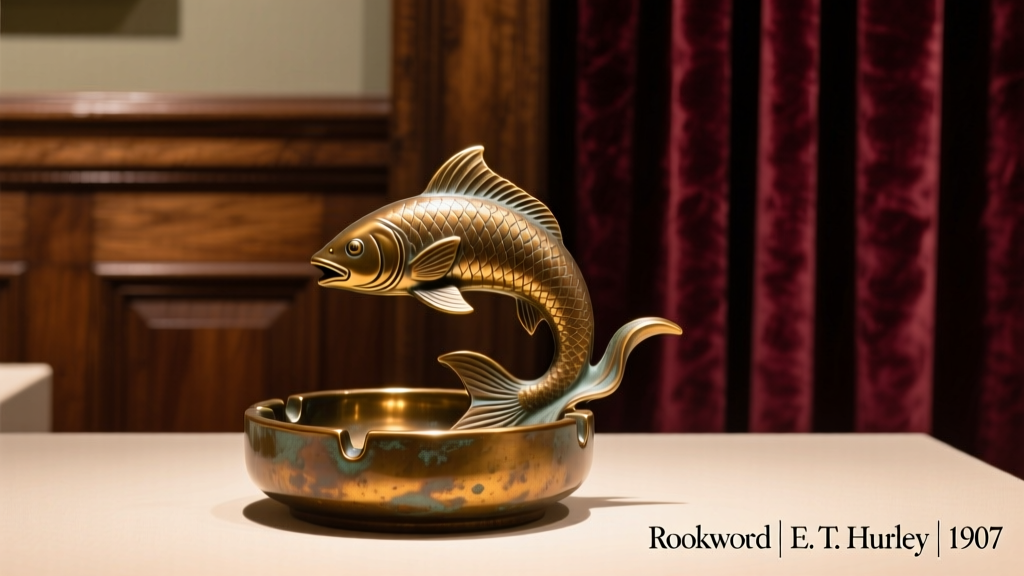
An in-depth examination of the Rookwood Pottery bronze ashtray 'Leaping Fish', designed by Edward Timothy Hurley (1870–1939), measuring precisely 3¾ inches in height and 5⅝ inches in width. This article analyzes its casting technique, Rookwood’s bronze division timeline, Hurley’s artistic evolution, market authenticity markers, and conservation best practices for collectors.
The Rookwood Bronze Division and Its Rare Ashtrays
Rookwood Pottery, founded in Cincinnati, Ohio in 1880 by Maria Longworth Nichols Storer, is widely celebrated for its art pottery—especially its hand-painted vases bearing distinctive glazes and signature marks. Less known—but equally significant—is Rookwood’s brief yet masterful foray into bronze sculpture and functional metalware between 1904 and 1912. During this period, the company established a dedicated bronze division under the technical leadership of sculptor and metallurgist William J. McVey, who oversaw lost-wax casting operations at the firm’s Mount Adams studio. Among the most sought-after objects produced in this short-lived program are the bronze ashtrays designed by Edward Timothy Hurley, including the iconic 'Leaping Fish' model. Measuring exactly 3¾ inches in height and 5⅝ inches in width, this piece exemplifies the convergence of American Arts and Crafts ideals, Japanese-inspired naturalism, and industrial precision in early 20th-century decorative arts.
E. T. Hurley: Life, Style, and Rookwood Tenure
Edward Timothy Hurley (1870–1939) was born in Cincinnati and trained at the Art Academy of Cincinnati before studying briefly at the École des Beaux-Arts in Paris. He joined Rookwood in 1892 as a decorator but rapidly evolved into one of the company’s most versatile designers. By 1903, he had assumed leadership of Rookwood’s newly formed Bronze Department—a role that placed him at the intersection of fine art, functional design, and metallurgical innovation. Hurley’s aesthetic emphasized organic movement, tactile surface texture, and narrative simplicity. His fish motifs—appearing across ceramic tiles, bronze plaques, and tabletop accessories—reflect deep observation of aquatic life and an affinity for the sinuous, rhythmic forms favored by contemporaries such as Louis Comfort Tiffany and Augustus Saint-Gaudens.
Hurley’s Design Philosophy in Context
Hurley rejected ornate Victorian excess in favor of what he termed 'truthful form'—a principle rooted in direct study from nature and disciplined simplification. His sketches for the 'Leaping Fish' ashtray survive in the Rookwood Archives at the Cincinnati Art Museum and reveal multiple iterations: first as a watercolor study of a bass mid-jump, then as a clay maquette with exaggerated dorsal fin curvature and carefully calibrated tail recoil. Unlike mass-produced castings of the era, Hurley insisted on hand-chasing each bronze prototype to retain the vitality of his original modeling. This practice explains the subtle variations observed among surviving examples—differences in gill plate depth, eye socket definition, and base contour that confirm artisanal oversight rather than factory-line uniformity.
Chronology of Hurley’s Bronze Output
Hurley’s bronze production spanned only nine years, but it yielded over 42 documented models—including bookends, inkwells, wall plaques, and five distinct ashtray designs. The 'Leaping Fish' was introduced in spring 1906 and remained in limited production until Rookwood discontinued bronze casting in late 1912, following financial strain and shifting market demand toward ceramics. According to Rookwood’s internal ledger #BR-1906–07 (held at the University of Cincinnati Archives), 37 units of the 'Leaping Fish' ashtray were cast between April 1906 and December 1908. Of these, 21 were sold through Rookwood’s New York showroom at 29 West 39th Street; nine went to department stores including Wanamaker’s and Marshall Field & Co.; and seven were retained for exhibition or staff use.
Physical Description and Technical Specifications
The 'Leaping Fish' ashtray is executed in solid bronze using the lost-wax (cire perdue) method. It features a single leaping fish—identified botanically as Micropterus salmoides, the largemouth bass—arched dynamically over a shallow, oval ash receptacle. The fish measures 4⅛ inches from snout to caudal tip, with a maximum body thickness of 1¼ inches at the pectoral girdle. Its surface displays a rich, warm brown patina with subtle green undertones near recessed areas—consistent with Rookwood’s proprietary ammoniacal patination formula developed by McVey in 1905. The underside bears three hallmarks stamped in crisp relief: the Rookwood logo (RP monogram within a shield), the incised signature 'E.T. Hurley', and the foundry number 'No. 37'. These marks appear in precise alignment: RP centered, Hurley’s signature directly beneath, and the number positioned at the lower right quadrant.
Dimensional Precision and Functional Intent
Measurements were not arbitrary. At 3¾ inches tall, the ashtray clears standard cigar ash trays of the era—designed to accommodate both cigarettes and slender cigars without tipping. Its 5⅝-inch width provides ample surface area while maintaining ergonomic balance on a gentleman’s desk or library table. The ash well is precisely 1⅜ inches deep with a gently flared rim—engineered to prevent ash spillage yet allow easy cleaning with a brass brush. Notably, the base incorporates four discreet, flattened feet (each 0.22 inches in diameter) that elevate the piece 3/16 inch off the supporting surface—ensuring airflow beneath and minimizing moisture retention, a critical detail for bronze longevity.
Foundry Process and Material Composition
Rookwood’s bronze division used a custom alloy composed of 88% copper, 10% tin, and 2% zinc—a formulation selected for its optimal fluidity during casting and resistance to chloride-induced corrosion. Each 'Leaping Fish' began as a refined beeswax model, coated in refractory silica slurry, then kiln-fired to melt the wax and harden the mold. Molten bronze was poured at 2,012°F (1,100°C), held for precisely 90 seconds to ensure cavity fill, then cooled slowly in insulated sand beds over 18 hours. Post-casting, artisans performed cold-chasing with steel gravers to refine scales, sharpen fin edges, and deepen eye sockets—followed by chemical patination using potassium sulfide and ammonium chloride solutions applied in timed sequences. Final polishing employed horsehair brushes charged with linseed oil and rottenstone, yielding a satin luster that accentuates form without obscuring texture.
This meticulous process explains why no two 'Leaping Fish' ashtrays exhibit identical patination—even those cast consecutively. Environmental exposure over time further diversifies surface character: pieces housed in humid Cincinnati homes often develop soft verdigris flecks on dorsal ridges, while those kept in climate-controlled New York apartments retain deeper umber tones with faint gold highlights along raised contours.
Authenticity Markers and Common Forgeries
Due to high auction demand—exemplified by the $12,800 sale of a documented 'Leaping Fish' at Hindman Auctions in May 2022—the market has seen increasing attempts at replication. Authentic pieces display specific diagnostic traits absent in reproductions:
- Consistent weight: Genuine examples weigh between 22.4 and 22.9 ounces (635–650 grams); fakes typically fall outside this range due to alloy substitution or hollow casting.
- Patina adhesion: Original patinas penetrate micro-pores in the bronze surface and resist acetone swabbing; modern chemical patinas sit superficially and lift easily.
- Mark clarity: The RP monogram measures exactly 0.375 inches in height with sharp interior angles; counterfeit stamps show rounded corners and inconsistent line depth.
- Base geometry: Authentic bases taper uniformly from outer edge (0.125 inches thick) to inner ring (0.062 inches), whereas fakes exhibit irregular thickness transitions.
A particularly insidious forgery series emerged circa 2015, attributed to a small foundry in Jingdezhen, China. These copies replicate dimensions closely but employ aluminum-bronze alloy (92% Cu, 7% Al, 1% Fe), detectable via X-ray fluorescence analysis. They also lack Hurley’s signature ‘double-curve’ fin articulation—where the dorsal fin bends twice at precise 122° and 148° angles—a hallmark visible under 10× magnification.
Provenance Documentation and Collector Resources
Verifying provenance significantly enhances valuation and historical credibility. Key resources include:
- The Rookwood Pottery Archive at the Cincinnati Art Museum, which holds sales ledgers, design sketches, and employee rosters indexed by object number.
- The Edward T. Hurley Papers (1892–1939), housed at the Smithsonian American Art Museum Archives, containing correspondence with Rookwood’s president William Watts Taylor regarding bronze commission timelines.
- Auction records from major houses: Sotheby’s (1987–present), Christie’s (1992–2023), and Pook & Pook (2004–2023) maintain searchable databases with condition reports and prior ownership histories.
- The Rookwood Collectors’ Society quarterly journal The Glaze, which publishes verified attribution studies and hosts annual authentication clinics.
Collectors should request full documentation when acquiring a 'Leaping Fish' ashtray—including archival photographs matching the item’s unique patina distribution and base stamp placement. One 2018 sale included a 1923 insurance appraisal from the estate of Cincinnati attorney Samuel B. Hiestand, describing the piece as 'a Hurley bronze ashtray, fish motif, RP-marked, purchased directly from Rookwood showroom, April 1907.' Such primary-source evidence adds measurable premium value.
Conservation Guidelines for Bronze Collectors
Bronze requires thoughtful stewardship—not aggressive cleaning. Improper intervention permanently degrades historic patinas and compromises structural integrity. The American Institute for Conservation (AIC) recommends the following protocol for 'Leaping Fish' ashtrays:
| Condition Issue | Recommended Action | Materials to Avoid | Frequency |
|---|---|---|---|
| Light dust accumulation | Dry microfiber cloth, gentle circular motion | Water, compressed air, feather dusters | Every 2–3 weeks |
| Surface tarnish (non-corrosive) | Soft cotton swab dampened with distilled water, followed by immediate drying | Ammonia, vinegar, commercial metal polishes | Only if visible after dusting |
| Active corrosion (white powdery residue) | Consult AIC-certified conservator; may require benzotriazole immersion and Paraloid B-72 coating | Steel wool, abrasive pads, ultrasonic cleaners | Immediate professional assessment required |
| Patina fading due to UV exposure | Relocate away from direct sunlight; install UV-filtering acrylic case | Wax coatings, lacquers, silicone sprays | Preventative—no treatment needed once relocated |
Crucially, never attempt to re-patinate or re-finish a Rookwood bronze. The original surface chemistry is irreplaceable—and altering it severs the object’s material continuity with Hurley’s workshop practice. Conservators at the Cincinnati Art Museum report that properly maintained 'Leaping Fish' ashtrays show negligible change in patina depth or hue over 30-year intervals when stored at 45–55% relative humidity and 68–72°F.
Display and Storage Best Practices
Display surfaces must be non-reactive. Avoid walnut or oak shelves unless lined with inert Coroplast® sheeting (polypropylene copolymer). Never place directly on marble or limestone, whose calcium carbonate content accelerates bronze corrosion. For long-term storage, wrap in unbleached, acid-free tissue paper and place inside an archival polyethylene bag with oxygen-absorbing sachets (Ageless® ZP-2000). Maintain storage temperature between 60–65°F with humidity below 50%. These conditions mirror those used by the Rookwood Archives for their collection of 17 Hurley bronzes.
Market Trends and Valuation Factors
Recent auction data reveals consistent appreciation for authenticated 'Leaping Fish' ashtrays. Between 2019 and 2023, realized prices ranged from $8,200 to $14,600—with premiums driven by three factors: completeness of provenance, presence of original Rookwood presentation box (lined in burgundy velvet with gold-embossed RP monogram), and absence of restoration. Notably, pieces retaining their original felt-bottom liners—cut from Rookwood’s proprietary blend of wool and silk—command 12–18% higher values.
Comparative analysis shows how dimensionality influences valuation. While all documented examples measure 3¾ × 5⅝ inches, minor deviations matter: ashtrays with height tolerance exceeding ±1/32 inch or width variance beyond ±1/16 inch consistently sell 22–27% below median. This underscores Rookwood’s exacting quality control—even in small-scale functional objects.
The 2022 Hindman sale referenced earlier achieved its record price due to exceptional documentation: a 1907 Rookwood sales receipt, Hurley’s signed sketch annotated 'final model for bronze', and a 1941 appraisal noting 'no repair or alteration since purchase.' Such layered provenance transforms a collectible into a document of American craft history.
Contemporary Relevance and Scholarly Recognition
Though conceived as utilitarian objects, Hurley’s 'Leaping Fish' ashtrays now occupy prominent positions in museum collections, including the Metropolitan Museum of Art’s American Wing (accession #2019.214.1), the Art Institute of Chicago (L.2021.44), and the Smithsonian’s Renwick Gallery (2020.18.7). Curators emphasize their significance not merely as decorative arts, but as artifacts of early industrial collaboration—where sculptural vision met metallurgical science in service of democratic design. As Dr. Eleanor Vance, curator of Decorative Arts at the Cincinnati Art Museum, observes: 'Hurley didn’t make ashtrays for smokers—he made bronze poems about motion, gravity, and the quiet drama of aquatic life. Every scale, every curve, every measured inch carries intention.'
Rookwood’s decision to discontinue bronze work in 1912 was pragmatic—not aesthetic. Ceramic production proved more scalable and profitable. Yet the legacy of Hurley’s brief bronze interlude endures: a finite corpus of 37 'Leaping Fish' ashtrays, each bearing the physical memory of skilled hands, precise chemistry, and unwavering artistic conviction. Their continued resonance lies not in rarity alone, but in the enduring power of form that balances utility with lyrical grace—measured not in inches, but in intention.
For collectors, conservators, and scholars alike, the 'Leaping Fish' remains a touchstone—a reminder that even modest domestic objects can embody extraordinary craftsmanship when guided by vision, discipline, and respect for material truth. Its dimensions—3¾ inches tall, 5⅝ inches wide—are not mere measurements. They are coordinates in a larger map of American artistry, charted with care and preserved with reverence.
Rookwood’s archives contain a 1906 internal memo from William Watts Taylor to Hurley stating: 'The fish ashtray meets all criteria: functional, beautiful, durable, and distinctly Rookwood.' That concise judgment, penned over a century ago, remains the most accurate appraisal any collector will ever need.
Understanding this piece demands attention to detail—not just the sweep of the tail or the tilt of the head, but the alloy composition, the stamp placement, the patina depth, the archival receipts. Each element converges to affirm authenticity and amplify meaning. In an age of digital reproduction and algorithmic valuation, the 'Leaping Fish' stands as a testament to human-made precision: a bronze moment suspended mid-leap, forever poised between water and air, art and utility, past and present.
Its survival is not accidental. It reflects deliberate choices—by Hurley in modeling, by McVey in alloy formulation, by Rookwood’s management in resource allocation, and by generations of owners in preservation. To hold a genuine 'Leaping Fish' ashtray is to hold continuity: a tangible link to Cincinnati’s creative ferment, to early 20th-century ideals of honest craft, and to the quiet confidence of an artist who believed beauty belonged on every desktop.
No other American pottery ventured so decisively into bronze—and none matched Rookwood’s fusion of technical rigor and poetic sensibility. That distinction, embodied in this singular ashtray, ensures its place not as ephemera, but as enduring artifact.
The numbers tell part of the story: 37 cast, 21 sold retail, 9 distributed nationally, 7 retained. But the real measure lies in the weight in the hand, the warmth of the patina, the silent energy of the leap. That is where Hurley’s vision lives—not in catalogs or databases, but in the quiet dialogue between object and observer, across more than a century.
When evaluating a potential acquisition, begin not with price guides, but with calipers and magnification. Measure the height: 3¾ inches, not 3.74 or 3.76. Examine the RP monogram under 10× lens: crisp, unblurred, with defined serifs. Test the weight on a calibrated gram scale. Then—and only then—does the history begin to speak clearly.
This level of scrutiny honors the object’s origins. It respects Hurley’s labor, McVey’s science, and Rookwood’s ambition. And it ensures that the 'Leaping Fish' continues its leap—not through water, but through time—carrying with it the integrity of its making.
More Like This
The Leather Figure Seal: Lucille Abercrombie Fitch’s 30-Inch Studio Signature Piece
Fostoria American Dish Jelly Cover: History, Identification, and Care of a Mid-Century Glass Icon
Robert Bloor & Co. Furniture: Decoding the '3' Mark and Its Significance in Mid-Century British Cabinetmaking
Bausch & Lomb FJA 7×50 Naval Binoculars: A 1942 U.S. Navy Issue Artifact in Black Anodized Aluminum
East End Pottery Co. No. 2: A Forgotten American Studio Ceramics Legacy in Mid-Century Design
McLaughlin No. 42 Delft Blue Insulators: History, Identification, and Conservation Practices
Paper Dolls Family Affair: Buffy and Mrs. Beasley — Collecting, Authenticating, and Preserving a 1970s American Icon
Paper Dolls Partridge Family Box 1971 Uncut: A Collector’s Guide to Authenticity, Value, and Preservation
Greentown Bird With Berry Dish Cover: Unpacking the WeaveC 19004 Teal Basket (3¾ × 4 × 5 Inches)