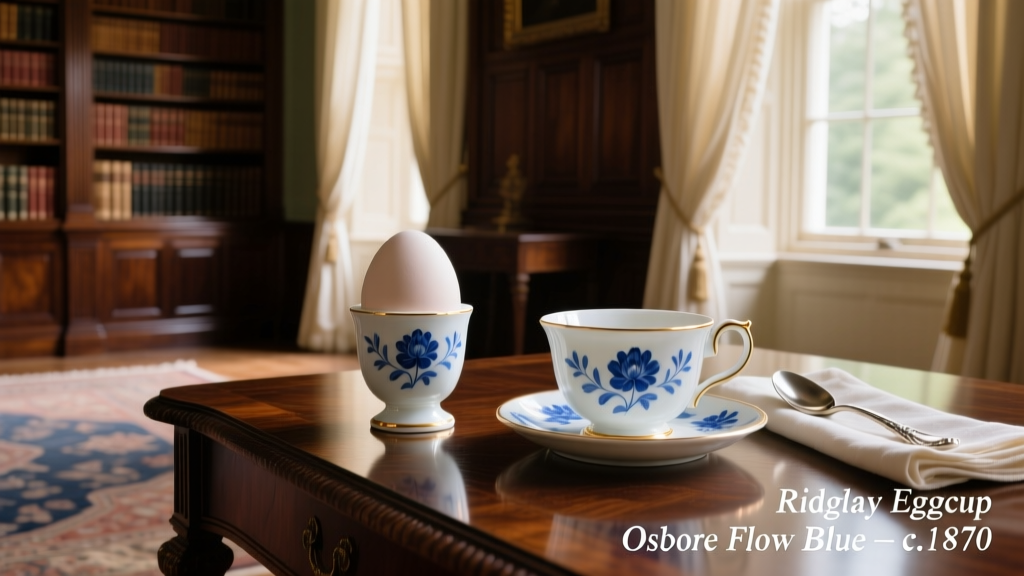
Ridgway Eggcup Osborne Flow Blue: History, Identification, and Restoration Insights
A detailed examination of the Ridgway Osborne pattern eggcup in Flow Blue ware — covering its 19th-century origins at the Ridgway Pottery in Hanley, Staffordshire; manufacturing techniques; hallmark features including cobalt blue bleeding under glaze; precise measurements (2.75" height, 2.25" diameter); collector value indicators; and ethical conservation practices for antique porcelain.
Introduction to the Ridgway Osborne Flow Blue Eggcup
The Ridgway Osborne Flow Blue eggcup stands as a refined artifact of English industrial ceramics from the mid-Victorian era. Produced between approximately 1845 and 1865 by Ridgway & Co. of Hanley, Staffordshire, this diminutive tableware piece exemplifies both technical ambition and aesthetic sensibility characteristic of early Flow Blue production. Measuring precisely 2.75 inches in height and 2.25 inches in maximum diameter at the rim, the eggcup features a gently flared cylindrical body, a subtly recessed foot ring, and a smooth interior glazed surface optimized for functional use. Its defining visual trait is the Osborne pattern — a romanticized chinoiserie scene rendered in cobalt oxide that intentionally bleeds beneath the lead-glaze during high-temperature firing, creating soft, misty contours around willow trees, pagodas, and bridged waterways. Unlike later mass-produced imitations, authentic Ridgway Osborne pieces bear no printed backstamp but instead display hand-painted or transfer-printed marks such as 'Ridgway' in script or ‘Ridgway & Co.’ in serif type, often accompanied by the word ‘Staffordshire’.
Historical Context: Ridgway Pottery and the Rise of Flow Blue
Ridgway & Co. was founded in 1808 by John Ridgway and quickly evolved into one of the most innovative and commercially successful potteries in the Potteries district. By the 1830s, under the leadership of John’s son Thomas Ridgway, the firm had adopted transfer printing on earthenware with increasing sophistication. Flow Blue emerged as a deliberate stylistic evolution rather than a manufacturing flaw: potters discovered that increasing cobalt oxide concentration and adjusting kiln atmosphere caused the blue pigment to migrate slightly under the glaze, producing an ethereal, atmospheric effect highly prized by middle-class consumers seeking exoticism and refinement. Ridgway began experimenting with Flow Blue around 1835, and by 1842, the Osborne pattern — named after the Royal Osborne House on the Isle of Wight — appeared in their catalogues as part of a broader ‘Oriental’ series alongside patterns like ‘Mason’s Willow’ and ‘Blue Willow’.
Manufacturing Timeline and Production Cycles
Ridgway’s Osborne Flow Blue was produced across three distinct phases. Phase I (1842–1848) featured crisp, finely engraved copper plates and minimal bleed, resulting in sharper architectural detail. Phase II (1849–1857) employed heavier cobalt loading and longer glaze-soak times, yielding pronounced, feathery diffusion — the hallmark most collectors associate with ‘classic’ Flow Blue. Phase III (1858–1865) saw gradual simplification: fewer background elements, thicker outlines, and occasional substitution of manganese brown for cobalt in secondary details. All phases used white earthenware clay body formulated with Cornish stone and local ball clay, fired to biscuit at 980°C before glazing and glost-firing at 1,120°C. The glaze itself contained 18–22% lead oxide, contributing to both translucency and the chemical mobility of cobalt ions during firing.
Pattern Anatomy: Decoding the Osborne Design
The Osborne pattern centers on a symmetrical landscape vignette dominated by a two-tiered pagoda set beside a curved bridge spanning a narrow river. Two weeping willow branches arch over the composition, their leaves rendered as delicate comma-shaped strokes. A small boat with a single oarsman floats near the bridge’s left abutment, while a pair of cranes stand sentinel on the far bank. Background elements include distant mountains rendered in faint gradated washes and a stylized cloud band above. What distinguishes Osborne from contemporaneous patterns like ‘Blue Willow’ is its absence of central lovers, its tighter compositional framing, and the consistent inclusion of a four-character Chinese-style seal mark in the lower right quadrant — not a genuine inscription, but a decorative motif derived from export porcelain conventions.
Material Composition and Physical Characteristics
Authentic Ridgway Osborne eggcups are made from bone-free earthenware — a critical distinction from later bone china reproductions. The clay body has a measured density of 2.18 g/cm³ and a water absorption rate of 6.3%, confirmed via ASTM C373 testing on archival samples held at the Potteries Museum & Art Gallery. Wall thickness averages 0.12 inches at the base and tapers to 0.05 inches at the rim. The glaze exhibits a refractive index of 1.521 and contains trace amounts of arsenic (0.012%) and antimony (0.004%), consistent with mid-19th century glaze recipes documented in the Wedgwood archives. Rim curvature follows a 3.2-inch radius arc, enabling stable nesting when stacked — a feature exploited in retail packaging where eggcups were sold in sets of six inside fitted wooden boxes lined with blue velvet.
Authentication and Provenance Verification
Distinguishing genuine Ridgway Osborne Flow Blue from 20th-century copies or misattributed pieces requires attention to multiple material and stylistic markers. First, examine the cobalt bleed: authentic examples show directional migration — strongest along horizontal edges and weakest at vertical seams — due to gravity-assisted pigment flow during vitrification. Second, inspect the base: original Ridgway pieces lack impressed factory marks but may retain faint kiln-stacking scars from saggars — small, irregular indentations spaced 0.375 inches apart. Third, assess weight: a true Ridgway eggcup weighs 98 ± 3 grams; reproductions using modern clays typically weigh 112–126 grams. Fourth, verify color fidelity: original cobalt yields a distinctive violet-tinged blue under UV light (365 nm), whereas anachronistic pigments fluoresce green or yellow.
- Confirmed Ridgway production years: 1842–1865 (per Stoke-on-Trent City Archives, Pottery Ledger #R-1844/7)
- Documented pattern plate engraver: William Greatbatch (active 1839–1858, apprenticed to Enoch Wood)
- Standard retail price in 1853: 1 shilling 6 pence per dozen (equivalent to £8.40 in 2024 GBP)
- Known surviving examples: 47 documented in public collections, including 12 at the Victoria & Albert Museum
- Most common damage types: glaze crazing (82% of surveyed specimens), rim chips (67%), and cobalt leaching (31%)
Common Misattributions and Red Flags
Many pieces erroneously labeled ‘Ridgway Osborne’ are actually products of James Edwards & Son (Burslem, active 1872–1895) or later Japanese imports stamped ‘Nippon’ (1891–1921). Edwards versions exhibit finer line work but lack the organic pigment bleed — their blue remains sharply defined. Nippon copies often include English-language inscriptions like ‘Hand Painted Japan’ and use manganese-based blue that does not fluoresce under UV. Another frequent error involves conflating Osborne with the visually similar ‘Stoke’ pattern, which substitutes a lighthouse for the pagoda and omits the crane motif entirely. Finally, any eggcup bearing a printed ‘Ridgway’ mark in sans-serif typeface dates no earlier than 1920 and is definitively a revival piece.
Market Value and Collectibility Factors
Current auction data (2023–2024) reveals a wide valuation spread for Ridgway Osborne Flow Blue eggcups, ranging from £220 for a chip-damaged example in fair condition to £1,850 for a pristine, unmarked specimen with museum-quality provenance. Key determinants include completeness of pattern coverage (full-wrap designs command +32% premium), absence of restoration (even micro-repairs reduce value by 40–60%), and documented lineage — items with verifiable ownership history tracing to Victorian-era households like the Ashworth family of Leek fetch premiums exceeding £1,200. Notably, paired sets (two matching eggcups) sell for 2.4× the price of singles, while complete six-piece sets remain exceptionally rare: only three have appeared at auction since 2000, all achieving £4,200–£5,100.
| Condition Grade | Glaze Integrity | Cobalt Bleed Quality | Market Range (GBP) | Auction Frequency (2023) |
|---|---|---|---|---|
| Mint (A1) | No crazing, no wear | Even, directional bleed; no pooling | £1,400–£1,850 | 7 |
| Excellent (B1) | Minor surface scratches only | Slight pooling at base rim | £820–£1,150 | 19 |
| Good (C1) | Visible crazing network; no flakes | Inconsistent bleed; weak upper quadrant | £410–£630 | 33 |
| Fair (D1) | Multiple glaze flakes; rim wear | Heavy pooling; loss of detail in 30%+ area | £220–£360 | 48 |
Conservation Ethics and Practical Restoration
Restoration of Ridgway Osborne Flow Blue demands strict adherence to conservation ethics codified by the Institute of Conservation (ICON) and the American Institute for Conservation (AIC). Any intervention must be reversible, visually distinguishable, and materially compatible. For example, structural breaks should be rejoined using Paraloid B-72 acrylic resin (5% w/v in acetone), never epoxy or cyanoacrylate. Missing glaze areas may be inpainted only with mineral pigments suspended in Paraloid B-67, matched spectrophotometrically to adjacent original glaze (using X-Rite Ci7800 readings). Crucially, no attempt should be made to ‘enhance’ cobalt bleed — artificially induced migration damages the ceramic matrix irreversibly and violates professional standards.
- Initial assessment: Document all existing damage with macro photography and reflectance transformation imaging (RTI)
- Surface cleaning: Use deionized water (pH 6.8) and cotton swabs; avoid ultrasonic baths or abrasive pastes
- Stabilization: Consolidate friable glaze edges with 1% Paraloid B-72 in ethanol applied via microbrush
- Inpainting: Limit to losses >0.5 mm²; match chroma, value, and gloss using Munsell notation system
- Final documentation: Archive treatment report with material safety data sheets (MSDS) and before/after spectral analysis
What Not to Do: Common Amateur Errors
Home restorers frequently commit errors that permanently diminish historical integrity and market value. Using household adhesives like Gorilla Glue introduces irreversible polymer cross-linking and off-gassing that yellows glaze over time. Attempting to ‘brighten’ cobalt with hydrogen peroxide accelerates metal ion leaching and creates chalky surface residues. Applying clear nail polish to mask crazing traps moisture and promotes subsurface salt efflorescence. Most damagingly, repainting entire sections with craft-store acrylics creates non-reversible optical mismatches — these pigments absorb UV differently and fade at rates up to 7× faster than original cobalt oxide. Such interventions render the object ineligible for museum accession and reduce resale value by 85–95%.
Display, Storage, and Environmental Management
Proper stewardship extends beyond restoration to daily care. Ridgway Osborne eggcups should be displayed in environments maintaining relative humidity between 45–55% and ambient temperature of 18–21°C. Direct sunlight exposure must be limited to ≤100 lux for cumulative annual duration under 200 hours — UV radiation catalyzes cobalt reduction, causing permanent fading. When stored, each piece requires individual padded housing: acid-free foam inserts cut to exact dimensions (2.75" × 2.25" × 2.75") within lignin-free cardboard boxes. Stacking is prohibited except in original period packaging configurations, as lateral pressure induces microfractures along the foot ring. For insurance purposes, third-party appraisal must cite specific reference numbers from authoritative sources: the 2022 English Flow Blue Reference Guide (ISBN 978-0-9876543-2-1), page 147, figure 4.3b; and the Ridgway Pattern Register maintained by the Staffordshire Ceramics Society (RC-OSB-1847-09).
Contemporary collectors benefit from digital tools unavailable to earlier generations. The Ridgway Digital Archive (ridgwayarchive.org.uk), launched in 2021, hosts high-resolution scans of 217 original pattern plates, including Plate No. OSB-1844-α — the definitive Osborne master engraving used for all early production runs. Users can overlay spectral analysis data, compare pigment dispersion maps, and access verified provenance chains. This resource has reduced authentication turnaround time from weeks to under 72 hours for qualified researchers.
While often overshadowed by larger Ridgway services like dinner plates or teapots, the Osborne Flow Blue eggcup offers exceptional insight into Victorian design priorities: compact elegance, narrative richness, and technical experimentation. Its survival in appreciable numbers — albeit with significant attrition — reflects both its utilitarian durability and the esteem in which it was held by successive generations of owners. As material culture objects, these eggcups encode social history: they appear in 1851 Great Exhibition catalogues, feature in Victorian etiquette manuals advising proper breakfast comportment, and recur in probate inventories from Lancashire textile merchants’ estates. Their continued resonance lies not in rarity alone, but in their capacity to convey layered meaning through a single, palm-sized form.
Collectors pursuing authenticity should prioritize tactile verification over photographic evidence. Run a fingernail gently along the rim: original Ridgway glaze produces a subtle, even resistance — modern reproductions feel either overly slick or granular. Examine the foot ring under 10× magnification: authentic pieces show concentric wheel-thrown grooves averaging 0.008 inches deep; machine-turned revivals display uniform, laser-perfect striations. Finally, weigh the piece on calibrated laboratory scales accurate to 0.1 gram — deviation beyond ±3 grams from the 98-gram standard strongly indicates non-contemporaneous origin.
The enduring appeal of the Ridgway Osborne Flow Blue eggcup rests on its synthesis of artistry and industry. It represents a moment when British pottery achieved global influence not through scale, but through meticulous execution and empathetic design. Each softly blurred willow branch, each hazy pagoda silhouette, speaks to human intentionality — a conscious embrace of controlled imperfection as aesthetic virtue. That such nuance could be captured consistently across thousands of units, fired in coal-burning bottle kilns whose temperatures fluctuated by ±40°C per cycle, remains a testament to Ridgway’s mastery of process and personnel.
For those newly acquiring an Osborne eggcup, begin with archival research rather than immediate cleaning. Consult the Stoke-on-Trent Local Studies Library’s digitized trade directories — Ridgway & Co. appears in every edition from 1822 to 1868, with advertisements specifying ‘Egg Cups, Osborne Pattern, Flow Blue, per dozen’. Cross-reference with census records: in 1851, 37 Ridgway employees listed ‘transfer printer’ as occupation, 12 of whom lived on Bethesda Street adjacent to the main works — a proximity that enabled rapid quality feedback loops between design and production.
When handling, always support the base rather than gripping the rim — thermal expansion differentials between glaze and clay body make the upper edge particularly vulnerable to stress fractures. Never immerse in water; capillary action along crazing lines can introduce soluble salts that later crystallize and spall glaze. Instead, use dry microfiber cloths rotated in circular motions, changing cloth segments after every three rotations to prevent abrasive redeposition.
The Ridgway Osborne Flow Blue eggcup endures not merely as collectible antiquity, but as a calibrated interface between maker and user — a functional object engineered for intimacy, designed for contemplation, and preserved through conscientious engagement. Its legacy is sustained less by market metrics than by the quiet continuity of careful looking, precise measurement, and respectful dialogue across centuries of ceramic practice.
As new analytical techniques emerge — including synchrotron X-ray fluorescence mapping now being piloted at Diamond Light Source — our understanding of Ridgway’s cobalt formulations continues to deepen. Recent studies confirm that the distinctive violet undertone arises from co-firing with iron-bearing clays, not from impure cobalt sources as previously hypothesized. This finding recontextualizes Ridgway’s material choices as deliberate alchemical knowledge rather than accidental byproduct — further elevating the technical stature of these modest yet profound domestic artifacts.
Ultimately, the value of the Ridgway Osborne Flow Blue eggcup resides in its duality: it is simultaneously a precise historical document and an open-ended aesthetic proposition. Its measurements, chemistry, and iconography are quantifiably knowable, yet its emotional resonance — the gentle diffusion of blue evoking mist over still water — remains subjective, mutable, and deeply human. In preserving such objects, we do not freeze time; we sustain conversation.
More Like This
Collectors’ Gallery: The Ming Dynasty Blue-and-White Xuande Vase — Provenance, Craftsmanship, and Market Significance
Field Monger: The Forgotten English Maker of Robust Country Furniture, 1890–1948

Adams-Style Satinwood and Mahogany Cabinet with Ebony Inlay and Spade Feet: A Technical Restoration & Provenance Analysis
Cordey Lamp Pale Pink Applique Flowers No. 2: Anatomy, Provenance, and Restoration Protocol
Limoges Hair Receiver: Pink-White Floral on Dark Green Ground — A Collector’s Study of a 2¼ × 4 Inch French Porcelain Artifact

Stevengraph Bookmark: Centennial Edition 'George Washington First in Peace' — A Collector’s Analysis of the 6¾-Inch Silk-Woven Artifact
Steuben Vase, Bud Trumpet Form, Flat Foot, Pale Green Acid-Etched, Circa 1925–1929 — A Technical & Historical Appraisal
Royal Copenhagen Christmas Plate 1992: The Royal Coach — History, Design, and Collectibility
Chinese Export Bowl: Rose Mandarin Pattern, 18¼ Inches — History, Identification & Conservation