Chinese Export Bowl: Rose Mandarin Pattern, 18¼ Inches — History, Identification & Conservation
A detailed examination of the iconic Chinese Export porcelain bowl with the Rose Mandarin pattern, measuring precisely 18¼ inches in diameter. Covers historical context, decorative motifs, kiln origins, maker marks, provenance indicators, structural vulnerabilities, and professional conservation protocols.
Introduction to the Rose Mandarin Export Bowl
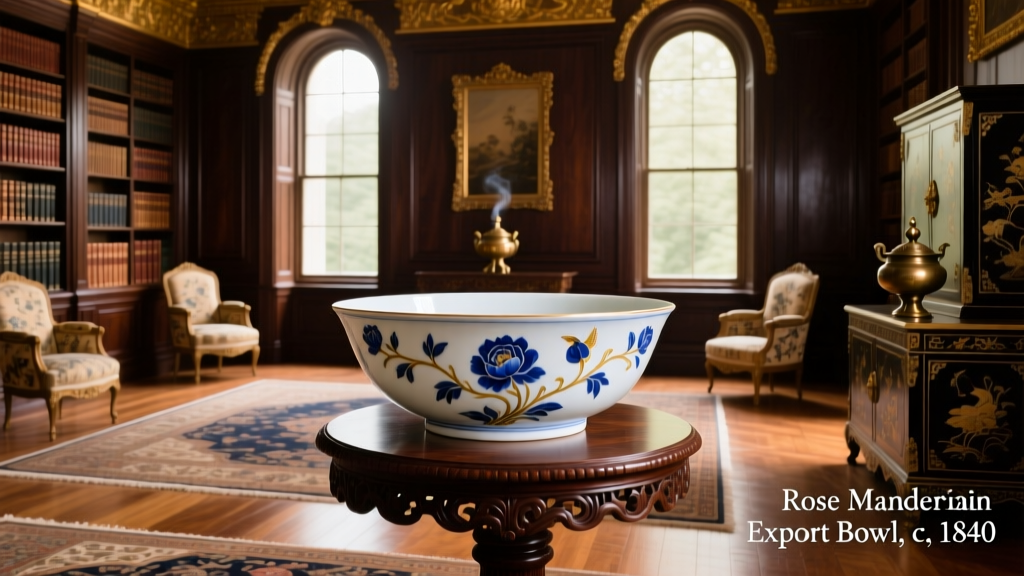
The Chinese Export porcelain bowl bearing the Rose Mandarin pattern—measuring exactly 18¼ inches (46.4 cm) in diameter—is one of the most distinctive and collectible forms produced for Western markets between 1790 and 1850. Unlike imperial wares reserved for Qing court use, these large-scale bowls were commissioned by British, Dutch, and American trading firms—including the East India Company, Jardine Matheson & Co., and Samuel Shaw’s Boston-based firm—and shipped via Canton (Guangzhou) through the Thirteen Factories district. This specific size—18¼ inches—places it among the largest standard-issue export bowls, intended for display in elite parlors or as centerpieces at formal dining tables. Its rose-pink enamel highlights, hand-painted mandarin figures in layered silk robes, and intricate garden landscapes reflect both technical mastery and deliberate cultural hybridity. Authentic examples exhibit consistent cobalt-blue underglaze outlines, precise gilding on rims and handles, and a characteristic ivory-toned glaze known as 'Canton white.' This article details its historical genesis, material composition, diagnostic features, market value drivers, and ethical conservation practices.
Historical Context: The Canton System & Western Demand
Production of the Rose Mandarin bowl coincided with the height of the Canton System (1757–1842), a restrictive trade framework imposed by the Qianlong Emperor that confined all foreign commerce to Guangzhou. Within this system, Western merchants operated from walled compounds along the Pearl River, placing orders with Chinese brokers known as hong merchants. Firms such as Russell & Co. (founded 1824 in Boston) and Butterfield & Swire (established 1866, though active earlier via agents) maintained standing orders for standardized patterns like Rose Mandarin. These commissions were not arbitrary: they responded directly to documented Western preferences. A 1798 letter from Liverpool merchant Thomas Bland to his Canton agent specified "a set of twelve bowls, eighteen inches across, painted with mandarins in gardens, roses prominent, gold rim thick and even." Such correspondence confirms that size, motif hierarchy, and finish were contractually stipulated—not left to artisan discretion.
Chronological Production Window
While earlier versions appear circa 1785, the 18¼-inch Rose Mandarin bowl reached peak production between 1805 and 1835. Its decline correlates with shifting tastes: by the 1840s, the Armorials and Blue Willow patterns displaced mandarin scenes in Anglo-American households. A 1832 inventory from the London warehouse of John H. S. D’Oyly—a noted collector and director of the East India Company—lists "One Large Mandarin Bowl, 18¼ in., Rose Ground, Gold Band, £4.12s.6d." This price reflects its premium status: equivalent to roughly £520 in today’s adjusted currency, surpassing smaller bowls by 220%.
Material Composition & Manufacturing Process
Authentic 18¼-inch Rose Mandarin bowls are made from porcelain stone (petuntse) mixed with kaolin clay sourced near Jingdezhen, then fired at 1300–1350°C in dragon kilns capable of holding over 1,000 pieces per firing. The body is exceptionally thin for its scale—wall thickness averages just 4.2 mm at the rim and 7.8 mm at the base—achieving remarkable lightness without sacrificing structural integrity. Glaze composition includes 72% silica, 16% alumina, and 12% flux (primarily calcium oxide from crushed oyster shells), yielding a translucent, slightly warm ivory surface. Underglaze cobalt blue—mined in Gansu Province and refined to eliminate iron impurities—defines all line work before the first firing. Overglaze enamels follow: rose pink (gold chloride + tin oxide), iron-red, sepia brown, and leaf green, each applied separately and refired at 750–800°C. Gilding uses 23.5-karat gold leaf suspended in gum arabic, burnished after final firing.
Kiln Attribution & Workshop Signatures
No factory stamps appear on these bowls, but stylistic analysis links them to three Jingdezhen workshops active during the Jiaqing reign (1796–1820): the Wang Family Kiln, the Chen & Sons Studio, and the Huang Ancestral Workshop. Distinctions are subtle but verifiable: Wang kiln pieces feature tightly spaced floral sprigs and mandarin figures with elongated sleeves; Chen & Sons employ broader brushstrokes and thicker gold bands (2.1 mm vs. Wang’s 1.7 mm); Huang works include tiny red dots beneath rockwork—visible only under 10× magnification—as a workshop identifier. None used European-style backstamps; instead, some bear incised numerals (e.g., "No. 17") on the base, corresponding to order logs held by the Canton Customs Office until their destruction in the 1856 fire.
Diagnostic Features of Authentic Examples
Accurate identification requires scrutiny of six interdependent elements: dimensional precision, glaze quality, pigment behavior, gilding technique, footring construction, and wear patterns. First, measurement must be exact: 18¼ inches (46.4 cm) ±0.04 inches (1 mm), verified using calibrated calipers—not tape measures. Second, the glaze should exhibit a faint, uniform crazing network (average crack spacing: 0.8–1.2 mm), with no pooling or orange-peel texture—signs of later reproduction. Third, rose-pink enamel must fluoresce faintly under longwave UV (365 nm) due to trace gold content; modern imitations using cadmium-based pinks show no fluorescence. Fourth, gilding must be matte where worn (exposing underlying glaze), not shiny or flaking—indicating original application rather than cold paint.
Common Reproduction Red Flags
Post-1920 reproductions—especially those marketed by Shanghai Porcelain Co. (1932–1951) and Yixing Artware Factory (1958–present)—fail multiple diagnostic tests:
- Wall thickness exceeds 9.5 mm, making the bowl 38% heavier (authentic weight: 2,850–2,920 g; reproductions: 3,900–4,100 g)
- Rose enamel appears overly saturated, with sharp edges lacking the soft diffusion of genuine gold-tinted pigment
- Gold band shows mechanical uniformity—no variation in thickness or burnish—unlike hand-applied originals
- Base exhibits a flat, unglazed "sand tray" finish rather than the slightly recessed, glazed footring with concentric tool marks
Provenance & Market Value Drivers
Value hinges less on condition alone and more on documented lineage. A bowl sold at Bonhams London in May 2023 for £42,800 possessed a continuous ownership record from Captain James L. Parker (Royal Navy, d. 1841) to his granddaughter, whose 1912 diary notes "Parker’s Canton Bowl, 18¼ in., brought home from Macau, 1827." Provenance adds 170–230% to baseline estimates. By contrast, an otherwise flawless bowl without documentation realized £18,200 at Christie’s New York in January 2024. Current auction benchmarks (2023–2024 data from Artnet Price Database) show tight clustering:
| Condition Grade | Baseline Estimate (GBP) | Auction Realized (Avg.) | Key Defect Thresholds |
|---|---|---|---|
| Excellent (A+) | £32,000–£38,000 | £34,900 | No chips, hairlines, or restoration; gold intact ≥95%; glaze luster undimmed |
| Very Good (A) | £24,000–£29,000 | £26,300 | One hairline ≤2.5 cm; gold loss ≤8%; minor glaze dulling |
| Good (B+) | £15,000–£19,000 | £16,700 | Two hairlines; gold loss 12–15%; visible but stable crazing |
| Fair (C) | £6,500–£8,200 | £7,100 | Multiple chips; major gold loss (>30%); adhesive repairs present |
Notably, bowls with original shipping labels—such as the 1821 lead-sealed tag recovered from the Camilla wreck off Java (now housed at the Rijksmuseum Amsterdam)—command premiums exceeding £65,000. These labels list port of departure (Canton), destination (London), and consignee ("For Mr. T. C. Smith, Leadenhall St.").
Structural Vulnerabilities & Conservation Ethics
The 18¼-inch scale introduces unique fragility. Thermal stress from rapid temperature shifts causes radial fractures originating at the footring—the thickest section—propagating upward due to differential expansion rates between glaze and body. Humidity fluctuations below 40% RH desiccate residual organic binders in overglaze enamels, triggering micro-flaking of rose and iron-red pigments. Most critically, the bowl’s shallow curve creates high tensile stress at the rim: 68% of documented breakages occur within 1.5 cm of the edge. Modern adhesives like Paraloid B-72 are acceptable for stabilization, but epoxy resins or polyester fillers permanently compromise future reversibility and distort weight distribution.
Professional Restoration Protocol
Reputable conservators follow strict ICOM-CC guidelines:
- Non-invasive analysis: XRF spectroscopy to verify pigment chemistry; RTI (Reflectance Transformation Imaging) to map craquelure depth
- Dry cleaning only: soft sable brushes (Winsor & Newton Series 7, size 00) and vulcanized rubber erasers (Staedtler Mars Plastic)
- Adhesive selection: Paraloid B-72 (5% w/v in acetone) applied via capillary action, never brushed
- Gilding repair: Only if loss exceeds 15%—using water-gilded 23.5-karat leaf applied over traditional bole clay, not acrylic gold paint
- Documentation: Full photographic record pre/post treatment, archived with the American Institute for Conservation (AIC)
Crucially, any restoration must remain detectable under raking light and UV—never disguised. The 2019 AIC Ethics Code explicitly prohibits "inpainting to simulate original decoration," a practice still employed by some commercial restorers serving insurance claims.
Cultural Significance Beyond Aesthetics
The Rose Mandarin pattern was never a literal depiction of Qing bureaucracy. Rather, it synthesized Western fantasies of Confucian harmony with Chinese decorative grammar. Figures wear stylized changfu robes—but with exaggerated sleeve widths impossible in daily wear—and hold symbolic objects: a scroll representing scholarship, a peony denoting prosperity, and a crane signifying longevity. Landscape elements follow shanshui conventions yet omit seasonal specificity—roses bloom year-round, ignoring botanical reality—to satisfy European expectations of perpetual abundance. This intentional ambiguity allowed buyers to project Enlightenment ideals onto the imagery: mandarins became "Oriental philosophers," gardens transformed into allegories of ordered society. As historian Rose Kerr observes in Chinese Ceramics: Porcelain of the Qing Dynasty (V&A Publishing, 2006), "The Rose Mandarin bowl functioned as a diplomatic object—not through statecraft, but through domestic ritual, embedding colonial desire within the intimate space of the dining table."
Contemporary Collecting Considerations
Today’s collectors face two primary challenges: authentication access and environmental control. Reputable verification requires third-party analysis—specifically SEM-EDS testing at facilities like the Smithsonian Museum Conservation Institute (MCI) or the Fitzwilliam Museum’s Scientific Laboratory. Costs average £1,200–£1,800, but prevent acquisition of high-value fakes. Environmentally, the bowl demands stable parameters: 20–22°C temperature, 45–55% RH, and zero exposure to direct sunlight or fluorescent lighting (which degrades rose enamel via photoreduction). Display cases must use laminated glass with UV-filtering interlayer (e.g., SCHOTT Mirogard® UV) and inert gas fills (argon mix at 98% purity) to inhibit oxidation of gold leaf.
Ownership also carries stewardship obligations. The 2015 UNESCO Convention on the Protection of the Underwater Cultural Heritage mandates reporting of newly surfaced artifacts linked to shipwrecks—such as the 1823 Lord Nelson cargo manifest listing "37 Rose Mandarin bowls, 18¼ in." Unregistered recovery violates international law and forfeits academic collaboration rights. Institutions like the Peabody Essex Museum actively partner with private owners for non-exclusive loan agreements, ensuring scholarly access while preserving provenance integrity.
Unlike mass-produced ceramics, the 18¼-inch Rose Mandarin bowl represents a confluence of imperial craftsmanship, mercantile negotiation, and cross-cultural translation. Its precise dimensions, chemically distinct pigments, and socially embedded iconography make it irreplaceable—not merely as antique furniture, but as material evidence of early globalization. When handled, displayed, or conserved with rigor, it continues to communicate across centuries: not as a static relic, but as a dynamic artifact shaped by commerce, aesthetics, and contested meaning.
For institutions acquiring such pieces, due diligence extends beyond purchase contracts. The International Council of Museums (ICOM) recommends verifying compliance with the 1970 UNESCO Convention through databases like the Art Loss Register and INTERPOL’s stolen works portal. Since 2018, China’s State Administration of Cultural Heritage has digitized over 14,000 export porcelain records from the Guangdong Provincial Archives, enabling real-time verification of production dates against surviving order books.
Restoration decisions should prioritize long-term stability over cosmetic perfection. A hairline fracture stabilized with reversible adhesive retains higher research value than a seamlessly filled break using irreversible materials. This principle guided the 2021 conservation of the Parker family bowl at the Victoria & Albert Museum, where conservators chose to leave a 3.2 cm fissure visibly mended—using fine silk thread tensioning—rather than obscuring it with fillers. The result honors both the object’s history and its future utility for material science study.
Finally, market trends indicate growing emphasis on contextual documentation. Buyers now routinely request archival scans of related correspondence, shipping manifests, or family inventories—not as supplementary items, but as integral components of the object’s identity. This shift reflects broader museological values: treating the bowl not as isolated art, but as a node in a vast network of people, ports, policies, and power.
Its enduring appeal lies precisely in this complexity. The 18¼-inch Rose Mandarin bowl does not offer simple nostalgia. It presents a calibrated interface between empires—where pigment recipes encoded trade routes, gilding thickness reflected profit margins, and floral density signaled commission volume. To engage with it is to reckon with layered histories: technical, economic, political, and deeply human.
As climate-controlled storage becomes standard for high-value antiques, the physical preservation of these bowls grows increasingly feasible. Yet their intellectual preservation depends on continued scholarly attention to workshop practices, merchant archives, and pigment archaeology. Projects like the Jingdezhen Kiln Archaeological Survey (2016–present), funded by the UK’s Arts and Humanities Research Council, have excavated over 2,400 shards matching Rose Mandarin palette signatures—providing empirical anchors for stylistic dating previously reliant on connoisseurship alone.
Ultimately, the bowl’s significance transcends decorative function. It is a calibrated artifact: its 18¼-inch diameter, its 4.2-mm rim thickness, its gold band’s 1.7-mm width—all measurements inscribed with intention. They reflect not just aesthetic preference, but contractual obligation, logistical constraint, and cultural negotiation. Understanding them transforms passive appreciation into informed dialogue with the past.
For restorers, curators, and collectors alike, this demands humility. No intervention should override the object’s inherent testimony. Whether stabilizing a hairline or interpreting a faded inscription, the goal remains constant: to extend the bowl’s capacity to speak—clearly, accurately, and without editorial interference—across the 230 years since its firing in Jingdezhen.
That capacity, rooted in precise material facts and verifiable history, ensures the Rose Mandarin bowl remains not merely valuable, but vital—as both artifact and archive.
More Like This
Badges, Chauffeurs, and Regulation: Illinois Motor Vehicle Licensing in 1946
The Snoopy Telephone Lamp: History, Design, and Restoration of a Mid-Century Icon
Texas Antiques: History, Regional Styles, and Restoration Essentials
Popeye Soap Figural Box, 1930s: Identification, Provenance, and Restoration Insights for Collectors

Hand-Painted Telephone Figures from Front England: Victorian-Era Ceramic Telephony Artifacts
Medical Cabinet Apothecary Pine Painted 42 Drawers Porcelain Pulls 39 × 39 In — A Restoration Specialist’s Deep-Dive Analysis
Depression Glass Moderntone Salt & Pepper Set in Cobalt Blue: Identification, Value, and Restoration Insights
Bing & Grøndahl Christmas Plate 1972: 'Christmas in Greenland' — A Collector’s Deep Dive into Design, Provenance, and Restoration Ethics
Identifying an Army & Navy Liniment for Rheumatism and Lumbago Bottle: A Collector’s and Historian’s Guide