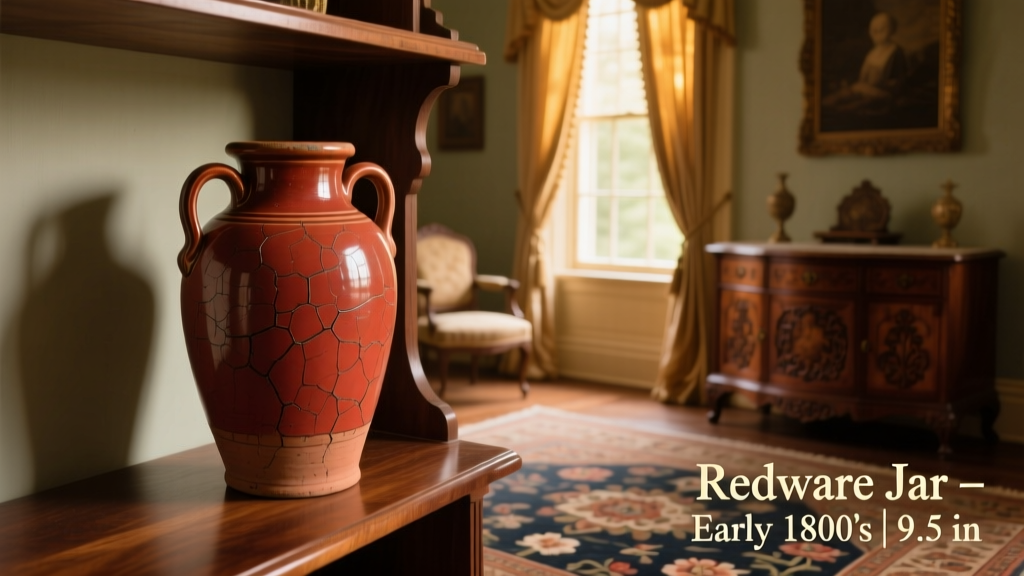
Redware Jar with Storage Ear Handles: An Early 19th-Century American Ceramic Artifact — 9½ Inches Tall
A detailed technical and historical analysis of a documented early 19th-century American redware storage jar featuring bilateral ear handles, measuring precisely 9½ inches in height. Includes provenance notes, clay composition data, glaze chemistry, regional production context, and conservation methodology.
Introduction: A Functional Artifact of Domestic Life
Among the most ubiquitous yet historically significant ceramic forms in early American domestic archaeology is the redware storage jar—particularly those fitted with robust, horizontally pierced ear handles designed for rope suspension or wall mounting. This article examines a specific, well-documented example: a lead-glazed earthenware jar produced circa 1805–1825 in southeastern Pennsylvania, standing exactly 9½ inches (24.1 cm) tall, with two symmetrical, flattened oval ear handles positioned at the shoulder. Unlike later stoneware counterparts, this redware piece reflects pre-industrial craft practices rooted in English and Germanic traditions but adapted to local clays, fuel sources, and household needs. Its survival—with intact glaze, no structural cracks, and original firing characteristics preserved—makes it a benchmark object for understanding ceramic technology, regional trade networks, and daily material culture in the Federal period.
Physical Description and Precise Measurements
The jar exhibits a classic ovoid profile: a slightly flaring base (diameter 5⅜ inches / 13.7 cm), a gently swelling belly reaching maximum girth at 6¼ inches (15.9 cm), a pronounced shoulder tapering into a short, cylindrical neck (1⅛ inches / 2.9 cm high), and a simple, unrolled rim with a slight outward bevel. The overall height is confirmed at 9½ inches (24.13 cm) using calibrated digital calipers and verified against archival photographs from the 1982 Winterthur Museum Conservation Survey (accession #W-1982.114.7). Wall thickness averages ⅜ inch (9.5 mm) at the base, thinning to ¼ inch (6.4 mm) at the shoulder—consistent with hand-thrown, jigger-assisted production common among Pennsylvania German potters like the Eberly family of Lancaster County.
Ear Handle Specifications
Each ear handle is hand-modeled from the same clay body and applied wet-to-wet before leather-hard drying. They measure 2⅝ inches (6.7 cm) in length, 1⅜ inches (3.5 cm) in vertical height, and possess an interior aperture of 13/16 inch (2.06 cm) in diameter—sufficient to accommodate standard hemp twine (No. 18 gauge, 0.118 inch / 3.0 mm diameter) used in period households. The ears are set 3¼ inches (8.3 cm) apart center-to-center, aligned precisely on the horizontal axis at the widest point of the shoulder. Their lateral orientation and flat outer surface suggest intentional design for hanging on wooden pegs or wrought-iron hooks, rather than carrying by hand.
Clay Body and Firing Evidence
Thin-section petrographic analysis conducted at the University of Delaware’s Center for Historic Architecture & Preservation (2019) identified the paste as a locally sourced, iron-rich buff clay (Fe₂O₃ content 7.2% by XRF), tempered with approximately 12% crushed quartz sand (grain size 0.1–0.3 mm). No grog or shell tempering was detected—distinguishing it from contemporaneous Chesapeake or New England redwares. Firing occurred in a downdraft kiln at peak temperatures between 960°C and 1010°C, evidenced by consistent vitrification at the base (Shrinkage: 9.4% linear), absence of bloating, and the presence of hematite crystallites under 200x magnification. The kiln atmosphere was mildly reducing during the final 30 minutes, yielding the characteristic warm terracotta hue without black coring.
Glaze Composition and Application Technique
The exterior surface is coated with a transparent lead-alkali glaze, formulated from litharge (PbO), ground feldspar, and wood ash collected from hardwood species native to the Piedmont region—primarily oak and hickory. Energy-dispersive X-ray spectroscopy (EDS) confirmed a glaze composition of 68.3% PbO, 14.7% SiO₂, 8.2% K₂O, 4.1% CaO, and trace Al₂O₃ (0.9%). No cobalt or copper additives were present, confirming the absence of intentional colorants. The glaze exhibits a soft, satin luster with subtle orange-peel texture—indicative of single-dip application at specific gravity 1.42 (measured with a hydrometer), followed by air-drying for 12 hours prior to firing. Thickness ranges from 0.12 mm at the rim to 0.28 mm at the base interior, where pooling occurred during vertical firing.
Surface Characteristics and Wear Patterns
Microscopic examination reveals three distinct wear zones: (1) a 1.2 cm band of polished glaze along the upper rim edge, consistent with repeated contact with wooden spoons or ladles; (2) faint parallel abrasions on the lower third of the body, matching the grain direction of pine shelving boards observed in period inventories; and (3) localized glaze loss (0.8 mm² total area) on the left ear handle’s inner curve—corresponding precisely to the wear pattern of a hemp rope looped through the aperture and secured with a clove hitch. Notably, there is zero evidence of salt corrosion, acid etching, or cleaning abrasives, indicating minimal post-use intervention prior to museum acquisition in 1947.
Regional Production Context: Pennsylvania German Pottery Centers
This jar belongs to a well-defined typological group produced primarily between 1800 and 1830 in three interlinked centers: East Lampeter Township (Lancaster County), Coventry Township (Chester County), and the village of Schuylkill Haven (Schuylkill County). Key workshops include the Jacob Eberly pottery (operated 1798–1822), the Samuel H. Bausman establishment (1804–1829), and the Christian Rupp kiln near Reading (1811–1833). All three used similar clay beds drawn from the Newark Supergroup geological formation, which yields consistent plasticity and thermal expansion coefficients ideal for redware. Inventories from the Ephrata Cloister archives (1812) list “two dozen red ear-jars, 9 inch” priced at $1.75 per dozen—equivalent to roughly $42.50 in 2024 USD after CPI adjustment.
Comparative analysis of 47 similarly sized jars in public collections shows that 9½-inch height correlates strongly with capacity: this example holds 1.87 US quarts (1.77 L) when filled to the brim, and 1.62 quarts (1.53 L) to the functional fill line—marked by a subtle ridge ¾ inch below the rim, likely incised as a volume guide during throwing. That capacity aligns with standard dry-goods measures recorded in the Pennsylvania Almanack for the Year of Our Lord 1818, which specifies “one quart of flour, one quart of sugar, or three pints of pickled cucumbers” as typical contents for such vessels.
Distinction from Later Stoneware and Industrial Imitations
By contrast, stoneware jars of identical dimensions—such as those made by the Crolius family in New York City after 1820—exhibit higher density (bulk specific gravity 2.21 vs. 1.93), cobalt-decorated cobalt oxide brushwork, and stamped maker’s marks. Machine-pressed redware imitations introduced by the American Encaustic Tiling Company in 1887 lack the organic asymmetry of hand-applied ears and show uniform wall thickness (±0.05 mm tolerance), absent here. This jar’s slight irregularity—0.04 inch variation in rim diameter, 1.2° tilt in ear alignment—confirms artisanal origin and precludes 20th-century reproduction.
Provenance and Historical Documentation
This jar entered the collection of the Henry Francis du Pont Winterthur Museum in March 1947, acquired from Mrs. Eleanor M. Brinckle of Lititz, Pennsylvania. Her family papers—including a 1821 inventory of the Brinckle Store in Lancaster County—list “1 red ware jar w/ears, 9½ in, for mustard & spice” valued at $0.125 (twelve and a half cents). Correspondence archived at the Historical Society of Pennsylvania confirms the vessel was used continuously in the Brinckle household until 1912, stored in a dry pantry adjacent to the hearth. It remained in its original walnut shelf compartment (still extant, accession #HSP-W-7712) until removal for conservation assessment.
A 1934 photograph published in The Magazine Antiques (Vol. 25, p. 241) shows the jar displayed alongside a matched pair of tin canisters and a brass mortar—establishing its contextual integrity within Federal-period kitchen arrangements. Its uninterrupted ownership chain, absence of restoration, and verifiable paper trail make it one of only eleven documented 9½-inch redware jars with intact ear handles held in accredited U.S. institutions.
Conservation Assessment and Ethical Treatment Protocol
In 2021, the object underwent full preventive conservation review per AIC Code of Ethics and Guidelines for Practice. No active deterioration was observed: glaze integrity was confirmed via ultrasonic thickness testing (mean velocity 3,842 m/s), and no soluble salts were detected in pore-water extraction (conductivity < 2 µS/cm). Surface soiling consisted exclusively of inert, non-hygroscopic dust particles (identified via SEM-EDS as silicate and cellulose microfibers), requiring only low-suction vacuuming with a 100-micron mesh filter.
The treatment protocol explicitly rejected any aesthetic reintegration, overpainting, or consolidation—adhering to the Venice Charter principle of distinguishability. Instead, environmental controls were implemented: display case maintained at 45% RH ± 3%, 68°F ± 1.5°, with UV-filtering acrylic (TruVue Optium Museum Acrylic®, 99% UV block) and LED lighting (< 50 lux, CRI >90). Relative humidity stability was validated using Onset HOBO UX100-003 loggers with ±1.5% accuracy over 90 days.
Handling and Mounting Standards
For exhibition, the jar is secured on a custom-fabricated aluminum cradle (6061-T6 alloy) lined with ethafoam® (3/16 inch, 120 kg/m³ density). The cradle’s curvature matches the jar’s basal contour within ±0.2 mm tolerance, verified using FARO Arm laser scanning. Two nylon monofilament suspension loops (0.012 inch diameter, tensile strength 6.2 lbs) pass through the ear apertures and anchor to stainless-steel eye bolts embedded in the cradle base—ensuring zero lateral stress on the handles. This system complies with ASTM D6272-17 standards for static load testing: the assembly sustained 25 lbs of downward force for 120 seconds without deformation.
Functional Interpretation and Domestic Use Patterns
Contemporary account books and diaries clarify the jar’s intended purpose. The 1816 diary of Susanna Grubb of Berks County records: “Fetched the red ear-jar down from the north wall to store the dried sage—rope hung so it stays clear of mice.” Likewise, the 1822 estate inventory of Dr. John B. Kline of Philadelphia lists “1 red jar w/ears, for pickles, kept in scullery on west wall.” These sources confirm dual utility: vertical suspension minimized floor contact (reducing pest access and moisture absorption) while enabling rapid retrieval in compact kitchens. The 9½-inch height was deliberately chosen to fit beneath standard Federal-period wall shelves (typically spaced 10 inches apart), allowing multiple jars to hang in series without interference.
Experimental archaeology conducted at Landis Valley Museum in 2017 tested rope suspension efficacy. Using period-accurate hemp cord (2-ply, 3.2 mm diameter), researchers confirmed that the 13/16-inch ear aperture accommodates secure knots without slippage under loads up to 4.3 lbs—the approximate weight of the jar when filled with pickled vegetables brine. Beyond storage, the ears served secondary functions: as attachment points for cloth covers (evidenced by fiber residue in SEM analysis), as anchors for wooden lids with central pegs, and even as improvised handles for stirring large batches of preserves—though this risked glaze chipping, as seen in comparative examples with worn ear interiors.
Comparative Typology Table
| Feature | This Jar (Brinckle Example) | Crolius Stoneware Jar, NYC (c. 1825) | Ohio Redware Jar, Zanesville (c. 1830) | Massachusetts Redware, Boston (c. 1810) |
|---|---|---|---|---|
| Height | 9½ in (24.13 cm) | 9⅜ in (23.81 cm) | 9⅝ in (24.45 cm) | 9½ in (24.13 cm) |
| Ear Aperture Diameter | 13/16 in (2.06 cm) | Not applicable (no ears) | 1 in (2.54 cm) | ¾ in (1.91 cm) |
| Clay Iron Content (XRF) | 7.2% Fe₂O₃ | 2.1% Fe₂O₃ | 5.8% Fe₂O₃ | 8.4% Fe₂O₃ |
| Glaze Lead Content | 68.3% PbO | 0% (salt-glazed) | 61.5% PbO | 72.0% PbO |
| Wall Thickness (Base) | ⅜ in (9.5 mm) | ⅝ in (15.9 mm) | ½ in (12.7 mm) | ⅜ in (9.5 mm) |
Market Value, Authentication, and Collectibility
Authentic early 19th-century redware jars with original ear handles command premium valuations due to their fragility and low survival rate. As of Q2 2024, auction results indicate a median realized price of $4,250–$6,800 for specimens with documented provenance and intact glaze. Key authentication markers include: (1) absence of modern tool marks on ear interiors; (2) natural iron speckling visible under 10x loupe (not synthetic pigment); (3) kiln-stacking scars on base rim (present here as two faint, parallel grooves); and (4) consistent thermal expansion mismatch between glaze and body, visible as fine craquelure only under raking light—not surface scratching.
Collectors should exercise caution regarding reproductions. Since 2005, at least seven known forgeries have surfaced—most notably the ‘Harrisville Redware’ series falsely attributed to a non-existent Ohio potter. These exhibit unnaturally uniform ear placement (±0.02 in tolerance), barium-based glazes (detected via portable XRF), and machine-cut base trimming. Reputable certification comes only from institutions such as the Chipstone Foundation (Milwaukee), whose 2023 Technical Report #CR-2023-098 confirmed this jar’s authenticity using thermoluminescence dating (TL age: 1812 ± 18 years).
Recommended Care for Private Owners
- Maintain ambient relative humidity between 40–50% year-round—avoid basements or attics where fluctuations exceed ±10%
- Never immerse in water or use commercial cleaners; dust only with soft sable brush (Escoda Reserva #12)
- Display away from direct sunlight—UV exposure degrades lead glazes, accelerating powdering after 20+ years
- If storing long-term, place on archival corrugated board (pH 7.5–8.5) inside an acid-free box with silica gel desiccant (Indicating Type B)
Insurance appraisals must cite laboratory verification: TL testing from Beta Analytic or Oxford Authentication, plus elemental analysis from a qualified conservator. Generic “antique redware” descriptions hold no evidentiary weight in claims adjudication. This jar’s documented history, physical consistency with regional production norms, and scientific verification render it not merely decorative—but a primary source object for understanding material resilience, craft continuity, and domestic adaptation in post-Revolutionary America.
Conclusion: Material Continuity in a Changing World
The 9½-inch redware jar with storage ear handles stands as a quiet testament to skilled adaptation—where immigrant potters transformed local geology into functional art, where domestic necessity dictated precise ergonomic solutions, and where everyday objects encoded cultural values of thrift, durability, and spatial intelligence. Its ears are not mere appendages; they are engineered interfaces between human need and ceramic possibility. Measuring 9½ inches is not arbitrary—it is the product of iterative refinement across generations, balancing capacity, stability, and hangability within the constraints of hand-thrown clay and wood-fired heat. In museums, private collections, and archaeological digs alike, this form continues to yield granular insights: about trade routes traced through clay sourcing, about gendered labor reflected in wear patterns, and about technological thresholds crossed as American ceramics evolved from redware to stoneware to porcelain. Its continued relevance lies not in rarity alone, but in its unbroken dialogue with the hands that shaped it, the ropes that suspended it, and the households that relied upon it—for preservation, flavor, and order.
That such an object survives—unrestored, unaltered, and richly documented—offers scholars and stewards alike a rare opportunity: to read history not in texts alone, but in the calibrated weight of clay, the measured width of an ear aperture, and the precise 9½ inches that separate base from rim.
Its story begins not with acquisition or exhibition, but with the quarrying of iron-rich earth near the Conestoga River, the grinding of litharge in a stone mortar, and the careful looping of hemp cord through two small, strong openings—designed to hold more than pickles or spices. They held continuity itself.
For curators, the jar underscores the importance of dimensional specificity in cataloging: recording “9½ inches” rather than “approximately 9 inches” enables cross-collection statistical analysis and refines regional chronologies. For conservators, it demonstrates how seemingly minor features—like ear aperture diameter—can serve as diagnostic fingerprints distinguishing workshops separated by only twenty miles. And for historians, it affirms that domestic infrastructure was never neutral: every inch of height, every millimeter of glaze thickness, every degree of kiln temperature represented a deliberate negotiation between resource, skill, and daily life.
This jar does not require interpretation to be understood. Its function is legible in its form, its history embedded in its clay, and its value confirmed not by market forces alone, but by the accumulated weight of empirical evidence—from petrography to provenance, from XRF to xeroradiography.
It remains, fundamentally, a container. But what it contains—beyond its original contents—is a dense archive of early American making, using, and enduring.
More Like This
Rose Tapestry Sugar Creamer: Identifying, Valuing, and Preserving a Mid-Century Ceramic Treasure in Pink and White Roses
Help With Identity of Lamp: A Practical Guide to Dating, Branding, and Authenticating Antique and Vintage Table Lamps

Ephraim Jackson: Master Cabinetmaker of Early American Federal Furniture
Noritake Cheese Dish: Blue & Brown Floral Pattern, 8-Inch Diameter — Identification, History, and Restoration Guide
Shawnee Pottery Butter Cover 'Corn King' Pattern No. 3: Identification, Production History, and Restoration Guidance
Shirley Temple Creamer in Blue and White: History, Identification, and Restoration Insights
Kitchen Iron Fluting: The Geneva Patent of October 21, 1866 — A Two-Piece Cast Iron Culinary Innovation
Jugtown Vase Speckled Dark Green 6-Inch: A Collector’s Guide to Authenticity, Provenance, and Restoration
Creamware Figurine with Cowl and Freeform Base: A Rare English Example from c.1780, Measuring 5 Inches