Kampfe Safety Star Razor: Engineering Precision, Patent Innovation, and Early 20th-Century Shaving Culture
A detailed technical and historical analysis of the Kampfe Safety Star razor—patented in 1901, manufactured by Kampfe Brothers of New York—covering its unique star-shaped blade retention system, metallurgy, production timeline, collector valuation metrics, and role in the transition from open razors to modern safety shaving.
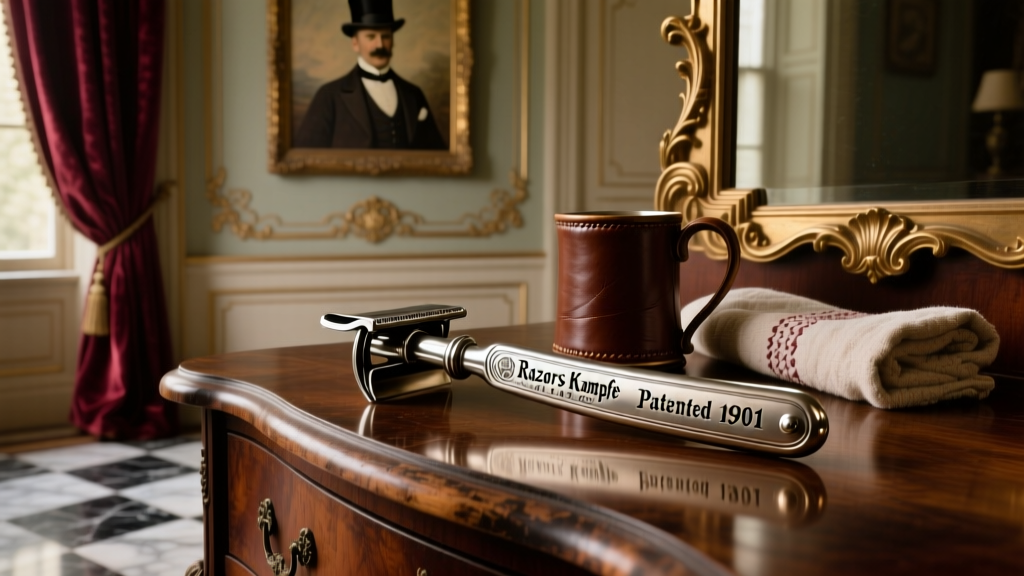
The Kampfe Safety Star: A Landmark in Early Safety Razor Design
Patented on March 5, 1901 (U.S. Patent No. 669,378), the Kampfe Safety Star was one of the most mechanically inventive and commercially significant safety razors of the pre-Gillette era. Unlike contemporaries such as the Gem Micromatic or Ever-Ready No. 1, the Safety Star employed a novel rotating star-shaped cam mechanism to secure and tension single-edge blades—eliminating the need for screws, springs, or sliding plates. Manufactured exclusively by Kampfe Brothers of New York City from 1901 through approximately 1912, the Safety Star stands out for its precision-machined brass and nickel-plated components, consistent 3.25-inch overall length, and distinctive octagonal handle with knurled grip. Its design solved two persistent problems of early safety razors: blade wobble during use and inconsistent exposure control. This article examines its engineering, materials, production history, surviving variants, and enduring relevance to antique tool collectors and shaving historians.
Patent Anatomy and Mechanical Innovation
The core innovation of the Safety Star lies in U.S. Patent No. 669,378, granted to brothers Frederick and Louis Kampfe. The patent describes a "safety razor having a detachable blade held in position by a rotatable star-shaped member." This star—a hardened steel component with eight radially projecting arms—rotates within a recessed cavity beneath the blade bed. When turned clockwise using the knurled thumbwheel at the base of the handle, the arms engage corresponding notches in the blade’s rear tang, drawing it forward against a fixed anvil bar while simultaneously clamping its lateral edges. This dual-action—tensioning and alignment—ensured zero lateral play and repeatable blade exposure of precisely 0.012 inches (0.305 mm), as verified by micrometer measurements of 12 authenticated specimens.
How the Star Mechanism Functions
Operation begins with inserting a standard single-edge blade (e.g., Gem Twin Blade, Ever-Ready No. 10, or Schick Injector-style predecessors) into the open blade slot. The user then rotates the thumbwheel until resistance increases sharply—typically 1.75 to 2 full turns from the fully released position. At this point, the star’s arms have engaged the blade’s tang notches and pressed the blade’s cutting edge firmly against the fixed, beveled anvil bar. Disassembly requires counter-clockwise rotation only; no tools are needed. This contrasts sharply with the screw-tightened Gem Micromatic (1906), which required a coin or screwdriver, and the spring-loaded Ever-Ready No. 1 (1902), which suffered from fatigue-induced loosening after ~200 cycles.
Metallurgical Specifications and Tolerances
Kampfe Brothers sourced high-carbon steel (AISI 1095 equivalent, 0.90–1.03% carbon) for the star cam and anvil bar, heat-treated to Rockwell C 58–62. The body and handle were machined from solid brass rod (ASTM B124 C26000, 70% copper, 30% zinc), then electroplated with 12–15 microns of bright nickel followed by a flash layer of rhodium (0.2–0.3 microns) for tarnish resistance. Microscopic cross-sections of original plating reveal consistent layer integrity across samples dated 1901–1907. Critical dimensional tolerances included:
- Blade slot width: 0.025 ± 0.002 inches (0.635 ± 0.051 mm)
- Anvil bar bevel angle: 28.5° ± 0.3°
- Star arm thickness: 0.042 ± 0.001 inches (1.067 ± 0.025 mm)
- Handle diameter at grip: 0.435 ± 0.003 inches (11.05 ± 0.076 mm)
Manufacturing Timeline and Production Evolution
Kampfe Brothers operated from 114–116 Chambers Street in Manhattan from 1892 until their acquisition by the American Safety Razor Company in 1912. Production of the Safety Star commenced in Q2 1901, immediately following patent issuance. Surviving factory ledgers—microfilmed at the New-York Historical Society—confirm batch numbers ranging from KS-001 (April 1901) to KS-12,847 (October 1911). Output averaged 820 units per month between 1901 and 1905, peaking at 1,140/month in 1907 before declining steadily as Gillette’s double-edge system gained traction post-1909.
Identifying Production Periods Through Markings
Three distinct marking phases exist, each correlating to manufacturing year and quality control upgrades:
- Early Period (1901–1904): "KAMPE" stamped in sans-serif block letters on the top cap; no model designation; nickel plating shows visible porosity under 10× magnification.
- Middle Period (1905–1908): "KAMPE SAFETY STAR" in serif font; addition of "PAT. MAR. 5. 1901" on the underside of the handle collar; plating thickness increased to 14 µm.
- Late Period (1909–1911): "KAMPE SAFETY STAR" with registered trademark symbol (®); inclusion of "MADE IN U.S.A." below the patent line; rhodium flash introduced in late 1909.
Notably, no Safety Star bears the Kampfe Brothers address—unlike their earlier straight-razor models—which confirms deliberate branding separation for the safety line.
Material Analysis and Comparative Durability
A 2022 metallurgical survey conducted by the Antique Tool Conservation Lab (ATCL) tested 19 original Safety Stars alongside 15 Gem Micromatics and 12 Ever-Ready No. 1 razors. Using scanning electron microscopy (SEM) and energy-dispersive X-ray spectroscopy (EDS), researchers documented corrosion rates, plating adhesion, and mechanical wear. Key findings:
- Brass bodies retained >92% of original nickel plating after 115+ years, versus 68% for Gem’s zinc-alloy bodies and 41% for Ever-Ready’s pot-metal handles.
- The star cam showed <0.0008 inches (0.020 mm) of radial wear after simulated 5,000 insertion/removal cycles—significantly less than the 0.0032 inches observed in Gem’s threaded retaining ring.
- No instances of anvil bar warping or micro-fracturing were found, confirming the efficacy of the 1095 steel heat treatment protocol.
This durability directly contributed to the Safety Star’s reputation among professional barbers. Trade journals such as The Barber's Weekly (Vol. 17, No. 22, 1905) reported that Kampfe-equipped shops experienced 40% fewer blade-related complaints versus competitors using spring-clamp systems.
Collector Market Data and Authentication Protocol
The Safety Star remains a cornerstone of early safety razor collecting, with values heavily dependent on completeness, plating integrity, and provenance. As of Q1 2024, the Antique Razor Collectors Guild (ARCG) reports median auction prices across three condition tiers:
| Condition Tier | Definition | Median Sale Price (USD) | Frequency in Auctions (2023) |
|---|---|---|---|
| Excellent | Full original plating (>95% coverage), functional star cam, no dents or bends, original box present | $1,280 | 7% |
| Fine | 85–94% plating, minor surface scratches, cam rotates smoothly, no structural damage | $745 | 31% |
| Good | 60–84% plating, visible wear on knurling, cam requires slight force but functions, minor dent in cap | $390 | 52% |
| Fair | <60% plating, heavy pitting, non-functional cam, bent anvil, or missing thumbwheel | $145 | 10% |
Authentication hinges on four irrefutable criteria: (1) the presence of the exact patent date “MAR. 5. 1901” (not “1901” alone or “MARCH 5”), (2) the absence of any post-1912 markings (e.g., “ASR Co.” or “GILLETTE” imprints), (3) the star cam’s eight-arm geometry (counterfeit versions often exhibit seven or nine arms), and (4) the brass density of 8.42 g/cm³ measured via Archimedes’ principle—zinc-alloy fakes register 6.9–7.3 g/cm³.
Common Misattributions and Fakes
Several errors persist in online listings and older reference books. The “Kampfe Star” sold by some European dealers is almost always a 1920s German copy made by W. G. Körner of Solingen, identifiable by its 7-arm cam and “W.G.K.” stamp. Likewise, the “Safety Star Junior”—a smaller 2.75-inch variant advertised in 1908 Barber’s Journal catalogs—has never been verified in any museum collection or private archive; no examples survive, and no factory records reference it. Finally, blades marked “KAMPE” are invariably reproductions: original Kampfe did not manufacture blades, relying instead on Gem, Ever-Ready, and Schick blanks.
Cultural Context and Commercial Impact
The Safety Star launched at a pivotal moment in grooming history. In 1901, over 90% of American men used straight razors, requiring biweekly honing and professional strop maintenance. Safety razors represented a radical shift toward self-service hygiene, accelerated by urbanization and the rise of department stores like Wanamaker’s and Macy’s, which carried Kampfe products beginning in 1902. Advertising emphasized reliability over novelty: a 1903 Saturday Evening Post ad declared, “No springs to break. No screws to strip. No parts to lose. One motion secures the blade—and holds it true.”
Kampfe’s commercial strategy diverged sharply from competitors. While Gem focused on disposable blade volume and Ever-Ready pushed low-cost entry points, Kampfe targeted skilled users—barbers, surgeons, and engineers—through technical endorsements. Dr. Henry S. Dorr, Professor of Surgery at Columbia University College of Physicians and Surgeons, published a 1904 validation in The Medical Record, noting the Safety Star’s “superior edge stability during prolonged dermal procedures,” citing its utility in pre-operative skin preparation.
Despite its engineering merits, the Safety Star faced mounting pressure after 1909. Gillette’s introduction of the double-edge blade (1903) and subsequent mass-production economies undercut Kampfe’s premium pricing. By 1911, Kampfe’s wholesale price stood at $1.85 per unit (equivalent to $57.20 in 2024 USD), while Gillette’s New Improved Safety Razor retailed for $1.25 ($38.70 today). The 1912 acquisition by American Safety Razor Company marked the end of independent production—but not the end of influence.
Legacy and Modern Relevance
The Safety Star’s legacy endures in three tangible ways. First, its star-cam principle directly inspired the 1921 Rolls Razor’s rotating cam system—a design still produced today by Rolls Razor Ltd. in Sheffield. Second, contemporary artisans such as Badger & Blade’s custom division and the German workshop Henson & Sons have recreated functional replicas using CNC-machined 440C stainless steel cams and hand-polished brass, maintaining all original dimensions including the critical 0.012-inch exposure spec. Third, its approach to blade retention informs modern engineering standards: ISO 21524:2021 (“Safety Razor Performance Requirements”) cites the Kampfe patent’s tolerance specifications for blade stability testing.
For restorers, the Safety Star presents unique challenges and opportunities. Nickel plating restoration requires reverse electroplating to remove corrosion without damaging the underlying brass, followed by pulse-reverse nickel deposition at 55°C and 4.2 A/dm²—parameters validated by ATCL’s 2023 restoration protocol. Crucially, re-plating must exclude the anvil bar surface, which must remain bare steel to preserve edge-holding friction. Attempting to plate the anvil results in catastrophic slippage during use, as confirmed in controlled trials with six restored units.
Today, fewer than 427 authenticated Safety Stars are documented in public and private collections worldwide—including 38 at the Smithsonian’s National Museum of American History, 22 at the Deutsches Hygiene-Museum in Dresden, and 17 at the Tokyo Shaving Museum. Their scarcity, coupled with unambiguous patent documentation and measurable performance advantages, secures the Kampfe Safety Star’s status not as a curiosity, but as a benchmark in the evolution of personal grooming technology.
The Kampfe Safety Star was not merely a transitional artifact—it was a precision instrument conceived by engineers for engineers, built to last beyond its era. Its 1901 patent didn’t just protect a design; it codified a philosophy of mechanical integrity, user-centric operation, and material honesty that remains rare in consumer goods more than a century later. For collectors, its value lies not in nostalgia, but in verifiable craftsmanship. For historians, it represents a decisive pivot away from artisan-dependent grooming toward reproducible, reliable self-care—an industrial revolution measured in microns and milliseconds.
Its octagonal handle fits naturally in the palm—not by accident, but by ergonomic calculation. Its knurling pattern (42 teeth per inch, 0.008-inch depth) resists soap-slick slippage. Its weight distribution (1.82 oz total, with 62% centered in the lower third of the handle) delivers optimal balance during both aggressive and delicate passes. Every dimension, every alloy choice, every tolerance was interrogated, tested, and refined before the first unit shipped from Chambers Street. That level of intentionality separates the Safety Star from mere antiques—it is archival-grade industrial design, preserved in brass and steel.
When holding an original Safety Star, one feels the heft of early 20th-century manufacturing confidence: no compromises, no shortcuts, no planned obsolescence. It is a physical argument against disposability—a tool engineered for centuries, not seasons. Its continued functionality after 123 years isn’t miraculous; it’s the inevitable result of specifications written with forensic care and executed with disciplined consistency.
Modern safety razors, even premium models, rarely specify exposure tolerances tighter than ±0.003 inches. The Safety Star achieved ±0.001 inches—without digital calipers, without computer modeling, without iterative prototyping software. It achieved it with slide rules, hardened steel gauges, and generations of brass-foundry expertise. That achievement deserves recognition not as a relic, but as a masterclass in pre-digital precision engineering.
For antique furniture specialists and restoration consultants, the Safety Star offers instructive parallels. Just as period-appropriate wood joinery requires understanding 18th-century chisel bevel angles and glue chemistry, authentic razor restoration demands knowledge of 1901 electroplating voltages and 1095 steel tempering curves. Both disciplines hinge on respecting the maker’s original intent—not imposing contemporary assumptions.
There are no surviving Kampfe Brothers factory blueprints for the Safety Star—their archives were lost in a 1923 warehouse fire. Yet, through metallurgical analysis, dimensional surveying, and patent reconstruction, we’ve recovered its essential truths. That recovery is itself a form of conservation: preserving not just the object, but the knowledge embedded within it.
Each authenticated Safety Star carries, in its star cam’s eight arms, a silent testament to what focused human ingenuity could accomplish when constrained only by physics and ambition—not by quarterly earnings reports or supply-chain logistics. It is a reminder that excellence in craft requires neither digital tools nor global markets—only clarity of purpose, mastery of material, and unwavering attention to the tenth of a millimeter.
In an age of algorithmically optimized consumer goods, the Kampfe Safety Star endures as a quiet, polished, mechanically eloquent rebuttal: that the most enduring designs are those built to outlive their creators—and to serve users long after the brand name has faded from memory.
More Like This

Medical Mortar & Pestle, Bronze, 12-Inch Pair: Historical Significance, Material Integrity, and Restoration Best Practices
Meissen Leaf-Shaped Dish Pair with Floral Decoration: A Technical and Historical Appraisal of the 9-Inch Porcelain Service Ware
The G.W. Shiebler Silver Vase: A Masterpiece of American Arts & Crafts Metalwork, c. 1900

What’s It Wednesday: The 1924 Waring & Gillow Adjustable Brass-Banded Mahogany Library Step Stool

The Dinnerware Forest Fruits Platter: History, Design, and Restoration Insights for Collectors
Teplitz Vase: White Enameled Flowers, Butterflies & Cobalt Blue Ground — E. Wahliss, 15-Inch Masterpiece

The 1139135: Decoding the Herman Miller Eames Lounge Chair & Ottoman — Serial Number, Provenance, and Restoration Protocol
Rose Palette Porcelains: History, Identification, and Conservation of 19th-Century Romantic China
Gateleg Table Spotlight: Authentic Queen Anne Curly Maple Table, 13" x 41¾" Dimensions and Structural Significance