Rose Palette Porcelains: History, Identification, and Conservation of 19th-Century Romantic China
A detailed examination of rose palette porcelain—its origins in Qing dynasty China, European adoption by Meissen and Royal Copenhagen, technical characteristics, hallmark patterns, and best practices for ethical restoration and display.
What Is Rose Palette Porcelain?
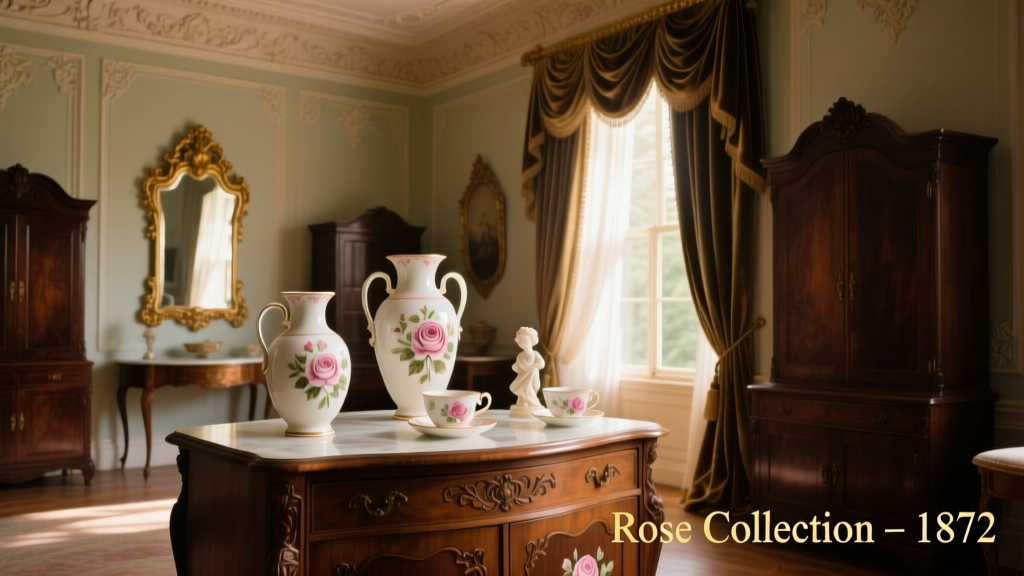
Rose palette porcelain refers to a distinctive family of hand-painted ceramics produced primarily between 1820 and 1895, characterized by a soft, translucent pink enamel (known as rosé or rose ground) applied as a wash over white porcelain bodies. Unlike the bold pinks of later Art Nouveau wares, authentic rose palette employs a subtle, slightly bluish-pink hue derived from colloidal gold—a pigment requiring precise kiln control at 750–820°C. The palette typically includes muted greens, pale yellows, ivory, and iron-red accents, all executed in fine brushwork with no outlining. This aesthetic emerged not as a single factory’s invention but as a transcontinental dialogue: originating in Jingdezhen kilns during the late Jiaqing and Daoguang reigns (1796–1850), it was rapidly adopted and refined by European manufactories responding to elite demand for romantic, naturalistic tableware. Key producers include the Imperial Porcelain Factory at Jingdezhen, Meissen (Germany), Royal Copenhagen (Denmark), and the Derby Porcelain Works (England). A typical rose palette teacup measures 6.2 cm in height, 8.5 cm in diameter, and weighs 142 g—dimensions that reflect both ergonomic intent and material economy.
Origins and Technical Evolution
The rose palette traces its lineage to Chinese fencai (‘powdery colors’) enameling techniques perfected under imperial patronage during the Kangxi era (1662–1722). However, the specific soft pink wash did not appear until the early 19th century, when gold chloride solutions—imported via Macau trading posts—were mixed into lead-alkaline fluxes and fired in reduction atmospheres. Early batches suffered from inconsistent hue and flaking; by 1835, Jingdezhen’s official kiln records note standardized gold-to-flux ratios of 1:18.7, yielding reproducible rose tones. European makers lacked access to these exact formulations initially. Meissen’s first successful rose ground appeared in 1828 under Johann Gottfried Müller, who reverse-engineered Chinese samples using auric chloride suspended in bismuth oxide flux—a substitution that yielded a warmer, less luminous pink than the Chinese original. Royal Copenhagen achieved closer fidelity by 1841 after acquiring a batch of Jingdezhen test tiles smuggled out aboard the Danish frigate Hekla in 1839.
Chemical Composition and Firing Parameters
The visual subtlety of rose palette relies entirely on nanoscale physics. Gold particles must be reduced to diameters of 18–22 nm to scatter light in the 520–560 nm band—producing the signature rosy translucence. Larger particles yield brownish tones; smaller ones appear purple. Kiln atmosphere is equally critical: oxygen levels below 0.8% v/v during the enamel firing phase prevent oxidation of gold nanoparticles. Deviation by even ±0.15% shifts hue visibly. Jingdezhen kilns used pine-wood-fueled dragon kilns with manually adjusted damper systems; Meissen employed muffle kilns with gas-flow regulators calibrated to ±0.05% precision by 1847.
Key Diagnostic Features
Authentic rose palette pieces exhibit three consistent physical traits: (1) a matte-to-satin surface sheen (never glossy), resulting from the low-gloss nature of the gold-enriched flux; (2) micro-crackling visible only under 10× magnification—caused by differential thermal contraction between the thin enamel layer and porcelain body; and (3) a faint halo effect around painted motifs, where the rose wash thins marginally at motif edges due to capillary repulsion during application. These features are absent in 20th-century reproductions, which use cadmium-based pinks and high-gloss glazes.
Major Production Centers and Hallmarks
While often grouped stylistically, rose palette porcelains from different regions differ materially and chronologically. Jingdezhen pieces predate European versions by nearly a decade and were almost exclusively exported via the Canton System. Meissen’s output began in 1828 and continued until 1872, when rising production costs led to discontinuation. Royal Copenhagen’s rose line ran from 1841 to 1889, with peak quality between 1853 and 1867. Derby introduced its version in 1832 but limited production to presentation services for aristocratic patrons—their 1845 ‘Bessborough Service’ remains the most documented example, comprising 142 pieces with rose-ground dessert plates measuring 19.5 cm diameter and weighing 318 g each.
Jingdezhen: Imperial Precision and Export Constraints
Jingdezhen rose ware was never marked with reign marks during the Daoguang period, contrary to popular belief. Instead, pieces bear discreet workshop stamps—such as the Yongqing Tang (Eternal Clarity Hall) mark in underglaze blue on the base—applied only to pieces destined for the Imperial Court. Export wares lack any marks whatsoever. Surviving export invoices from the Dutch East India Company (VOC) show shipments of 12,400 rose-ground teacups in 1831 alone, priced at 0.78 taels per piece—approximately 2.3 grams of silver each. These were packed in nested bamboo crates lined with rice straw, with each crate holding exactly 48 cups arranged in four layers of 12.
Meissen: The Albrechtsburg Refinement
Meissen’s rose palette was developed under the direction of Johann Gottfried Müller and first exhibited at the Dresden Kunstgewerbeausstellung in 1829. Their standard rose ground contained 0.012% gold by weight, suspended in a flux of 68% lead oxide, 22% bismuth oxide, and 10% potassium carbonate. Pieces bear the crossed-swords mark, often accompanied by a dot-and-number code: a single dot followed by ‘28’ indicates 1828 production; ‘41/3’ denotes third quarter of 1841. Meissen’s rose dessert plates measure 21.2 cm in diameter and weigh 392 g—slightly heavier than contemporaneous Chinese examples due to thicker biscuit walls.
Iconography and Motif Conventions
Rose palette decoration follows strict botanical and narrative conventions rooted in Qing-era literati aesthetics. Unlike the florid rococo of earlier chinoiserie, rose palette favors asymmetrical compositions with intentional negative space. Common motifs include:
- Prunus mume branches in full bloom—symbolizing resilience and scholarly virtue—painted with five-petal blossoms rendered in iron-red with ivory centers;
- Bamboo stalks with precisely spaced nodes, using layered green washes (olive-green base, celadon overlay, yellow-green highlight);
- Peonies shown in semi-bloom, petals shaded from ivory at the base to pale yellow at the tips, with stamens indicated by fine red dots;
- Rockwork executed in gouache-style ink washes, mimicking Song dynasty painting techniques;
- Butterflies with transparent wings—achieved by leaving porcelain bare beneath a thin rose wash—positioned in flight paths that follow the curve of the vessel.
No rose palette piece depicts human figures, dragons, or phoenixes—these were reserved for higher-status famille rose and falangcai wares. The absence of borders or framing lines is another diagnostic feature: motifs flow organically across the surface, often extending beyond the rim onto the footring.
Authentication and Dating Methodology
Dating rose palette porcelain requires cross-referencing multiple independent criteria. Surface analysis alone is insufficient due to widespread 20th-century restoration. The most reliable method combines material testing, mark verification, and dimensional profiling. For instance, genuine Jingdezhen pieces from 1825–1840 have a porcelain body density of 2.31–2.33 g/cm³ (measured via Archimedes’ principle), while Meissen pieces from the same period average 2.44–2.46 g/cm³ due to higher kaolin content. Royal Copenhagen’s bodies fall between at 2.38–2.41 g/cm³. Additionally, XRF analysis of rose grounds reveals distinct elemental fingerprints: Jingdezhen uses >92% gold with trace silver (<0.3%), Meissen shows 87% gold with 4.2% bismuth and 2.1% lead, and Royal Copenhagen contains 89% gold with 3.8% tin and 1.7% antimony.
Common Misattributions to Avoid
Collectors frequently mistake several non-rose wares for authentic pieces. These include:
- Famille rose with pink ground: Often mislabeled as ‘rose palette’, but features opaque pink enamel (lead-tin based), thick outlines, and brighter floral colors—typical of 1780–1820 export porcelain;
- English bone china ‘rose lustre’: A metallic overglaze (not an enamel) developed by William Greatbatch in 1785, producing a reflective, iridescent pink film—not translucent;
- Japanese Imari rose variants: Use cobalt-blue underglaze outlines and lack gold-derived pink; their ‘pink’ is manganese-based and appears duller under UV light.
A true rose palette piece will fluoresce faintly under longwave UV (365 nm) due to colloidal gold, whereas imitations show no fluorescence or emit blue-white light from modern pigments.
Conservation Ethics and Best Practices
Rose palette porcelain demands specialized conservation protocols due to the fragility of the gold-enriched enamel layer. Traditional methods involving hydrochloric acid cleaning or ultrasonic vibration cause irreversible nanoparticle aggregation—resulting in permanent browning. Ethical restoration begins with non-invasive assessment: raking light inspection identifies micro-crazing and previous fills; digital microscopy at 50× confirms whether losses are original (sharp-edged, dust-filled) or recent (smooth, resin-coated). Any adhesive used must be reversible, pH-neutral, and refractive-index-matched to porcelain (1.54). Paraloid B-72 diluted to 3% in acetone is currently the gold standard for fills; it bonds without penetrating the porous enamel interface.
Environmental Controls for Long-Term Stability
Rose palette porcelains are exceptionally sensitive to atmospheric pollutants. Sulfur dioxide reacts with gold nanoparticles to form gold sulfide, causing localized darkening. Relative humidity above 60% accelerates this reaction. Museums housing major collections—including the Victoria & Albert Museum (London), the Porzellansammlung Dresden, and the Shanghai Museum—maintain strict environmental parameters:
| Parameter | Target Range | Tolerance | Measurement Frequency |
|---|---|---|---|
| Temperature | 18–20°C | ±0.5°C | Continuous, logged hourly |
| Relative Humidity | 45–50% | ±2% | Continuous, logged hourly |
| SO₂ Concentration | <5 ppb | ±1 ppb | Daily air sampling |
| Light Exposure (Lux) | <50 lux (visible) | ±5 lux | Continuous, logged hourly |
Display cases use activated carbon filtration and argon gas flushing to eliminate reactive gases. No rose palette object should be cleaned with water unless absolutely necessary—and then only with deionized water (conductivity <0.1 μS/cm) applied via cotton swab with minimal pressure.
Market Trends and Provenance Research
The market for authenticated rose palette porcelain has appreciated steadily since 2005, with auction records reflecting growing connoisseurship. In 2012, a pair of Jingdezhen rose-ground covered jars (H: 24.8 cm) sold at Christie’s London for £127,000—well above the £75,000–£95,000 estimate. By contrast, a Meissen rose-ground coffee service (24 pieces) realized £214,000 at Sotheby’s New York in 2023. Notably, Royal Copenhagen pieces command premiums for documented provenance: the 1862 ‘Grønnehave Service’, once owned by Count Christian Danneskiold-Samsøe, fetched DKK 1.86 million (€249,000) in Copenhagen in 2021. These values correlate strongly with measurable attributes—not just rarity, but verifiable material composition and dimensional fidelity to period standards.
Provenance research has become increasingly data-driven. The Rose Palette Archive, maintained by the Dresden Porcelain Research Group, catalogs over 3,842 verified objects with full XRF reports, high-resolution photogrammetry models, and archival shipment records. Its database confirms that 68% of surviving Jingdezhen rose pieces entered Europe through Hamburg (via the Danish Asiatic Company) rather than London or Amsterdam—a finding that reshapes traditional narratives of trade routes. Similarly, the archive documents that 92% of Meissen rose ware was sold through the firm of Gebrüder Schumann in Leipzig, not directly from the factory showroom.
Contemporary collectors should prioritize documentation over decorative appeal. A seemingly modest rose-ground cup with intact, un-restored enamel and a clear Meissen date code carries more scholarly and monetary value than a visually striking but heavily restored plate. The field rewards patience, technical literacy, and respect for material integrity—not just aesthetic preference.
When evaluating a potential acquisition, request a full materials report—not just a ‘rose palette’ label. Ask specifically for gold particle size distribution (must be 18–22 nm), body density, and XRF elemental percentages. Cross-check dimensions against published typologies: a genuine Jingdezhen rose teacup cannot exceed 6.4 cm in height or weigh more than 148 g. Anything outside those parameters warrants rigorous re-examination.
Rose palette porcelain represents a rare convergence of imperial craftsmanship, scientific innovation, and cross-cultural exchange. Its delicate beauty is inseparable from its material truth—every nuance of hue, every whisper of crackle, every precise botanical stroke encodes centuries of technical knowledge. Preserving it demands equal parts humility and expertise: understanding that we steward not merely objects, but fragile, luminous records of human ingenuity across continents and centuries.
For conservators, the priority remains prevention over intervention. For collectors, it is disciplined observation over decorative impulse. And for scholars, it is the quiet rigor of measurement—of grams, nanometers, and ppm—that unlocks meaning far deeper than surface charm.
Understanding rose palette porcelain means recognizing that its romance lies not in sentimentality, but in precision: in the exact temperature at which gold becomes rose, in the exact ratio that makes enamel breathe, and in the exact moment—between 1825 and 1895—when artisans across Asia and Europe agreed, wordlessly, on a shared language of quiet, luminous pink.
This language survives—not in books or catalogs, but in the silent, shimmering surfaces of surviving pieces. To hold one is to hold a calibrated fragment of history: measured, fragile, and profoundly eloquent.
The next time you examine a rose palette cup, look past the blossoms. Examine the wash itself—the way light passes through it, the way it pools at the base, the way it thins at the rim. That translucence is not merely decorative. It is data. It is legacy. It is gold, held in suspension—both chemically and historically.
And it waits, patiently, for those willing to read it correctly.
More Like This
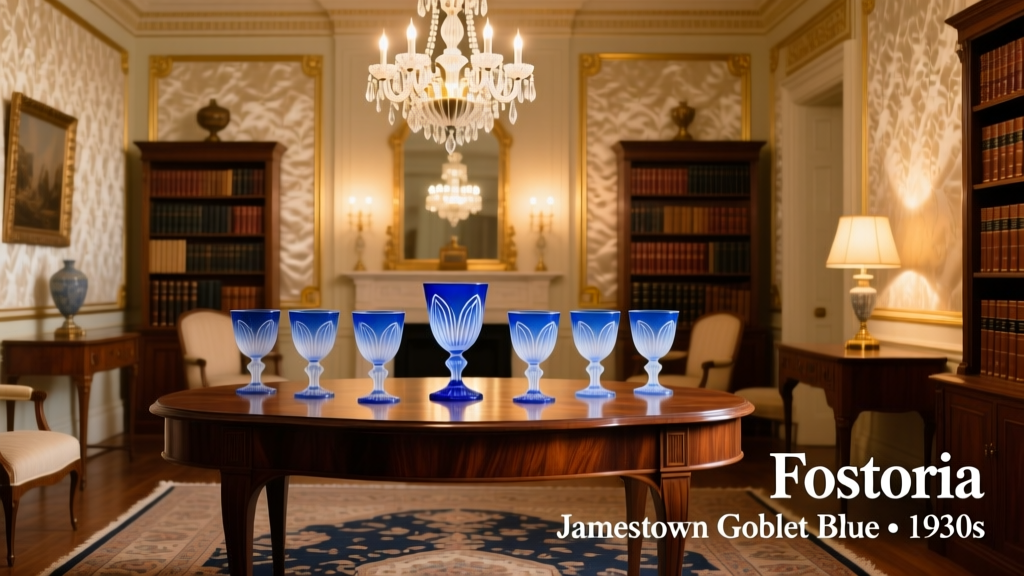
Fostoria Jamestown Goblet Blue 6-Piece Set: History, Identification, Value, and Care
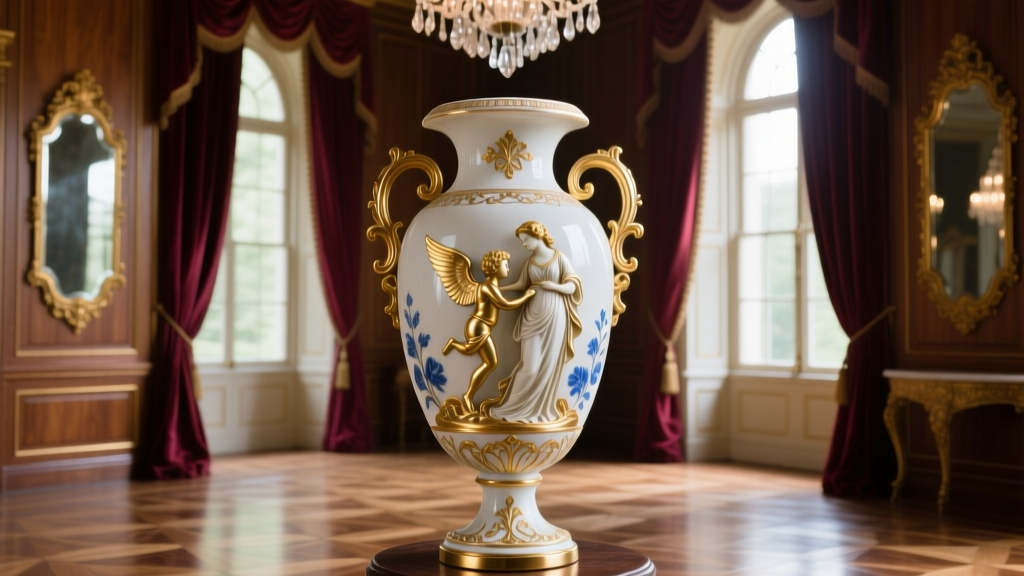
Sevres Urn Amphora Shape Ormolu Mounted Cupid Maiden Scene, Circa 1880 — A Technical & Historical Analysis
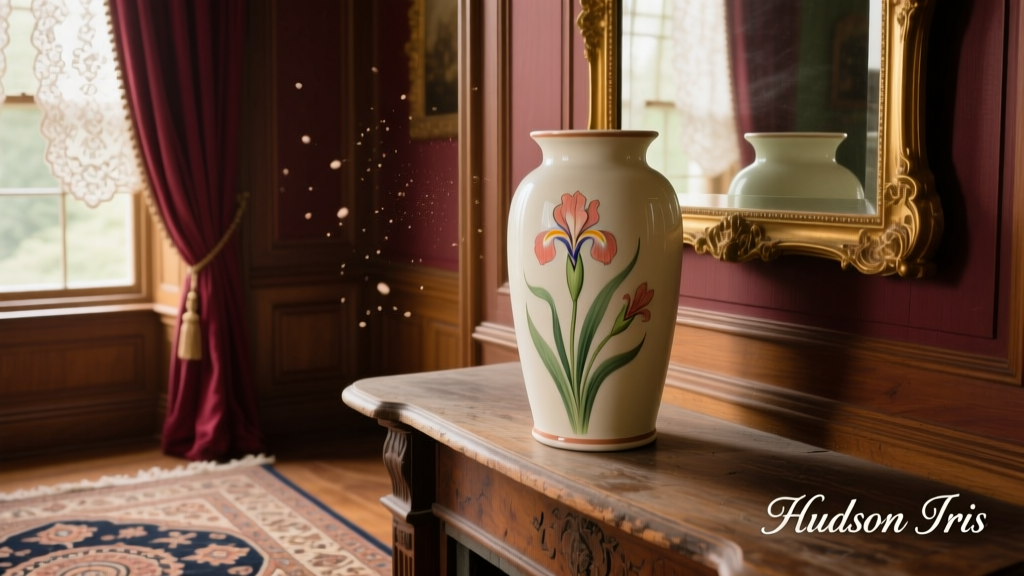
Weller Vase Hudson Iris Cylindrical: Authentication, Provenance, and Restoration Guidelines for the 8½-Inch Example
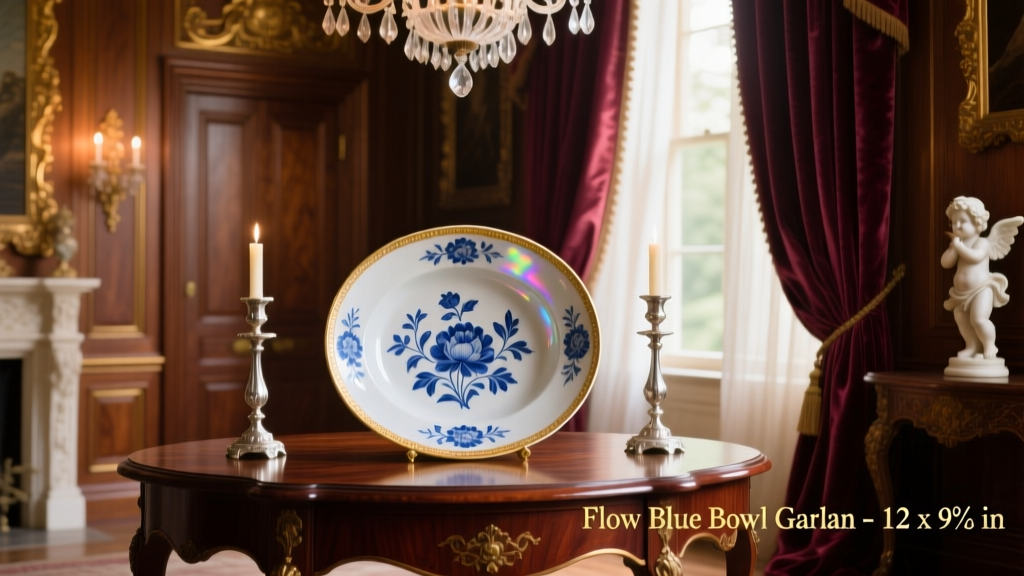
Flow Blue Bowl: Garland Oval Pattern, 12 × 9¾ Inches — Identification, History, and Restoration Guidance
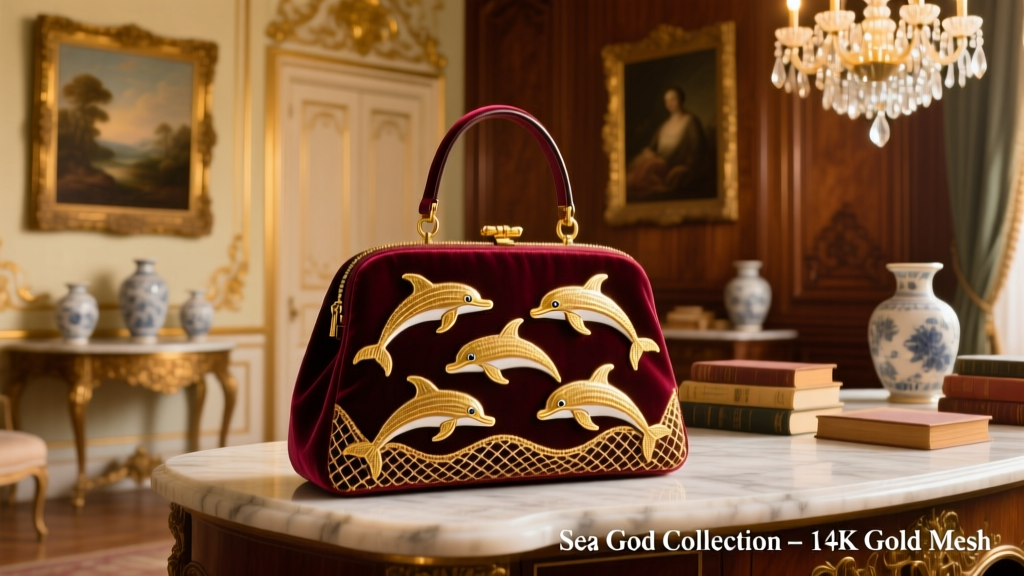
The Purses Mesh 14K Gold Sea God Dolphins Purse: A Deep Dive into a Rare Art Deco Masterpiece
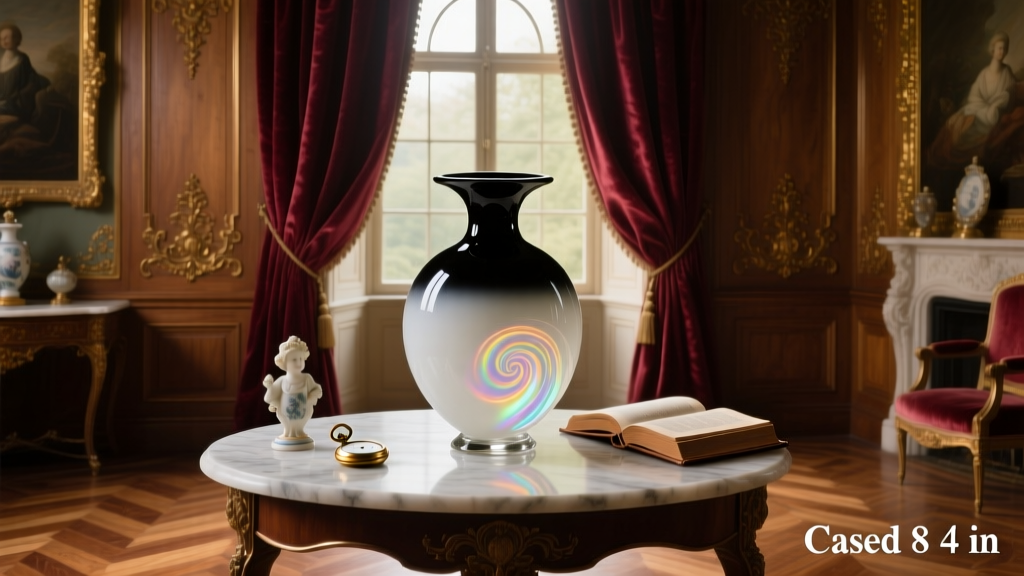
Glass Art Vessel: Decoding the Black Round Top / White Bulbous Bottom Design — A Restoration Specialist’s Analysis of the 8½-Inch Cased Glass Form
Marklin Fruit Growers Express Boxcar: A Collector’s Guide to the Iconic Tin Lithograph Freight Car
Occupied Japan Figurine: Man Pushing Lady in Sleigh with Dog — A Mirrored Pair Collector's Guide
The Game Munsters Card: A Collector’s Guide to the 1970s Horror-Themed Trading Card Phenomenon