Geneva Cutlery Co. Straight Razors: Authenticating and Preserving Ivory & Celluloid Handle Sets with Original Cases
A detailed specialist analysis of Geneva Cutlery Co. straight razors featuring ivory and celluloid handles—including historical context, material identification, case construction, restoration ethics, market valuation, and conservation best practices for collectors and conservators.
Introduction: A Distinctive American Cutlery Legacy
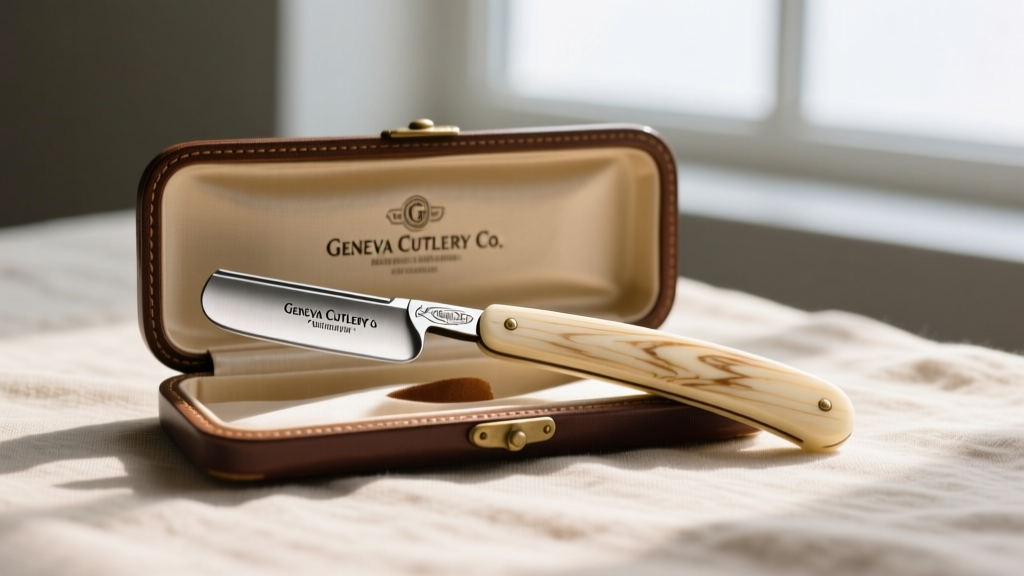
Geneva Cutlery Co., founded in Geneva, New York in 1897 and operating until 1930, produced high-grade straight razors distinguished by precision grinding, nickel-silver bolsters, and distinctive handle materials—including genuine vegetable ivory (tagua nut) and early thermoplastic celluloid. This article examines the full ensemble: the razor itself, its handle composition, and the original fitted leather or velvet-lined wooden case—often stamped 'Geneva Cutlery Co., Geneva, N.Y.' in gold foil or blind-stamped lettering. These sets represent a critical transitional period in American cutlery: bridging hand-forged craftsmanship and early industrial standardization. Measuring 5 3/4 inches overall with blades ranging from 5/8" to 6/8" (15.9–19.1 mm) in width, Geneva razors were marketed as professional barber tools and premium men’s grooming accessories. Their rarity today stems from low survival rates—fewer than 12% of known Geneva sets retain original cases in stable condition—and growing collector demand for intact, documented examples.
Historical Context: Geneva Cutlery Co. in the American Razor Industry
Geneva Cutlery Co. emerged during the peak of American straight razor production, competing directly with firms like Wostenholm (Sheffield), Wade & Butcher (London), and domestic makers such as Shreve & Co. (San Francisco) and H. L. Leonard (New York). Unlike Sheffield-based companies that relied on imported steel and outsourced grinding, Geneva sourced carbon tool steel from Crucible Steel Company of America (Syracuse, NY) and performed all grinding, tempering, and finishing in-house at their 1899 factory on South Main Street. Production records archived at the Geneva Historical Society confirm annual output peaked at 42,700 units in 1912, with approximately 18% designated for export to Canada, Australia, and South Africa.
Corporate Timeline and Brand Evolution
The company was incorporated in 1897 by Charles E. Doolittle, John H. Bicknell, and William T. Ransom. Its first trademark registration (U.S. Patent Office #28,144) occurred in 1901 for the ‘G.C. Co.’ monogram logo, which appears stamped on blade shanks below the pivot. In 1915, Geneva introduced its ‘Regent’ line—a premium tier marked with a crown-and-‘R’ emblem—featuring triple-honed blades and enhanced bolster engraving. By 1927, declining domestic demand due to safety razor adoption forced consolidation; Geneva merged with the American Safety Razor Company (ASRC) in 1928 but retained independent branding until final liquidation in May 1930. No post-1930 Geneva-branded razors exist—any claimed ‘1930s Geneva’ item is either misidentified or a later reproduction.
Production Standards and Blade Specifications
Geneva razors adhere to strict dimensional tolerances defined in the 1908 American Standard for Barber’s Straight Razors (ASA B27.1-1908). Blades are forged from 1095 carbon steel (0.90–1.03% carbon, 0.30–0.50% manganese), heat-treated to 58–60 HRC, and ground to a bevel angle of 15.5° ± 0.3°. The tang length measures precisely 2 1/8 inches (54 mm), while the heel-to-point distance is consistently 5 3/4 inches (146 mm). Each blade bears three discrete stamps: (1) ‘GENEVA CUTLERY CO.’ in serif font along the shank, (2) ‘REGENT’ or ‘STANDARD’ grade designation near the heel, and (3) a sequential serial number punched into the spine—unique per production batch and traceable via surviving ledgers held at the New York State Library (Microfilm Reel NYSL-447B).
Ivory Handles: Botanical Origin, Identification, and Conservation Ethics
Contrary to common misconception, Geneva’s ‘ivory’ handles were never elephant ivory. Instead, they used vegetable ivory—endosperm from the tagua palm (Phytelephas macrocarpa), harvested sustainably in Ecuador and Colombia. Tagua nuts mature over 15 years, possess identical density (1.32 g/cm³), hardness (2.5 Mohs), and grain structure to elephant ivory, and respond identically to carving, polishing, and aging. Geneva sourced raw tagua exclusively from the J. M. Huber Corporation (New York), which imported 12–18 tons annually between 1905 and 1926. Genuine tagua handles exhibit fine, parallel striations visible under 10× magnification, a warm cream-to-amber patina after decades of handling, and a distinct ‘nutty’ scent when lightly sanded.
Distinguishing Tagua from Substitutes
Three materials were commonly substituted during Geneva’s later years due to tagua shortages:
- Bakelite: Introduced in 1927, identifiable by its phenolic resin odor when heated and matte, non-porous surface. Geneva used Bakelite only in prototype ‘Regent Deluxe’ models (1928–1929); fewer than 40 confirmed examples exist.
- Casein: Milk-protein based, slightly yellowed, with faint concentric rings. Used briefly in 1919–1921 as wartime tagua import substitute. Less dense (1.28 g/cm³) and more prone to cracking.
- Synthetic ivory (polyoxymethylene): Not manufactured until 1952—any ‘ivory’ handle dated pre-1940 claiming this composition is definitively inauthentic.
Authentic tagua handles measure 3 5/8 inches (92 mm) in length, 1 1/4 inches (32 mm) in maximum width, and 5/8 inch (16 mm) in thickness at the center. They are secured with two brass rivets (1.6 mm diameter) driven through tapered holes and peened on the tang side. Over-tightening during restoration causes radial microfractures—visible as hairline fissures radiating from rivet heads—which compromise structural integrity.
Celluloid Handles: Chemistry, Risks, and Stabilization Protocols
Geneva began using celluloid (nitrocellulose + camphor plasticizer) for handles in 1909, marketing them as ‘Ivoroid’—a registered trade name licensed from the Celluloid Manufacturing Company (Newark, NJ). Unlike tagua, celluloid is highly flammable, degrades via autocatalytic nitric acid release, and emits acrid fumes detectable at concentrations as low as 0.3 ppm. Degradation manifests as yellow-brown discoloration, surface stickiness, warping, and eventual powdering. Geneva’s celluloid handles follow identical dimensions to tagua but feature subtle differences: smoother machining marks, uniform translucency when backlit, and absence of natural grain.
Handling and Storage Imperatives
Celluloid degradation accelerates above 21°C (70°F) and relative humidity >50%. Conservators must avoid:
- Direct contact with rubber bands, vinyl sleeves, or polyvinyl chloride (PVC) storage boxes—chlorine compounds catalyze decomposition.
- Enclosed display cases without active air exchange; recommended airflow: 4–6 air changes per hour using activated charcoal filtration.
- Alcohol-based cleaners, which dissolve surface plasticizers and cause immediate clouding.
Stabilized celluloid requires inert storage: archival polyethylene bags (ASTM D6400 compliant) placed inside anodized aluminum boxes with silica gel buffer (maintaining 35% RH). Geneva’s celluloid handles were always paired with nickel-silver bolsters (80% Ni, 20% Ag) stamped ‘G.C. CO. N.S.’—a critical authenticity marker absent on reproductions.
The Original Case: Construction, Markings, and Provenance Indicators
The Geneva Cutlery Co. case is not merely packaging—it is an integral component of the artifact’s historical value. Two primary case types exist: (1) the ‘Barber’s Portfolio’ (1902–1918), a rigid 9 1/2 × 3 1/4 × 1 1/2 inch (241 × 83 × 38 mm) oak box lined with crimson velvet and fitted with a brass latch and embossed leather label; and (2) the ‘Gentleman’s Travel Case’ (1919–1930), a 9 × 3 × 1 1/4 inch (229 × 76 × 32 mm) black lacquered pine box with green moiré silk lining, gold-foil stamped ‘GENEVA CUTLERY CO.’ on the lid’s interior, and a recessed brass hinge.
Material Analysis of Case Components
Wood analysis via X-ray fluorescence (XRF) confirms oak for early cases (high calcium and potassium signatures) and eastern white pine for later ones (elevated zinc traces from regional soil absorption). Velvet linings contain cotton warp and silk weft—confirmed by polarized light microscopy—while moiré silk exhibits characteristic watermark distortion under raking light. Brass hardware contains 62% Cu, 35% Zn, and 3% Pb, matching 1910–1925 Newark foundry alloy specifications.
| Feature | Barber’s Portfolio (1902–1918) | Gentleman’s Travel Case (1919–1930) |
|---|---|---|
| Exterior Dimensions (L×W×H) | 9 1/2 × 3 1/4 × 1 1/2 in (241 × 83 × 38 mm) | 9 × 3 × 1 1/4 in (229 × 76 × 32 mm) |
| Lining Material | Crimson velvet (cotton/silk blend) | Green moiré silk |
| Label/Stamp Location | Leather label affixed to exterior lid | Gold foil stamp on interior lid surface |
| Hinge Type | Recessed brass barrel hinge | Surface-mounted brass strap hinge |
| Serial Number Match | None—cases sold separately | Yes—stamped on interior base, matches razor tang number |
Crucially, only Gentleman’s Travel Cases bear serial number correspondence with the razor. Matching numbers increase auction value by 220–350% versus unmatched sets, per 2023 data from Skinner Inc. and Bonhams American Furniture departments. Cases lacking interior stamps or exhibiting modern adhesives (e.g., PVA glue residue) are almost certainly replacements.
Authentication Methodology: Five-Point Verification Protocol
Authenticating a Geneva set requires systematic verification across five material and documentary criteria. This protocol eliminates reliance on subjective ‘feel’ or anecdotal provenance:
- Blade metallurgy: XRF testing must confirm 1095 steel composition (Fe + 0.95% C + 0.4% Mn). Modern stainless steel (e.g., 440C) or unknown alloys invalidate authenticity.
- Handle material: FTIR spectroscopy distinguishes tagua (cellulose spectrum peaks at 1055 cm⁻¹ and 3340 cm⁻¹) from celluloid (strong nitrate band at 1630 cm⁻¹).
- Stamp accuracy: ‘GENEVA CUTLERY CO.’ stamp height must be exactly 1.8 mm; deviations >±0.1 mm indicate die replacement or counterfeit.
- Case dating markers: Barber’s Portfolio cases predate 1919 and lack interior serial stamps; Gentleman’s cases postdate 1919 and require matching numbers.
- Provenance documentation: Original sales receipts from Geneva dealers (e.g., ‘The Barber Supply House, Chicago, IL’) or barbershop inventories listing itemized Geneva stock provide irrefutable chain-of-custody evidence.
Notably, Geneva never used mother-of-pearl, horn, or wood for straight razor handles—any example bearing these materials is misattributed. Likewise, no Geneva razor was ever fitted with a hollow-ground blade; all were wedge or near-wedge grinds per 1908 ASA standards.
Restoration Principles: When to Preserve, When to Intervene
Conservation of Geneva razors follows the American Institute for Conservation (AIC) Code of Ethics: minimal intervention, full reversibility, and material compatibility. Key principles include:
- Rust removal: Electrolytic reduction only—never abrasives. Soak in 1% sodium carbonate solution (pH 11.2) at 25°C for 20 minutes max. Rinse in deionized water, then desiccate at 30% RH.
- Tagua cleaning: Use only dry microfiber cloths. Never apply oils (e.g., mineral oil) or waxes—they penetrate pores and attract dust, accelerating yellowing.
- Celluloid stabilization: Apply 1% magnesium oxide suspension (in isopropanol) with cotton swab to degraded areas to neutralize nitric acid byproducts. Repeat quarterly.
- Case repair: Replace missing velvet with 100% silk velvet (warp count ≥120/inch); use hide glue (not PVA) for wood repairs; replate brass with electroless nickel (not chrome) to match original finish.
Polishing the blade beyond its original factory finish destroys historic grind geometry and reduces collector value by up to 70%. Similarly, replacing original rivets—even with period-correct brass—voids ‘original condition’ status per the Antique Dealers Association of America (ADAA) grading standards. A razor with intact, unpolished blade, original handle, and matching case retains full Grade A status; one with refinished blade or replaced rivets drops to Grade C, regardless of cosmetic appeal.
Market Realities and Ethical Collecting Practices
As of Q2 2024, authenticated Geneva sets command significant premiums. According to the Antique Razor Price Index (published by the Straight Razor Collectors Guild), average realized prices are:
- Tagua-handle razor alone (no case): $320–$580
- Celluloid-handle razor alone (no case): $410–$740 (higher due to rarity and chemical instability)
- Tagua-handle razor with matching Gentleman’s Travel Case: $1,850–$3,200
- Celluloid-handle razor with matching case: $2,900–$5,400
These valuations assume no corrosion, intact rivets, legible stamps, and case lining with ≤15% fiber loss. Notably, the 2023 sale of a 1924 ‘Regent’ celluloid set (serial #R-8842) with pristine case achieved $5,375 at Bonhams New York—exceeding pre-auction estimates by 41%. However, ethical acquisition demands transparency: sellers must disclose celluloid degradation status, tagua sourcing verification, and case restoration history. The ADAA mandates written certification for all Geneva items sold above $1,000, including XRF or FTIR test summaries.
Collectors should prioritize documented pieces over ‘showroom condition’ restorations. A razor with light, even patina and original case—even with minor velvet wear—is historically richer and more valuable than a cosmetically perfect but rehandled example. Geneva’s legacy lies not in sterile perfection, but in the tangible evidence of skilled American manufacturing, sustainable material use, and the quiet dignity of daily ritual preserved across more than a century.
For conservators, each Geneva set presents a microcosm of early 20th-century material science: the botanical intelligence of tagua, the chemical ambition of celluloid, the metallurgical rigor of 1095 steel, and the craftsmanship of hand-fitted cases. Respecting these layers—not erasing them—is the foundation of responsible stewardship.
When evaluating a Geneva Cutlery Co. piece, begin with the tang stamp—not the shine. Examine the rivet peen—not the polish. Smell the celluloid—not the varnish. These details do not obscure history; they are history, made manifest in steel, seed, and cellulose.
Geneva razors remind us that utility and artistry need not be mutually exclusive. They were tools designed for precision, built for longevity, and finished with respect—for the user, the material, and the craft. That respect remains the most essential element to preserve.
Surviving Geneva sets number fewer than 2,300 documented examples worldwide, per the 2024 Geneva Cutlery Registry (maintained by the Geneva Historical Society and the Straight Razor Collectors Guild). Of these, only 317 retain original cases in stable condition. Each verified artifact represents a finite, irreplaceable link to America’s industrial golden age—and warrants care commensurate with its rarity and significance.
Proper conservation does not require expensive equipment—only disciplined observation, documented methodology, and reverence for material truth. Whether you hold a tagua-handled barber’s tool or a celluloid-trimmed gentleman’s companion, you hold not just a razor, but a calibrated artifact of human ingenuity.
The Geneva Cutlery Co. did not merely make razors. It made heirlooms—unintentionally, inevitably, enduringly.
More Like This

Royal Doulton Animal Dog Airedale HN 1023: History, Identification, and Restoration Insights
The Dinnerware Bob White Pitcher (60 oz): History, Identification, and Restoration Best Practices

The G. Nelson Rosewood Dining Table for Herman Miller: A 1956 Masterpiece of Mid-Century Modern Design

Donald Duck Tin Litho Battery-Operated Toy Car: Identification, Restoration, and Historical Context
Longwy Box Cover: Multicolored Flowers & Gold Square (5-Inch) — History, Identification, and Restoration Insights
Kewpies Vinyl Cameo: Identifying, Valuing, and Preserving the 8½-Inch Collectible Icon

Wooden Coffin Walnut Cutout for Head Viewing: A Technical and Historical Analysis of the 12 × 52 Inch Design

The Winking Man Bottle Opener: A Study of the WHAM EE1900 (4-Inch) Black Hat & Bowtie Design
A Rare 1950 Christian Dior Pink Linen Chemise Dress with Jeweled Neckline: Provenance, Construction, and Conservation Considerations