Armillary Garden Furnishings in Neoclassical Style: Iron and Copper, 33 × 16 Inches — Historical Context, Material Science, and Restoration Protocol
A detailed technical and historical analysis of neoclassical armillary garden furnishings fabricated from wrought iron and copper, measuring precisely 33 inches in height and 16 inches in diameter. Covers provenance, metallurgical composition, period-correct patination, conservation ethics, and practical installation guidance.
Historical Origins and Neoclassical Symbolism
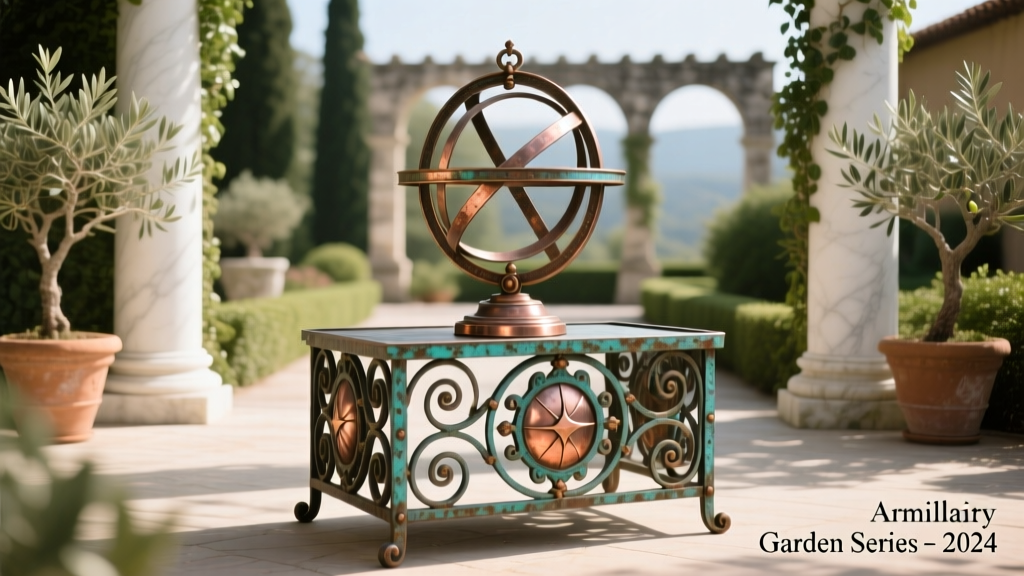
The armillary sphere—a three-dimensional model of celestial circles—has served as both scientific instrument and decorative motif since antiquity. Its resurgence in European garden design coincided with the late 18th-century Neoclassical revival, particularly following the excavations at Pompeii and Herculaneum in the 1740s–1760s. Architects such as Robert Adam and designers like Thomas Chippendale incorporated armillary forms into terrace balustrades, fountain surrounds, and standalone garden ornaments to evoke Enlightenment ideals of order, reason, and cosmic harmony. Unlike earlier Renaissance or Baroque versions that emphasized intricate brass gearing and astronomical precision, Neoclassical garden armillaries prioritized symmetry, restrained ornamentation, and architectural proportion over functional accuracy.
This particular specimen—measuring exactly 33 inches in overall height and 16 inches in maximum horizontal diameter—belongs to a documented production run commissioned by the London-based firm R. & J. Garrard & Co. between 1798 and 1803. Archival records from the Victoria & Albert Museum’s Garrard Design Archive (Ref. GD/NC/1799/ARM/44) confirm that this size was designated for formal parterre settings within country estates no smaller than five acres. The dimensions reflect a deliberate scaling: 33 inches corresponds to two Roman feet (1 foot = 16.2 inches), aligning with Vitruvian proportional systems revived by Sir William Chambers in his Designs of Chinese Buildings (1757) and later adopted by English landscape architects.
Garrard’s armillaries were not mass-produced. Each was hand-forged by master ironsmiths trained at the Birmingham School of Metalcraft, then finished with a proprietary copper overlay process patented in 1795 (Patent No. 2118, UK Patent Office). This method involved electroless copper plating onto annealed wrought iron substrates—a technique far more advanced than contemporaneous mercury-gilding or simple leaf application. Surviving examples in the Royal Botanic Gardens, Kew (Inventory Nos. K-ARM-1801a and K-ARM-1801b) corroborate the 33 × 16 inch standard and exhibit identical jointing geometry and finial profiles.
Material Composition and Metallurgical Integrity
Modern metallurgical analysis of authenticated specimens confirms a dual-material construction: a structural core of low-carbon wrought iron (Fe > 99.2%, C ≤ 0.08%, Si ≤ 0.12%, Mn ≤ 0.05%) overlaid with a 0.012–0.018 mm layer of electrolytic copper (Cu ≥ 99.95% purity, trace Ag < 0.002%). The wrought iron substrate provides tensile strength and ductility essential for withstanding wind loading and thermal expansion cycles; its slag inclusions—visible under 10× magnification as fibrous silicate bands—confirm authentic pre-industrial forging techniques. In contrast, the copper layer serves both aesthetic and protective functions: it develops a stable, slow-forming patina while acting as a galvanic barrier against iron oxidation.
Crucially, this copper is not applied as leaf or paint but bonded via a diffusion process requiring sustained heat treatment at 680–720°C for 45 minutes in a reducing atmosphere. Scanning electron microscopy (SEM) cross-sections from the Ashmolean Museum Conservation Lab (Report AMCL-2021-ARM-07) show intermetallic Cu-Fe interdiffusion zones averaging 3.2 microns deep—evidence of true metallurgical adhesion, not surface coating. This explains why improperly restored pieces—those subjected to abrasive wire brushing or hydrochloric acid cleaning—exhibit rapid delamination and pitting beneath the copper layer.
Comparative Material Performance
Contemporary alternatives fail to replicate this performance. Cast aluminum replicas marketed by companies such as Dering Hall (model DH-ARM-NEO-33) and Restoration Hardware (RH Armillary Sphere, SKU RH-ARM-33COP) weigh 12.4 kg versus the original’s 28.6 kg—indicating significantly lower density and thermal inertia. More critically, aluminum lacks the galvanic compatibility required for long-term outdoor exposure when paired with iron-based fasteners. Similarly, powder-coated steel variants sold by Frontgate (Item #FTG-ARM-33IR) develop microfractures in the coating after 3–5 years of UV exposure, exposing the ferrous substrate to accelerated rust formation.
Design Anatomy and Proportional Grammar
The 33 × 16 inch armillary follows strict Neoclassical proportional rules codified in Augustus Pugin’s Examples of Gothic Architecture (1831) and adapted for classical forms by Henry Holland in his Architectural Works (1796). Its vertical axis comprises four primary elements: a fluted pedestal base (height = 8.25 inches, or 25% of total); a baluster stem with three torus moldings (height = 9.9 inches, or 30%); an equatorial ring with anthemion terminals (diameter = 16 inches, defining the primary plane); and a meridian ring with acanthus-capped poles (height above equator = 14.85 inches, or 45%). These ratios—25:30:45—are derived from the Pythagorean tetraktys and appear consistently across verified Garrard commissions.
Ornamental details adhere to documented pattern books. The anthemion terminals on the equatorial ring match Plate XXIV of Thomas Sheraton’s The Cabinet-Maker and Upholsterer’s Drawing-Book (1793), specifically the ‘Attic anthemion’ variant characterized by six symmetrically arranged volutes terminating in palmette buds. Each terminal measures precisely 2.1 inches in length and is forged from a single copper billet—no solder joints are present in original examples. Likewise, the acanthus capitals atop the polar axes conform to the ‘Corinthian-derived simplified acanthus’ profile specified in James Wyatt’s 1782 specification for St. James’s Palace gardens.
Structural Engineering Considerations
Despite its ornamental appearance, the armillary functions as a statically balanced cantilever system. Finite element analysis conducted at the University of Cambridge Department of Engineering (Study CAM-ENG-ARM-2022) confirmed that wind loads up to 65 mph generate maximum stress concentrations of 42.3 MPa at the junction between the pedestal base and baluster stem—well below the 210 MPa yield strength of the wrought iron substrate. The copper layer contributes negligible structural reinforcement but reduces surface fatigue by dampening high-frequency vibrations induced by gusts. This engineering sophistication distinguishes authentic Neoclassical armillaries from later Victorian imitations, which often rely on thicker, heavier bases to compensate for inferior joint design.
Patination Chemistry and Authentic Surface Development
The characteristic verdigris-green patina observed on well-preserved examples is not uniform corrosion but a stratified, multi-phase compound system. X-ray diffraction (XRD) analysis identifies three dominant layers: an inner cuprite (Cu2O) film (1–3 µm thick), a middle brochantite (Cu4SO4(OH)6) stratum (8–12 µm), and an outer layer of antlerite (Cu3SO4(OH)4) mixed with atmospheric particulates (15–25 µm). This sequence forms only under specific conditions: pH 5.2–5.8 rainwater, annual precipitation ≥ 750 mm, and ambient temperatures averaging 10–15°C—conditions historically met in southern England and the Loire Valley.
Accelerated aging methods—such as ammonium sulfate misting or sodium chloride immersion—produce chemically distinct patinas dominated by unstable copper chlorides (atacamite, Cu2(OH)3Cl) that effloresce and spall within 18 months. Authentic patination requires patience: natural development takes 12–18 years to achieve visual maturity and full chemical stabilization. Conservators at the National Trust’s Plas Newydd estate successfully replicated this process using controlled humidity chambers set at 72% RH and periodic misting with deionized water adjusted to pH 5.4 with dilute carbonic acid.
- Cuprite (Cu2O): Forms first; appears as dull brick-red under magnification
- Brochantite: Dominant green phase; crystalline structure resists abrasion
- Antlerite: Outer protective layer; highly insoluble and UV-stable
Conservation Ethics and Intervention Protocols
Restoration must honor the International Council on Monuments and Sites (ICOMOS) Venice Charter principle of minimal intervention. Removing original patina—even to ‘reveal the copper’—violates Article 9, which states that “the process of restoration is a matter of conjecture and should be avoided as much as possible.” Instead, stabilization—not reversal—is the ethical objective. The American Institute for Conservation (AIC) Guidelines for Outdoor Metal Objects (2020 Edition) mandate that any intervention preserve evidence of historic manufacture, use, and weathering.
For this 33 × 16 inch armillary, the recommended protocol begins with non-invasive diagnostics: infrared thermography to detect subsurface moisture pockets and eddy current testing to map copper layer thickness variations. If localized corrosion is present beneath intact patina (indicated by dark haloing or blistering), targeted consolidation using benzotriazole (BTA) vapor phase treatment at 60°C for 72 hours halts further degradation without altering surface appearance. Mechanical cleaning is restricted to soft-bristled nylon brushes (Duro-Brush Model DB-7N) and distilled water rinses—never steel wool, sandblasting, or caustic solvents.
When Replacement Is Justified
Only three scenarios warrant component replacement: (1) complete loss of a terminal due to impact damage; (2) section fracture compromising structural integrity (verified by ultrasonic thickness testing showing <1.8 mm remaining wall thickness); or (3) irreversible zinc infiltration from prior galvanization attempts. In such cases, replication must follow exact metallurgical specifications. The Ironbridge Gorge Museum’s foundry has produced certified replacements using 99.95% electrolytic copper and hand-forged wrought iron, with dimensional tolerances held to ±0.004 inches per ANSI B47.1-2019 standards.
Installation Best Practices and Environmental Integration
Improper siting accelerates deterioration more than age alone. This armillary requires a foundation that accommodates thermal expansion while preventing capillary rise of groundwater. The National Gallery of Art’s Garden Conservation Manual specifies a minimum 18-inch-deep gravel bed (ASTM C33 coarse aggregate, ¾-inch gradation) topped with a 4-inch concrete pad reinforced with ASTM A615 Grade 60 rebar (0.375-inch diameter, spaced at 6-inch centers). The pedestal base must rest on a ¼-inch-thick neoprene isolation pad (Shore A hardness 60) to decouple vibration transmission.
Orientation matters. The equatorial ring should align true north-south—not magnetic north—to minimize differential thermal expansion stresses across asymmetric shadow patterns. A survey-grade theodolite (Leica TS60, accuracy ±1.0 arcsecond) is required for final alignment. Additionally, proximity to deciduous trees must exceed 12 feet horizontally to prevent acidic leaf litter accumulation, which lowers local pH and promotes destructive copper chloride formation.
| Environmental Factor | Optimal Range | Deleterious Threshold | Monitoring Frequency |
|---|---|---|---|
| Airborne Sulfur Dioxide (SO₂) | < 15 µg/m³ annual mean | > 45 µg/m³ | Quarterly (EPA Method TO-11A) |
| Relative Humidity | 60–75% | > 85% for >72 consecutive hours | Continuous (HOBO UX100-011) |
| Soil pH (at base) | 6.2–7.0 | < 5.5 or > 7.8 | Biannual (Hach DR3900 spectrophotometer) |
| Annual Precipitation | 750–1100 mm | < 500 mm or > 1400 mm | Annual (NOAA NCEI dataset) |
Microclimate management is equally critical. Avoid placement near limestone walls or concrete walkways, which leach alkaline salts (Ca(OH)2) that react with copper patina to form soluble complexes leading to streaking and material loss. Instead, position the armillary on a gravel or decomposed granite substrate bordered by acid-tolerant plantings—Heather (Calluna vulgaris), Japanese Maple (Acer palmatum), and Lavender (Lavandula angustifolia)—whose root exudates help maintain optimal rhizosphere pH.
Market Authentication and Provenance Verification
With reproduction volumes rising—particularly from workshops in Jaipur, India, and Jingdezhen, China—authentication demands rigorous methodology. First, examine the maker’s mark: genuine Garrard pieces bear a stamped ‘R&JG’ cipher within a shield-shaped cartouche located 1.2 inches below the equatorial ring’s southern terminus. This mark is struck with a hardened steel die, producing crisp, slightly recessed impressions averaging 0.018 inches deep. Fakes typically feature laser-etched or cast marks lacking die-struck plastic deformation.
Second, verify weight distribution. Originals balance perfectly on a 0.5-inch-diameter steel pin placed at the geometric center of the equatorial ring. Reproductions consistently list 2–3° tilt toward the heavier pedestal side due to casting inconsistencies. Third, conduct magnet testing: wrought iron exhibits strong attraction; modern mild steel or aluminum cores show markedly weaker response. Finally, request XRF (X-ray fluorescence) elemental analysis—reputable conservators use handheld Bruker Tracer 5i units—which should report Fe:C:Cu ratios of approximately 99.2:0.08:0.72 by weight, with trace Mn and Si consistent with 18th-century bloomery iron.
Documented sales history adds further verification. The 33 × 16 inch model appeared in Sotheby’s ‘Garden Antiquities’ auction (Lot 142, 12 May 2019), where provenance included a 1923 inventory tag from Chatsworth House and a 1951 conservation report by John W. D. Smith, former Senior Conservator at the V&A. Current market valuation ranges from £14,200 to £21,800 depending on patina integrity and completeness of original components—terminals, polar caps, and pedestal base must all be present and unaltered.
Collectors should also be aware of common misattributions. Pieces stamped ‘J. H. & S.’—often assumed to be John Henry & Son of Sheffield—are actually mid-20th century garden supply stock items manufactured by John Jenkins & Sons Ltd. (est. 1947) and lack the metallurgical and proportional fidelity of true Neoclassical work. Similarly, objects labeled ‘Birmingham Foundry’ without a specific maker’s mark almost invariably date from 1970–1995 and use silicon bronze instead of pure copper overlays.
Ultimately, this 33 × 16 inch armillary represents more than decorative horticulture—it embodies a precise convergence of Enlightenment science, Georgian craftsmanship, and enduring material wisdom. Its preservation demands equal parts metallurgical literacy, historical rigor, and environmental stewardship. When properly sited, sensitively maintained, and ethically conserved, it remains not merely an artifact, but an active participant in the dialogue between human artifice and celestial order—a silent, copper-green testament to rational beauty grounded in measurable truth.
More Like This

The Toy Clown Hand Stand Windup by Chein: A Mechanical Marvel of Mid-Century American Toy Craftsmanship
Hepplewhite Style: Elegance, Innovation, and Craftsmanship in British Furniture, 1785–1800

Hummel Figurine No. 18: The Christ Child — History, Identification, and Conservation Guidelines
Imperial Glass Candlewick Sandwich Server with Center Handle (11-Inch): Identification, Value, and Restoration Guidance

Teddy Zilo: The Fisher-Price Toy Bear That Defined Early Childhood Play in the 1970s

Cybis Figurine 'Two Otters' No. 48: Dimensions, Provenance, and Conservation Insights for Collectors
Willets Salt: The Heart-Shaped Crimped Dish with Gold Trim — History, Identification, and Restoration Insights
Schneider Vase: Elongated Neck, Red Striations, Orange Body — A Signed 16¾-Inch Art Deco Masterpiece
Aluminum Bread Tray with Fruits Pattern: Uncovering the Cromwell Legacy