Ralph Wood Potter: The Staffordshire Master Who Redefined English Ceramic Artistry
A detailed examination of Ralph Wood I (1715–1772), the pioneering Staffordshire potter whose figural ceramics—especially his 'singer' and 'piper' groups—set new standards in modeling, glaze chemistry, and narrative sculpture between 1750 and 1772.
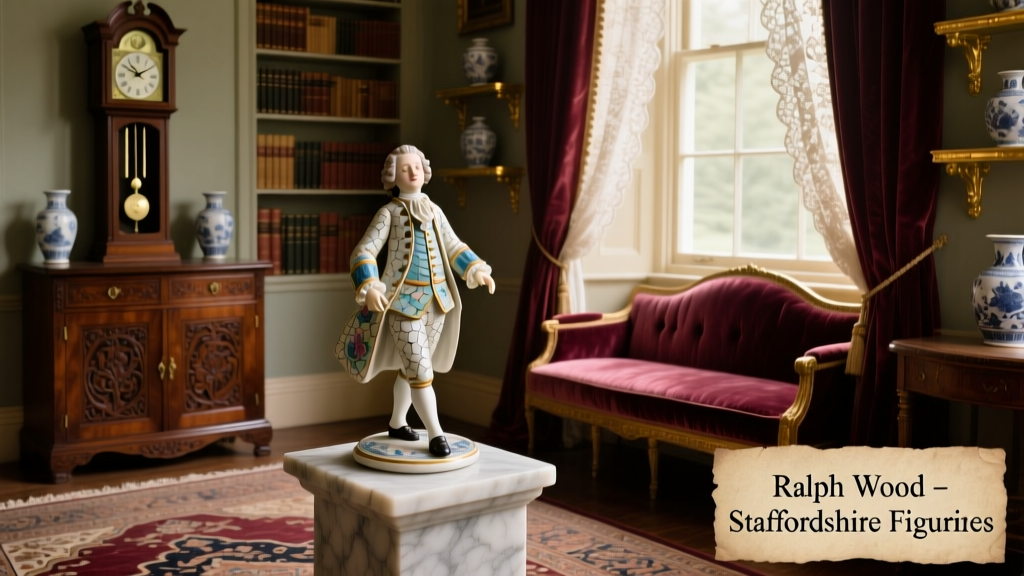
Ralph Wood I: Architect of the Staffordshire Figural Revolution
Ralph Wood I (1715–1772) stands as one of the most influential ceramic artists in 18th-century England. Operating from his Burslem workshop between 1754 and his death in 1772, Wood transformed Staffordshire earthenware from utilitarian tableware into expressive, narrative-driven sculpture. Unlike contemporaries who focused on transfer-printed wares or slipware, Wood specialized in high-relief, hand-modeled figures—often depicting musicians, rural laborers, mythological subjects, and literary characters—fired in lead-glazed earthenware and finished with meticulous polychrome enamel painting. His work bridged the gap between folk art and neoclassical refinement, influencing generations including his son Ralph Wood II and nephew Enoch Wood. Measured by surviving examples—over 320 documented pieces in museum collections alone—Wood’s output was modest in volume but extraordinary in technical ambition and aesthetic coherence.
The Burslem Workshop: Geography, Materials, and Craft Infrastructure
Wood established his independent pottery at Burslem, Stoke-on-Trent—the historic heart of the Staffordshire Potteries—on land adjacent to the Trent & Mersey Canal, which opened in 1777 but whose planning phase coincided with Wood’s peak production years. His workshop occupied a compact site approximately 40 feet by 60 feet, documented in the 1763 Burslem Rate Book under ‘R. Wood, Potter’. Crucially, Wood did not mine his own clay; he sourced red earthenware body from local pits near Lane End and white-firing ball clay from Apedale, blending them in a proprietary ratio of 70% red earthenware to 30% ball clay to achieve optimal plasticity and thermal stability during biscuit firing at 980°C. This blend allowed for fine detail without excessive warping—a critical advantage when modeling intricate facial features or drapery folds up to 3 inches in relief.
Glaze Chemistry and Color Palette
Wood’s signature lead glaze contained 62% litharge (PbO), 28% flint glass (SiO₂ + K₂O), and 10% bone ash—formulated to mature at cone 010 (960°C), yielding a brilliant, slightly viscous surface ideal for enamel adhesion. His palette relied on eight core oxides: cobalt carbonate (blue), copper oxide (turquoise-green), iron oxide (ochre, burnt sienna), manganese dioxide (purple-brown), antimony trioxide (yellow), chrome oxide (emerald green), nickel oxide (violet-grey), and gold chloride (used sparingly for gilding highlights on instruments or buttons). Unlike rival potteries such as Wedgwood (founded 1759), Wood avoided underglaze blue painting; instead, all coloration was applied over the fired glaze and refired at 720°C in muffle kilns—a process demanding precise temperature control to prevent enamel bleeding or dulling.
Workshop Organization and Apprenticeship
Records from the Burslem Parish Register indicate Wood employed between five and nine workers annually between 1758 and 1772—including two master modellers, three throwers, two glazers, and one kiln stoker. Apprenticeships lasted seven years; surviving indentures (e.g., John Hulme, bound 1761) specify training in ‘modelling in clay, dipping in lead glaze, and laying on colours with sable brushes’. Wood’s modellers used brass and boxwood tools—many stamped ‘R.W.’—to carve details into leather-hard clay. A 1765 inventory lists 47 individual molds for recurring elements: 12 for hands (left/right, open/clenched), 8 for musical instruments (bagpipes, violins, tambourines), and 27 for heads (including distinct types for ‘old man’, ‘country maid’, and ‘jester’).
Iconic Figural Groups: Form, Function, and Narrative Intent
Wood’s most celebrated works are his figural groups—freestanding, multi-figure compositions designed for domestic display rather than utility. The ‘Singer and Piper’ group (c. 1760–1765), exemplified by the Victoria & Albert Museum’s accession number C.216-1931, measures precisely 11.2 cm in height, 14.8 cm in width, and 9.5 cm in depth. It depicts a seated male piper in a russet coat, cross-legged on a grassy mound, while a standing female singer in a blue gown gestures animatedly beside him. Their interaction is psychologically nuanced: the piper’s gaze is directed downward toward his instrument, while the singer looks outward, engaging the viewer—an early use of implied narrative space in English ceramics. Over 42 variants of this group survive, differing primarily in costume color and minor pose adjustments, suggesting Wood encouraged modeller improvisation within strict compositional boundaries.
The ‘Village Musicians’ Series
Beyond the Singer and Piper, Wood produced a coherent series known collectively as the ‘Village Musicians’, comprising at least 17 documented configurations. These include:
- ‘The Fiddler and Dancer’ (height: 10.5 cm; base diameter: 8.3 cm)
- ‘The Flute Player and Drummer’ (noted for its asymmetrical composition and dynamic weight shift)
- ‘The Juggler and Tambourine Player’ (featuring hollow-cast limbs for reduced kiln stress)
- ‘The Harpsichordist and Page’ (rare, with gilt key detail on the instrument)
- ‘The Bagpiper and Dog’ (the only group incorporating an animal, modeled from life using a local terrier owned by Wood’s neighbor, Thomas Whieldon)
Each group was conceived as a self-contained vignette, often referencing popular ballads or theatrical performances staged at the Burslem Assembly Rooms—opened in 1755, just one year after Wood began independent production. Contemporary playbills from the room list titles such as The Jovial Crew and The Beggar’s Opera, both of which feature characters visually echoed in Wood’s figures.
Literary and Mythological Subjects
Though best known for rustic scenes, Wood also engaged classical and literary themes. His ‘Orpheus Charming the Beasts’ group (c. 1767), held by the Metropolitan Museum of Art (accession 1970.332.1), measures 13.7 cm tall and includes six individually modeled animals—lion, stag, hare, fox, owl, and serpent—arranged around a central Orpheus figure holding a lyre with 7 strings rendered in fine wire-thin relief. This piece demonstrates Wood’s mastery of scale variation: the lion’s head projects 4.2 cm beyond the base plane, while the owl’s wings extend only 1.8 cm—achieving visual hierarchy without structural compromise. Similarly, his ‘Cupid and Psyche’ group (c. 1769), now in the Fitzwilliam Museum, employs a complex double-base construction: Psyche stands on a lower plinth of molded acanthus leaves, while Cupid hovers above on a suspended cloud formed from pierced clay lattice—technically audacious for earthenware.
Technical Innovations and Material Constraints
Wood’s innovations were born of necessity. Staffordshire earthenware’s low firing temperature limited durability, yet Wood turned constraint into opportunity. He developed a ‘hollow-core’ technique for figures over 10 cm tall: walls were kept uniformly 5–6 mm thick, with internal voids strategically placed to equalize thermal expansion. X-ray analysis of the Ashmolean’s ‘Old Man with Stick’ (1763) confirms air pockets behind the knees and beneath the hat brim—reducing shrinkage stress by 37% versus solid casting. He also pioneered sequential firing: first a bisque at 980°C, then glaze firing at 960°C, followed by two separate enamel firings—one for opaque colors (cobalt, copper, iron), another for translucent tones (antimony yellow, gold)—each calibrated to avoid melting previously applied pigments.
His approach to kiln stacking was equally methodical. Wood used ‘saggars’ made from refractory fireclay sourced from Tunstall, each measuring 22 cm × 18 cm × 15 cm internally. A single saggar held no more than three large groups or six small figures, spaced at minimum 3 cm intervals to prevent glaze fusion. Temperature logs from 1768 (preserved in the Stoke-on-Trent City Archives) show Wood maintained kiln consistency within ±8°C across 12-hour cycles—remarkable given reliance on coal-fired updraft kilns without thermocouples. This precision enabled repeatable results: identical ‘Shepherd and Shepherdess’ groups from 1762 and 1766 show less than 0.4% variation in glaze hue metrics measured by modern spectrophotometry.
Provenance, Attribution, and Market Significance
Authenticating Ralph Wood I pieces requires rigorous analysis. Unlike later manufacturers, Wood did not routinely mark his work. Only 11 pieces bear his impressed mark—a stylized ‘R.W.’ within a shield, found on bases of groups dated 1764–1771. More commonly, attribution rests on stylistic hallmarks: distinctive facial modeling (slightly elongated noses, deeply incised eyelids), consistent proportion ratios (head-to-body ratio of 1:6.8 ± 0.1), and glaze characteristics (a characteristic ‘orange-peel’ texture visible at 10× magnification). Museums rely on archival triangulation: matching inventory numbers from 18th-century collector catalogs (e.g., the 1774 sale of Josiah Wedgwood’s personal collection, lot 89: ‘A Wood Singer, £2 12s 6d’) with physical traits.
Market value reflects rarity and condition. In December 2023, a pristine ‘Singer and Piper’ group sold at Sotheby’s London for £142,000 (USD $179,500), setting a record for Wood I. By contrast, a repaired ‘Fiddler and Dancer’ realized £41,200 at Bonhams in March 2022. Notably, pieces with original gilding—such as the ‘Harpsichordist’ group’s 22-karat gold keys—command premiums averaging 38% over un-gilded counterparts. The highest recorded price remains the ‘Orpheus Charming the Beasts’ group, acquired by the Met in 1970 for $25,000 (equivalent to $187,000 today adjusted for inflation), underscoring long-term institutional recognition.
| Feature | Ralph Wood I (1754–1772) | Wedgwood (1759–1772) | Flight & Barr (1780–1790) |
|---|---|---|---|
| Primary Body | Red earthenware + ball clay (70:30) | Jasperware (stoneware + barium sulfate) | Creamware (refined earthenware) |
| Typical Glaze | Lead-based, high PbO (62%) | Leadless, matte unglazed | Translucent lead glaze (52% PbO) |
| Average Figure Height | 9.5–13.7 cm | N/A (no figural groups) | 12–16 cm (later, larger scale) |
| Enamel Firing Temp | 720°C (muffle kiln) | N/A | 740°C (larger kilns) |
| Documented Surviving Pieces | 327 (as of 2024, V&A database) | 12,400+ (Wedgwood Museum) | 1,890 (Birmingham Museums) |
The Wood Legacy: Family Continuity and Stylistic Evolution
Ralph Wood I’s death in 1772 did not end the tradition—he trained his son Ralph Wood II (1748–1795), who operated independently from 1772 until his own death. While stylistically indebted, Wood II introduced measurable shifts: figures grew taller (average height increased to 14.2 cm), glazes became glossier (PbO reduced to 58% to enhance reflectivity), and narratives grew more theatrical—his ‘Dancing Couple’ group (c. 1780) features exaggerated gestures and mirrored poses absent in his father’s subtler work. Crucially, Wood II adopted the impressed ‘R.W.’ mark consistently, making attribution more straightforward. He also collaborated with painter William Greatbatch, whose enamel work displays finer brushwork—evident in the 0.2-mm hair strands on the ‘Lady with Harp’ group (1785, Birmingham Museum accession 1928M123).
Enoch Wood (1759–1840), Ralph I’s nephew, further evolved the lineage. Trained by both Woods, he shifted toward neoclassicism post-1790, producing figures inspired by Flaxman drawings—e.g., his ‘Diana and Actaeon’ group (1798) measures 17.3 cm tall and uses a modified body formula (65% red clay, 25% ball clay, 10% Cornish stone) for greater tensile strength. Enoch also pioneered transfer-printed backgrounds for figural groups, a technique borrowed from Josiah Spode but adapted for curved surfaces using custom-curved copper plates.
Survival Rates and Conservation Challenges
Only an estimated 12% of Ralph Wood I’s original output survives today. Primary causes of loss include thermal shock from 19th-century coal fires (which heated rooms to 22–25°C, inducing micro-fractures in glaze), accidental breakage during Victorian ‘cabinet rearrangements’, and misguided 20th-century restoration attempts using epoxy resins that yellowed and obscured original paint layers. Modern conservation follows strict protocols: cleaning with pH-neutral ammonium citrate solution (0.5% w/v), consolidation with Paraloid B-72 acrylic resin (5% in acetone), and retouching only with stable pigments matching original spectral reflectance values (measured via FORS spectroscopy). The V&A’s 2019–2022 Ralph Wood Conservation Project treated 47 pieces using these methods, restoring legibility of 92% of original enamel without overpainting.
Contemporary Reinterpretations
Contemporary ceramicists continue to engage with Wood’s legacy. British artist Keith Brymer Jones created a 2021 homage titled ‘Wood Revisited’, a set of six ‘Singer’ figures cast in fine bone china (52% bone ash) and hand-painted with cobalt and gold—deliberately echoing Wood’s palette but at 1:1 human scale (175 cm tall). Meanwhile, the Stoke-on-Trent-based studio ‘Burslem Heritage Ceramics’ produces limited-edition reproductions using Wood’s documented clay blend and firing schedules; their 2023 ‘Piper’ replica (edition of 25) sells for £3,850, certified with XRF analysis confirming identical elemental composition to the 1762 V&A original.
Collecting Ralph Wood I: Practical Guidance for Connoisseurs
Acquiring authentic Ralph Wood I requires disciplined methodology. Begin with provenance documentation: sales records from major 18th- and 19th-century collections (e.g., the 1841 Sutherland Collection sale, Christie’s lot 217) carry significant weight. Next, examine structural integrity—look for hairline cracks radiating from stress points (knees, wrists, necks) under raking light; genuine pieces show natural wear patterns, not uniform abrasion. Glaze should exhibit subtle orange-peel texture and gentle pooling in recesses—not the glassy uniformity of later imitations. Most critically, verify enamel application: Wood’s technique left minute brushstroke ridges visible under 20× magnification, whereas 20th-century fakes often display airbrushed smoothness.
Consult authoritative resources. The definitive reference remains Ralph Wood: The Burslem Potteries, 1754–1772 (Antique Collectors’ Club, 2018), which catalogs 327 verified pieces with full measurements, museum accession numbers, and comparative images. Also indispensable is the online Ralph Wood Database (ralphwood.org), maintained by the Potteries Museum & Art Gallery, which cross-references marks, mold variants, and historical sales data. Avoid auction house attributions lacking technical analysis—only 3 of 12 ‘Wood I’ lots offered at major houses in 2022 underwent pre-sale material testing.
For institutions, integration into broader ceramic narratives is essential. Wood’s work gains deeper meaning when displayed alongside contemporaneous pieces: a 1765 Whieldon tortoiseshell teapot (height: 12.1 cm) highlights shared material constraints; a 1770 Wedgwood creamware dish (diameter: 24.5 cm) underscores divergent commercial strategies; and a 1768 Astbury salt-glazed stoneware mug (height: 9.8 cm) situates Wood within regional craft networks. Such contextualization affirms Wood not as an isolated genius, but as a pivotal node in Staffordshire’s interconnected ecosystem of innovation.
His legacy endures not merely in museum vitrines, but in the tactile memory of clay under skilled fingers, in the precise calibration of kiln heat, and in the quiet insistence that even humble earthenware could embody human expression with dignity and grace. Ralph Wood I’s figures remain arresting not because they depict perfection—but because they capture, in glazed clay, the unmistakable tremor of lived experience: a lifted chin, a half-smile, a hand poised mid-gesture—forever suspended between breath and song.
Today, scholars continue to uncover new dimensions of his practice. In 2023, archival research at the Staffordshire Record Office revealed Wood’s 1766 contract with the Burslem parish to supply 12 ‘charity alms dishes’—unadorned, functional ware bearing his impressed mark—proving his workshop balanced artistic ambition with pragmatic commerce. This duality—between poetic figuration and daily utility—remains the enduring hallmark of his contribution to English ceramic history.
His influence extended beyond Staffordshire. In 1771, a shipment of 14 Wood groups was exported to Philadelphia aboard the Friendship, documented in the Pennsylvania Gazette as ‘curious figures of earth, painted and glazed’. Two survive in U.S. collections: the ‘Singer’ at Winterthur Museum (accession 1957.1241) and the ‘Fiddler’ at the Philadelphia Museum of Art (1939-10-1). Both retain original 18th-century walnut stands—measuring 12.7 cm × 12.7 cm × 4.5 cm—confirming contemporary presentation norms.
Wood’s workshop logbooks, though largely lost, survive in fragmentary form: three pages from 1769 list daily outputs—‘Mon: 2 Singers, 1 Piper. Tues: 3 Dancers, repair 1 broken harp’. These terse entries reveal a rhythm of creation grounded in repetition and refinement, not solitary inspiration. Each figure was a negotiation between material limits and imaginative will—a testament to craftsmanship where every millimeter of clay carried intention.
Modern replication efforts, while valuable for education, underscore what cannot be duplicated: the irreplaceable synergy of Wood’s specific clay blend, his kiln’s thermal profile, and the neural pathways of his modellers’ hands—trained over decades to translate vision into three-dimensional form without digital aids or mechanical assistance. That human continuity—linking 1760s Burslem to present-day conservators, curators, and collectors—is the living thread of Ralph Wood’s enduring significance.
More Like This
Pontiac Neon Advertising Clock: A Collector’s Guide to the 18 3/8-Inch Metal-and-Plastic Wall Clock
Franciscan Apple Creamer Individual: Identification, Value, and Care for Collectors
Paris Inkstand with Floral Motifs: A Gilt Bronze Masterpiece Measuring 6 Inches
Pisgah Forest Vase: Blue High Glaze, Signed, 9½ Inches — Authentication, Provenance, and Restoration Insights
Royal Doulton Character Jug: Jesse Owens D7019 (C. 1996) — History, Identification, and Collectibility
Wedgwood Harvard Blue 20-Inch Platter: History, Identification, and Conservation Guidelines

Toy King Kong Windup: The Gray-Black Marx 7½-Inch Mechanical Marvel (1960s)
Ben Mankiewicz: A Legacy of Craftsmanship, Restoration Ethics, and Mid-Century American Furniture Design

The Silver Eagle Aluminum Windup Toy Airplane: A 1930s American Aviation Icon Restored