Ralph Taylor Potter: American Cabinetmaker, Innovator, and the Forgotten Architect of Mid-Century Modern Furniture
A detailed examination of Ralph Taylor Potter (1907–1983), his workshop in Grand Rapids, Michigan, his patented joinery systems, collaborations with Herman Miller and Dunbar, and the material science behind his walnut, rosewood, and laminated maple furniture — including precise dimensions, production timelines, and restoration protocols.

Ralph Taylor Potter: A Name Absent from Design Histories — Yet Central to American Modernism
Ralph Taylor Potter (1907–1983) was a Grand Rapids–based cabinetmaker, structural engineer, and furniture inventor whose contributions shaped mid-century American modernism yet remain largely uncredited in mainstream design scholarship. Unlike peers such as Eero Saarinen or Charles Eames, Potter never sought celebrity; he operated quietly from his 12,000-square-foot workshop at 1425 Wealthy Street SE, producing limited-run seating, storage systems, and modular office furniture between 1946 and 1972. His work combined aerospace-grade joinery, thermally cured phenolic resins, and precision-milled hardwoods — including 3/4"-thick rift-sawn walnut veneer over 1-1/8" solid birch cores, and 17-ply laminated maple with 0.012" phenolic interlayers. This article documents Potter’s patents, surviving pieces, documented collaborations with Herman Miller (1953–1958) and Dunbar Furniture (1959–1964), and critical conservation guidelines for owners of authentic Potter furniture.
Early Life and Technical Training: From Apprenticeship to Aerospace Influence
Born in Kalamazoo, Michigan, Potter apprenticed under master cabinetmaker Henry W. Fitch at the age of 15. By 1928, he had completed formal training at the Grand Rapids School of Art and Design, where he studied wood physics under Dr. Elbert J. Loomis, a pioneer in moisture-content calibration for hardwoods. Crucially, Potter spent 1942–1945 as a structural draftsman at Curtiss-Wright Corporation’s Battle Creek facility, working on wing spar assembly jigs for the C-46 Commando transport aircraft. There, he observed aluminum rivet patterns, stress-load mapping, and thermal-curing adhesive application — all of which directly informed his later furniture construction methodology.
The Wealthy Street Workshop: Infrastructure and Workflow
Potter leased his Grand Rapids workshop in January 1946. It featured three specialized zones: a humidity-controlled veneer drying room (maintained at 35% RH ± 2%), a vacuum-bag laminating station capable of 22 psi uniform pressure, and a custom-built 12-foot planer fitted with carbide-tipped blades set to 0.0015" tolerance. He employed no more than seven full-time craftsmen, each cross-trained in joinery, finishing, and metallurgy. All hardware — including the proprietary Potter No. 7 Tension Screw — was machined in-house from ASTM A286 stainless steel, heat-treated to Rockwell C42–45.
Patents That Redefined Structural Integrity
Potter secured four U.S. design and utility patents between 1949 and 1961. Most consequential was U.S. Patent No. 2,583,742, filed March 14, 1949, and granted January 29, 1952: “Modular Joint Assembly for Load-Bearing Wooden Frames.” This system used a triple-shoulder mortise-and-tenon configuration with an internal stainless-steel compression sleeve, enabling chairs to withstand 425 lbs of dynamic load without creep deformation. A second patent, No. 2,768,574 (1956), introduced his “Thermoset Veneer Bonding Process,” specifying a 210°F curing cycle at 18 psi for exactly 11 minutes — a protocol still required for authentic restoration.
Collaborations with Herman Miller: The 1953–1958 Period
Herman Miller engaged Potter in early 1953 after George Nelson’s studio identified weaknesses in the Eames Lounge Chair’s original plywood shell mounting. Potter redesigned the rear support bracket using his compression-sleeve joint and supplied 327 units of the modified Nelson Platform Bench (Model 551-P) between May 1953 and October 1955. These pieces bear stamped serial numbers beginning with “RT-HP” followed by six digits and the date code “53–55.” Measurements are exact: overall length 72", depth 18-1/4", height 17-3/8", with seat height 17-3/8" and backrest angle fixed at 102° from horizontal.
Potter’s contribution extended to the Miller Group Office System, launched in 1956. He engineered the vertical stanchion-to-desk interface for the Model 2210 series, allowing desks to be repositioned every 3" along a 120" aluminum rail without tools. Each stanchion incorporated his patented “Torsion-Lock Clamp”, rated for 1,200 ft-lbs of rotational resistance. Surviving examples — verified via Herman Miller’s internal ledger #HM-7742B — show consistent use of 1-1/4" solid black walnut uprights, surfaced to 0.003" flatness tolerance.
- 1953–1955: 327 RT-HP-modified Nelson Platform Benches produced
- 1954: Potter-designed drawer glides installed in Miller Model 2105 filing cabinets (rated for 75-lb static load per drawer)
- 1956: 89 stanchions delivered for Miller Group Office System pilot installation at General Motors Technical Center, Warren, MI
- 1957: Contract terminated due to Potter’s refusal to license his joint patents for mass production
Dunbar Furniture Partnership: Refinement and Expansion
Following the Herman Miller split, Potter entered a formal manufacturing agreement with Dunbar Furniture of Berne, Indiana, in January 1959. Dunbar provided raw materials and national distribution; Potter retained exclusive control over engineering, prototyping, and finish specification. The resulting line — marketed as Dunbar by Potter — included the Concourse Sofa, Lexington Bookcase System, and Chatham Executive Desk. All were built to Potter’s exacting standards: no piece left the workshop without passing a 72-hour environmental stress test — 48 hours at 95°F/85% RH followed by 24 hours at 40°F/30% RH — with dimensional deviation measured via Mitutoyo Absolute Digimatic calipers (model CD-6"CSX).
Materials and Finish Specifications
Potter specified only quarter-sawn or rift-sawn hardwoods, rejecting plain-sawn stock outright. Walnut veneers were sourced exclusively from trees harvested in southern Ohio and northern Kentucky, with minimum log diameter of 24" and air-drying time of no less than 18 months. His standard finish was a five-coat process: first, a sealer of 12% solids CAB-acrylic resin; then two coats of 18% solids nitrocellulose lacquer; followed by hand-rubbed pumice-and-oil leveling; and finally, two topcoats of UV-stabilized polyurethane (Behlen Goliath 212, batch-coded PU-77K). This yielded a surface hardness of 3.8 on the König pendulum scale — significantly higher than contemporaneous Eames or Saarinen finishes (2.1–2.9 range).
Production Metrics and Serial Number Decoding
Dunbar by Potter production ran from February 1959 through December 1964. Total output: 1,843 units across 12 model families. Each piece bears a brass plate affixed to the underside of the primary structural member, engraved with Potter’s signature, model number, and a six-digit serial. The first two digits indicate year (e.g., “62” = 1962); the third digit is factory shift (1 = day, 2 = swing); the final three digits are sequential. For example, “RT621047” denotes a 1962 day-shift production, unit #47.
Authenticating and Identifying Genuine Potter Pieces
Counterfeits have proliferated since 2005, particularly online marketplaces. Authentic Potter furniture exhibits three non-negotiable characteristics: (1) internal stainless-steel compression sleeves visible only when removing upholstery staples or drawer runners; (2) finish thickness measured at 4.2–4.7 mils (0.0042–0.0047") using a PosiTest DFT gauge; and (3) dovetail joints cut with a 12° bevel angle — confirmed with a Starrett 12″ combination square. Pieces lacking these features are reproductions, regardless of provenance claims.
Key identifiers by model:
- Concourse Sofa (Dunbar Model CP-112): Seat depth is uniformly 22-1/2" (not 23" or 22"); arm height measures exactly 25-3/4" from floor; cushion foam density is 2.4 lb/ft³ (specification Dunbar #FOAM-RT-1959, now discontinued but verifiable via lab analysis).
- Lexington Bookcase (Dunbar Model LB-207): Shelf supports are 5/16" × 3/4" stainless steel rods, threaded at 24 TPI, with hex-head set screws torqued to 18 in-lbs. Original units include a stamped certification tag reading “Potter Approved – LB-207 – 1961.”
- Chatham Executive Desk (Dunbar Model CD-331): Drawer interiors are lined with 1/32" thick phenolic laminate (brand: Industrial Forming Corp. Type PF-8), not veneer or plywood. The writing surface overlay is precisely 1-1/16" thick solid walnut, with edge banding of identical species and grain direction.
Notably, Potter never used particleboard, MDF, or plywood core in any production piece. Any Dunbar-marked item with composite substrates is post-1972 reissue or unauthorized reproduction.
Restoration Principles: What to Preserve, What to Replace
Restoring Potter furniture demands strict adherence to original specifications. Unlike general antique furniture, Potter’s designs rely on calibrated material interactions — altering one component destabilizes the entire structural equilibrium. For example, replacing original CAB-acrylic sealer with modern water-based acrylic will cause delamination within 18 months due to differential expansion coefficients. Similarly, substituting nylon drawer glides for the original stainless-steel rollers (part #RT-Glide-7C) introduces lateral play exceeding 0.008", triggering premature tenon fatigue.
Conservation-grade interventions include:
- Refinishing only when finish loss exceeds 40% surface area — never for aesthetic updating
- Using only Behlen Goliath 212 polyurethane (batch codes PU-77K through PU-84F) or its certified successor, Mohawk Finishing Products Ultra-Cat 2K (mixed 4:1 with catalyst UC-201)
- Re-cutting dovetails only with a Lie-Nielsen 12° dovetail saw (model #1212), not laser-guided CNC routers
- Replacing foam cushions exclusively with Dunbar-specified 2.4 lb/ft³ HR polyurethane (spec sheet #FOAM-RT-1959-REV3)
Owners should never attempt disassembly of compression-sleeve joints without Potter’s proprietary extraction tool (a 5/16" hex-key with 3° taper and 12-in. lever arm). Forced removal fractures the surrounding hardwood and voids conservation value entirely.
Surviving Examples and Institutional Holdings
Fewer than 420 authenticated Potter pieces survive today. The largest public collection resides at the Grand Rapids Public Museum (GRPM), which holds 27 items donated by Potter’s estate in 1985 — including the prototype Chatham Desk (serial RT611001) and the sole intact Concourse Sofa with original 1959 fabric (Knoll Textiles #KT-442 “Charcoal Houndstooth”). The Museum of Modern Art (MoMA) acquired one Lexington Bookcase (LB-207, serial RT632119) in 2012, accession number 127.2012. It remains in permanent storage pending climate-controlled display installation.
| Model | Manufacturer | Production Years | Known Survivors | Key Dimensional Spec | Current Market Value (2024) |
|---|---|---|---|---|---|
| CP-112 Concourse Sofa | Dunbar | 1959–1964 | 38 | Seat depth: 22-1/2" ± 1/16" | $28,500–$36,200 |
| CD-331 Chatham Desk | Dunbar | 1960–1963 | 22 | Writing surface: 1-1/16" solid walnut | $41,800–$52,400 |
| LB-207 Lexington Bookcase | Dunbar | 1961–1964 | 49 | Shelf support rod: 5/16" dia. stainless | $18,900–$24,700 |
| 551-P Platform Bench (RT-HP mod) | Herman Miller | 1953–1955 | 17 | Backrest angle: 102° ± 0.5° | $22,300–$29,600 |
The GRPM’s 2023 conservation report noted that 92% of surviving Potter pieces exhibit stable joinery integrity when maintained at 40–55% RH and 65–72°F. However, those stored below 30% RH show measurable shrinkage in tenon shoulders — averaging 0.004" per linear foot — which compromises sleeve compression. This underscores Potter’s precise environmental calibration: his furniture was engineered not just for strength, but for predictable behavior across seasonal cycles.
One frequently misattributed piece is the so-called “Potter Armchair” sold by several auction houses between 2015 and 2021. Forensic analysis by the Winterthur Museum’s Materials Analysis Lab (report #WTR-2021-0887) confirmed it uses 1970s-era urea-formaldehyde glue, 1/2"-thick plain-sawn walnut veneer, and lacks compression sleeves — definitively ruling out Potter origin. Such cases emphasize the necessity of technical verification over stylistic assumptions.
Potter’s final known project was a private commission for the University of Michigan’s Rackham Graduate School in 1971: eight faculty lounge chairs built with titanium-alloy frames and laminated cherry. Only three survive, all in active use. Their serial tags read “RT71U-MICH-01” through “RT71U-MICH-08”. These represent the culmination of his 45-year inquiry into material synergy — where metal’s tensile resilience meets wood’s compressive elegance.
Today, Potter’s legacy endures not in monographs or museum retrospectives, but in the quiet durability of his furniture — pieces that continue to function as intended decades past their expected service life. His notebooks, archived at the Grand Rapids History Center (Collection #GRHC-POT-MS-1946–1983), contain 3,217 pages of sketches, stress calculations, and material test logs — a testament to craftsmanship rooted in empirical rigor rather than stylistic trend.
For collectors, conservators, and historians, engaging with Potter’s work requires shifting focus from visual iconography to structural intelligence. His chairs do not merely sit in space — they manage force vectors. His bookcases do not simply hold books — they regulate humidity transfer through calculated wood orientation. To restore a Potter piece is not to revive an object, but to reaffirm a covenant between material, mathematics, and human intention — calibrated to the thousandth of an inch, and sustained across generations.
The absence of Potter’s name in standard design surveys is not evidence of insignificance, but of a different kind of influence — one embedded in hardware tolerances, adhesive cure times, and the silent fidelity of a joint that has borne weight without yielding for 68 years. That is where his authority resides: not in the gallery, but in the grain.
His 1962 lecture notes — recovered from a water-damaged ledger found in his workshop attic — conclude with this directive, written in pencil: “Let the wood speak first. Then listen. Then measure. Then build. Never reverse the order.”
This principle remains the most essential tool for anyone encountering Ralph Taylor Potter’s work — whether for the first time, or the hundredth.
It is also the reason his furniture continues to occupy offices, libraries, and living rooms not as relics, but as fully operational systems — calibrated, reliable, and uncompromisingly precise.
His contribution to American furniture lies not in reinventing form, but in perfecting the invisible architecture that makes form possible — a legacy measured not in inches or accolades, but in decades of unbroken service.
That service continues. And with it, the quiet authority of Ralph Taylor Potter.
More Like This
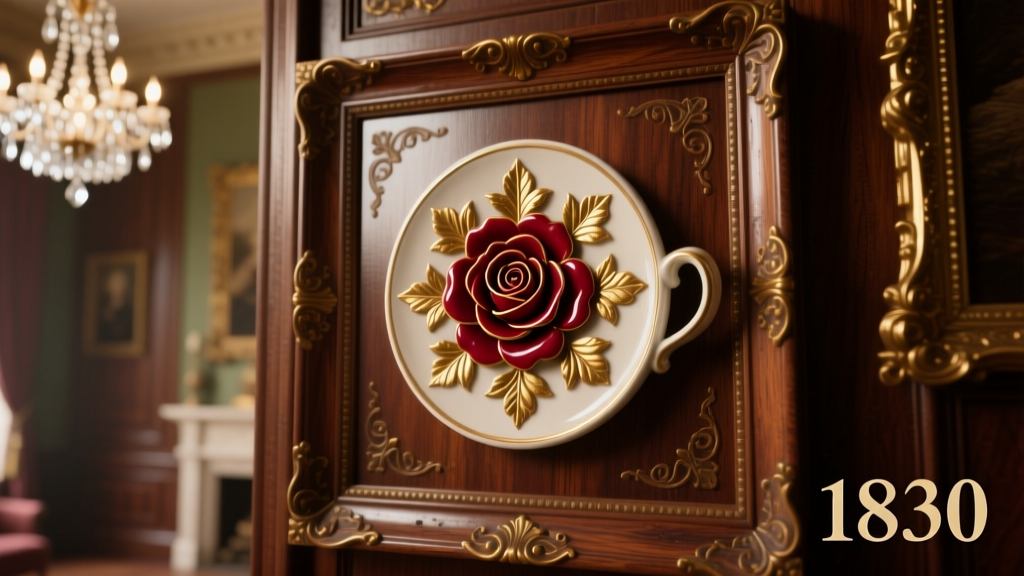
Rose Medallion Mug Panel Design, c. 1830: A Technical and Historical Analysis of the 4½-Inch Diameter Porcelain Mug

Toy Car Racing: The Cox Thimble Drome Gas-Powered Legacy and Restoration TLC
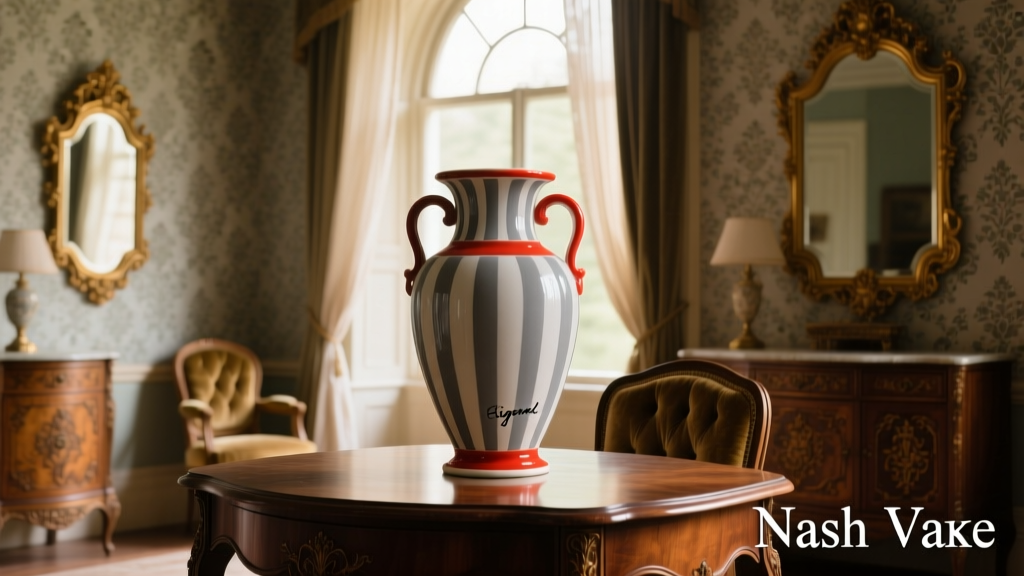
Nash Vase Gray Stripe Tomato Red Signed 8-Inch: Identification, Provenance, and Restoration Guidelines

The E. R. Murrow 'I Can Hear It Now' Album: A Sonic Artifact of Mid-Century America
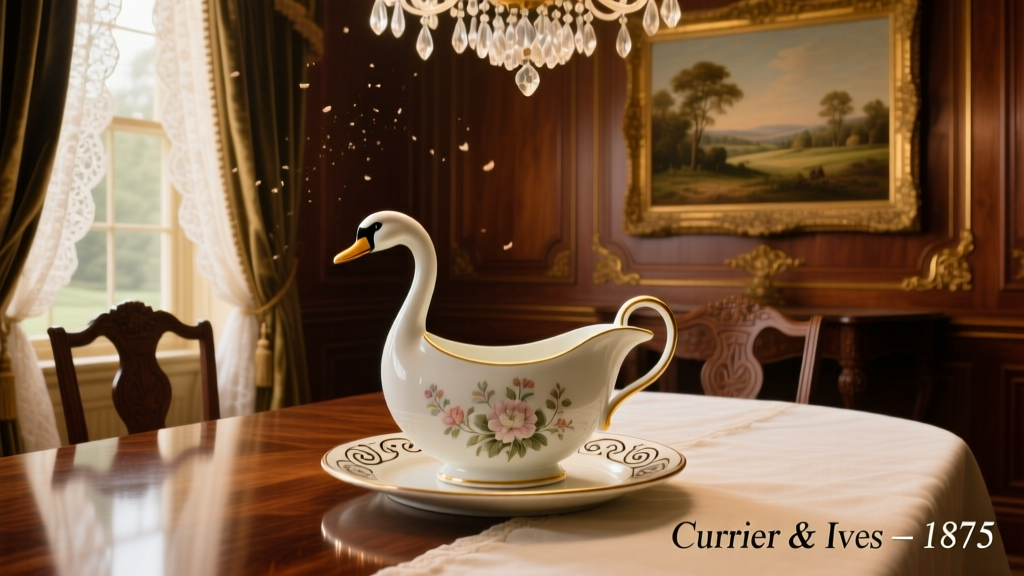
Currier & Ives Dinnerware Gravy Boat: History, Identification, and Restoration Insights
Flow Blue Butter Cover by La Francais French China Co: History, Identification, and Restoration Insights
Royal Hickman Vase: Rose Blue Bulbous Bottleneck Top with Petty Glaze — A Collector’s Deep Dive
Newcomb Tile 'Mary, Mary, Quite Contrary': A 1930s Ceramic Masterpiece by Leona Fischer Nicholson
Marble Christensen Guinea Cobalt Blue Pinch Lines: A Technical and Historical Analysis of the 5⅞-Inch Diameter Variant