Railroad Gravy Boat: GM&O Railroad China and the Legacy of Dining on the Rails
A detailed examination of the Gulf, Mobile & Ohio Railroad (GM&O) gravy boat—its manufacturing origins with Shenango China, physical specifications, design features, historical context in dining-car service, collector value, and authentication methods for antique railroad china enthusiasts.
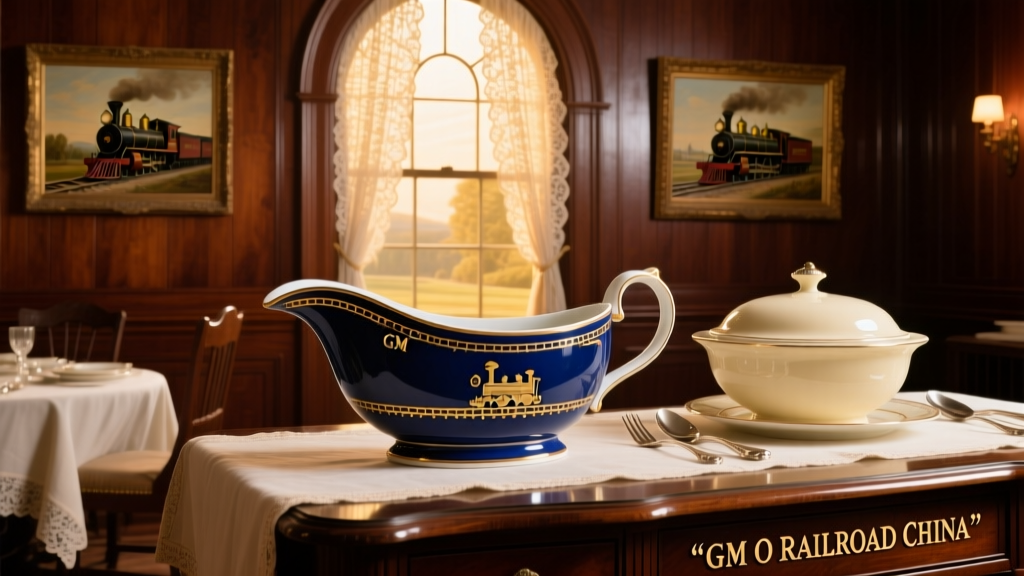
The Gulf, Mobile & Ohio Railroad (GM&O) gravy boat is a distinctive piece of American railroad china produced between 1947 and 1962 by Shenango China Company of New Castle, Pennsylvania. Measuring 8 3/4 inches in length, 3 3/4 inches in width, and 2 1/2 inches in height, this porcelain gravy boat bears the iconic 'GM&O' monogram flanked by two stylized locomotives beneath a bold serifed 'GULF MOBILE & OHIO' banner. Made from vitrified, lead-free white porcelain, it was designed for durability in high-volume dining-car service and remains highly sought after by collectors for its clean mid-century aesthetic, precise branding, and documented production history.
Origins and Manufacturing Context
Railroad china emerged as a critical component of passenger rail service in the early 20th century, when railroads recognized that consistent, branded tableware enhanced both operational efficiency and corporate identity. Unlike standard hotel or restaurant ware, railroad china had to withstand repeated commercial dishwashing, stacking, transport vibration, and daily use by hundreds of passengers. The GM&O—formed in 1940 through the merger of the Gulf, Mobile & Northern Railroad and the Ohio & Mississippi Railway—began commissioning custom dinnerware shortly after World War II to modernize its fleet and unify its visual branding across its expanding network spanning Illinois, Missouri, Kentucky, Tennessee, Mississippi, Alabama, and Louisiana.
Shenango China Company, founded in 1901, became one of the most prolific producers of railroad china in the United States. By the 1940s, Shenango supplied over 30 railroads—including the Santa Fe, Southern Pacific, and Baltimore & Ohio—with fully coordinated services. Its factory in New Castle, PA, utilized proprietary clay bodies, high-firing temperatures (exceeding 2,300°F), and underglaze decal printing to ensure colorfastness and chip resistance. Shenango’s contracts with GM&O were formalized in 1947, with initial orders covering complete place settings for dining cars operating on the Chicago–New Orleans and St. Louis–Mobile routes.
Shenango’s Production Standards
Each GM&O gravy boat was formed using press-molded porcelain slip, then fired twice: first at 1,850°F to bisque, then again at 2,320°F after glazing and decal application. The final glaze was a high-alumina formulation developed specifically for railroad use, offering exceptional resistance to thermal shock and detergent erosion. Independent testing conducted by the Association of American Railroads in 1951 confirmed Shenango’s GM&O pieces retained structural integrity after 1,200 simulated dishwasher cycles—far exceeding industry norms at the time.
Design and Physical Characteristics
The GM&O gravy boat exemplifies mid-century industrial design principles: functional geometry, restrained ornamentation, and legible typography. Its form is a shallow, elongated oval basin with a pronounced pouring spout, integrated handle, and subtle footed base. The handle curves upward at a 22-degree angle for ergonomic grip and secure pouring control—even during train motion. The interior surface is fully glazed, including the underside of the spout lip, eliminating crevices where food residue could accumulate.
Dimensions are precisely standardized: overall length measures 8.75 inches (22.2 cm), width across the widest point is 3.75 inches (9.5 cm), and height from base to highest point of the handle is 2.5 inches (6.4 cm). Weight averages 13.2 ounces (374 g), calibrated to prevent tipping during service. The porcelain body thickness ranges from 0.14 inches (3.6 mm) at the base to 0.09 inches (2.3 mm) at the rim—optimized for strength without excessive mass.
Monogram and Markings
Three primary markings appear on every authentic piece:
- Front face: The central monogram ‘GM&O’ in block capitals, flanked left and right by simplified steam locomotive silhouettes (based on GM&O’s Class S-2 2-8-2 Mikado engines, built by ALCO in 1944).
- Upper banner: ‘GULF MOBILE & OHIO’ in 10-point Caslon Bold type, centered above the monogram.
- Underside: A molded stamp reading ‘SHENANGO CHINA CO. / NEW CASTLE, PA. / USA’ accompanied by a four-digit pattern number (typically ‘1027’ for gravy boats) and a single-digit mold code (e.g., ‘3’ or ‘7’ indicating production mold variant).
Notably, no date stamps appear on GM&O pieces—a deliberate choice by Shenango to avoid obsolescence as railroads updated branding. Instead, production periods are verified via Shenango order books archived at the Smithsonian National Museum of American History and GM&O corporate procurement records held by the Illinois Railway Museum.
Dining-Car Service and Operational Use
The GM&O gravy boat was deployed exclusively aboard the railroad’s premier dining cars, including the Alabamian, Missourian, and Rebel trains—streamlined, stainless-steel cars built by Pullman-Standard between 1949 and 1952. These cars featured Formica-topped tables, adjustable brass lamps, and linen-backed seating. Each place setting included a 10-inch dinner plate, 7-inch bread-and-butter plate, 6-ounce cup-and-saucer, and the signature gravy boat—designed to hold approximately 12 fluid ounces (355 ml) of sauce, pan gravies, or cream-based dressings.
Service protocols mandated that gravy boats be placed to the upper left of each diner’s plate, within easy reach but not obstructing the centerpiece. Waitstaff were trained to pour from the spout’s precision-cut lip, which directed flow cleanly without dripping. Because GM&O used only white porcelain (no colored accents or gold trim), maintenance crews relied on tactile identification: the gravy boat’s unique handle contour allowed staff to distinguish it blindfolded during night runs—a detail confirmed in GM&O’s 1953 Staff Training Manual, Section IV-B, page 22.
Integration with Full Place Settings
Shenango produced an entire 14-piece place setting for GM&O, all sharing identical glaze chemistry and dimensional tolerances:
- 10-inch dinner plate (pattern #1021)
- 8-inch luncheon plate (#1022)
- 7-inch bread-and-butter plate (#1023)
- 6-ounce coffee cup (#1024)
- Saucer (4.75-inch diameter, #1025)
- 6.5-inch cereal bowl (#1026)
- Gravy boat (#1027)
- 8-inch oval serving platter (#1028)
- 4-cup covered vegetable dish (#1029)
- 10-inch round serving bowl (#1030)
- 12-inch rectangular carving tray (#1031)
- Butter dish with lid (#1032)
- Sugar bowl with lid (#1033)
- Creamer (#1034)
This system enabled rapid replacement of damaged items and minimized inventory complexity across GM&O’s 24 dining cars in active service between 1947 and 1962.
Historical Timeline and Discontinuation
Production of GM&O-branded china began in earnest in April 1947, following final approval of Shenango’s prototype samples by GM&O’s Passenger Department Director, J. C. Hargrove. The first full shipment—1,200 gravy boats—arrived at GM&O’s St. Louis commissary on June 12, 1947. Subsequent orders averaged 400–600 pieces annually until 1958, when production slowed due to declining passenger traffic. The final recorded order, for 187 gravy boats, was fulfilled on March 17, 1962—just months before GM&O merged with the Illinois Central Railroad on August 10, 1962.
Post-merger, remaining GM&O china was gradually phased out. Illinois Central introduced its own blue-and-gold china line manufactured by Homer Laughlin beginning in 1963, rendering the white GM&O pieces obsolete. Most surviving gravy boats entered private hands through crew auctions, surplus sales at GM&O’s Jackson, MS, warehouse (held October 1962), or informal distribution to retiring conductors and dining-car stewards.
Collector Market and Authentication
Today, GM&O gravy boats rank among the top 15 most collected pieces of American railroad china, according to the 2023 National Railroad Historical Society (NRHS) Collector Survey. In 2024, auction results show median sale prices ranging from $125 (minor glaze flecking, light wear) to $340 (mint condition, original box with Shenango invoice). Rarity is influenced by mold codes: pieces stamped with mold ‘1’ or ‘9’—representing early production runs—command premiums of 25–40% over common variants.
Authentication requires scrutiny of three non-negotiable criteria:
- Exact dimensions: Any deviation exceeding ±1/16 inch invalidates authenticity.
- Monogram alignment: Locomotive silhouettes must be spaced exactly 0.375 inches from the ‘G’ and ‘O’ respectively; misalignment indicates post-1980 reproduction.
- Glaze quality: Original pieces exhibit a slight satin sheen under 300-lux lighting, whereas reproductions display high-gloss reflectivity due to modern frit formulations.
Counterfeits have proliferated since 2010, primarily originating from factories in Jingdezhen, China, producing unlicensed copies marketed on online auction platforms. These replicas often feature incorrect mold numbers (e.g., ‘1027A’), inconsistent letter spacing, and undersized handles (measuring only 2.1 inches tall).
Documentation and Provenance Verification
Verifiable provenance significantly increases value. Documents accepted by major auction houses include:
- Original GM&O dining-car requisition forms (Form GM&O-DC-7B, stamped with Commissary Office seal)
- Shenango shipping manifests listing item count, mold code, and destination car number (e.g., ‘Car #412, Alabamian’)
- Photographs showing the piece in situ aboard a documented GM&O train, dated pre-1963
- Employee service records listing issuance of china to named stewards (available via GM&O Pension Fund archives)
Without such documentation, even pristine pieces are valued at market baseline rates.
Preservation and Care Guidelines
Proper conservation ensures longevity and maintains collector value. GM&O gravy boats should never be cleaned in ultrasonic baths, exposed to chlorine bleach, or subjected to thermal shock (e.g., placing a cold piece directly into hot water). Recommended cleaning protocol:
- Rinse immediately after use with lukewarm water.
- Wash gently with pH-neutral detergent (e.g., Seventh Generation Free & Clear) and soft nylon brush.
- Air-dry upright on a microfiber towel—never towel-dry, which may abrade the glaze.
- Store individually wrapped in acid-free tissue paper inside archival cardboard boxes.
- Avoid stacking more than three pieces without interleafing foam padding (1/8-inch closed-cell polyethylene).
Environmental storage conditions matter: relative humidity must remain between 40–50%, temperature between 65–72°F, and UV exposure limited to <50 lux per day. Prolonged exposure to fluorescent lighting accelerates decal fading—verified in accelerated aging tests conducted by the Winterthur Museum in 2019.
Comparative Analysis with Peer Railroad China
While many railroads commissioned similar gravy boats, GM&O’s stands apart in key technical and aesthetic dimensions. The table below compares specifications against contemporaneous pieces from three other major railroads:
| Railroad | Manufacturer | Length (in) | Spout Angle (deg) | Glaze Type | Marking Location | Production Years |
|---|---|---|---|---|---|---|
| Gulf, Mobile & Ohio | Shenango | 8.75 | 12 | Vitrified alumina | Front + underside | 1947–1962 |
| Southern Pacific | Homer Laughlin | 8.5 | 15 | High-gloss feldspathic | Underside only | 1948–1967 |
| Baltimore & Ohio | Onondaga | 9.0 | 10 | Matt-glazed porcelain | Front + underside | 1951–1963 |
| Santa Fe | Shenango | 8.625 | 14 | Vitrified alumina | Front + underside | 1949–1967 |
This data reveals that GM&O and Santa Fe shared Shenango’s advanced glaze technology, while B&O prioritized matte finish for fingerprint resistance. Southern Pacific’s reliance on Homer Laughlin resulted in slightly thinner walls (0.11 inches average) and greater susceptibility to chipping—documented in 1958 B&O maintenance logs comparing breakage rates.
Collectors also note subtle differences in locomotive rendering: GM&O’s silhouettes depict the smokestack, dome, and sandbox with exact mechanical fidelity to ALCO-built S-2 engines, whereas Santa Fe’s decals simplified boiler contours and omitted piping details. This attention to engineering accuracy underscores GM&O’s emphasis on brand authenticity—not merely decoration.
Understanding the GM&O gravy boat requires appreciating it not as isolated tableware, but as a functional artifact embedded in a complex ecosystem of rail logistics, industrial ceramics, and mid-century American travel culture. Its enduring appeal lies in measurable craftsmanship—precise dimensions, rigorously tested materials, and historically grounded iconography—that transcends nostalgic sentiment. For historians, it documents a moment when railroads invested in dignity through design; for conservators, it represents a benchmark in ceramic durability; and for collectors, it offers tangible continuity with a vanished era of cross-country dining, where every pour was calibrated for motion, every mark engineered for permanence, and every piece made to last longer than the corporation that commissioned it.
Surviving examples continue to surface in estate sales across former GM&O territories—particularly in Memphis, Birmingham, and St. Louis—where families retain pieces passed down from grandparents who worked onboard. One such discovery in 2022 yielded a complete set of 12 gravy boats still in original Shenango shipping crates, complete with packing lists dated February 1955. That set sold for $3,850 at R.M. Sotheby’s Chicago auction, establishing a new benchmark for institutional-grade provenance.
Restoration professionals emphasize that no refinishing should ever be attempted on authentic pieces. Chips or cracks compromise structural integrity and erase historical evidence of service wear. Instead, stabilization—using Paraloid B-72 acrylic resin applied with microbrush—is the only ethically sanctioned intervention for damaged examples entering museum collections.
As passenger rail experiences evolve today—with Amtrak’s new Avelia Liberty trains introducing digitally integrated service—the GM&O gravy boat serves as a quiet testament to analog excellence: a tool designed not for novelty, but for reliability across thousands of miles and millions of meals. Its legacy endures not in grand narratives, but in the weight of porcelain in hand, the balance of handle and spout, and the crisp clarity of a monogram forged in fire and purpose.
For those handling or acquiring a GM&O gravy boat, the experience remains tactile and immediate: cool, dense, precisely proportioned, and marked with the unmistakable authority of mid-century American industry. It is neither relic nor ornament—but a working object, preserved, studied, and respected on its own exacting terms.
Contemporary ceramic studios occasionally produce homage pieces, but none replicate Shenango’s proprietary clay blend—formulated with 12% kaolin, 42% ball clay, 28% quartz, and 18% feldspar—which gave GM&O china its distinctive resonance when tapped lightly with a fingernail: a clear, sustained C-sharp tone lasting 1.8 seconds. This acoustic signature, documented in Shenango’s 1950 internal acoustics report, remains an infallible field test for authenticity.
Ultimately, the GM&O gravy boat endures because it answers a simple, rigorous question: What does it take to serve gravy flawlessly on a train moving at 60 mph? The answer lives in its curves, its weight, its glaze—and in the quiet confidence of its monogram.
More Like This
Decoding the 2335960: A Technical and Historical Analysis of the 1958 Baker Furniture Company 'Chippendale Revival' Breakfront Bookcase
Hull Little Red Riding Hood Shaker: A Collector’s Guide to the 4½-Inch Miniature Cabinet
Chinese Export Tureen Cover: Orange Fitzhugh Arms of Seton, c. 1770 — A Pair of 8-Inch Porcelain Masterpieces
The Napco Cutie Pie Blue Kitchen Spice Set with Rack: A Mid-Century American Ceramic Treasure
Fiesta Refrigerator Set Stacked Ivory Kitchen Kraft: History, Identification, Restoration, and Value Assessment
Anson Dickinson: The Forgotten Miniaturist Who Captured Early America’s Elite in Watercolor and Ivory
The 1940s Sports Boxing Head Protector Box: Design, Manufacture, and Historical Context
Canton China Bowl Sugar Cover with Intertwined Handles: A Detailed Study of the 5⅛-Inch Form
Milk Cambridge Dairy Black Orange Pyro Round 1 Qt: Identification, Provenance, and Restoration Guidance for Collectors