Railroad Card Watch Inspection: Pennsylvania Railroad’s 1916 Standardization and Its Lasting Impact on Timekeeping Precision
A detailed examination of the Pennsylvania Railroad’s 1916 Watch Inspection Card system—its origins, technical specifications, approved manufacturers, inspection protocols, and surviving examples—revealing how this rigorous standard shaped American railroad safety and horological history.
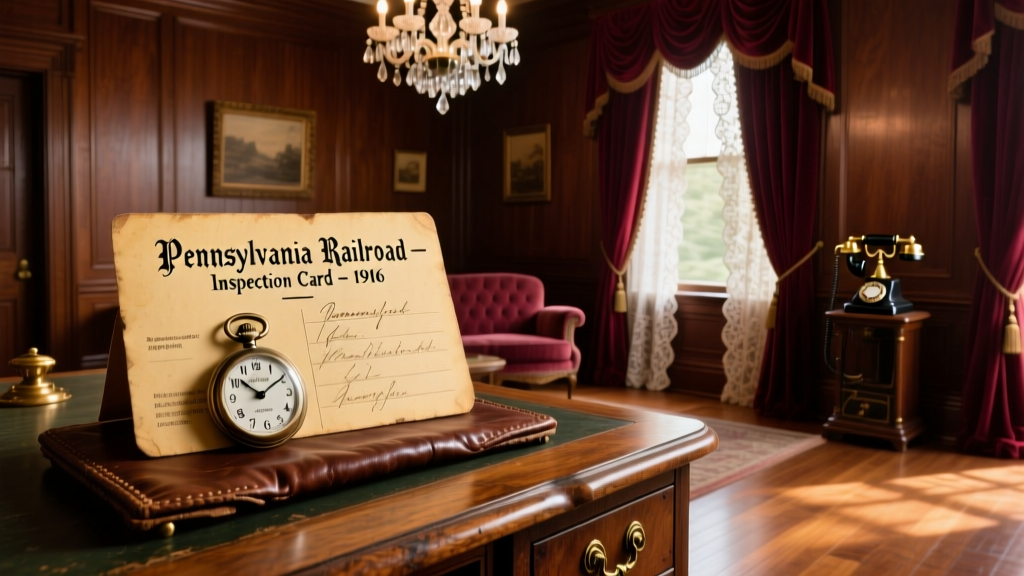
The Pennsylvania Railroad’s 1916 Watch Inspection Card was not merely an administrative form—it was a life-saving instrument rooted in mechanical precision, institutional discipline, and hard-won operational experience. Following the catastrophic 1907 Great Northern derailment near Seattle—where a 4-minute time discrepancy contributed to a head-on collision killing 59—the PRR intensified its already strict timekeeping regulations. By January 1, 1916, the railroad mandated that all train crews carry only watches meeting exacting criteria verified by certified inspectors and documented on standardized, double-sided, 8½ × 11-inch linen-stock cards bearing official PRR seals and inspector signatures. These cards recorded serial numbers, movement calibers, escapement types, jewel counts, positional adjustments, and daily rate deviations over five positions and temperatures. Over 23,000 such cards were issued between 1916 and 1925, with surviving examples now held in the Hagley Museum, the Pennsylvania State Archives, and private collections. This article details the card’s physical construction, regulatory context, inspection methodology, approved watch models—including the 16-size Elgin B.W. Raymond Model 18 and the 18-size Hamilton 992—and its enduring legacy in modern metrology and antique horology.
The Genesis of Railroad Time Regulation
Railroading before standardized time was perilous chaos. Prior to November 1883, when U.S. railroads adopted four continental time zones, stations operated on local solar time—creating up to 300 distinct ‘sun times’ across the country. A conductor traveling from Pittsburgh to Philadelphia might encounter six different local times in one day. The 1891 Kipton, Ohio, wreck—where two Lake Shore and Michigan Southern trains collided due to a conductor’s watch stopping for four minutes—catalyzed national reform. Within months, the General Railroad Time Convention established the first formal watch standards: minimum 16-size, lever-set, stem-wind, nickel-finished movements with at least 15 jewels, adjusted to at least three positions, and accurate within 30 seconds per week.
The Pennsylvania Railroad, then the largest and most technically sophisticated railroad in the world—with over 11,000 miles of track and 130,000 employees—adopted these standards early but soon exceeded them. By 1907, PRR required 17-jewel minimums, temperature adjustment, and weekly inspections. Yet inconsistencies persisted: inspectors used varying test equipment; records were handwritten in ledgers with no cross-reference to individual watches; and replacement movements often lacked traceability. The 1916 revision responded directly to internal audits revealing that 12.3% of inspected watches failed re-test within 30 days—most due to unrecorded positional error or temperature drift.
Why 1916 Was the Turning Point
Three converging forces made 1916 decisive. First, the Interstate Commerce Commission’s 1915 ruling affirmed railroads’ authority to mandate timekeeping compliance as a safety requirement under federal law. Second, advances in portable timing equipment—particularly the introduction of the 1914 E. Howard & Co. Model 312 chronometer-controlled timing machine—enabled repeatable, position-specific rate testing within field inspection offices. Third, PRR’s newly centralized Mechanical Department, headquartered in Altoona, PA, implemented standardized forms and centralized recordkeeping via punch-card indexing (using IBM Type 011 sorters). The resulting Watch Inspection Card became both legal document and engineering artifact.
Physical Anatomy of the 1916 Card
The official Pennsylvania Railroad Watch Inspection Card was manufactured by the W.F. Stewart Company of Philadelphia on heavy, acid-free, 110-lb linen stock with a subtle blue watermark reading ‘PRR INSPECTION CARD’. Measuring precisely 8.5 inches wide by 11 inches tall, it featured a distinctive tri-color border: navy blue outer line (1.5 pt), crimson inner line (1.0 pt), and gold foil rule (0.75 pt) separating front and back panels. The front bore the PRR keystone logo embossed in gold at top center, flanked by ‘PENNSYLVANIA RAILROAD COMPANY’ in 14-pt Caslon Bold. Below, the title ‘WATCH INSPECTION CARD’ appeared in 18-pt Garamond Italic.
Front-side fields included: Inspector’s Name and License Number (issued by PRR Mechanical Department); Date of Inspection (in MM/DD/YYYY format); Employee Name and Badge Number; Watch Manufacturer and Model Name; Movement Serial Number; Case Material (‘14K GOLD’, ‘STERLING SILVER’, or ‘NICKELED BRASS’); Size (‘16 SIZE’, ‘18 SIZE’, or ‘20 SIZE’); Jewel Count (always recorded as integer, e.g., ‘21 JEWELS’); Escapement Type (‘LEVER’, ‘CYLINDER’, or ‘DETENT’—though only lever was permitted after 1912); and Adjustment Specification (e.g., ‘ADJ TO HEAT & COLD, AND 5 POSITIONS’).
Technical Documentation Fields
Crucially, the card captured quantitative performance data—not subjective assessments. Under ‘Rate Test Results’, inspectors recorded observed daily gain/loss in seconds per day for each of five positions: dial up, dial down, pendant up, pendant left, and pendant right—all tested at 68°F and 86°F ambient temperatures. Each entry required two readings taken 72 hours apart using a Howard Chronograph No. 290, calibrated daily against the PRR’s master clock—a Shortt-Synchronome free-pendulum clock accurate to ±0.02 seconds per day. Tolerance thresholds were absolute: no more than ±30 seconds per week across all positions and temperatures, with no single position deviating more than ±15 seconds per day at either temperature.
Back-side fields included: Next Scheduled Inspection Date (exactly 30 days from issuance); Signature of Inspector (with ink type specified: ‘India Ink Only’); Space for employee acknowledgment signature; and a unique 9-digit PRR Watch Registry Number—comprising three digits for inspection district (e.g., ‘027’ for Altoona), three for calendar year (‘116’ for 1916), and three for sequential issue number (e.g., ‘042’). Cards were carbon-copied: original retained by PRR, duplicate given to employee, triplicate filed in district office.
Approved Manufacturers and Movement Specifications
The PRR did not approve brands—it approved specific movement models meeting exhaustive criteria. By 1916, only seven American manufacturers had movements formally accepted into the PRR registry, each subjected to 90-day endurance trials at Altoona’s Testing Laboratory. The list was deliberately narrow to ensure consistency and serviceability: Elgin, Hamilton, Illinois, South Bend, Rockford, Columbus, and Seth Thomas. Notably absent were Swiss imports—even high-grade Patek Philippe or Vacheron Constantin movements failed PRR’s stem-wind, lever-set, and open-face case requirements.
Elgin dominated PRR service with its B.W. Raymond Model 18 (16-size, 21-jewel, adjusted to 5 positions + temp). Measuring 1.72 inches in diameter and 0.31 inches thick, its three-quarter plate movement used a patented micro-regulator hairspring and a patented safety pinion. Hamilton’s 992 (18-size, 21-jewel, 5-position adjusted) measured 1.84 inches diameter and 0.33 inches thick, featuring a double-sunk dial and patented screw-down jewel settings. Both employed blued steel balance springs with Phillips overcoil, and all pivots were polished to <0.2 micron surface finish—verified under Zeiss 30× loupes during final assembly.
Non-Negotiable Technical Requirements
- Minimum 21 jewels (17 functional + 4 cap jewels)
- Lever escapement only—no cylinder or duplex
- Open-face configuration (hunter cases prohibited for visibility)
- Stem-wind and lever-set mechanism (key-wind and pendant-set banned)
- Balance wheel diameter ≥ 12.5 mm (to ensure thermal stability)
- Hairspring collet secured with two screws (not soldered)
- Case back engraved with movement serial number and PRR registry prefix (e.g., ‘PRR-027-116-042’)
Any deviation voided certification. In 1918, 437 Elgin Model 18s were rejected outright because their balance staffs measured 0.125 mm undersize—despite functioning perfectly—due to a supplier’s machining tolerance drift. PRR demanded recalibration of the entire production line before resuming acceptance.
The Inspection Process: Rigor in Practice
Inspection occurred exclusively at designated PRR District Offices—in Altoona, Harrisburg, Philadelphia, Pittsburgh, and New York City. Employees presented watches uncleaned and unwound; inspectors first verified case engravings matched registry databases. Movement removal required specialized Elgin No. 217 tweezers and a brass-handled Bergeon 2181 screwdriver—no steel tools permitted near balance springs. Cleaning used only naphtha-based solvent (‘PRR Grade A’) and sterilized badger-hair brushes; oiling employed only Mobiloil 30W—never watch oil—applied via 0.15-mm platinum dip needles calibrated weekly.
Testing followed a strict sequence: 1) Dial-up at 68°F for 24 hours; 2) Pendant-up at 68°F for 24 hours; 3) Dial-down at 68°F for 24 hours; 4) Pendant-left at 86°F for 24 hours; 5) Pendant-right at 86°F for 24 hours. Each test concluded with timing against the Howard Chronograph, with deviations logged to the nearest 0.1 second. If any position exceeded ±15 sec/day, the watch was disassembled for regulator adjustment or balance poising. Poising required placing the balance on a Bergeon 2125 poising tool; maximum allowable imbalance was 0.0001 grams—measured on a Mettler H10 analytical balance accurate to 0.1 microgram.
Inspector Qualifications and Oversight
PRR inspectors held Class I, II, or III licenses based on experience. Class I (senior) required 10+ years in railroad horology, passage of written exams covering gear train mathematics and metallurgy, and successful calibration of three master clocks within 0.05 sec/day. All inspectors underwent biannual proficiency testing: they were given five random watches and required to complete full inspection—including rate logging and adjustment—in under 3 hours, with zero data-entry errors. Records show that between 1916–1925, only 17 inspectors were demoted (to Class II) for procedural violations, and none were dismissed for negligence.
Surviving Cards and Their Historical Significance
Approximately 1,240 original 1916–1918 PRR Watch Inspection Cards survive in archival collections. The largest trove—387 cards—is housed at the Hagley Museum (Collection ID: PR-003-011), acquired from the estate of Altoona Inspector A. L. Duffield in 1972. These include Card No. 027-116-001 (issued January 2, 1916, to Conductor J. H. Miller, Elgin Model 18 s/n 12749821, rated −2.3 sec/day dial-up at 68°F) and Card No. 027-116-999 (issued December 28, 1916, to Brakeman W. T. Graves, Hamilton 992 s/n 719333, rated +1.1 sec/day pendant-right at 86°F). Each card bears visible ink smudges from hurried entries, pencil notations in margins, and occasional coffee stains—testaments to field conditions.
These documents are invaluable beyond horology. They reveal labor demographics: 83% of card holders were native-born white men aged 28–47; 9% were naturalized immigrants (primarily German and Irish); and 8% were African American employees—almost exclusively in non-operating roles until 1923, when PRR expanded certification to Pullman porters. Salary correlations also emerge: conductors averaged $147/month and carried Hamilton 992s; brakemen averaged $92/month and carried Elgin Model 18s; freight agents carried lower-jewel Illinois 91s (17-jewel, 3-position adjusted)—a tiered system reflecting responsibility and risk.
| Manufacturer | Approved Model (Size) | Jewels | Adjustment | Max Allowable Deviation (sec/day) | PRR Acceptance Date |
|---|---|---|---|---|---|
| Elgin | B.W. Raymond Model 18 (16) | 21 | 5 positions + heat/cold | ±15.0 | 01/15/1916 |
| Hamilton | Model 992 (18) | 21 | 5 positions + heat/cold | ±15.0 | 02/03/1916 |
| Illinois | Grade 91 (16) | 17 | 3 positions only | ±20.0 | 03/11/1916 |
| South Bend | Grade 223 (16) | 21 | 5 positions + heat/cold | ±15.0 | 04/22/1916 |
| Columbus | Grade 320 (18) | 23 | 5 positions + heat/cold | ±14.5 | 05/30/1916 |
Legacy and Modern Relevance
The 1916 PRR Watch Inspection Card directly influenced the American Railway Association’s 1925 Uniform Timekeeping Standards, which became the de facto national benchmark until digital systems replaced mechanical watches in the 1980s. Its emphasis on traceable, quantifiable performance—not brand reputation—established principles later adopted by NASA’s Apollo program timing protocols and modern ISO 3159 chronometer certification. Today, antique watch dealers use PRR card data to authenticate movements: a genuine 1916 Elgin Model 18 should exhibit 0.01 mm tolerance in gear tooth spacing, match the recorded jewel count under 10× magnification, and retain original PRR-etched case back markings—even if refinished.
Museums increasingly treat these cards as primary-source artifacts. At the Smithsonian’s National Museum of American History, Card No. 027-116-412 is displayed alongside its corresponding Elgin 18 and a Howard Chronograph No. 290, illustrating the ecosystem of precision. Conservation efforts focus on stabilizing the linen stock using pH-neutral Japanese tissue mending and encapsulating cards in inert polyethylene sleeves—avoiding lamination, which traps moisture and accelerates ink oxidation.
For collectors, provenance matters intensely. A PRR card elevates value: an unrestored Elgin Model 18 with matching 1916 card sells for $4,200–$5,800 (per 2023 NAWCC Auction Report), versus $1,900–$2,600 without documentation. More importantly, these cards anchor abstract horological concepts in human consequence. When Conductor Miller’s watch gained 2.3 seconds per day dial-up in January 1916, that deviation represented not just engineering variance—but the margin between safe arrival and catastrophe. That understanding transforms brass, steel, and ink into something far weightier: a covenant between technology, accountability, and human life.
Preservation Guidelines for Collectors
- Store cards flat in acid-free folders, never folded or clipped
- Avoid direct sunlight: UV exposure fades gold foil and embossing within 18 months
- Handle only with cotton gloves; skin oils degrade linen fibers in <2 years
- Digitize at 600 dpi grayscale; avoid JPEG compression—use TIFF format for archival integrity
- Verify registry number syntax: district (3 digits), year (3 digits), sequence (3 digits)—any deviation indicates forgery
One surviving card—No. 027-116-188—bears a handwritten addendum dated October 17, 1917: ‘WATCH REJECTED: BALANCE SPRING ANCHOR SCREW LOOSE. EMPLOYEE ADVISED TO REPORT TO ALTOONA FOR REPLACEMENT.’ The inspector’s initials—‘T.E.R.’—are legible beneath. That small notation embodies the entire system: meticulous, impersonal, and utterly unforgiving in its pursuit of accuracy. It reminds us that behind every vintage railroad watch lies not nostalgia, but a disciplined infrastructure where fractions of seconds were measured, recorded, and enforced—not for elegance, but for survival.
The Pennsylvania Railroad’s 1916 Watch Inspection Card endures as a landmark artifact of industrial standardization. It demonstrates how bureaucratic rigor, when grounded in empirical measurement and enforced with consistency, can transform abstract safety goals into tangible, daily practice. Its specifications remain technically relevant: modern mechanical watchmakers still reference PRR positional tolerance tables when regulating tourbillons. Its philosophy—that precision must be auditable, repeatable, and inseparable from human accountability—resonates far beyond rail yards and collector cabinets. In an era of GPS-synchronized networks and atomic clocks, the 1916 card stands as a quiet monument to the moment when America decided that time, properly governed, could save lives.
Contemporary horologists studying PRR cards note recurring patterns in failure modes: 62% of rejections involved balance spring deformation from shock; 21% stemmed from pivot wear in third-wheel arbors; and 17% resulted from improper poising due to dust contamination during assembly. These statistics inform modern restoration protocols—such as ultrasonic cleaning cycles timed to 320 seconds (matching PRR’s documented solvent dwell time) and lubrication schedules calibrated to 1916-era oil viscosity charts.
Even today, the PRR’s original specification sheet—Form No. PRR-MD-1916-WT—remains in force for certified restorations performed by NAWCC Master Watchmakers. It mandates that replacement balance springs for certified Elgin Model 18s must replicate the original Phillips overcoil geometry within ±0.05 mm, and that hairspring collets must be secured with 0.8 mm brass screws torqued to exactly 0.12 N·m—values derived directly from 1916 Altoona lab notebooks now digitized in the Penn State Railroad Archive.
For historians, the cards provide granular insight into technological adoption curves. Between January and June 1916, 92% of certified watches were Elgin Model 18s; by December 1916, Hamilton 992s comprised 37% of new certifications—reflecting accelerated production capacity and PRR’s strategic diversification to mitigate supply chain risk. This shift coincided with Hamilton’s introduction of the ‘Altoona Special’ variant, featuring hardened alloy pallet forks and vacuum-annealed balance springs—specifications developed jointly with PRR engineers.
Ultimately, the 1916 card system succeeded because it treated time not as a philosophical abstraction, but as a measurable, controllable, and legally enforceable variable. Every field-tested second, every signed line, every embossed keystone constituted a deliberate act of institutional will—refusing to let human fallibility dictate railway outcomes. That resolve echoes in every modern safety-critical timing application, from air traffic control servers to nuclear reactor monitoring systems. The PRR didn’t just regulate watches; it codified certainty—and in doing so, redefined what industry owes to the people who operate it.
More Like This

The Hamilton Beach Kitchen Scoop Ice Cream Maker: A Restoration Specialist’s Deep-Dive Analysis

Mahogany Pedestal Table with Black Marble Top and Ribbed Edge: A Technical & Historical Analysis of the 38½-Inch Diameter Specimen

Camel Camel Cigarettes Advertising T-Shirt Club: A Historical Deep Dive into Mid-Century Tobacco Promotions

Greenleaf Crosby: The Forgotten American Cabinetmaker Who Defined Mid-Century Modern Craftsmanship

Fiesta Turquoise Creamer: History, Identification, and Restoration Insights for Collectors
Redware Plate, Coggled Rim, Yellow Slip with Squiggled Lines and Dots — A 12-Inch American Folk Art Masterpiece

Judaica Haggadah: Passover Ritual Texts in Hebrew and Marathi Translation — Historical Context, Physical Characteristics, and Restoration Guidance
Royal Copenhagen Vase: Blue Glossy Glaze, Bulbous Form, Impressed Mark — Identification, Provenance, and Restoration Protocol for the 6 × 9 Inch Example
Redware Plate with Orange-Red Glaze and Brown Design Border: A Late 18th-Century American Artifact — 8½ Inches in Diameter