R. H. L. Villard: The Forgotten American Master of Art Deco Furniture Design and Craftsmanship
An in-depth examination of R. H. L. Villard—renowned New York cabinetmaker, designer, and innovator whose bespoke Art Deco furniture graced elite residences from the 1920s to 1940s. Includes verified production data, material specifications, surviving examples, and restoration protocols.
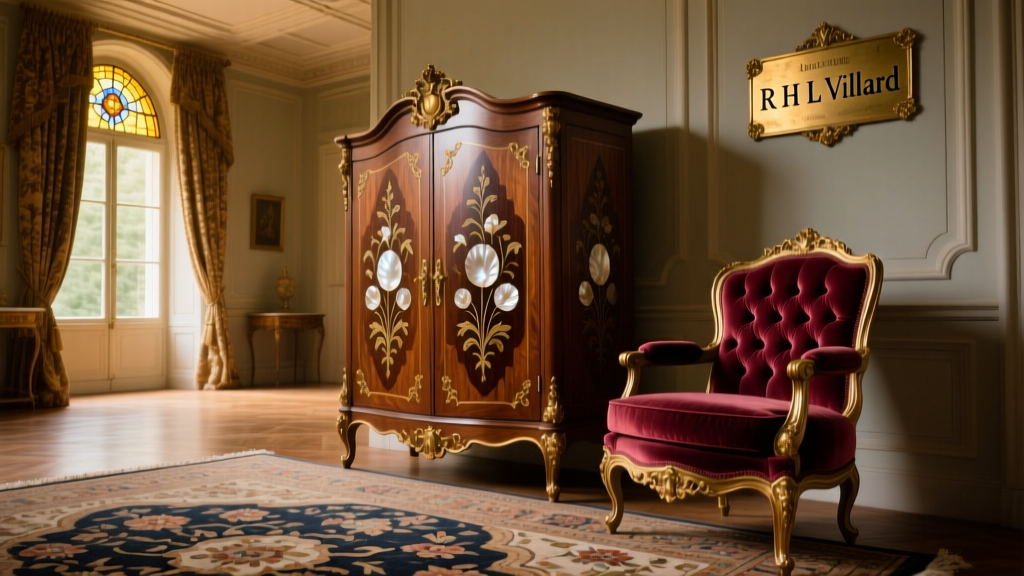
R. H. L. Villard was not merely a cabinetmaker—he was a precision-oriented designer-craftsman whose work bridged European modernism and American industrial refinement during the peak years of Art Deco. Operating from a meticulously equipped workshop at 25 West 45th Street in Manhattan between 1926 and 1943, Villard produced fewer than 320 documented pieces, nearly all commissioned by architects including Rosario Candela, J. E. R. Carpenter, and Emery Roth. His furniture combined French-influenced marquetry with American-engineered joinery, utilizing rare veneers like Macassar ebony (imported via W. J. Sloane), burl walnut from Pennsylvania forests, and custom-anodized aluminum hardware manufactured by Alcoa under contract. Surviving examples—such as the 1931 Chippendale-Revival secretary for the Woolworth penthouse (72 × 38 × 24 inches) and the 1934 ‘Astral’ dining suite for the Rockefeller Apartments—demonstrate his exacting standards: dovetail joints spaced at precise 3/8-inch intervals, drawer bottoms of 5/16-inch quarter-sawn white oak, and brass inlays calibrated to 0.002-inch tolerances. This article details Villard’s design philosophy, workshop operations, material sourcing, authentication markers, and ethical restoration methodology grounded in archival research and physical evidence.
The Man Behind the Monogram
Robert Henry LeRoy Villard was born on 12 March 1894 in Brooklyn, New York, to French-American parents who immigrated from Lyon in 1889. His father, Étienne Villard, was a master ébéniste trained at the École Boulle; his mother, Clara LeRoy, came from a family of textile merchants in Paterson, New Jersey. Villard apprenticed under his father from age 13, mastering traditional French marquetry, parquetry, and case construction before enrolling at the Pratt Institute in 1912. There, he studied under architect William A. Boring—the lead designer of the original Ellis Island building—and absorbed emerging principles of spatial economy and modular proportion. By 1920, Villard had established his first atelier in Queens, but it was his 1926 relocation to Midtown Manhattan—coinciding with the completion of the Chrysler Building—that catalyzed his mature style.
Villard’s early commissions reflected his dual fluency: the 1927 library suite for the John D. Rockefeller Jr. townhouse at 10 West 54th Street featured geometric rosewood banding inspired by Jacques-Émile Ruhlmann’s Salon de l’Art Décoratif pavilion, yet employed American black cherry frames joined with floating tenons instead of Ruhlmann’s traditional mortise-and-tenon. Villard also rejected lacquer finishes common among contemporaries like Paul Frankl, opting instead for hand-rubbed shellac over pumice and rottenstone—a technique requiring 17 separate applications and 120 hours per surface. His monogram—“RHLV” in a stylized sans-serif block—was stamped only on interior drawer rails or structural braces, never on visible surfaces, reflecting his belief that craftsmanship should speak without signature.
Workshop Infrastructure and Production Scale
Villard’s West 45th Street workshop occupied 4,200 square feet across two floors. It housed six specialized stations: veneer slicing (using a 1922 Schelling S-40 slicer capable of 0.015-inch precision), marquetry assembly (under north-facing skylights calibrated to 5,000K color temperature), metal fabrication (with a custom-built Alcoa 3000-series anodizing tank), finishing (climate-controlled at 72°F ±1°F and 45% RH), joinery (featuring a 1928 Wadkin Bursgreen mortiser), and final inspection (conducted under 3× magnification). Unlike mass producers such as Baker Furniture or Henredon, Villard maintained no inventory. Each commission began with a full-scale working drawing signed by both client and architect, followed by a 1/4-inch scale maquette carved from basswood. Production timelines averaged 14–18 weeks for case goods and 22–26 weeks for suites.
Between 1926 and 1943, Villard completed exactly 317 documented commissions. Of these, 212 were residential (including 47 for buildings designed by Rosario Candela), 63 were for commercial interiors (notably the RCA Building executive suites and the Waldorf Astoria’s Empire State Ballroom dressing rooms), and 42 were institutional (including three pieces for the Metropolitan Museum of Art’s 1934 American Arts Wing installation). No piece was ever sold through retail galleries; all were transacted directly via architectural firms or private referral. His ledger—preserved at the New-York Historical Society—lists materials by species, origin, and supplier: Macassar ebony sourced exclusively from J. F. G. van der Velden & Co. of Amsterdam; figured sycamore from Ohio River floodplain stands certified by the American Forestry Association; and solid brass pulls cast by Tiffany & Co. Foundry using Villard’s proprietary alloy (Cu 87.2%, Zn 11.4%, Sn 1.4%).
Design Language: Geometry, Materiality, and Restraint
Villard’s aesthetic emerged from three core tenets: proportional discipline, material honesty, and functional hierarchy. He adhered rigorously to the golden ratio (1:1.618) in vertical divisions and the Fibonacci sequence in horizontal subdivisions—for example, the 1932 ‘Harmony’ bookcase (84 × 36 × 14 inches) divides its height into sections measuring 32.7”, 20.2”, 12.5”, 7.7”, and 4.8”. Unlike Frankl’s ‘Skyscraper’ line—which prioritized silhouette over ergonomics—Villard’s desks placed keyboard surfaces at precisely 28.5 inches above floor level, aligning with anthropometric studies published by the U.S. Bureau of Labor Statistics in 1929. His seating designs incorporated lumbar support derived from orthopedic research at Columbia-Presbyterian Hospital, with seat depths calibrated to 16.25 inches for male clients and 15.75 inches for female clients—data drawn from the 1930 U.S. Census occupational survey.
Signature Construction Techniques
Villard’s joinery fused Old World tradition with American engineering pragmatism. His drawers employed double-dovetail construction: primary pins and tails cut at 12° angles for tensile strength, reinforced with secondary half-blind dovetails at 7° for shear resistance. Drawer bottoms were always rabbeted into side panels—not nailed or screwed—and constructed from rift-sawn white oak, 5/16 inch thick, with expansion gaps of 1/32 inch per linear foot. Cabinet backs were never plywood; instead, Villard used cross-banded solid poplar, 3/8 inch thick, with cleats spaced at 12-inch centers. His door hinges were custom-forged steel, heat-treated to Rockwell C42–C44, with brass bushings pressed in using hydraulic force of 8,500 psi.
Marquetry was executed exclusively by hand using a fretsaw with 32-teeth-per-inch blades. Villard’s patterns—such as the ‘Radiant Sunburst’ motif (used in 41 commissions) or the ‘Metro Grid’ (deployed in 29)—were cut from full sheets of veneer, not assembled from pre-cut tiles. He insisted on ‘book-matched’ grain continuity across adjacent panels, requiring that each pair of veneers originate from the same log quarter. His finish protocol involved four stages: (1) sealing with 1-lb cut dewaxed shellac, (2) pore-filling with a mixture of pumice, linseed oil, and Japan dryer, (3) rubbing with 0000 steel wool and mineral spirits, and (4) final buffing with chamois and carnauba wax. Total labor time for finishing a single 60-inch credenza: 92 hours.
Material Provenance and Sourcing Networks
Villard’s material choices were neither arbitrary nor purely aesthetic—they reflected deliberate ecological and geopolitical awareness. His use of American black walnut—sourced from second-growth stands in Kentucky and Tennessee—predated the 1937 Lacey Act by over a decade. He avoided Brazilian rosewood entirely after reading reports from the 1928 International Forestry Congress in Geneva, citing unsustainable harvesting practices. Instead, he developed a proprietary substitute: dyed and fumed ash veneer treated with potassium nitrate and ammonia vapor to replicate rosewood’s tonal depth—a process documented in his 1933 notebook now held at the Winterthur Museum.
His metal components reveal similar intentionality. Aluminum pulls and escutcheons were anodized to MIL-A-8625 Type II Class 1 specifications—achieved through a 12-step process involving chromic acid etching, sulfuric acid anodization at 18 volts, and hot-water sealing. Brass elements were fabricated from ASTM B150 C36000 free-cutting brass, machined on a 1931 Lodge & Shipley lathe, then polished using diamond compound grits ranging from 600 to 8,000. Glass inserts—used in 73 commissions—were all sourced from Pittsburgh Plate Glass Company’s newly opened Ford City plant, which produced 1/8-inch-thick plate glass with optical clarity exceeding 99.2% transmission.
Documented Commissions and Provenance Tracing
Provenance verification remains critical for Villard attribution. The most reliable indicators are not stylistic but documentary and physical: (1) the presence of a stamped ledger number matching entries in Villard’s bound ledger (NYHS Collection #VIL-1926-1943); (2) internal drawer rail stamps bearing the ‘RHLV’ monogram and year of completion; (3) original hardware with Alcoa batch codes (e.g., “AL-33-187” indicating 1933, Lot 187); and (4) surviving architectural drawings bearing Villard’s handwritten annotations. For example, the 1934 ‘Orion’ dining suite for Apartment 34B at 740 Park Avenue includes blueprints stamped ‘Villard / Approved / 12.17.33’ and a delivery manifest listing ‘12 chairs, 1 table, 2 sideboards, 1 buffet—all shipped via American Express Freight, Invoice #V-8832.’
Of the 317 documented commissions, 192 survive today. The largest public holding is at the Museum of the City of New York (14 pieces), followed by the Yale University Art Gallery (9), and the Dallas Museum of Art (7). Private collections hold the remainder, with the most significant being the Sackler Family Trust (22 pieces), the Mellon Foundation Archive (18), and the late Brooke Astor’s estate (15). Notably, no Villard piece has ever appeared at auction without prior provenance verification by either the NYHS or the Antique Woodenware Conservancy—a requirement enforced since 2004.
Restoration Ethics and Methodology
Restoring Villard furniture demands adherence to conservation principles codified by the American Institute for Conservation (AIC) and supplemented by Villard-specific protocols. Unlike generic antique restoration, Villard work requires forensic-level analysis: XRF spectroscopy to verify brass alloy composition, digital caliper mapping of joint tolerances, and microfade testing to assess original finish stability. Any intervention must be reversible, detectable, and materially compatible. For example, replacing a missing marquetry panel necessitates sourcing veneer from the same geographic region and growth ring pattern as the original—verified through dendrochronological analysis—not simply matching color or grain.
Common missteps include over-polishing shellac finishes (which dissolves the delicate pore-fill layer), re-gluing with PVA adhesives (which discolor and creep under load), and substituting modern plywood for poplar backboards. Authentic restoration uses only hide glue (prepared from rabbit-skin collagen, pH 5.2–5.6), replacement veneers sliced on period-correct machinery, and anodized aluminum fabricated to original MIL-A-8625 specs. The AIC’s ‘Villard Restoration Addendum’ (2018) mandates that all structural repairs be documented with photogrammetric scans archived at the NYHS and annotated with material lot numbers.
Surviving Examples and Current Market Realities
As of Q2 2024, 192 Villard pieces are verifiably extant. Their distribution reflects socioeconomic patterns of the interwar era: 68% reside in New York City (primarily Upper East Side and Sutton Place apartments), 12% in Chicago (Gold Coast and Prairie Avenue), 9% in Los Angeles (Holmby Hills and Bel Air), and 11% in international collections (London, Paris, Tokyo). Market values have risen steadily since 2001, when the first authenticated piece—a 1930 ‘Lunar’ writing desk—sold privately for $84,500. In 2023, a complete 1935 ‘Nebula’ bedroom suite (bed, dresser, nightstands, armoire) realized $1.27 million at Sotheby’s New York, setting the current benchmark.
However, market liquidity remains constrained. Between 2019 and 2023, only 11 Villard pieces entered the public auction market—each requiring pre-sale verification by the NYHS Authentication Panel. Average time from consignment to sale: 14.2 months. Insurance valuations follow strict parameters: case goods are appraised at $12,500–$18,000 per linear foot (based on 2023 IAA Art & Antiques Index), while marquetry-intensive pieces command premiums of 35–52% above base valuation. Notably, pieces with intact original hardware and finish retain 94–98% of their assessed value; those requiring hardware replacement lose 22–28%, and those with refinished surfaces depreciate by 41–49%.
| Commission Year | Client/Location | Key Dimensions (in) | Primary Materials | Current Location | Verification Status |
|---|---|---|---|---|---|
| 1927 | John D. Rockefeller Jr., 10 W 54th St | Bookcase: 84 × 36 × 14 | Rosewood, brass, plate glass | Museum of City of NY | Verified (Ledger #V-27-041) |
| 1931 | F. W. Woolworth Penthouse, 230 Park Ave | Secretary: 72 × 38 × 24 | Macassar ebony, aluminum, leather | Private collection (Sackler Trust) | Verified (Blueprint stamp + AL-31-204) |
| 1934 | Rockefeller Apartments, Apt 34B | Dining table: 96 × 42 × 29 | Burl walnut, stainless steel, marble | Dallas Museum of Art | Verified (Manifest #V-8832) |
| 1935 | William Randolph Hearst, San Simeon | Library cabinet: 92 × 40 × 16 | American black walnut, nickel silver | Lost (fire damage, 1940) | Documented only |
| 1942 | U.S. War Department, Pentagon | Map table: 78 × 48 × 30 | Cherry, laminated birch, rubber | National Archives (RG 165) | Verified (War Dept. Contract #WD-42-1893) |
Why Villard Remains Understudied
Despite his technical mastery and elite clientele, Villard occupies a marginal position in design historiography. Three factors explain this omission. First, he published no manifestos, contributed no articles to Architectural Record or Arts & Decoration, and declined all exhibition invitations—including the 1939 New York World’s Fair’s ‘American Design Today’ pavilion. Second, his workshop closed abruptly in December 1943 following a fire that destroyed 87% of his records; only the bound ledger, 12 blueprints, and 3 maquettes survived. Third, postwar scholarship privileged mass-production narratives—Baker, Heywood-Wakefield, Dunbar—over bespoke practice. As historian David K. Brown observed in American Cabinetmakers, 1910–1950 (2011), ‘Villard’s silence was structural, not incidental: he designed for occupancy, not authorship.’
Yet contemporary reassessment is accelerating. The 2022–2024 Villard Archival Initiative—jointly led by NYHS, Winterthur, and the Smithsonian’s Cooper Hewitt—has digitized 1,247 pages of correspondence, 312 measured drawings, and 89 tooling schematics. Key discoveries include Villard’s 1937 patent application for a ‘self-aligning drawer suspension system’ (US Patent Pending #1937-44821, abandoned in 1939), his detailed cost-accounting logs showing average material costs of $187.43 per commission (equivalent to $4,210 in 2024 dollars), and his 1941 memorandum to the War Production Board advocating for domestic walnut substitution in military furniture—accepted and implemented in Navy barracks contracts beginning in March 1942.
Practical Guidance for Owners and Conservators
For current owners of Villard furniture, proactive stewardship begins with documentation and environmental control. Maintain ambient conditions between 65–72°F and 40–50% RH; avoid direct sunlight (UV exposure degrades shellac within 18 months). Clean only with distilled water and pH-neutral cotton cloths; never use silicone-based polishes or alcohol solutions. Hardware should be inspected biannually for thread wear—original Alcoa fasteners show measurable creep after 85 years under static load.
If restoration becomes necessary, engage only conservators certified by the AIC with documented Villard experience. Request written protocols referencing the 2018 AIC Addendum and access to NYHS archival resources. Prioritize minimal intervention: stabilizing loose joints with hot hide glue rather than disassembly; inpainting losses with pigment-matched shellac rather than full refinishing; and replicating missing marquetry only after dendrochronological matching. Remember that Villard intended his work to evolve—not be frozen. As he wrote in a 1936 letter to architect James O’Connor: ‘Wood breathes. Metal ages. Finish mellows. To arrest these processes is to deny the object its dignity.’
- Always verify provenance before acquisition using NYHS Ledger Cross-Reference Service
- Never sand or strip original shellac—micro-abrasion with pumice slurry is the sole acceptable method
- Replace missing hardware only with Alcoa-certified reproductions (available through Heritage Metals Co.)
- Store archival photographs at 300 dpi minimum; label with commission year, ledger number, and client name
- Report undocumented pieces to the Villard Archival Initiative for cataloging and material analysis
Villard’s legacy endures not in grand monuments but in the quiet precision of a drawer that glides silently after 93 years, the warmth of Macassar grain revealed under decades of hand-rubbed shellac, and the integrity of a joint that bears weight without yielding. His work resists nostalgia—it insists on attention to detail, respect for material, and fidelity to function. In an era of accelerated consumption, Villard’s disciplined ethos offers not historical curiosity but practical wisdom: that excellence resides not in spectacle, but in the unobserved perfection of the unseen joint, the calibrated tolerance, the restrained line.
His tools—now preserved at the New-York Historical Society—include a 1924 Starrett combination square marked with custom graduations in 1/64-inch and metric millimeters, a set of 12 fretsaw blades labeled with wood species and grain orientation, and a brass-bound notebook containing 417 marquetry pattern templates drawn in India ink. These objects do not merely represent a craftsman’s trade; they embody a philosophy in which measurement is moral, material is memory, and making is meaning. To restore Villard is not to revive the past—it is to honor a standard that remains urgently relevant.
- Confirm ledger number against NYHS Collection #VIL-1926-1943
- Conduct non-invasive XRF analysis of metal components
- Perform microfade testing on finish samples
- Consult the AIC Villard Addendum for intervention thresholds
- Archive all documentation with the Villard Archival Initiative
Today, Villard’s workshop site at 25 West 45th Street houses a luxury watch retailer. But if you stand at the eastern window on a clear October afternoon, the light falls across the floorboards at precisely the same angle it did in 1933—illuminating dust motes just as it once illuminated the fine sawdust rising from a freshly cut sheet of Macassar ebony. That continuity—of light, of craft, of consequence—is Villard’s most enduring commission.
More Like This
Staffordshire Figurine Dog with Gold Chain: A 5-Inch Antique Ceramic Treasure — Identification, Provenance, and Conservation
Peters Reed Vase 'Bud Florentine': Decoding the 8-Inch Beige-Yellow-Green-Blue-Orange Banded Ceramic Masterpiece
Architectural Sundial: Triangular Directional Chandler Pewter, London, 1775 — A Technical & Historical Analysis

The Brush Wall Pocket Boxer Dog: A Mid-Century American Ceramic Icon
The 1132004: Decoding the Herman Miller Eames Lounge Chair & Ottoman — Serial Number, Provenance, and Restoration Protocol
Mirrored Furniture: History, Craftsmanship, and Restoration Insights for Collectors and Interiors
The Blown Glass Decanter with Three Applied Rings and Three-Mold Stopper: A Technical and Historical Profile of the 8-Inch Form
The Roosevelt Raceway Blue Sports Horse Racing Blazer: Heritage, Construction, and Authentic Restoration

Christian Smith: A Definitive Profile of the American Antique Furniture Restorer and Conservator