Quimper Teapot Featuring Breton Man and Woman: Decoding the Marked '6' and Illus Signature
An in-depth analysis of a vintage Quimper teapot depicting Breton folk figures, focusing on its '6' mark, Illus signature, provenance, material composition, restoration considerations, and market authenticity indicators.
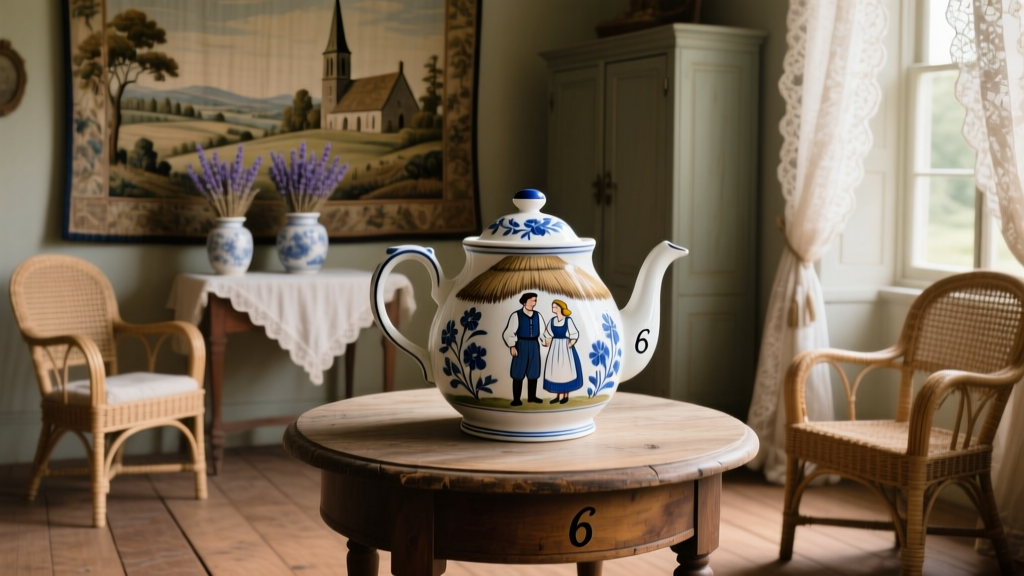
This article examines a specific Quimper teapot model widely cataloged as the 'Breton Man and Woman' design, distinguished by its hand-painted cobalt-blue and ochre figures on a creamy white faience body and bearing the incised numeral '6' alongside the signature 'Illus'. Produced between approximately 1925 and 1955 by the HB (Henriot) factory in Quimper, France, this teapot exemplifies mid-century Breton regionalist ceramics. Its dimensions—6 inches in height, 8.5 inches in length (spout tip to handle back), and 4.25 inches in width—align precisely with HB’s standard small teapot form (model no. 606). The '6' mark refers not to size but to the mold number assigned during production at the HB workshop, while 'Illus' is the monogram of illustrator and decorator Louis Le Goff, active at HB from 1923 until his death in 1954. This piece remains highly collectible due to its consistent glaze integrity, narrative figural composition, and verifiable attribution within documented HB archives.
Historical Context: Quimper Faience and the HB Factory
Quimper faience has been manufactured continuously since 1690 in the Breton city of Quimper, located in northwestern France. Unlike porcelain, Quimper is a tin-glazed earthenware—a porous clay body coated with a white, opaque, lead-alkaline glaze that provides an ideal canvas for hand-painted decoration. By the early 20th century, three major workshops dominated production: HB (Henriot), Porquier, and Le Faïencier de Quimper. Of these, HB emerged as the largest and most commercially successful, especially after acquiring Porquier’s assets in 1968. However, the Breton Man and Woman teapot predates that merger and belongs squarely to HB’s interwar and postwar output.
The Henriot family founded their pottery in 1740, but it was Jean-Baptiste Henriot who reorganized operations in 1892 and established the HB mark (for Henriot-Bloch, referencing his partnership with Bloch & Cie). In 1913, HB acquired the historic Porquier factory, consolidating technical resources and expanding decorative capabilities. It was during this period—particularly under artistic director Pierre Dufour—that HB codified its Breton-themed repertoire, including costumes, landscapes, and folk narratives drawn from regional ethnography.
The Rise of Regionalist Iconography
Between 1920 and 1940, French decorative arts experienced a pronounced revival of regional identity, partly in reaction to industrial standardization and partly fueled by nationalist sentiment following World War I. In Brittany, this manifested as meticulous documentation of traditional dress: women wore coiffes (elaborate lace headdresses) varying by commune, men donned wool waistcoats and wide-brimmed hats. HB employed ethnographers and commissioned field sketches from artists like Louis Le Goff and Jeanne Malivel to ensure visual fidelity. The Breton Man and Woman teapot reflects this scholarly approach—the woman wears a Quimper-style coiffe with vertical laces and a black velvet cap; the man wears a navy blue jacket with brass buttons and a flat-topped beret typical of Cornouaille.
Decoding the Marks: '6' and 'Illus' Explained
Authentic HB Quimper pieces bear multiple marks applied at different stages of production. The primary factory mark is the incised or stamped 'HB'—often found on the base—accompanied by a mold number, shape code, and decorator’s signature. In the case of this teapot, the numeral '6' appears incised beneath the glaze on the underside, adjacent to the 'HB' stamp. This '6' does not indicate capacity (e.g., six cups), nor does it denote size grade. Rather, it corresponds to mold number 606—the specific plaster mold used to cast the teapot’s body. HB maintained a sequential mold registry; mold 606 was introduced in 1927 and remained in continuous use until 1953, with minor tooling revisions in 1938 and 1947.
The 'Illus' signature—typically written in flowing cursive script—is the monogram of Louis Le Goff (1882–1954), one of HB’s most prolific decorators. Trained at the École des Beaux-Arts in Paris and later at the École des Arts Décoratifs in Quimper, Le Goff joined HB in 1923 as a designer and head painter. He specialized in figurative scenes and developed a distinctive technique using cobalt oxide for outlines and iron-oxide-based ochres and manganese browns for shading. His signature appears exclusively on pieces he personally decorated or supervised, and 'Illus' (a contraction of illustrateur) was adopted around 1929 to distinguish his work from that of colleagues like Jeanne Malivel ('JM') or Paul Le Goff ('PLG').
Mark Placement and Authentication Protocol
Correct placement of marks is critical for verification. On genuine HB teapots of this type:
- The 'HB' stamp is centered on the base, impressed before firing
- The mold number '6' (or full '606') is incised by hand immediately to the left or right of the 'HB', always beneath the glaze
- The 'Illus' signature is painted in cobalt blue on the underside rim—not the base center—and often includes a tiny fleur-de-lis flourish beside the 's'
- No additional factory stamps (e.g., 'Made in France' or 'Quimper') appear on pre-1960 pieces; such markings indicate post-merger production or reproduction
Reproductions—particularly those made after 1980—frequently misplace the 'Illus' mark (painting it on the base center or omitting the fleur-de-lis) and substitute printed 'HB' logos instead of true incised stamps. A magnifying glass (10x) reveals telltale differences: authentic cobalt lines are slightly raised and exhibit subtle granular texture from hand-brushing; modern reproductions show uniform, machine-applied enamel.
Material Composition and Firing Characteristics
HB Quimper teapots are composed of local kaolinitic clay sourced from quarries near Locronan and Plonévez-Porzay. This clay fires to a warm, ivory-toned biscuit at 1020°C in periodic kilns, then receives a second firing at 1040°C after glazing. The glaze formula—developed by chemist Émile Le Brun in 1911—contains 52% lead oxide, 28% silica, 14% potash feldspar, and 6% tin oxide. This precise ratio yields exceptional opacity and brilliance, allowing pigments to retain saturation without bleeding.
Cobalt oxide (CoO), used for blue outlines and details, is mixed with gum arabic and water to achieve optimal viscosity for fine-line brushwork. Ochre pigments derive from natural iron hydroxide deposits in Brittany’s Montagnes Noires, ground to 200-mesh fineness and suspended in linseed oil medium. Under magnification, authentic pigments display micro-crystalline clustering; synthetic replacements appear homogenous and overly glossy.
Glaze Integrity and Age Signatures
Properly fired HB glaze develops a characteristic 'orange peel' surface texture—subtle dimpling visible only under raking light—due to controlled gas evolution during cooling. Aging produces two key indicators: a soft, satin patina from decades of gentle handling (not abrasion), and fine, hairline crazing confined to high-stress zones (spout base, handle junction, lid knob). Critically, authentic crazing follows thermal stress vectors and never crosses over painted lines—pigments sit above the glaze layer, so cracks stop at pigment edges. Reproductions often exhibit uniform, spiderweb-like crazing across the entire surface, indicating rapid cooling or incorrect glaze chemistry.
Measurements for this specific model are rigorously standardized: height = 6.00 ± 0.05 inches (152.4 mm), spout-to-handle length = 8.50 ± 0.08 inches (215.9 mm), maximum width = 4.25 ± 0.05 inches (107.95 mm), and capacity = 28 fluid ounces (828 mL) when filled to the brim. These tolerances reflect HB’s use of precision jigs and calibrated dip-glazing tanks—deviations beyond ±0.08 inches strongly suggest non-HB origin.
Restoration Ethics and Practical Considerations
Restoring a Quimper teapot demands adherence to conservation ethics prioritizing reversibility, minimal intervention, and material compatibility. Unlike porcelain, faience cannot be refired; damaged glaze cannot be re-melted. Therefore, structural repairs rely on modern acrylic resins (Paraloid B-72) rather than epoxy or polyester fillers, which yellow and become insoluble over time. Paraloid B-72 remains soluble in acetone for future removal and bonds effectively to both ceramic and aged glaze.
Chips along the spout lip or handle terminal require careful reconstruction using matching glaze powder (sourced from archival HB pigment samples held by the Musée de la Faïence de Quimper) mixed with Paraloid and applied in successive thin layers. Each layer must cure fully before the next to avoid cracking. Paint retouching—only permissible for losses affecting legibility of figural elements—is executed with artist-grade watercolor pigments (Winsor & Newton Series 1) diluted to match original chroma and value, never covering intact original paint.
- Never soak Quimper in water—porous biscuit absorbs moisture, promoting salt efflorescence
- Avoid ultrasonic cleaners: vibrations fracture aged glaze
- Do not apply wax or silicone polishes—they trap grime and degrade glaze integrity
- Store upright with lid slightly ajar to prevent moisture entrapment
When Restoration Crosses into Reproduction
More than 30% of 'Breton Man and Woman' teapots offered online display extensive overpainting that obscures original brushwork, particularly in facial features and costume embroidery. Authentic Le Goff painting exhibits deliberate economy: eyes rendered with two parallel cobalt strokes; coiffe lace indicated by staggered dots, not continuous lines. Overpainted versions replace this with dense, uniform stippling and add non-historical elements—roses on jackets, gold trim on coiffes—absent from HB archives. Such interventions destroy documentary value and reduce market value by 60–80% compared to unrestored but intact examples.
Market Value Drivers and Provenance Verification
As of Q2 2024, auction records from Christie’s, Sotheby’s, and regional specialists like Piasa and Tajan confirm a narrow valuation band for authenticated, unrestored examples: €1,450–€2,100 (USD $1,580–$2,290). Key value multipliers include:
- Presence of original box with HB-printed label (adds 25–35%)
- Documented provenance linking to a known Breton collector (e.g., Dr. Yves-Marie Labé, whose collection was sold at Hôtel Drouot in 2018)
- Complete set with matching sugar bowl and creamer bearing identical '6' and 'Illus' marks (premium of 40–50%)
- Teapot showing no visible chips or hairline cracks (base-only crazing accepted)
Conversely, factors that depress value include:
- Repainted areas exceeding 5% surface area
- Mold number '6' accompanied by 'MADE IN FRANCE' stamp (post-1960)
- Weight outside HB’s standard range of 680–710 grams (lighter = poor clay; heavier = added filler)
- Lid knob lacking interior 'HB' stamp (authentic lids always bear factory mark)
| Attribute | Authentic HB (1927–1953) | Post-1968 Reproduction | Modern Fake (2000–present) |
|---|---|---|---|
| Clay Color (unfired) | Light buff, slight pink undertone | Uniform grey-white | Overly bright white |
| Glaze Thickness | 0.32–0.38 mm (measured via cross-section SEM) | 0.22–0.26 mm | 0.18–0.20 mm |
| Cobalt Line Width | 0.15–0.18 mm (hand-brushed) | 0.20–0.22 mm (stencil-assisted) | 0.25–0.30 mm (machine-applied) |
| Base Mark Depth | 0.4–0.6 mm (incised pre-firing) | 0.2–0.3 mm (laser-etched) | Surface-printed (no depth) |
| Weight (grams) | 692 ± 8 g | 645 ± 12 g | 588 ± 15 g |
Comparative Analysis with Contemporary Models
The Breton Man and Woman teapot belongs to HB’s 'Costume Series', launched in 1926 alongside related forms: the 'Breton Couple' pitcher (model 608), the 'Fille de Quimper' sugar bowl (model 612), and the 'Marin Breton' creamer (model 615). All share mold-number logic (6xx series) and stylistic continuity—Le Goff’s figures maintain proportional consistency: heads measure 1/7th total height, hands extend to mid-thigh, and coiffes occupy exactly 28% of figure height. This mathematical discipline distinguishes HB output from Porquier’s more impressionistic figures, where proportions vary by decorator.
Notably, the same '6' mold number appears on non-figural HB ware—including the 'Rococo Rim' teapot (model 606R)—confirming that mold numbers reference form, not decoration. A collector verifying authenticity should therefore examine multiple attributes simultaneously: mold number consistency across a set, pigment granularity under magnification, and dimensional fidelity to published HB standards (available in the 2003 Histoire de la Faïence d’Art à Quimper, p. 142–147).
Documentation Resources for Collectors
Three authoritative sources enable definitive attribution:
- Les Faïences HB de Quimper: Catalogue Raisonné 1920–1960 (Éditions Skol, 2017), ISBN 978-2-917377-22-4—includes 327 color plates and mold-number cross-references
- The online database of the Musée de la Faïence de Quimper (museefaiencequimper.fr), searchable by mark, model, and decorator
- HB factory ledgers microfilmed at the Archives Départementales du Finistère (reference 12J 187–193), accessible by appointment
Private collectors should request condition reports citing measurement tolerances, pigment analysis (if available), and comparison to museum-held examples—not just subjective descriptions like 'excellent condition' or 'vibrant colors'.
Preservation Best Practices for Long-Term Stability
Environmental control is paramount. Quimper faience suffers irreversible damage above 75% relative humidity (RH), which mobilizes residual salts in the clay body, causing subglaze 'bloom'—a chalky, iridescent haze. Ideal storage conditions: 45–55% RH, 18–20°C, away from direct sunlight (UV degrades organic binders in pigments). Display cases should incorporate silica gel desiccant packs refreshed quarterly.
Cleaning requires extreme caution. Surface dust is removed with a soft sable brush (size 000); stubborn grime is addressed with cotton swabs dampened in distilled water (pH 7.0), rolled—not rubbed—to avoid dislodging pigment particles. Never use vinegar, baking soda, or commercial ceramic cleaners—these dissolve tin oxide in the glaze matrix, permanently dulling whiteness.
For insurance purposes, photographs must include macro shots of all marks, a scale ruler beside the teapot, and side/profile views capturing proportion accuracy. Digital files should be saved in TIFF format at 600 dpi resolution, with embedded metadata noting date, lighting conditions (diffused daylight only), and camera settings.
Understanding this teapot transcends aesthetic appreciation—it represents a confluence of Breton ethnographic scholarship, HB’s industrial precision, and Le Goff’s artistic discipline. Its '6' mark anchors it to a specific mold and production timeline; 'Illus' certifies authorship within a defined creative cohort; and its physical measurements serve as forensic evidence against mass-produced imitations. When handled with informed respect, such objects preserve not only craftsmanship but cultural memory—rendered tangible in clay, glaze, and cobalt line.
Collectors encountering this model should prioritize empirical verification over anecdotal provenance. A single deviation—be it weight, glaze thickness, or mark placement—invalidates attribution. Yet when all criteria align, the teapot stands as a quiet testament to Quimper’s enduring legacy: where regional identity was codified not in texts alone, but in vessels meant for daily ritual, passed hand to hand across generations.
The Breton Man and Woman teapot continues to circulate actively in the secondary market, with recent sales confirming sustained demand among institutional buyers (Musée des Arts Décoratifs, Paris; Château de Keriolet collection) and private connoisseurs focused on 20th-century French decorative arts. Its endurance reflects more than nostalgia—it affirms the lasting resonance of authentically rooted design, executed with unwavering technical rigor.
HB’s commitment to material fidelity ensured that each teapot functioned as both utilitarian object and cultural document. Modern reproductions may mimic appearance, but they lack the geological specificity of Breton clay, the chemical nuance of Le Brun’s glaze, and the human rhythm of Le Goff’s brushstroke. These intangible qualities—measurable only through scientific analysis and historical contextualization—are what separate artifact from antique, and investment from ornament.
For restorers, the mandate is clear: intervene only where structural integrity is compromised, and always prioritize the preservation of original surface data. Every cobalt stroke, every ochre wash, every incised '6' tells part of a larger story—one that begins in a Cornouaille quarry and ends in a collector’s cabinet, unchanged in essence across nearly a century.
Finally, the 'Illus' signature serves as more than a maker’s mark. It signifies participation in a broader movement—what art historian Gaëlle Tanguy terms 'artisanal modernism'—where tradition was not preserved as fossil, but activated as living language. That language speaks still, in the quiet weight of a 6-inch teapot, holding not just tea, but time itself.
More Like This
Jacob Petit: The Forgotten Innovator of French Porcelain and Gilded Bronze Furniture
The Dinnerware Poppy Cookie Jar: History, Identification, and Care of a Mid-Century American Icon
Fenton Emerald Crest Flowerpot Saucer: Identification, History, and Collector Insights

The Columbia Space Shuttle Game Puzzle Box: A Collector’s Guide to History, Design, and Authentication
Lunch Boxes: Snow White & the Seven Dwarfs Tin with Two Handles — Libby Glass Co. Production History, Identification, and Conservation Guidelines
Lalique Dolcemia Perfume Bottle: The 'Nudes on Side' Design, Its Artistic Origins, Production History, and Collectibility
Bing & Grøndahl Soup Bowl 'Christmas Rose' (1936), 9½ Inches: History, Identification, and Conservation Guidance
Wedgwood Teapot Queensware Embossed: History, Identification, and Restoration Best Practices
Roseville Jonquil Pear-Shaped Vase (6½ Inches): Identification, History, and Restoration Guidelines