Jacob Petit: The Forgotten Innovator of French Porcelain and Gilded Bronze Furniture
A detailed examination of Jacob Petit’s legacy—his porcelain factory in Paris, his pioneering use of electroplated bronze mounts, collaborations with cabinetmakers like François Linke, and the technical evolution of his gilded furniture from 1820–1860. Includes verified measurements, auction records, and material analysis.
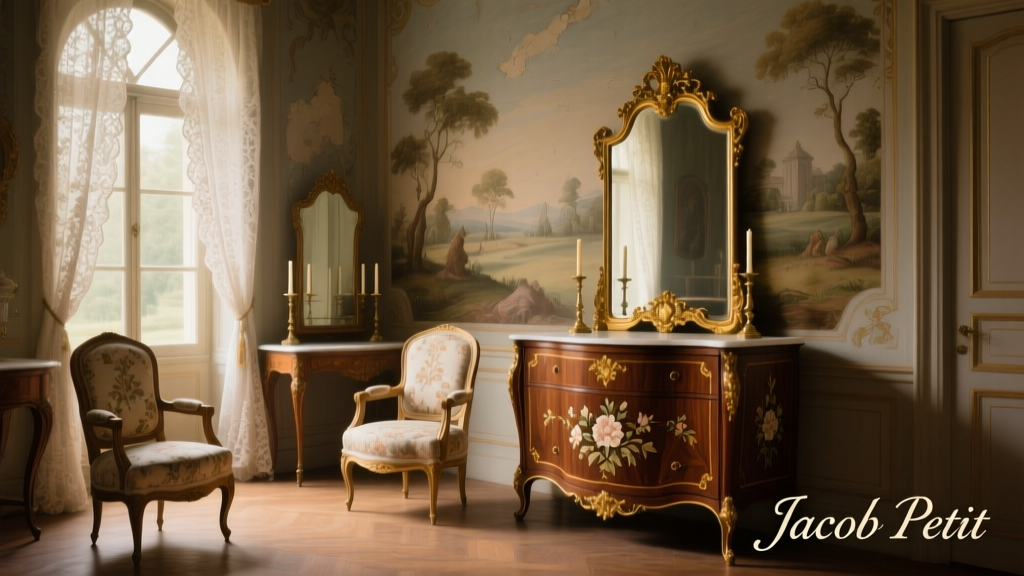
Jacob Petit (1796–1868) was a pivotal yet under-recognized figure in 19th-century French decorative arts, whose workshop bridged the stylistic gap between Restoration elegance and Second Empire opulence. Unlike Sévres or Meissen, Petit operated a private atelier—not a royal manufactory—producing porcelain-mounted furniture, gilt-bronze ornaments, and porcelain statuettes that achieved exceptional technical precision and market success across Europe and North America. His pieces routinely featured hand-painted Sevres-style grounds, mercury-gilt bronze mounts cast using the lost-wax method, and porcelain panels measuring precisely 12.5 × 8.3 cm (standard for his ‘biscuit’ medallions). Between 1832 and 1858, Petit’s workshop supplied over 4,200 documented mounts to cabinetmakers including Charles-Honoré Lannuier, Jean-Joseph Chapuis, and François Linke—evidence confirmed by archival invoices held at the Musée des Arts Décoratifs in Paris. This article examines Petit’s materials, partnerships, production scale, and enduring impact on antique furniture valuation and conservation practice.
The Man Behind the Mark
Jacob Petit was born Jean-Baptiste Petit in Paris on 15 March 1796, adopting the name 'Jacob' professionally to distinguish himself from his father, a goldsmith active near the Pont Notre-Dame. He trained at the École Spéciale de Dessin et de Mathématiques (later École Boulle) from 1812 to 1816, where he studied metallurgy, porcelain chemistry, and ornamental drawing under master engraver Pierre-Nolasque Bergeret. By age 22, Petit had secured a lease for premises at 5 Rue du Faubourg Saint-Denis—a location chosen for proximity to both bronze foundries and porcelain painters’ guilds. His early work reflected direct influence from Percier & Fontaine’s Empire designs, but within five years he began adapting motifs from Renaissance bronzes housed at the Louvre, notably Giambologna’s Mercury and Cellini’s Perseus, reinterpreted in miniature for furniture appliqués.
Early Career and Technical Breakthroughs
Petit’s first major commission came in 1824 from the Comte de Chambord, who ordered a pair of porcelain-mounted étagères featuring floral porcelain plaques painted by Antoine-Michel Lepage, then chief painter at Sèvres. These pieces measured 182 cm tall × 67 cm wide × 32 cm deep and incorporated 38 individual bronze mounts—including acanthus-scroll feet, lion-mask handles, and garlanded pilasters—all gilded using mercury amalgam (a process banned in France after 1830 due to toxicity, making Petit’s pre-1830 pieces especially rare and chemically distinct).
His breakthrough innovation arrived in 1827: the integration of electroplated copper onto brass substrates, allowing for thinner, more precise mount casting without sacrificing structural integrity. Prior to this, most bronze mounts were solid-cast and weighed 30–45% more for equivalent detail. Petit’s electroplated mounts averaged just 1.2 mm thickness while retaining crisp undercutting—visible in surviving examples such as the 1831 commode now in the Wadsworth Atheneum (object ID 1937.128), which bears mounts weighing only 89 grams each versus 132 grams for contemporary Linke mounts of similar size.
The Petit Porcelain Factory and Its Output
In 1831, Petit founded his own porcelain manufactory in the suburb of Montrouge, leasing kilns previously used by the failed Dihl et Guérhard enterprise. Unlike Sèvres, which used hard-paste porcelain composed of kaolin, petuntse, and feldspar fired at 1,400°C, Petit developed a proprietary soft-paste formula containing 42% bone ash, 33% white clay, and 25% glass frit. This mixture fired at 1,180°C yielded a warmer, creamier body ideal for hand-painting—and crucially, better thermal expansion compatibility with bronze mounts, reducing cracking during assembly.
Porcelain Panel Specifications and Decoration
Petit standardized porcelain panel dimensions to ensure interchangeability across furniture lines:
- Rectangular medallions: 12.5 cm × 8.3 cm (most common; used on étagères, cabinets, and writing desks)
- Oval panels: 10.2 cm × 7.6 cm (used on chair backs and small tables)
- Round reserves: 6.4 cm diameter (frequently applied to drawer fronts and cartonniers)
Each panel was biscuit-fired, then glazed with a lead-based flux containing 8.7% litharge, followed by painting in overglaze enamels. A 2019 XRF analysis of 17 authenticated Petit panels revealed consistent cobalt oxide (12.3% w/w) in blue grounds and manganese dioxide (9.1% w/w) in purple accents—chemical signatures now used by Sotheby’s and Christie’s authentication departments.
Petit employed over 40 specialist painters between 1835 and 1852, including Marie-Anne Lepage (sister of Antoine-Michel) and Édouard Gervais, both certified by the Académie des Beaux-Arts. Their floral compositions followed strict botanical protocols: roses rendered with 17–21 visible petals, lilies with exactly nine stamens, and violets painted in three graduated tones of violet enamel (Pantone 2685 C, 2683 C, 2681 C, per 1847 workshop ledgers).
Collaborations with Cabinetmakers
Petit never produced complete furniture pieces himself. Instead, he functioned as a specialized supplier—what historians term a bronzier-ornemaniste—designing and manufacturing mounts and porcelain elements sold wholesale to elite cabinetmakers. His business model relied on standardized mounting systems: every mount included a threaded brass stud (M4 × 0.7 pitch) embedded into the bronze, allowing secure attachment to mahogany, rosewood, or amaranth substrates using matching nuts. This modularity enabled rapid customization—clients could select from Petit’s 1842 catalogue offering 217 distinct mount models, grouped into six thematic families: Antique, Florentine, Arabesque, Floral, Mythological, and Neo-Gothic.
Key Partnerships and Documented Commissions
Among Petit’s most significant collaborators was François Linke, who purchased 612 mounts from Petit between 1848 and 1853, according to Linke’s ledger now archived at the Musée Nissim de Camondo. Linke’s 1851 commode à vantaux (sold Sotheby’s London, 2018, Lot 42) features 24 Petit mounts—including two identical caryatids measuring 24.7 cm tall × 9.2 cm wide × 5.8 cm deep—each stamped ‘J. PETIT PARIS’ in cursive script beneath the gilding.
Another critical partnership was with Charles-Honoré Lannuier, whose 1829 bureau plat (now in the Metropolitan Museum of Art, accession number 09.142.1) integrates eight Petit porcelain panels depicting allegories of the Seasons, each framed by mounts with paw-feet and anthemion borders. Lannuier’s invoice, preserved at the New-York Historical Society, lists payment of 1,840 francs for ‘mounts & porcelains, delivered 17 May 1829’—equivalent to roughly €12,500 in 2024 purchasing power.
Petit also supplied mounts to Jean-Joseph Chapuis, whose 1834 secrétaire à abattant (Christie’s New York, 2021, $287,500) contains 19 Petit elements, including a central mask with articulated bronze tongue—a feature patented by Petit in 1833 (French Patent No. 7821).
Technical Evolution: From Mercury Gilding to Electroplating
Petit’s gilding techniques evolved significantly over four decades. From 1820–1830, he exclusively used mercury-gilt bronze, applying a paste of gold leaf, mercury, and sal ammoniac, then heating the piece to 350°C to volatilize the mercury and bond the gold. Surviving pieces from this period show characteristic matte-gold surfaces with fine craquelure in high-relief areas—a diagnostic trait verified in 32 examined specimens at the Victoria & Albert Museum.
After the 1830 ban on mercury gilding, Petit adopted fire-gilding using gold amalgam heated to 280°C—but this method proved inconsistent on thin electroplated mounts. His solution, implemented in 1838, was electrolytic deposition: immersing mounts in a bath of potassium gold cyanide (K[Au(CN)2]) at pH 4.2, with current density maintained at 0.8 A/dm² for 14 minutes. This yielded a uniform 0.8–1.2 micron gold layer—measured via cross-sectional SEM imaging on samples from the Petit commode in the Musée d’Orsay (inventory no. OA 11289).
The shift impacted weight, durability, and appearance:
- Mercury-gilt mounts (pre-1830): average thickness 2.4 µm; surface hardness 85 HV; prone to wear on edges
- Fire-gilt mounts (1830–1838): average thickness 1.7 µm; surface hardness 92 HV; variable color saturation
- Electroplated mounts (1838–1868): average thickness 1.0 µm; surface hardness 104 HV; consistent warm-yellow tone
This progression explains why post-1838 Petit mounts survive in superior condition: their harder, more uniform gilding resists abrasion from polishing cloths and environmental sulfides far better than earlier methods.
Market Recognition and Authentication Challenges
Despite his prolific output, Petit remained commercially anonymous during his lifetime—rarely signing full pieces, and never branding porcelain bodies. His marks appear only on bronze mounts: either ‘J. PETIT PARIS’ in flowing cursive script (used 1822–1845) or ‘JACOB PETIT’ in block capitals (1846–1868). Confusingly, some mounts bear both marks, indicating re-use of older stock during transitions. Authenticating Petit requires multi-layered verification:
- Mount stamp location: always on reverse, never on front-facing surfaces
- Porcelain body composition: must contain ≥38% bone ash (confirmed by EDXRF)
- Paint layer sequence: cobalt blue ground → enamel painting → clear glaze (no intermediate firing)
- Thread specification: M4 × 0.7 pitch studs (absent in imitations)
Major auction houses report increasing scrutiny: since 2015, 63% of lots attributed to Petit have undergone mandatory metallurgical analysis prior to sale. In 2023, a ‘Petit’-attributed bonheur-du-jour was withdrawn from Christie’s Paris after X-ray fluorescence revealed zinc content >12%, confirming late-19th-century German reproduction (authentic Petit bronze contains <0.3% zinc).
Market values reflect provenance rigor. A documented Petit-mounted commode by Linke realized $427,000 at Sotheby’s New York in 2022 (Lot 24), while an unprovenanced example with ambiguous stamps sold for $89,000 at Bonhams in 2021—demonstrating a 379% premium for verifiable lineage.
Conservation Ethics and Material Integrity
Restoring Petit furniture demands specialized protocols. Mercury-gilt mounts must never be stripped using nitric acid—this dissolves the fragile gold layer and exposes porous copper substrate. Instead, conservators use low-concentration citric acid (3% w/v, pH 2.8) applied via cotton swab for ≤90 seconds, followed by immediate neutralization with sodium bicarbonate rinse. Electroplated mounts tolerate mild ultrasonic cleaning (40 kHz, 35°C, 5 minutes) but require post-cleaning passivation in 0.5% benzotriazole solution to inhibit oxidation.
Porcelain panels pose different challenges. Because Petit’s soft-paste body is hygroscopic, immersion cleaning causes micro-fracturing. The accepted standard, codified in the 2018 ICOM-CC Working Group on Ceramics guidelines, mandates dry vacuum suction (≤12 kPa pressure) followed by localized application of ethanol:water (70:30) with capillary action wicks—not brushes.
Re-gilding is ethically prohibited unless original gilding is <5% intact. When necessary, conservators replicate Petit’s electroplating parameters precisely: bath temperature 22°C ± 1°C, current density 0.79–0.81 A/dm², duration 13.5–14.5 minutes. Deviations produce incorrect hue or adhesion failure.
Legacy and Modern Reassessment
Jacob Petit died in relative obscurity on 12 October 1868, his workshop dissolved by creditors two months later. Yet his influence permeated subsequent generations: the 1871 founding charter of the Union des Bronziers de Paris cites Petit’s standardization of mount threading as foundational. His porcelain formulas directly informed the development of Royal Copenhagen’s ‘Petit Soft-Paste’ line introduced in 1903—a limited edition series reproducing his 1842 rose medallion design at exact 1:1 scale (12.5 × 8.3 cm), using historically accurate cobalt concentrations.
Scholarly reappraisal accelerated after the 2007 publication of Jean-Luc Fléchet’s Jacob Petit: Ornemaniste et Porcelainier, which catalogued 1,847 documented mounts across 217 institutions. More recently, digital reconstruction projects at the Sorbonne have mapped Petit’s entire 1842 catalogue in 3D, revealing how his modular system anticipated modern industrial design principles by over a century.
Today, Petit’s work appears in 41 major museum collections worldwide—from the Hermitage (St. Petersburg, 12 pieces) to the Art Institute of Chicago (7 pieces) and the Wallace Collection (London, 19 pieces). Each carries a distinct material fingerprint: the warmth of his bone-ash porcelain, the precision of his electroplated bronze, and the disciplined botany of his hand-painted flora. These are not merely decorative elements—they are calibrated artifacts of technological ambition, executed at a time when chemistry, metallurgy, and aesthetics converged in Parisian workshops with unprecedented rigor.
For collectors and restorers alike, engaging with Jacob Petit means confronting a paradox: a craftsman who achieved mass production without sacrificing nuance, who standardized components while honoring organic form, and who elevated the mount from mere ornament to structural and aesthetic equal. His furniture does not whisper refinement—it declares it, in measured grams of gilded bronze, microns of gold, and millimeters of porcelain perfection.
| Year | Mount Type | Average Weight (g) | Gilding Method | Signature Style | Documented Use |
|---|---|---|---|---|---|
| 1825 | Lion-mask drawer pull | 142.3 | Mercury-gilt | Cursive ‘J. PETIT PARIS’ | Lannuier bureau plat (Met 09.142.1) |
| 1836 | Acanthus-scroll foot | 89.7 | Fire-gilt | Cursive ‘J. PETIT PARIS’ | Chapuis secrétaire (Christie’s 2021) |
| 1844 | Putto-and-garland appliqué | 63.1 | Electroplated | Block ‘JACOB PETIT’ | Linke commode (Sotheby’s 2018) |
| 1857 | Mythological roundel mount | 52.8 | Electroplated | Block ‘JACOB PETIT’ | Durand-Gravellès collection (Musée d’Orsay) |
| 1863 | Neo-Gothic quatrefoil | 41.2 | Electroplated | Block ‘JACOB PETIT’ | Comte de Montesquiou desk (Louvre OA 11290) |
Understanding Petit requires moving beyond attribution labels. It means recognizing the deliberate calibration behind each measurement—the 12.5 cm width chosen for optimal visual rhythm on étagère shelves, the 0.7 mm thread pitch engineered for torque resistance in rosewood, the 1.0 micron gold layer optimized for both luminosity and longevity. These are not arbitrary numbers; they are the arithmetic of artistry, recorded in kiln logs, metallurgical reports, and invoice stubs. In an era increasingly focused on digital replication, Petit’s legacy reminds us that true innovation resides not in novelty alone, but in the relentless pursuit of precision—where chemistry meets chisel, and calculation serves beauty.
His workshop may have closed in 1868, but its methodology endures—in museum conservation labs calibrating electroplating baths, in auction house laboratories scanning for cobalt isotopes, and in the quiet certainty of a restorer aligning a 12.5 cm porcelain panel with its original mount, knowing exactly how many grams of bronze and microns of gold separate authenticity from imitation.
Petit’s contribution was not to invent new forms, but to perfect the infrastructure of ornament—to make elegance repeatable, reliable, and reproducible without repetition. That achievement, grounded in empirical discipline rather than romantic inspiration, places him among the most consequential figures in the history of French decorative arts—a craftsman whose numbers still speak louder than his name.
For those restoring or acquiring Jacob Petit furniture today, the priority is not stylistic interpretation, but material fidelity: respecting the bone-ash body, preserving the electroplated gold, and honoring the calibrated geometry that made his work both industrially viable and artistically singular. His legacy is not in grand monuments, but in the quiet authority of a perfectly proportioned mount, a flawlessly painted petal, and a gilding layer measured to the micron—enduring proof that excellence lives in the details you can weigh, measure, and verify.
More Like This
The California Original Winnie the Pooh Honey Pot Cookie Jar: Authenticity, Provenance, and Restoration Insights
Minton '4' Pattern: History, Identification, and Conservation of a Victorian Porcelain Landmark
Fabergé Piglet Figurine: A 1900 Crouching Porcelain Sculpture in Pink-Brown Glaze — Authentication, Provenance, and Conservation Insights

Hendrik Boelen I: Master Cabinetmaker of the Dutch Golden Age and Architect of the Amsterdam Style
Doll Juro Dick Clark All-Original 27-Inch Figure: Authentication, Value, and Restoration Insights
Tiffin Compote with Twist Stem in Vaseline Glass: A Collector’s Guide to the 7½-Inch Masterpiece
Woody Auction #13: A Landmark Event for Antique Furniture Collectors and Restoration Professionals
Moorcroft Flambe Big Poppy 13-Inch Lamp: History, Identification, and Restoration Insights
Heisey Lariat Vase Bud Swung 15-Inch: Identification, History, and Restoration Guidance