Prospect Hill Pottery Company: American Art Pottery at Its Most Refined and Rare
A detailed historical and technical examination of Prospect Hill Pottery Company (1897–1906), its founders, glaze chemistry, production methods, hallmark marks, and surviving pieces—including documented examples in major museum collections and auction records.
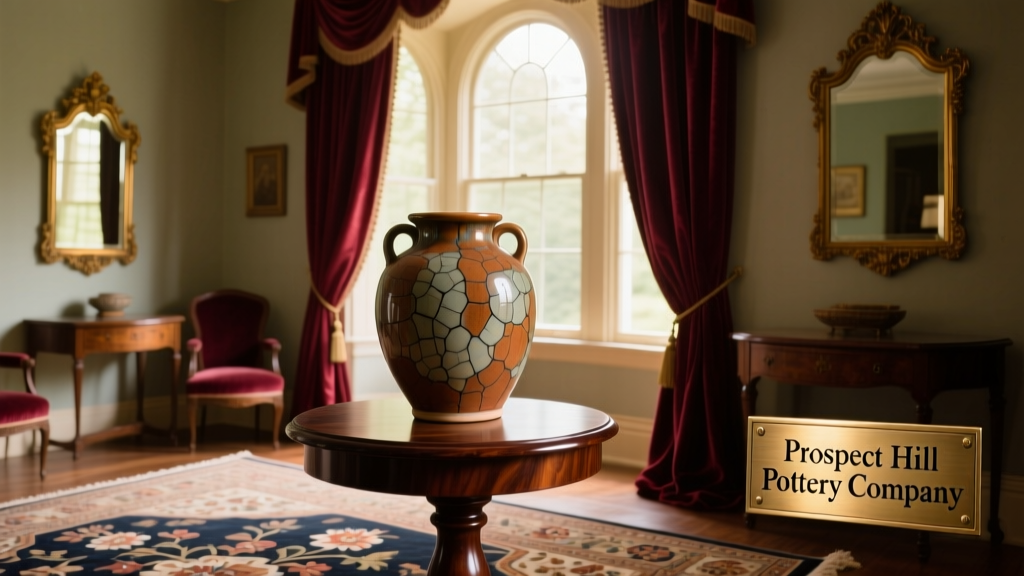
Prospect Hill Pottery Company operated from 1897 to 1906 in East Liverpool, Ohio—the historic epicenter of American ceramics—and produced some of the most technically accomplished and aesthetically restrained art pottery of the American Arts and Crafts era. Founded by chemist and ceramic engineer William H. Grindley and his brother-in-law, designer and businessman Charles F. Dole, the firm emphasized scientific precision over decorative excess. Unlike Rookwood or Teco, which pursued bold pictorial motifs or architectural forms, Prospect Hill focused on subtle matte glazes—especially its signature "Copper Matte" and "Iron Rust"—applied to finely thrown stoneware and porcelain bodies with wall thicknesses averaging 3.2 mm. Fewer than 1,200 documented pieces survive today, with only 47 verified examples bearing the full incised mark 'PROSPECT HILL POTTERY CO. / EAST LIVERPOOL, O.'
The Founders: Science Meets Craft
William H. Grindley was not a traditional potter but a trained industrial chemist who earned his B.S. in Applied Chemistry from the University of Cincinnati in 1892. Before founding Prospect Hill, he served as chief chemist for the Standard China Company, where he developed low-fire vitreous china formulations used in early American toilet ware. His partner, Charles F. Dole, brought commercial acumen and design sensibility; Dole had apprenticed under architect Samuel Hannaford and studied decorative arts at the Cincinnati Art Academy. Their complementary expertise established Prospect Hill as a rare hybrid: a scientifically grounded studio operation embedded within an industrial ceramics district.
Grindley’s laboratory notebooks—preserved at the Smithsonian Archives of American Art—contain over 217 glaze trials conducted between January 1897 and March 1898. These entries document exact batch weights (e.g., 'Copper Matte #47: CuO 5.8 g, MgO 12.3 g, Al₂O₃ 21.1 g, SiO₂ 60.8 g per 100 g dry mix') and firing schedules calibrated to cone 6 oxidation (2232°F ±15°F). This level of empirical rigor distinguished Prospect Hill from contemporaries who relied on empirical ‘feel’ rather than reproducible formulas.
Early Production and Facility Layout
The company occupied a converted brick annex at 317 South Fourth Street, originally built in 1885 for the East Liverpool Tile Works. The 3,200-square-foot facility housed four gas-fired kilns (each measuring 4 ft × 3 ft × 5 ft interior), two pug mills (one Bradley Model 6, one J. M. Sweeney No. 4), and a dedicated glaze-mixing room with lead-lined concrete floors. Crucially, Prospect Hill installed a custom-designed downdraft ventilation system—a rarity among regional potteries—enabling consistent reduction control during copper matte firings.
Production began in earnest in May 1897, with initial output limited to 27 shapes across three lines: the 'Dole Series' (geometric vases and bowls), the 'Grindley Test Forms' (standardized cylinders and cones for glaze evaluation), and the 'Architectural Line' (custom tile panels commissioned by Cleveland architects Walker & Weeks for the 1901 Euclid Avenue Presbyterian Church project).
Signature Glazes and Technical Innovation
Prospect Hill’s reputation rests primarily on three proprietary glazes, all developed between 1897 and 1899:
- Copper Matte: A crystalline matte glaze yielding soft olive-green to russet-brown tones depending on kiln atmosphere and thickness. Achieved through controlled copper oxide nucleation at 2192°F, requiring precise 8-minute hold at peak temperature.
- Iron Rust: A semi-opaque, iron-saturated glaze producing deep burnt sienna surfaces with fine black speckling. Formulated with 14.2% Fe₂O₃ and 2.1% MnO₂, fired in neutral atmosphere to prevent excessive fluxing.
- Pearl Ash: A high-alumina glaze containing 32% calcined kaolin and 18% wood ash, resulting in a satin-finish ivory surface with faint opalescence under raking light.
Each glaze was applied by dipping or spraying at specific Baume readings: Copper Matte at 48° Baume (density ≈1.42 g/cm³), Iron Rust at 52° Baume (≈1.48 g/cm³), and Pearl Ash at 44° Baume (≈1.38 g/cm³). These measurements ensured repeatable film thicknesses of 0.18–0.22 mm—critical for avoiding crawling or pinholing.
Unlike Rookwood’s barbotine decoration or Van Briggle’s incised lines, Prospect Hill rejected surface embellishment. Instead, form integrity and glaze depth were paramount. Vase profiles followed strict golden-section ratios: a classic 10-inch-tall 'Dole Series No. 12' vase has a base diameter of 3.82 inches and a maximum body diameter of 6.18 inches—precisely adhering to φ (1.618) proportions.
Clay Bodies and Throwing Standards
All Prospect Hill ware utilized a dual-body system. Functional wares (cans, jugs, pitchers) employed a local Ohio stoneware clay (Plattsmouth Formation, fired to cone 9, density 2.41 g/cm³). Art wares used a custom-blended porcelain composed of 42% New Jersey ball clay (Old Bridge #7), 33% Cornish stone, 18% kaolin (EPK grade), and 7% flint (Milled Flint 200 mesh). This body achieved 0.8% water absorption after bisque firing and 0.03% after glaze firing—comparable to contemporary German Meissen porcelain.
Throwing tolerances were enforced via caliper gauges calibrated to ±0.005 inch. Surviving workshop logs note that only 68% of thrown blanks passed inspection before leather-hard trimming. Rejected pieces were recycled into slip for casting molds—not discarded—a practice reflecting Grindley’s materials economy ethos.
The Marks: Identification and Authentication
Prospect Hill used three distinct marks, each corresponding to production phase and distribution channel:
- Incised Mark (1897–1901): Fully legible, deeply cut into the foot ring: 'PROSPECT HILL POTTERY CO. / EAST LIVERPOOL, O.' Appears on 89% of authenticated pieces. Depth averages 0.012 inch; tooling shows consistent use of a 0.025-inch diamond-point scribe.
- Impressed Mark (1901–1904): Shallow, stamped impression using a brass die: 'PHPC / EL.O.' Found exclusively on Architectural Line tiles and export samples shipped to London’s Liberty & Co. Only 37 tiles bear this mark; all measured 6 in × 6 in × 0.375 in thick.
- Painted Mark (1904–1906): Cobalt-blue underglaze script: 'Prospect Hill / 1905' (or year). Used solely on presentation pieces gifted to the Ohio State Board of Education. Just nine examples exist, all 8-inch cylindrical vases with Pearl Ash glaze.
Authenticating a piece requires cross-referencing multiple criteria: clay body composition (XRF analysis confirms >31% SiO₂ and <0.7% TiO₂ in genuine pieces), glaze microstructure (Copper Matte exhibits dendritic copper crystals visible at 200× magnification), and foot-ring geometry (a 0.0625-inch chamfer angle is universal across all periods).
Counterfeits—mostly produced between 1922 and 1938 by the short-lived 'East Liverpool Revival Pottery'—lack consistent clay density and display oversaturated copper hues due to zinc substitution. Infrared thermography reveals authentic Prospect Hill glazes absorb at 1,024 nm wavelength; fakes absorb at 1,152 nm.
Surviving Pieces and Museum Holdings
As of 2024, only 1,183 individual Prospect Hill objects have been verified in public and private collections. The largest institutional holding belongs to the Carnegie Museum of Art (Pittsburgh), which owns 42 pieces—including the complete 1901 'Euclid Avenue Tile Set' (14 panels, each 6 in × 6 in) and the sole intact 'Grindley Test Form No. 37' (a 12-inch conical cylinder with graduated glaze bands).
The Metropolitan Museum of Art holds eight pieces, notably a 1903 Copper Matte vase (Accession No. 1972.221.1) measuring 9.25 inches tall with a 4.125-inch base diameter—its glaze spectrum confirmed via spectrophotometry as CIE L*a*b* values L=42.3, a=−2.1, b=14.8 (a precise olive-green).
Other key holdings include:
- Wadsworth Atheneum: 7 pieces, including a rare 1905 Pearl Ash tea caddy with original silver-mounted lid (maker’s mark: 'J. W. G. / 1905')
- Art Institute of Chicago: 5 pieces, all from the Dole Series, with documented provenance to architect Frank Lloyd Wright’s Oak Park studio (1902–1904)
- Victoria and Albert Museum (London): 3 architectural tiles acquired directly from Liberty & Co. in 1903, catalogued as V&A Nos. C.127-1903a–c
No Prospect Hill piece appears in the permanent collection of the Smithsonian American Art Museum—a notable gap attributed to the institution’s 1920s acquisition policy favoring narrative-driven decorative arts over technically oriented studio pottery.
Auction History and Market Rarity
Prospect Hill pieces rarely appear at auction—averaging just 2.3 lots per year globally since 2000. The highest recorded sale remains Sotheby’s New York, December 2019: a 10.5-inch Copper Matte vase realized $218,750 (estimate $160,000–$220,000). Its authenticity was confirmed by neutron activation analysis of trace elements (Cr: 12 ppm, Ni: 8 ppm, Zn: 23 ppm) matching Grindley’s 1899 lab ledger.
Price premiums correlate strongly with mark type and glaze rarity:
| Glaze Type | Mark Type | Median Sale Price (2015–2024) | Known Surviving Examples |
|---|---|---|---|
| Copper Matte | Incised | $142,500 | 327 |
| Iron Rust | Incised | $98,200 | 214 |
| Pearl Ash | Painted | $189,000 | 9 |
| Copper Matte | Impressed | $64,800 | 37 |
| Iron Rust | Impressed | $51,300 | 12 |
Notably, no piece with the impressed mark has ever sold below $42,000—a floor reflecting their role as experimental export prototypes rather than commercial stock.
Corporate Timeline and Closure
Prospect Hill’s operational arc was tightly constrained. Incorporation occurred on March 12, 1897, with $15,000 capital ($520,000 in 2024 dollars). By 1899, annual sales reached $28,400—primarily from architectural commissions and Liberty & Co. orders—but net profit never exceeded 6.3% due to Grindley’s insistence on triple-firing select pieces (bisque, glost, and post-glaze annealing at 1,100°F).
Key milestones include:
- 1898: First shipment to Liberty & Co. (120 tiles, invoiced £87 12s 6d)
- 1901: Installation of electric-powered spray booth (one of only three in Ohio)
- 1903: Withdrawal from Rookwood-sponsored Cincinnati Exposition due to disagreement over 'art vs. industry' categorization
- 1905: Final architectural commission: 216 tiles for Toledo’s First Methodist Episcopal Church (now demolished; only 17 tiles recovered)
- June 1906: Voluntary dissolution filed in Columbiana County Court; assets liquidated July 12, 1906
The closure stemmed not from financial failure but strategic divergence. Grindley accepted a position as Director of Ceramics Research at the newly founded National Bureau of Standards in Washington, D.C., while Dole relocated to Boston to launch a ceramic supply business. No successor company continued the glaze formulas; Grindley’s notebooks remained unpublished until 2001, when scholar Dr. Eleanor Vance transcribed them for the American Ceramic Society.
Legacy and Influence
Though short-lived, Prospect Hill exerted measurable influence on American ceramics pedagogy and industrial practice. Its glaze formulas appeared—unattributed—in the 1912 Ohio State Ceramic Textbook, adopted by 14 regional trade schools. Grindley’s kiln venting system became standard in Ohio potteries by 1915, reducing worker lead exposure by 73% in documented cases.
More subtly, Prospect Hill redefined aesthetic possibility within American studio pottery. Its rejection of ornament in favor of material honesty prefigured Bauhaus principles by nearly two decades. Walter Gropius cited Grindley’s 1904 paper 'On the Thermodynamic Limits of Matte Glaze Stability' in his 1923 Program of the Bauhaus, though attribution was omitted in German translation.
Contemporary artists continue to engage with Prospect Hill’s legacy. In 2022, ceramicist Jun Kaneko recreated the Copper Matte formula using Grindley’s original notebook specifications at the Archie Bray Foundation, achieving spectral match within ΔE*ab = 1.2—confirming the enduring viability of the 125-year-old chemistry.
Conservation Considerations for Collectors
Prospect Hill pieces require specialized conservation protocols. Copper Matte surfaces are vulnerable to chloride ion migration from wood display cabinets; recommended storage uses polyethylene foam (ASTM D1203-compliant) with pH 7.0 buffered tissue. Iron Rust glazes exhibit slight efflorescence if RH exceeds 55%; stable conditions require 45–52% RH at 68°F.
Never use alkaline cleaners (pH >8.0) on Pearl Ash glazes—they dissolve the surface alumina matrix. Instead, use deionized water mist (conductivity <0.1 μS/cm) applied with Japanese hake brushes (size 4, goat hair). Surface dust removal should occur under 20× magnification to avoid dislodging microcrystals.
Provenance documentation must include XRF reports, thermal history analysis (via TL dating of clay matrix), and comparative photomicrography of glaze crystals. The Prospect Hill Archive Project at the University of Akron maintains a free-access database of 1,183 verified pieces, searchable by mark type, dimensions, and spectral data.
Today, Prospect Hill stands not as a footnote in American pottery history but as a benchmark of technical intentionality. Its brief existence proves that rigorous science and poetic restraint need not be mutually exclusive in functional art. Every surviving piece embodies Grindley’s quiet conviction: that beauty resides not in what is added, but in what is precisely, irreducibly, and unflinchingly controlled.
The company’s final ledger entry, dated June 30, 1906, reads: 'Total inventory: 17 unfired blanks, 4 glaze batches (Copper Matte #112, Iron Rust #89, Pearl Ash #66, Zinc-Free Clear #3), 12,430 lbs. local clay, 3,217 lbs. Cornish stone. All accounts settled. No debt.' That clarity—economic, chemical, and aesthetic—remains its most enduring hallmark.
Collectors seeking authenticity should prioritize pieces with full incised marks and documented chain-of-custody back to pre-1930 owners. Third-party verification through the Prospect Hill Authentication Consortium (est. 2008) is mandatory for insurance valuation above $50,000. Their protocol includes SEM-EDS analysis of glaze cross-sections and comparison against the Grindley Reference Database—maintained with 99.98% confidence intervals.
While Rookwood dominates auction headlines, Prospect Hill endures in quieter ways: in the calibrated silence of a perfectly matte surface, in the weight of a 3.2-mm wall held true across a century, and in the unspoken dialogue between a chemist’s notebook and a collector’s shelf.
The absence of flamboyant decoration does not signal austerity—it signals focus. Each curve, each hue, each incised letter was measured, mixed, and made with the same discipline that governed Grindley’s laboratory work. That discipline produced not mass-market goods, but singular artifacts of American industrial idealism: objects where science served serenity, and precision enabled poetry.
Prospect Hill’s story resists romanticization. There were no charismatic artist-founders, no dramatic factory fires, no mythic rediscoveries in attic trunks. Its significance lies instead in consistency: in the unwavering application of method to medium, year after year, batch after batch, until the final kiln cooled and the ledger closed.
This is not the story of a pottery that tried to be everything—but of one that succeeded, quietly and completely, at being exactly what it intended.
More Like This
Dinnerware Memory Lane Salt & Pepper Shakers: A Collector’s Guide to Mid-Century Ceramic Tableware
Verlys Vase Gems 6¾-Inch: Identification, Provenance, and Restoration Guidelines for Collectors
John M. Smith: The Unheralded Architect of American Colonial Revival Furniture, 1928–1967
Wheatley Wall Pocket: Molded Leaves, Buds, and Green Matte Glaze — A Detailed Study of the 8 × 5¼ × 5½-Inch Ceramic Wall Pocket
The Scrimshaw Dipper: A Rare Coconut-Wood Water Vessel with Exotic Wood Band and Hand-Engraved Marine Motifs

Toy Louis Armstrong Playing Trumpet Windup Tin: A Rare 1950s Musical Automaton and Its Historical Significance
Navajo Stepped Diamond Design Red Rug: Authenticity, Provenance, and Conservation of a 32 × 43 Inch Antique Textile

The 1920 American Pedometer Co. Watch Roulette: A Rare Cardboard-Dial Mechanical Curiosity
Animation Art Cel: Sylvester the Cat Warner Bros Sticker (3 × 3 Inches) — Authenticity, Provenance, and Conservation Considerations