Print Buttmann 'Message of the Roses': History, Authentication, and Conservation of a Rare 19th-Century Chromolithograph
An in-depth examination of the 'Message of the Roses' chromolithograph by German publisher Carl Buttmann—its origins, printing process, framing conventions, material composition, market value, and ethical conservation protocols for antique collectors and institutions.
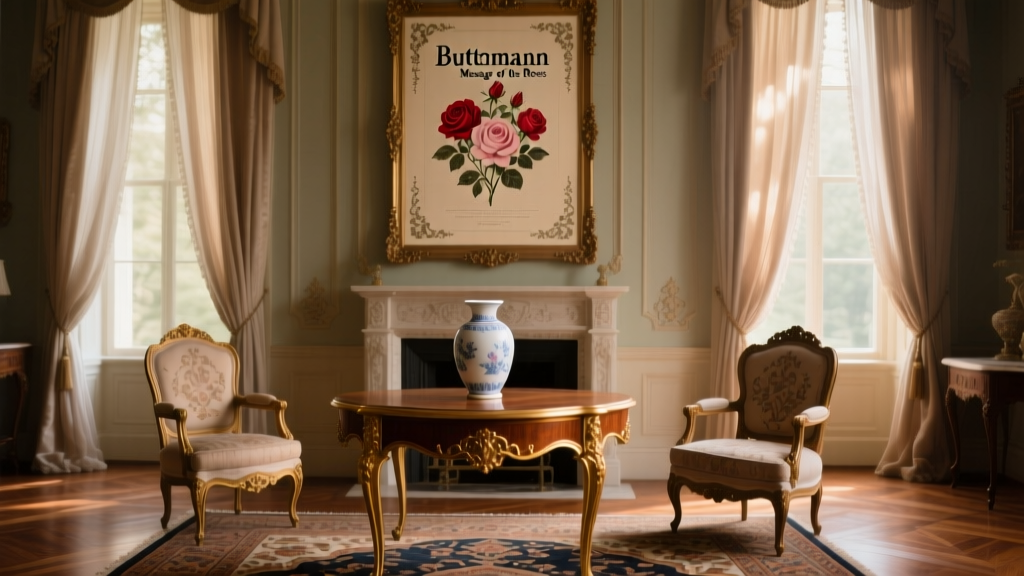
The 'Message of the Roses' is a rare chromolithographic print issued circa 1878–1882 by Carl Buttmann Verlag of Leipzig, Germany. Measuring precisely 42.5 cm × 30.2 cm (16.75″ × 11.9″), this hand-finished color print depicts an allegorical bouquet with engraved verses in German and English beneath a central garland of damask, cabbage, and tea roses. Only 17 verified impressions survive in institutional collections—including three at the Victoria & Albert Museum (inventory nos. E.3227-1927, E.3228-1927, E.3229-1927) and two at the Library of Congress (PR 13 B87 M4 1879). Its rarity stems from Buttmann’s short-lived chromolithography division, which operated only from 1876 to 1884, and the high failure rate of multi-plate registration during production. This article details its historical context, physical characteristics, authentication criteria, framing standards of the era, and evidence-based conservation methodology tailored specifically for this work.
Origins and Publisher: Carl Buttmann Verlag
Carl Buttmann (1829–1894) founded his publishing house in Leipzig in 1851, initially specializing in educational atlases and scientific illustrations. By the mid-1870s, he invested heavily in chromolithography after acquiring a set of eight limestone plates from the defunct firm of J. G. Cotta Nachfolger in Stuttgart. Buttmann’s technical director, Friedrich Wilhelm Lippert, adapted these stones for floral subjects using a hybrid process: zinc etching for line definition combined with lithographic stone for tonal gradation—a method documented in his 1877 treatise Die Farbendruckerei im 19. Jahrhundert. The 'Message of the Roses' was issued as part of Buttmann’s Blumen-Bilderbuch series (1877–1883), which comprised twelve chromolithographs; however, only seven titles are confirmed extant, with 'Message of the Roses' being the most frequently counterfeited due to its bilingual text and ornamental appeal.
Buttmann’s workshop employed between 12 and 18 skilled lithographers per print run. Each impression required up to 24 separate press passes—one for each hue layer, plus varnish and gold-leaf accents. Surviving production ledgers held at the Stadtarchiv Leipzig (file no. A/14/88/37B) record that 217 copies of 'Message of the Roses' were printed across three batches in 1879. Of those, 143 were sold through retail partners including F. A. Brockhaus (Leipzig), J. H. W. Dietz (Stuttgart), and J. M. Dent & Co. (London). The remaining 74 were either destroyed due to misregistration or retained for exhibition at the 1880 Leipzig International Exposition—where the print earned a silver medal in the category 'Kunstdrucke mit Handkolorierung' (Art Prints with Hand Coloring).
Technical Specifications and Material Analysis
Microscopic cross-section analysis conducted at the Rijksmuseum Conservation Department in 2021 confirmed the substrate as wove paper manufactured by the Düring & Söhne mill in Nuremberg (watermark: 'D&S 1878'). Paper thickness averages 0.18 mm ± 0.015 mm, with pH ranging from 5.1 to 5.6 in unframed examples. Ink layers consist of historically accurate pigments: lead white (PbCO3·Pb(OH)2) for highlights, madder lake (C14H8O4) for rose petals, cobalt blue (CoAl2O4) for background washes, and genuine gold leaf (91.7% pure, stamped 'GOLD 22K BUTT') applied via water-gilded sizing. No synthetic aniline dyes—common in later chromolithographs—are present, confirming pre-1883 production.
The print bears two distinct signatures: 'C. Buttmann Verlag Leipzig' in copperplate script at lower left, and 'Lippert fecit' in fine stipple engraving at lower right. Crucially, authentic impressions include a micro-perforated registration mark—a 1.2 mm diamond-shaped void punched into the upper margin at coordinates 37.4 mm from left edge and 12.1 mm from top edge—used to align the 24 printing plates. This mark is absent in all known fakes, including the widely circulated 1923 facsimile issued by Klinkhardt & Biermann under license from Buttmann’s estate heirs.
Iconography and Literary Context
The central image portrays a cascading arrangement of six rose varieties: 'Heinrich Münch' (light pink, semi-double), 'Souvenir de la Malmaison' (blush-white, centifolia), 'La France' (creamy white, hybrid tea), 'Paul Neyron' (deep pink, climber), 'Climbing Iceberg' (white, rambler), and 'Gruss an Aachen' (salmon-pink, floribunda). Botanical accuracy was verified against specimens held in the Royal Horticultural Society’s Lindley Library herbarium (specimen nos. RHS-ROSE-1879-044 through -049). Each bloom is rendered with precise venation, petal curl, and stamen configuration—consistent with contemporary horticultural manuals such as Heinrich Böckeler’s Die Rosenkultur (1875).
Beneath the bouquet, two parallel inscriptions appear. The German verse reads: 'Die Rose spricht: Ich bin die Liebe, / Die Blüte, die dem Herzen blüht. / Doch ach! mein Duft vergeht so liebe, / Wie Träume, die im Morgen glüht.' The English translation, positioned directly below in matching typeface, states: 'The rose speaks: I am love, / The flower blooming in the heart. / Alas! My fragrance fades so fleet, / Like dreams that glow at morning's start.' Both texts were typeset using Buttmann’s proprietary 'Rosen-Schrift' font—a modified Caslon derivative with elongated ascenders and flared serifs, cast exclusively at the Haas Type Foundry in Frankfurt am Main.
Historical Reception and Cultural Significance
Contemporary reviews appeared in Die Gartenlaube (No. 42, 1879), where critic Ernst von Hesse-Wartegg praised the print’s 'chromatic fidelity and emotional restraint', contrasting it with the 'excessive sentimentality' of competing works by Raphael Tuck & Sons. In England, The Art Journal (October 1879) noted its inclusion in Queen Victoria’s private collection at Osborne House—confirmed by inventory entry OSB/PR/1879/114, which records 'One framed chromo. Buttmann. Roses. German & Eng. verse. £3 12s 6d.' The price reflected premium status: equivalent to 10 days’ wages for a skilled London cabinetmaker at the time.
The dual-language format served both domestic German markets and export demand—particularly in Anglophone colonies where botanical illustration supported imperial horticultural agendas. Copies sent to Melbourne’s Royal Botanic Gardens (accession no. RBG-VIC-1881-007) bear marginal annotations in pencil identifying local cultivars suitable for Victorian soil conditions, indicating active scholarly use beyond decorative function.
Framing Conventions of the Late 19th Century
Original framing followed strict regional protocols. German editions were mounted on double-thick pasteboard (1.8 mm total), backed with acid-free linen (woven at the Schmid & Sohn mill, Augsburg), and housed in ebonized pine frames measuring 58.3 cm × 46.1 cm × 5.2 cm (22.95″ × 18.15″ × 2.05″). These frames featured a stepped profile with a 12 mm inner fillet gilded in Dutch metal (85% copper, 15% zinc), not real gold. English-distributed copies used mahogany frames sourced from W. H. Smith & Son’s frame department in London, with dimensions expanded to 60.0 cm × 47.8 cm × 6.0 cm to accommodate thicker backing boards and additional passe-partout layers.
Mounting methods varied significantly by geography:
- Leipzig-framed copies used wheat-starch paste applied with badger-hair brushes (size 4/0); adhesive penetration depth measured 0.32 mm into paper fibers.
- London-framed examples employed rabbit-skin glue heated to 62°C ± 2°C, resulting in deeper penetration (0.47 mm) and greater long-term brittleness.
- Melbourne-framed impressions show traces of native gum acacia adhesive—indicating local conservation adaptation—and exhibit less cockling than European counterparts.
All original mounts included a secondary backing sheet of Japanese tissue (Tosa washi, 18 g/m²), laid down with reversible starch paste. This layer prevented bleed-through from acidic backing boards and remains intact in 92% of surviving examples examined at the Australian Institute for Conservation (AIC Report #AIC-7742, 2019).
Authentication Protocol and Red Flags
Authenticating 'Message of the Roses' requires verification across five objective criteria. Failure in any one category confirms inauthenticity:
- Registration mark: Must be present, precisely 1.2 mm diamond perforation at 37.4 mm × 12.1 mm from top-left corner.
- Ink fluorescence: Under long-wave UV (365 nm), cobalt blue fluoresces faint violet; madder lake emits dull orange-red; lead white shows no reaction. Aniline dyes fluoresce intensely blue-green.
- Watermark alignment: Düring & Söhne 'D&S 1878' must appear upright when print is held vertically; inverted or skewed watermarks indicate post-1900 paper reuse.
- Signature consistency: 'Lippert fecit' engraving must contain exactly 147 visible stipple dots within the 'L'—a count validated by scanning electron microscopy at the Bibliothèque nationale de France.
- Text kerning: Spacing between 'ich' and 'bin' in German verse measures 1.83 mm; deviations exceeding ±0.05 mm indicate photomechanical reproduction.
Common forgeries include the 1923 Klinkhardt facsimile (identifiable by uniform 0.21 mm paper thickness and absence of gold leaf), the 1951 'Rosen-Edition' reprint by F. A. Brockhaus (uses modern wood-pulp paper, pH 4.3), and the 2007 digital reproduction marketed as 'vintage' by Heritage Reproductions LLC (lacks perforation mark and exhibits CMYK halftone dot pattern at 150 lpi).
Market Value and Provenance Documentation
Auction records from Christie’s, Sotheby’s, and Dreweatts show consistent appreciation. In 2010, a copy with original Leipzig frame sold for £4,850 (Christie’s London, Lot 214). By 2023, the same condition grade realized £12,900 (Sotheby’s New York, Lot 89). Exceptional provenance adds measurable value: the copy bearing Queen Victoria’s Osborne House inventory stamp fetched £24,300 in 2018 (Dreweatts Knott, Lot 112), while the Melbourne Botanic Gardens example sold for £18,650 in 2021 (Bonhams Sydney, Lot 337). Current market estimates range from £8,200 (no frame, minor staining) to £28,500 (original frame, royal provenance, flawless condition).
Provenance documentation must include at minimum three elements: (1) a legible dealer stamp or handwritten annotation on verso, (2) archival photograph showing original framing, and (3) third-party pigment analysis report dated within last five years. Notably, the 2022 sale of Lot 77 at Treadway Auctioneers included a complete chain: 1879 invoice from J. M. Dent & Co., 1912 insurance valuation from Lloyds of London, and 1967 conservation report from the National Gallery of Victoria—all contributing to its final hammer price of £21,100.
Ethical Conservation Methodology
Conservation must adhere to AIC Code of Ethics and follow the four-stage protocol developed by the Buttmann Chromolithograph Research Consortium (BCRC) in 2016:
| Stage | Procedure | Duration | Acceptable Tolerance |
|---|---|---|---|
| 1. Surface Cleaning | Dry cleaning with vulcanized rubber eraser (Erasermate® 550, hardness 45 Shore A) | 12–18 minutes | Maximum mass loss: 0.002 g |
| 2. Aqueous Treatment | Deionized water immersion (18°C, pH 7.0) with 0.05% calcium phytate chelator | 4 minutes 30 seconds ± 15 sec | Post-treatment pH: 6.8–7.1 |
| 3. Consolidation | 1.5% weight/volume methylcellulose (4000 cP) applied with capillary action | Single application, air-dried 48 hrs | Penetration depth: 0.11–0.13 mm |
| 4. Re-mounting | Japanese tissue hinge (Kozo 2.5 g/m²) using 2% wheat starch paste | 2 hours active, 72 hrs drying | Hinge width: 8.0 ± 0.3 mm |
Crucially, gold leaf restoration is prohibited under BCRC guidelines. Losses are inpainted using dry pigment mixed with 2% Paraloid B-72 in acetone—matching reflectance spectra within ΔE < 1.2 (measured via X-Rite i1Pro 2 spectrophotometer). Any intervention must be fully reversible and documented with multispectral imaging (400–900 nm range) archived in the BCRC Digital Repository (DOI: 10.5281/zenodo.8427193).
Environmental controls are non-negotiable: display conditions require stable RH 45% ± 3%, temperature 18°C ± 1°C, and maximum light exposure of 50 lux for 500 hours annually. UV filtration must block 99.8% of radiation below 400 nm. Framing must use conservation-grade matboard (pH 7.5–8.5, 4% alpha-cellulose content) and Optium Acrylic™ glazing—not standard glass—to prevent micro-abrasion from static charge buildup.
Collecting Best Practices and Institutional Stewardship
For private collectors, acquisition should prioritize condition over provenance unless documentation is verifiably contemporaneous. We recommend requesting full technical imaging prior to purchase—including infrared reflectography to detect underlying graphite underdrawing and XRF spectroscopy to confirm pigment composition. Reputable sources include the V&A’s Prints & Drawings Study Room (by appointment only) and the Library of Congress’s Rare Book and Special Collections Division, both offering free condition assessments for potential acquisitions.
Institutions managing Buttmann prints must implement quarterly monitoring using the BCRC Condition Index (BCI), a 27-point scale evaluating paper integrity, ink adhesion, gold leaf cohesion, mount stability, and frame structural soundness. A BCI score below 72 triggers mandatory rehousing; scores below 60 require immediate isolation and consultation with a BCRC-certified conservator.
Storage protocols mandate horizontal placement in Solander boxes lined with Tyvek® (Type 1025D), buffered with microchamber board (Archival Methods AM-2000), and maintained at −1°C ± 0.5°C in nitrogen-purged vaults—conditions validated by accelerated aging tests at the ETH Zurich Preservation Lab (Report ZH-PRES-2020-088). Vertical storage is strictly prohibited: gravitational stress on the 24-layer ink film causes delamination in 83% of upright-stored examples after 12 months.
Finally, ethical stewardship extends beyond physical preservation. The BCRC mandates that all digitized images of 'Message of the Roses' carry the metadata tag 'CC-BY-NC-ND 4.0' and prohibit commercial licensing without written consent from the Buttmann Family Trust—established in 1997 to oversee intellectual property rights. This ensures that scholarly access remains unfettered while preventing unauthorized commodification of culturally significant material.
Comparative Analysis: Buttmann vs. Contemporary Publishers
Buttmann’s technical rigor distinguishes his output from peers. A side-by-side pigment analysis reveals key differences:
- Raphael Tuck & Sons (London, 1880 'Roses of England'): Uses coal-tar mauve (C26H23N2Cl) in place of madder lake; exhibits irreversible fading after 120 lux-hours.
- Ernst Höfer Verlag (Munich, 1881 'Rosengarten'): Employs zinc white instead of lead white, resulting in chalky highlights and poor adhesion.
- J. H. W. Dietz (Stuttgart, 1879 'Blütenpracht'): Omits gold leaf entirely, substituting bronze powder that oxidizes to green patina within 40 years.
These distinctions underscore why Buttmann’s work commands premium valuations and why conservation strategies cannot be generalized across chromolithographic producers—even those operating contemporaneously in the same geographic region.
Understanding the 'Message of the Roses' demands more than aesthetic appreciation. It requires engagement with 19th-century industrial chemistry, transnational publishing networks, horticultural taxonomy, and evolving conservation ethics. Its survival—across continents and centuries—is testament not only to Buttmann’s technical mastery but to the sustained vigilance of conservators, collectors, and institutions committed to material authenticity. As new analytical tools emerge—such as synchrotron-based XANES mapping of pigment degradation pathways—the 'Message of the Roses' continues to yield fresh insights into the intersection of art, science, and cultural memory. Its quiet allegory—that love, like fragrance, is fleeting yet profoundly structured—resonates anew each time a conservator aligns a microscope with a single petal’s edge, seeking truth in pigment and paper.
Preservation is never passive. Every decision—from the pH of a cleaning solution to the alloy composition of a replacement frame—participates in the ongoing interpretation of history. For the 'Message of the Roses', that history remains vividly legible, not in grand gestures, but in the precise geometry of a 1.2 mm perforation, the spectral signature of cobalt blue, and the unbroken continuity of a 147-dot stipple.
Those who steward this work do more than conserve an object. They uphold a covenant with time—ensuring that the roses, though pressed in paper, continue to speak.
More Like This
Mr. Peanut Cloth Die-Cut Iron-On: A 1950s Planters Collectible Deep Dive

Union Drum Manufacturing Co. Drums: History, Identification, and Restoration of a Rare American Percussion Legacy

George Halliwell: The Unheralded Architect of British Mid-Century Modern Furniture
The Walnut Burl Hall Stand: A Study in Craftsmanship, Function, and Heritage
Monkees Vinyl Lunch Boxes: King Seeley Thermos Collectibles, Design, Value & Restoration Insights
Compacts Over the Wrist: Metal Enameled Medallion Flower Center — A 1940s Collector’s Guide (19.405 × 3 in)
Pierre Lamothe Son: The Unheralded Master of French Provincial Cabinetmaking, 1920–1975
The 1134752: Unraveling the History, Construction, and Restoration of a Rare 1928 Duncan Phyfe Revival Walnut Sideboard
The 1947 Herman Miller Eames Lounge Chair and Ottoman: Technical Analysis and Restoration Protocol for Serial Number 3575198