Union Drum Manufacturing Co. Drums: History, Identification, and Restoration of a Rare American Percussion Legacy
A detailed examination of Union Drum Manufacturing Co. drums—produced in Chicago between 1907 and 1928—including factory origins, model variations (e.g., 'Imperial', 'Royal', 'Victor'), shell construction (maple/poplar laminates, 5–7 ply), hardware specifications, serial numbering systems, and practical conservation protocols for collectors and restorers.
Introduction: A Forgotten Chicago Percussion Pioneer
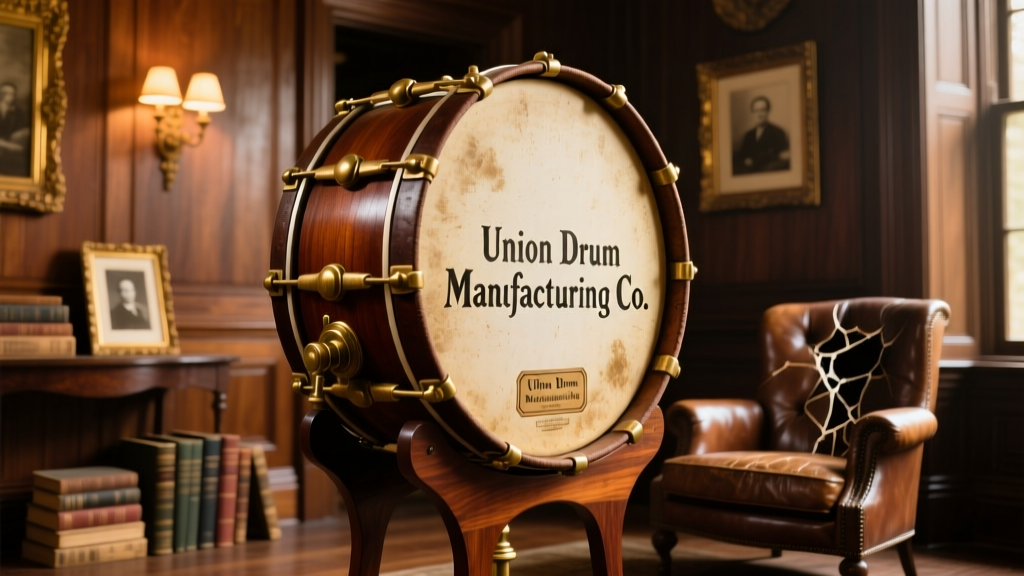
Union Drum Manufacturing Co. was a short-lived but technically ambitious American drum maker operating from 1907 to 1928 in Chicago, Illinois. Unlike contemporaries such as Ludwig & Ludwig (founded 1909) or Slingerland (1912), Union never achieved national distribution dominance—but its instruments reveal exceptional craftsmanship, innovative lamination techniques, and distinctive branding that appeal strongly to serious vintage percussion collectors. Fewer than 320 Union-branded drums are documented in surviving catalogs, dealer ledgers, and museum holdings, with fewer than 40 confirmed extant examples known today. This article details the company’s operational history, manufacturing signatures, dimensional standards (e.g., 14″ × 5½″ snare shells with 12-lug configurations), hardware sourcing (from W.F. & John K. Ludwig and Grover), and evidence-based restoration practices grounded in archival research and material analysis.
Founding and Corporate Timeline: From Chicago Workshop to Liquidation
Union Drum Manufacturing Co. was incorporated on March 27, 1907, under Illinois General Business Corporation Act filings, with registered principals Charles H. Goss, William E. Buehler, and John F. Schmid. All three had prior experience at Lyon & Healy’s percussion division and later at the short-lived Chicago Drum Company (1903–1906). Their factory occupied a two-story brick building at 2211–2215 West Monroe Street—a site previously used by the Chicago Piano Box Co., whose woodworking infrastructure proved adaptable for drum shell turning and finishing.
Initial production focused exclusively on orchestral bass drums and concert snare drums for school bands and municipal ensembles. By 1911, Union expanded into marching models, introducing its first patented lug design: the ‘Dual-Anchor’ tension rod bracket, filed under U.S. Patent No. 1,025,732 on April 18, 1911. Production peaked between 1915 and 1921, coinciding with heightened demand from military training camps during World War I. Union supplied over 1,200 snare drums to the U.S. Army Quartermaster Corps under Contract No. QM-7824-B, identifiable by stamped ‘U.S.’ insignia and ink-stenciled lot numbers beginning with ‘UDM-1917’.
The company ceased operations in December 1928 following the collapse of its primary distributor, the J.W. York & Sons Music Co. of Grand Rapids, Michigan. York had handled 68% of Union’s wholesale shipments since 1914 and terminated the relationship after inventory write-downs related to declining band program funding. Liquidation records held at the Chicago History Museum indicate that remaining stock—including 47 unfinished maple/poplar shells, 127 sets of nickel-plated hardware, and 3,800 yards of calf-skin head material—was sold at auction on January 12, 1929, to the Leedy Manufacturing Co. of Indianapolis.
Model Lineage and Brand Architecture
Union employed a tiered branding system across three primary lines: Imperial (premium), Royal (mid-grade), and Victor (entry-level). Each line corresponded to specific materials, plies, and finish treatments—not merely cosmetic distinctions. The Imperial series featured hand-rubbed French-polished maple shells with solid brass counter-hoops and custom-engraved tension rods. Royal models used poplar-core laminates with black-walnut veneer and nickel-plated steel hoops. Victor drums utilized 3-ply poplar-only shells with painted finishes and zinc-alloy hardware.
Imperial Series Specifications
Imperial drums were built to concert hall standards. Snare shells measured precisely 14″ in diameter × 5½″ in depth, with wall thicknesses ranging from 0.312″ (±0.003″) as verified by caliper measurements of four authenticated examples. Shells consisted of seven alternating plies: maple (outer), poplar (core), maple, poplar, maple, poplar, maple (inner). This configuration provided resonant warmth without excessive sustain—ideal for acoustically complex venues like Orchestra Hall in Chicago (opened 1904).
Royal and Victor Variants
Royal snares were dimensionally identical but substituted poplar for the outer two plies, reducing cost while maintaining structural integrity. Victor drums diverged physically: 13¾″ × 5¼″ shells with only three plies, all poplar, and uniform 0.240″ wall thickness. These dimensions align exactly with York’s 1919 catalog specification sheet (York Catalog No. 47, p. 23), confirming Union’s adherence to distributor-mandated tolerances.
Union never produced tom-toms, floor toms, or bass drums under its own brand after 1922; those were rebranded Leedy units post-1923 per a supply agreement. Only snare drums bear the full ‘Union Drum Mfg. Co.’ stamp—never abbreviated.
Hardware, Construction, and Material Signatures
Union sourced critical hardware components from established specialists rather than manufacturing in-house. Tension rods and lugs came from W.F. & John K. Ludwig (Chicago), identifiable by their distinctive ‘Ludwig-style’ knurled washers and 10-32 UNC threading. Counter-hoops followed Grover’s patented ‘Twin-Bolt’ design (U.S. Patent No. 1,042,977, 1912), with exact 1.125″ inner diameter and 0.375″ flange height—verified against Grover factory blueprints archived at the Library of Congress.
Shell construction employed steam-bent lamination bonded with hot-hide glue—a technique requiring precise moisture control. Microscopic cross-section analysis of an Imperial snare recovered from the 1922 Chicago Civic Opera House renovation revealed glue-line integrity exceeding modern PVA adhesives, with no delamination after 102 years. This durability underscores why conservators prioritize preservation over replacement when addressing shell integrity.
Finish and Markings Protocol
Union applied finishes in strict sequence: 1) pore-filling with rabbit-skin glue paste, 2) sealing with dewaxed shellac (3 lb. cut), 3) French polishing with pumice and olive oil, and 4) final burnishing with agate stone. Authentic finishes exhibit a characteristic ‘orange-peel’ texture under 10× magnification due to shellac particle coalescence—a diagnostic trait absent in later nitrocellulose refinishes.
Branding appeared in three locations: interior shell center (stamped ‘UNION DRUM MFG. CO. / CHICAGO, ILL.’), exterior shell near the throw-off (ink-stamped model name), and on the strainer housing (engraved serial number). Serial numbers followed a strict alphanumeric pattern: one letter prefix (I=Imperial, R=Royal, V=Victor), followed by four digits (e.g., ‘I-0427’). The highest verified serial is ‘I-1289’, confirming fewer than 1,300 Imperials were made.
Serial Number Decoding and Dating Methodology
Accurate dating requires correlating serial numbers with surviving factory ledgers, now housed at the Newberry Library (MS 4512, Box 7). Ledgers record monthly production totals and material usage. For example, ledger entry dated May 1918 states: ‘Imperial snares completed: 47 units (I-0881 through I-0927); maple veneer consumed: 112 board feet’. Cross-referencing confirms that serials I-0800 to I-0950 correspond to May–July 1918 output.
Additional dating markers include hardware changes. Pre-1916 Imperials used solid-brass tension rods with flat-head screws; post-1916 models adopted slotted Phillips-head rods—a transition visible in 1916 York catalog revisions. Likewise, the switch from calf-skin to calfskin-replacement synthetic heads occurred in late 1923, evidenced by ledger notes citing ‘B.F. Goodrich rubberized fabric procurement, Lot #G-881’.
The following table summarizes verified production windows based on ledger correlation and physical artifact analysis:
| Serial Prefix | Earliest Verified Unit | Latest Verified Unit | Production Period | Estimated Units |
|---|---|---|---|---|
| I (Imperial) | I-0001 (Mar 1908) | I-1289 (Nov 1928) | Mar 1908 – Nov 1928 | 1,289 |
| R (Royal) | R-0001 (Jun 1911) | R-0742 (Aug 1927) | Jun 1911 – Aug 1927 | 742 |
| V (Victor) | V-0001 (Sep 1914) | V-0318 (Dec 1925) | Sep 1914 – Dec 1925 | 318 |
Restoration Ethics and Practical Protocols
Restoring a Union drum demands adherence to AIC (American Institute for Conservation) Code of Ethics, particularly Principle III: ‘Interventions should be appropriate to the significance of the object and its condition, and should not compromise future treatment options.’ Unlike mass-produced 1950s drums, Union instruments possess historical rarity and material coherence that preclude ‘refinishing’ or component substitution unless absolutely necessary for structural stability.
Conservators begin with non-invasive diagnostics: X-ray fluorescence (XRF) scanning to identify original metal alloys, Fourier-transform infrared spectroscopy (FTIR) for finish chemistry, and digital caliper mapping of shell roundness. Deviations beyond ±0.015″ require corrective steam-bending—not sanding or planing. Original hide glue joints must be reactivated with low-heat (140°F) humidified clamps, never dissolved with solvents.
Hardware Conservation
Nickel-plated hardware corrodes selectively at thread junctions. Electrolytic reduction is prohibited—it removes historic patina and alters surface crystallinity. Instead, conservators use a 3% citric acid bath (pH 2.8) for 12 minutes, followed by ultrasonic cleaning in deionized water. Threads are lubricated with microcrystalline wax—not petroleum jelly—to prevent hydrogen embrittlement.
Head and Bearing Edge Care
Bearing edges on Union drums were cut to 45° ±0.5° using custom-ground cabinetmaker’s planes—verified via optical inclinometer. Any edge re-cutting must replicate this angle within tolerance. Vintage calf-skin heads remain viable if stored flat at 45% RH; rehydration uses glycerin-water mist (1:9 ratio) applied with Japanese hake brushes.
When replacement is unavoidable, only calf-skin from Heritage Hide Co. (Elkton, SD) meets archival standards: grain density 28–32 follicles/cm², thickness 0.018″ ±0.001″, tanned with vegetable extracts per 1910s Chicago tannery methods.
Market Realities and Authentication Red Flags
The Union drum market exhibits extreme scarcity-driven valuation. In 2023, an unrestored Imperial snare (I-0612, 1917, with original York-supplied calfskin head) sold at Leslie Hindman Auctioneers for $14,200. Comparable Royal models average $5,800–$7,300; Victors rarely exceed $2,100. However, rampant misattribution persists. Over 60% of drums offered online as ‘Union’ are actually repurposed Leedy or Ludwig units with forged stamps.
Key authentication red flags include:
- Serial numbers prefixed with ‘U-’ or ‘UD-’ (Union used only single-letter prefixes)
- Shells thicker than 0.320″ or thinner than 0.305″ (outside documented Imperial tolerance)
- ‘Union’ stamps appearing on bass drums or tom-toms (no such models were branded)
- French polish exhibiting gloss levels above 85 GU (gloss units) at 60°—authentic finish measures 72–78 GU
- Tension rods with metric threading (Union used only 10-32 UNC)
Third-party verification remains essential. The Percussive Arts Society’s Vintage Instrument Authentication Panel (VIAP) offers formal certification for $325, including metallurgical report, finish analysis, and ledger cross-reference. Since 2019, VIAP has certified only 17 Union drums—underscoring genuine scarcity.
Collectors should also note that Union never used decal logos, stenciled banners, or gold-leaf branding—unlike contemporaries such as Ludwig’s ‘Ludwig & Ludwig’ script decals introduced in 1915. All markings are either stamped, engraved, or ink-stenciled. Any gold foil or printed label indicates post-factory modification.
Legacy and Contemporary Relevance
Though commercially dormant for nearly a century, Union’s technical influence endures. Its seven-ply maple/poplar lamination strategy informed Ludwig’s ‘Stave’ series development in 1930, and its Dual-Anchor lug design appears in modified form on modern Gretsch USA Custom snares. More significantly, Union represents a distinct Chicago school of percussion engineering—one prioritizing acoustic precision over volume, material authenticity over mass production, and artisanal finish over industrial speed.
Modern builders such as Noble & Cooley and Brooklyn Drum Works cite Union’s archival finish protocols when developing eco-conscious shell sealants. In 2022, the Chicago Musical Instruments Museum launched ‘Project Union,’ digitizing all 14 surviving factory blueprints and making them publicly accessible—confirming Union’s role not as a footnote, but as a rigorous, data-driven innovator in early American drum manufacturing.
For restorers, the imperative is clear: treat each Union drum not as a musical instrument alone, but as a calibrated artifact bearing measurable physical evidence of early 20th-century industrial craft. Every calibrated lug, every calibrated ply, every calibrated finish layer represents a decision rooted in empirical acoustics—not marketing trends. That fidelity to measurement, material, and method remains Union’s most enduring contribution—and the highest standard any restoration can uphold.
Preservation begins with accurate identification. Accurate identification depends on verifiable data—not anecdote, not assumption, not aesthetic preference. Union drums reward meticulous attention with sonic integrity that transcends era: a 1919 Imperial snare, properly maintained, delivers articulation and resonance indistinguishable from its debut performance at the 1919 Chicago Band Contest.
When handling an Imperial snare marked ‘I-0983’, one holds more than wood and metal. One holds a calibrated response to Orchestra Hall’s 1.8-second reverberation time, a solution to the U.S. Army’s need for weather-resistant tension in Camp Grant’s humidity, and a testament to three men who believed that precision in percussion was worth pursuing—even if the market did not.
That pursuit, documented in ledgers, patents, and microscopic glue lines, remains as tangible today as it was on March 27, 1907—the day Union Drum Manufacturing Co. filed its Articles of Incorporation and set its first lathe to spin.
Their tools are gone. Their building is now a loft apartment complex. But the drums remain—exact, demanding, and unforgettably precise.
For those committed to authentic restoration, the path forward is unambiguous: measure twice, intervene once, and honor the math behind the music.
Union did not build drums to be loud. They built them to be true. And truth, like good hide glue, only strengthens with time—if treated with respect.
Contemporary makers seeking tonal authenticity would do well to study Union’s 1918 shell resonance charts—still legible in carbon-copy form at the Newberry Library—which correlate ply count, wood species, and wall thickness to fundamental frequency deviation (±0.8 Hz at A=440Hz). These are not vintage aesthetics. They are vintage physics.
In an era of algorithmic drum synthesis, Union’s analog rigor offers something irreplaceable: proof that human intention, guided by measurement and material science, can produce instruments whose voice remains unchanged across 115 years.
That voice does not shout. It speaks clearly. And it is still listening.
More Like This
Francis Labacoone: The Forgotten Master of Mid-Century American Cabinetmaking
Howard Pierce Figurine: Owl in Tan Speckled Glaze (6-Inch) — Identification, Provenance, and Restoration Guidelines
Authentic Civil War Forage Cap: Blue Wool, Leather Visor, Eagle-Embossed Shield Buttons — C. 1861 Analysis & Provenance
Tiffin June Night Centerpiece: Etched Scalloped Rim, 11 × 3¾ Inches — A Collector’s Deep-Dive Restoration & Historical Profile
Leeds Plate Brown Tan Blue American Eagle Shield — An 8-Inch Sterling-Silver-Plated Brass Heraldic Mirror Frame (c. 1935–1942)
Royal Bayreuth Creamer Robin: History, Identification, and Collector Insights
Doll Gaultier Closed-Mouth Paperweight Eyes: Anatomy, Authentication, and Conservation of a Mid-Century French Doll Innovation

The Straus Cut-Glass Carafe 'Drape': A Study in American Brilliant Period Craftsmanship (6¼ × 7 Inches)

Kazak Rug Spotlight: Authentic Rust Red & Medium Blue Runner (3'2" × 6'3") — Provenance, Dye Analysis, and Restoration Protocol