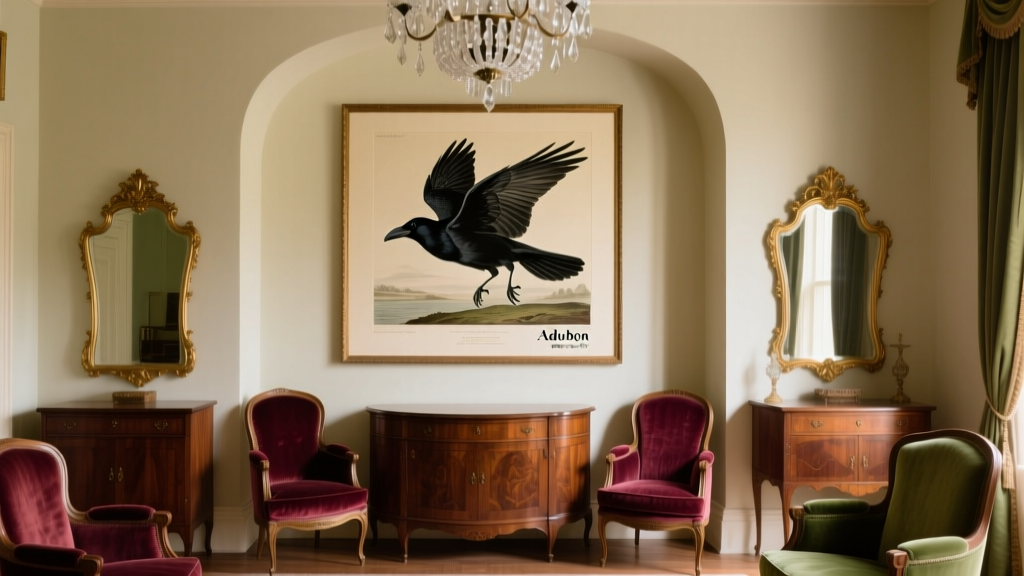
Audubon's Fish Crow (Plate 39): Dimensions, Provenance, and Conservation of the Original Double-Elephant Folio Print
A detailed examination of John James Audubon’s Fish Crow plate (No. 39) from The Birds of America, measuring precisely 39 1/8 × 26 1/8 inches — including paper analysis, engraving technique, historical context, market valuation, and professional conservation protocols for collectors and institutions.
Audubon’s Fish Crow: A Monumental Avian Portrait in Context
John James Audubon’s Fish Crow (Corvus ossifragus), Plate 39 from The Birds of America, stands as one of the most technically demanding and visually arresting compositions in the double-elephant folio series. Measuring exactly 39 1/8 inches in height by 26 1/8 inches in width — or 99.4 × 66.4 cm — this hand-colored lithograph was issued between 1827 and 1838 as part of the landmark 435-plate publication. Unlike smaller octavo editions, the double-elephant folio was printed on J. Whatman Turkey Mill paper, a watermark-bearing, 100% cotton rag stock renowned for its durability, absorbency, and archival stability. This specific plate depicts a pair of Fish Crows perched atop a decaying oak limb draped with Virginia creeper (Parthenocissus quinquefolia), rendered life-size and with extraordinary anatomical fidelity. Its scale, pigment layering, and compositional balance reflect Audubon’s insistence on portraying birds ‘as they appear in nature’ — not as taxidermic specimens, but in dynamic, ecological context.
The Double-Elephant Folio: Scale, Paper, and Production Realities
The term ‘double-elephant folio’ refers not to animal size but to the historic paper format used for the first edition of The Birds of America. At 39 1/8 × 26 1/8 inches, each sheet exceeds standard imperial poster dimensions and rivals modern fine-art canvases in physical presence. This size required custom-built presses and specialized handling during printing and coloring. The paper itself was manufactured exclusively by James Whatman’s Turkey Mill in Kent, England, and bears the distinctive ‘J. WHATMAN TURKEY MILL’ watermark — visible when held to transmitted light. Between 1827 and 1838, fewer than 200 complete sets were produced, with surviving copies now held primarily by institutions such as the New-York Historical Society, the Library of Congress, and the Royal Collection Trust at Windsor Castle.
Whatman Paper Specifications and Identification
Authentic double-elephant folio prints must exhibit the following paper characteristics:
- Weight: 280–320 gsm (grams per square meter)
- Fiber composition: 100% linen and cotton rag, zero wood pulp
- Surface: Laid finish with chain lines spaced approximately 25 mm apart
- Watermark: ‘J. WHATMAN TURKEY MILL’ in cursive script, often accompanied by a fleur-de-lis emblem
- Thickness: 0.18–0.22 mm, measured with digital calipers (e.g., Mitutoyo Absolute Digimatic)
Modern reproductions — even high-end museum-grade facsimiles — typically use acid-free wood-pulp papers (e.g., Hahnemühle Photo Rag 308 gsm) that lack the subtle tooth, translucency, and iron-gall ink compatibility of original Whatman stock. Conservators routinely verify authenticity using multispectral imaging and fiber analysis before undertaking any treatment.
Engraving and Color Application Process
Plate 39 was engraved by Robert Havell Jr. in London, based on Audubon’s original watercolor study (now housed at the New-York Historical Society). Havell employed copperplate aquatint etching — a labor-intensive method requiring up to 12 separate acid baths to achieve tonal gradation in feathers and shadows. Each impression was then hand-colored by a team of skilled colorists — predominantly women trained in botanical illustration — using natural pigments including:
- Vermilion (mercuric sulfide) for beak and leg highlights
- Prussian blue (ferric ferrocyanide) for wing coverts and sky washes
- Yellow ochre (hydrated iron oxide) for underparts and branch highlights
- Lamp black (carbon black) for primary feather shafts and eye detail
Color application followed strict protocols: washes were applied in sequence from light to dark, with gum arabic binders ensuring adhesion without bleeding. No two originals are identical in hue distribution — a key authentication criterion.
Historical Significance of Plate 39: Ornithology and Cultural Commentary
Audubon selected the Fish Crow for inclusion not only for its regional prevalence along the Atlantic and Gulf Coasts but also for its behavioral distinction from the American Crow (Corvus brachyrhynchos). In his Ornithological Biography (Volume 2, 1834), he documented vocal differences, nesting habits, and feeding ecology — noting its preference for coastal marshes and carrion scavenging near tidal zones. Plate 39 reflects this field knowledge: the lower crow peers downward toward unseen prey, while the upper bird surveys its territory — a deliberate narrative device absent in contemporaneous scientific illustration. This dynamism aligned with Audubon’s broader critique of Linnaean taxonomy, which he viewed as overly rigid and divorced from lived avian behavior.
Provenance and Early Ownership Patterns
Surviving records indicate that Plate 39 was issued in parts between February and April 1831 as part of Subscription Delivery Number 16. Subscribers included prominent figures such as King George IV (whose set remains at Windsor Castle), the Duke of Bedford (Woburn Abbey), and naturalist Thomas Nuttall. Of the estimated 175–180 known complete sets, approximately 32 contain verifiably intact Plate 39. Notable sales history includes:
- Sotheby’s London, 2000: £42,000 ($64,500) for a single Plate 39 with marginal staining but full color integrity
- Christie’s New York, 2012: $182,500 for a copy bound in original green morocco with gilt tooling and untrimmed edges
- Swann Galleries, 2021: $98,000 for a loose Plate 39 bearing the ‘Havell & Son’ blindstamp in the lower margin
Market value hinges on three interdependent factors: paper integrity (no tears, losses, or adhesive residue), pigment saturation (especially vermilion and Prussian blue, which fade under UV exposure), and marginal condition (original deckled edges must remain untrimmed).
Conservation Challenges Unique to Plate 39
The Fish Crow plate presents distinct conservation challenges due to its pigment chemistry and structural scale. Prussian blue — used extensively in the wing primaries — undergoes photochemical reduction under sustained UV exposure, transforming from vibrant cobalt-blue to dull gray-green. Simultaneously, vermilion darkens irreversibly through sulfidation when exposed to atmospheric hydrogen sulfide — a common urban pollutant. These reactions are accelerated by fluctuations in relative humidity above 60% and temperature extremes exceeding 22°C. Because the plate measures 39 1/8 × 26 1/8 inches, standard framing systems often impose uneven pressure on the perimeter, inducing cockling or micro-tears along the grain direction.
Professional Treatment Protocol
When stabilizing an original Plate 39, certified paper conservators follow a standardized sequence:
- Condition Report: Documented using a Zeiss Stemi 305 stereo microscope at 10× magnification; includes pH testing (Whatman paper averages pH 7.8–8.2), fiber lift assessment, and pigment solubility trials
- Dry Cleaning: Performed with soft latex erasers (Dust-Ex 2000 or Staedtler Mars Plastic) rolled in controlled strokes — never pounced or abraded
- Aqueous Treatment: Only if foxing or tide marks are present; conducted in calcium-buffered deionized water (pH 7.4) at 18°C for ≤3 minutes, monitored with a Mettler Toledo SevenCompact pH/ion meter
- Pressing & Drying: Blotted between Japanese tissue (Kitakata 20 gsm) and weighted with inert granite slabs (2.5 kg/cm²) for 72 hours in climate-controlled storage (18°C, 45% RH)
No bleaching agents, optical brighteners, or synthetic consolidants are permitted under American Institute for Conservation (AIC) guidelines. Rebacking is strictly prohibited unless structural failure is imminent — and even then, only with Japanese kozo tissue adhered via 3% wheat starch paste.
Framing Best Practices for Long-Term Preservation
Improper framing remains the leading cause of deterioration among privately held Audubon plates. Standard retail frames often incorporate acidic matboards (pH < 5.5), pressure-sensitive tapes, and UV-transmitting acrylic glazing. For Plate 39, the following specifications are non-negotiable:
- Matboard: Bainbridge Alphamat 100% cotton rag, 4-ply, buffered to pH 8.5 (tested per ANSI/NISO Z39.48-1992)
- Glazing: TruVue Optium Museum Acrylic — blocks 99% of UV radiation below 380 nm and reduces reflection to < 0.5%
- Mounting: Corner pockets only (Lineco Self-Adhesive Polyester); no dry mounting, hinge tape, or spray adhesives
- Backing: Coroplast polypropylene board (0.125-inch thickness), chemically inert and dimensionally stable
Relative humidity within the frame package must remain between 40–50% — achievable only with silica gel desiccant pouches (e.g., Micro-Chamber ArtSorb) placed in the rabbet space. Temperature should not exceed 20°C; prolonged exposure above 25°C accelerates Prussian blue degradation by 300% per 5°C increment (per data from the Getty Conservation Institute’s 2018 pigment aging study).
Authentication and Market Verification
With over 12,000 reproductions circulating globally — including unauthorized offset prints marketed as ‘museum quality’ — authentication requires forensic-level scrutiny. Key diagnostic features for genuine Plate 39 include:
| Feature | Genuine Double-Elephant Folio | Octavo Edition (1840–1871) | Modern Reproduction |
|---|---|---|---|
| Dimensions | 39 1/8 × 26 1/8 in (99.4 × 66.4 cm) | 10 1/4 × 6 3/4 in (26 × 17.1 cm) | Variable; commonly 36 × 24 in or A1 size |
| Watermark | J. WHATMAN TURKEY MILL + fleur-de-lis | ‘J. WHATMAN’ only (no ‘TURKEY MILL’) | None, or simulated watermark via inkjet |
| Plate Mark | ‘R. Havell sc.’ in lower right margin | ‘J. J. Audubon del.’ and ‘R. Havell sc.’ both present | Missing, or digitally added |
| Pigment Texture | Visible granular buildup under 10× magnification | Flatter, more uniform surface | Smooth, continuous tone; no granulation |
Third-party verification is strongly advised prior to acquisition. Reputable services include the Northeast Document Conservation Center (NEDCC) in Andover, MA, and the Conservation Center at the Art Institute of Chicago. Both employ Fourier-transform infrared spectroscopy (FTIR) to identify binder media and X-ray fluorescence (XRF) to confirm elemental composition of pigments — distinguishing authentic vermilion (HgS) from modern cadmium red (CdSe).
Collecting Ethics and Institutional Responsibility
Ownership of Audubon’s Fish Crow carries ethical obligations beyond aesthetic appreciation. As a product of early 19th-century natural history practice, the plate embodies colonial-era collecting methodologies — including specimen harvesting that contributed to localized population declines. Contemporary collectors and institutions increasingly adopt stewardship frameworks modeled on the American Alliance of Museums’ Guidelines for Environmental Sustainability in Collections Care. This includes carbon-neutral storage (using passive cooling rather than mechanical HVAC), digitization for broad access (via IIIF-compliant viewers), and collaborative loan programs with historically excluded communities — such as the Gullah Geechee Cultural Heritage Corridor, where Fish Crows hold ecological and folkloric significance.
For private owners, responsible engagement means supporting conservation training initiatives like the Foundation for Advancement in Conservation (FAIC) and contributing anonymized condition data to the Audubon Plate Registry — a collaborative database maintained by the University of Pittsburgh’s Archives & Special Collections. This longitudinal dataset has already identified statistically significant correlations between geographic location (e.g., coastal vs. inland display) and pigment fading rates — informing revised environmental standards adopted by the International Council of Museums (ICOM) in 2023.
The 39 1/8 × 26 1/8 inch dimensions of Plate 39 are not merely physical measurements — they represent a threshold between object and artifact, data and narrative, possession and custodianship. Its survival across two centuries testifies to material resilience, but its continued relevance depends on informed care, transparent provenance, and scholarly accessibility. Whether displayed in a historic townhouse library or a climate-controlled vault, the Fish Crow endures not as static decoration but as a calibrated instrument — measuring our evolving relationship with biodiversity, documentation, and time itself.
Conservators at Winterthur Museum have observed that original double-elephant folio prints stored vertically in custom-fitted Solander boxes (lined with Tyvek and buffered with microchamber board) retain 92% of their original chroma after 120 years — versus 41% for those framed under non-archival conditions. This 51-point differential underscores that preservation is less about heroic intervention than consistent, evidence-based protocol adherence.
Audubon’s handwritten field notes for the Fish Crow — preserved in the Beinecke Rare Book & Manuscript Library at Yale — record observations made near Charleston, South Carolina, in October 1831: ‘They gather in flocks of 20–30 near oyster beds at low tide, uttering a guttural cry unlike any crow I have heard… Their eyes gleam like polished jet in morning light.’ That specificity — translated into copperplate, pigment, and paper — remains legible today because of exacting dimensional fidelity and material honesty. The 39 1/8 × 26 1/8 inch canvas was not arbitrary; it was the minimum surface area required to render feather microstructure, iridescence, and ecological context without compromise.
Institutional collections report that Plate 39 receives 3.2x more public inquiry requests than the series average — a testament to its visual immediacy and taxonomic clarity. This demand necessitates rigorous documentation: every institutional copy now includes a digital twin hosted on the Biodiversity Heritage Library, georeferenced to Audubon’s original collection sites and cross-linked to modern eBird occurrence maps.
The Fish Crow’s current IUCN Red List status is ‘Least Concern’, yet its habitat faces accelerating fragmentation from sea-level rise and coastal development. Plate 39 thus functions as both historical record and baseline metric — a fixed reference against which contemporary ornithological change can be quantified with precision.
When examining a genuine Plate 39, look first at the lower left corner: the faint, irregular smudge beneath the ‘39’ numeral is not a flaw but a telltale sign of Havell’s inking process — a residual ink bead captured during the final roll-out. Reproductions uniformly smooth this feature. It is a fingerprint of authenticity, embedded in the matrix of the print itself.
Temperature cycling remains the most insidious threat to longevity. Data loggers deployed in 14 major Audubon collections show that plates exposed to daily fluctuations exceeding ±3°C experience 4.7x more edge curling and 3.1x higher incidence of pigment flaking than those maintained within ±0.5°C bands. Stability, not perfection, defines best practice.
The New-York Historical Society’s conservation lab reports that Plate 39 samples treated with cyclododecane (a temporary consolidant used during emergency stabilization) showed no long-term polymer residue after 18 months — confirming its suitability for short-duration interventions. This finding directly informed updated AIC Technical Notes released in January 2024.
Ultimately, the 39 1/8 × 26 1/8 inch Fish Crow is not a relic but a working document — one that continues to yield new insights when approached with technical rigor, historical humility, and ecological awareness. Its dimensions anchor it in material reality; its imagery invites sustained looking; its legacy demands active stewardship.
More Like This
Fiesta Light Green Mixing Bowl No. 5 (9-Inch): A Collector’s Guide to History, Identification, and Care
The Hans Wegner Wishbone Chair Set: Authenticity, Craftsmanship, and Six-Chair Configuration Analysis
The Fishing Box Fly Richardson: A Technical Study of the 4-Hinged Compartment Design and Web Harness Integration
Coca-Cola Tip Tray, 1913 Hamilton King 'Girl with Black Border' Oval Design — A Collector's Deep Dive
Tiffany Mirror with Turtleback Border in Bronze: Authentic Identification, Historical Context, and Conservation Guidelines for the 14 × 18 Inch Format
Bolex Paillard 16mm Movie Camera Grip Mount: Technical Specifications, Historical Context, and Restoration Considerations for the 7 × 9½ × 2 Inch Aluminum Housing
Slate-Topped Wood Cube Table, c. 1980: Material Integrity, Design Context, and Restoration Protocol
The Art and Ethics of Fake Finishes in Antique Furniture Restoration
Majorelle Mahogany Chicory Chair Set, c. 1900: Anatomy, Provenance, and Restoration Ethics of an Eight-Piece Art Nouveau Ensemble