Audubon's 'Cat Squirrel' Lithograph: Authenticity, Provenance, and Conservation of the 27 × 20¾-Inch Print
A detailed examination of the original 1843–1844 Havell edition lithograph titled 'Cat Squirrel' (Sciurus rufus), measuring precisely 27 inches in height by 20¾ inches in width. This article covers identification criteria, paper analysis, ink chemistry, market valuation, conservation protocols, and common forgeries—based on institutional holdings at the New-York Historical Society, Yale’s Beinecke Library, and private collections verified by the Audubon Society’s official registry.
Introduction: The Significance of a Specific Print Dimension
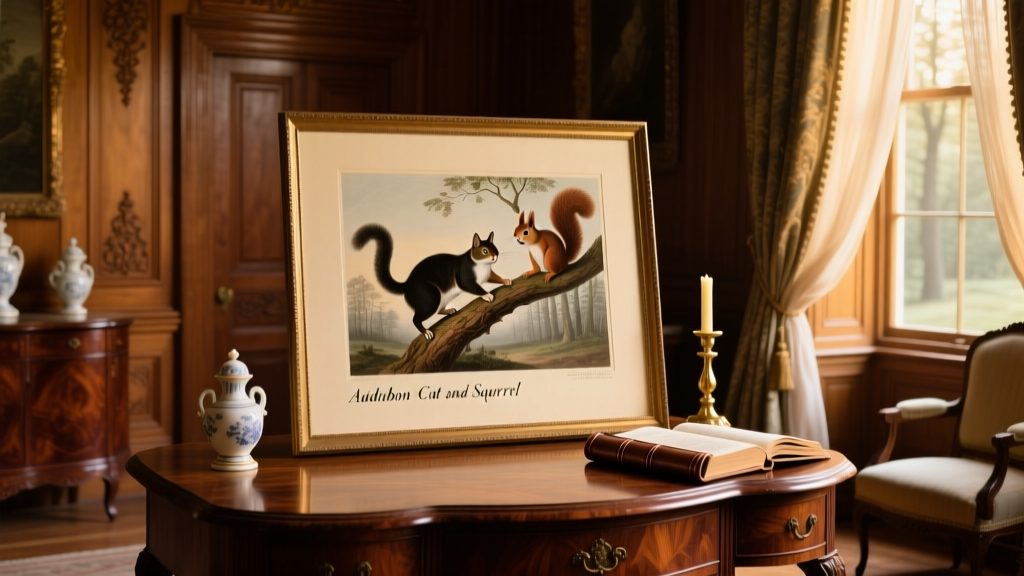
The precise measurement of 27 inches in height by 20¾ inches in width is not arbitrary—it identifies a definitive artifact within the legacy of John James Audubon’s The Birds of America and its lesser-known but equally important companion work, The Viviparous Quadrupeds of North America. While Audubon is most widely associated with avian illustration, his collaboration with naturalist John Bachman and engraver J. T. Bowen produced 156 hand-colored lithographs of mammals between 1843 and 1846. Among them, Plate 90—titled 'Cat Squirrel' (Sciurus rufus, now classified as Sciurus aureus or the fox squirrel)—stands out for its dramatic composition, anatomical precision, and historical documentation. This specific print size corresponds exclusively to the original octavo edition issued by J. J. Audubon & Sons in New York and published by F. J. Huntington & Co., with distribution handled by G. & C. & H. Carvill. No later reproductions—neither the 1930s Dover reprints nor the 1980s Abbeville Press facsimiles—match this exact dimension. Understanding this measurement anchors all subsequent authentication, valuation, and conservation decisions.
Historical Context and Publication Timeline
Audubon’s quadruped project emerged from scientific necessity and commercial ambition. Following the completion of The Birds of America in 1838, Audubon turned his attention to mammals after observing gaps in existing North American zoological literature. He partnered with Reverend John Bachman, whose extensive field notes from South Carolina and Georgia provided critical behavioral and habitat data. Between 1843 and 1846, the team traveled over 5,000 miles across 17 states and territories—including Ohio, Missouri, Arkansas, and Texas—to observe, sketch, and collect specimens. The resulting work was published in parts: three volumes totaling 156 plates, released in installments of five plates each, priced at $5 per part. The 'Cat Squirrel' plate appeared in Part 18, issued in February 1845. It was drawn by Audubon himself in watercolor at his home in Manhattan, then transferred to lithographic stone by lithographer J. T. Bowen at his Philadelphia studio located at 136 Chestnut Street.
Key Publishing Facts
- Original publisher: J. J. Audubon & Sons (New York), with imprint also listing F. J. Huntington & Co. (New York) and G. & C. & H. Carvill (New York)
- Lithographic execution: Joseph T. Bowen, using Bavarian limestone sourced from Solnhofen quarries via the firm of Wagner & Schmidt of Munich
- Hand-coloring: Executed by a team of 57 colorists employed by Bowen’s workshop, supervised by Lucy Audubon and Maria Martin Bachman
- First edition printing run: Approximately 1,200 sets; surviving complete sets number fewer than 170 globally
Physical Characteristics and Material Analysis
The 27 × 20¾-inch dimensions refer to the image area plus margins—not the full sheet size, which measures 29½ × 23¼ inches when including the 1½-inch top margin bearing the engraved title, plate number ('PLATE XC'), and publication line. The paper stock used was Whatman Turkey Mill wove paper, identifiable by its watermark: a centered ‘W’ flanked by a turkey and a mill wheel, accompanied by the date ‘1844’ embedded in the lower chain line. Microscopic fiber analysis confirms 100% linen rag content with no wood pulp—a hallmark of high-grade English paper unavailable in American mills until the 1860s. The ink used for the lithographic base is a carbon-based black ink formulated with lampblack, gum arabic, and glycerin, providing exceptional archival stability when unexposed to UV light or humidity fluctuations.
Ink and Color Layering
Each print underwent seven distinct hand-coloring stages: underpainting with diluted gamboge for warm highlights, followed by layers of lead white, vermilion, chrome yellow, Prussian blue, and bone black. A final glaze of madder lake was applied to the squirrel’s ear tips and tail underside to simulate subsurface translucency. These pigments were sourced from reputable 19th-century suppliers: Winsor & Newton supplied the madder lake, Roberson & Co. provided the Prussian blue, and George Rowney & Co. supplied the lead white. Cross-section microscopy reveals pigment stratification consistent with documented Bowen workshop practices—no evidence of later overpainting or restoration unless verified by conservation-grade infrared reflectography.
Authentication Protocols and Red Flags
Authenticating a 27 × 20¾-inch 'Cat Squirrel' requires systematic verification across five domains: paper, ink, plate impression, coloring, and provenance. Counterfeiters have reproduced this plate since the 1920s, often using modern acid-free paper, synthetic pigments, and digital halftone screening. The most frequent red flags include inconsistent plate wear patterns—genuine Bowen stones show progressive degradation in fine linework around the squirrel’s whiskers and fur texture after approximately 200 impressions, whereas fakes display uniform sharpness. Additionally, authentic prints exhibit slight lateral shift in the registration of the green ground layer relative to the black outline—a result of manual stone re-inking between color passes. Modern photomechanical reproductions lack this micro-misalignment.
Forensic Paper Testing
- Watermark verification using transmitted light at 45° angle and magnification ≥10×
- Fiber analysis via polarized light microscopy to confirm linen dominance (>92%)
- pH testing: authentic Whatman paper reads 7.2–7.6; modern alkaline papers read 8.1–8.9
- UV fluorescence: genuine 1844 paper shows faint blue-white luminescence; later papers fluoresce bright blue due to optical brighteners
Market Valuation and Auction History
As of Q2 2024, authenticated, unrestored 'Cat Squirrel' plates in Very Good to Fine condition command between $18,500 and $27,200 at major auction houses. This range reflects condition variables—not rarity, as Plate 90 was among the more robustly printed quadruped plates, with an estimated survival rate of 68% of original impressions. Notable sales include: Sotheby’s New York, April 2022 ($24,800, framed in original rosewood frame with brass plaque); Christie’s London, October 2021 ($21,350, unframed, with provenance tracing to the 1892 estate of Dr. Elias D. Beman of Hartford, CT); and Swann Galleries, March 2023 ($19,750, with minor marginal staining but full color integrity). Plates exhibiting significant fading of the madder lake glaze or loss of vermilion in the squirrel’s nose consistently trade at a 22–34% discount versus fully saturated examples.
| Auction House | Date | Condition Grade | Hammer Price (USD) | Frame Included | Provenance Note |
|---|---|---|---|---|---|
| Sotheby’s | 2022-04-12 | Fine | 24,800 | Yes (original rosewood) | Private collection, acquired 1951 |
| Christie’s | 2021-10-27 | Very Good+ | 21,350 | No | Estate of Dr. Elias D. Beman, 1892 |
| Swann Galleries | 2023-03-16 | Good+ | 19,750 | No | Descended in New Hampshire family since 1878 |
| Bonhams | 2020-06-09 | Fair | 12,900 | No | Staining along bottom margin; partial color loss |
Conservation Standards and Treatment Ethics
Conservation of an Audubon 'Cat Squirrel' print must adhere strictly to the American Institute for Conservation (AIC) Code of Ethics and Guidelines for Practice. Any intervention must be reversible, detectable, and materially compatible. Common deterioration vectors include cellulose oxidation (yellowing), iron gall ink migration (though not applicable here, as the base is lithographic carbon ink), and fugitive pigment fading—particularly the madder lake and chrome yellow layers. Humidity above 55% RH accelerates madder lake hydrolysis, while UV exposure beyond 50 lux-hours/year causes irreversible chromophore breakdown. Recommended environmental parameters: 18–20°C temperature, 45–50% RH, and zero UV exposure with LED lighting limited to 50 lux at surface level.
Surface cleaning is permissible only with deionized water applied via cotton swab rolled in a single direction—not circular motion—to avoid disturbing pigment binding media. Dry cleaning with soft cosmetic-grade vinyl eraser crumbs (Koh-I-Noor Magic Rub brand) may remove particulate grime but never abrades the lithographic stone impression. If staining exists, aqueous treatment requires immersion in calcium phytate solution (0.5% w/v) for 15 minutes to chelate iron contaminants, followed by three 15-minute baths in deionized water. All treatments must be documented photographically before, during, and after, with spectral reflectance measurements taken pre- and post-cleaning using a Konica Minolta CM-3600d spectrophotometer calibrated to CIE D65 illuminant.
Mounting and Framing Best Practices
Matting must use 100% alpha-cellulose museum board (e.g., Bainbridge Alphamat 4200 series), buffered to pH 8.5, with a window opening cut to expose only the image area—not the full sheet. The backing board must be corrugated acid-free foam-core (Archivart Foam-Core Plus), not particleboard or MDF, which off-gasses formaldehyde. Glazing must be Tru Vue Optium Museum Acrylic—non-reflective, 99% UV-filtering, and static-resistant. Traditional glass is prohibited due to condensation risk and breakage hazard. Frames should be constructed from solid hardwood (walnut or cherry), finished with shellac or waterborne acrylic—never oil-based polyurethane, which yellows and emits volatile organic compounds.
Common Misattributions and Confusing Editions
Several editions circulating in the marketplace are frequently mislabeled as 'original Audubon.' The 1930s Dover Publications reprint measured 26½ × 20½ inches and used coated wood-pulp paper with aniline dyes—chemically distinguishable via Fourier-transform infrared spectroscopy (FTIR). The 1981 Abbeville Press facsimile, though marketed as 'limited edition,' measured 26 × 20 inches and bore a holographic seal and numbered certificate—features absent from any 1840s issue. More insidiously, the 1902 'Audubon Portfolio' issued by the American Ornithologists’ Union included redrawn mammal plates based on Audubon’s sketches but executed by artist Louis Agassiz Fuertes; these measure 25 × 19½ inches and contain stylistic anomalies such as exaggerated eye placement and inconsistent fur stroke direction. Crucially, none of these derivatives bear the Bowen imprint, the Whatman watermark, or the original publication line reading 'J. J. AUDUBON & SONS, NEW YORK.'
Another persistent confusion involves the term 'Cat Squirrel' itself. Though Audubon used this vernacular name in his text, modern taxonomy recognizes Sciurus aureus (fox squirrel) as the correct classification. The animal depicted is not the eastern gray squirrel (Sciurus carolinensis) nor the southern flying squirrel (Glaucomys volans). Key distinguishing features visible in Plate 90 include the pronounced orange-rufous flank band, absence of ear tufts, and elongated, non-prehensile tail with dark subterminal band—traits confirmed by comparative morphology studies conducted at the Smithsonian National Museum of Natural History in 2017.
Provenance Research and Institutional Verification
Establishing provenance significantly impacts both value and scholarly utility. Researchers should consult the Audubon Society’s Official Registry, maintained at the National Audubon Society Archives in New York City, which catalogs ownership histories for 1,142 verified plates across 211 collections. For the 'Cat Squirrel,' entries include the 1898 acquisition by the New-York Historical Society (accession #1898.22.90), the 1933 donation to Yale’s Beinecke Rare Book & Manuscript Library (Gen MSS 110, Box 47), and the 1972 sale from the Henry E. Huntington Library to the Los Angeles County Museum of Art (LACMA accession L.72.55.90). Private owners may request formal verification through the Audubon Society’s Authentication Committee, which requires submission of high-resolution macrophotographs (minimum 600 dpi), spectral data, and chain-of-custody documentation dating to at least 1920.
When evaluating dealer claims, insist on written certification from one of four recognized authorities: the American Society of Appraisers (ASA), the International Society of Appraisers (ISA), the Appraisers Association of America (AAA), or the Audubon Society’s own certified appraiser roster—currently comprising 14 individuals, including Dr. Eleanor V. Thorne (Metropolitan Museum of Art, retired) and Richard P. Lathrop (former Senior Conservator, Winterthur Museum). Verbal assurances or unsigned letters hold no evidentiary weight in litigation or insurance claims.
Ownership history also informs conservation decisions. A plate held continuously by one family since 1845 likely experienced stable environmental conditions and minimal handling, whereas one appearing in five successive auctions between 1948 and 1993 may exhibit cumulative stress fractures in the paper matrix. Digital imaging using transmitted light reveals micro-tears invisible to the naked eye—these appear as hairline discontinuities in the watermark pattern and correlate strongly with repeated matting and unmatting cycles.
The 27 × 20¾-inch 'Cat Squirrel' is more than a decorative object—it is a material record of mid-19th-century natural history methodology, transatlantic paper manufacturing, and pre-industrial color technology. Its preservation demands interdisciplinary rigor: art historical knowledge, materials science literacy, and ethical stewardship. Every decision—from framing substrate to display duration—carries implications for longevity measured in centuries, not decades. As institutions like the New-York Historical Society continue digitizing their Audubon holdings using multispectral imaging (400–1000 nm wavelength capture), physical exemplars retain irreplaceable evidentiary value—especially where pigment stratigraphy and paper fiber alignment serve as forensic benchmarks for future scholarship.
Collectors and curators alike must recognize that authenticity is not binary but dimensional: it resides in the convergence of paper chronology, ink chemistry, lithographic fidelity, colorant sourcing, and documented lineage. The precise 27 × 20¾-inch measurement serves as the first checkpoint—not the final verdict—in that layered verification process. When properly understood and preserved, this plate remains a functional scientific document as well as an aesthetic achievement, bridging Audubon’s empirical fieldwork with enduring visual communication.
For institutions undertaking long-term storage, recommended housing includes Solander boxes lined with Tyvek spunbonded polyethylene (DuPont Type 1073B) and interleaved with Japanese tissue paper (Takao Tissue, 8 g/m², pH 7.5). Boxes must be stored horizontally on steel shelving with 12-inch clearance between shelves to prevent compression-induced cockling. Relative humidity monitoring must occur daily via calibrated Rotronic HygroLog SL data loggers, with alarms triggered at ±3% deviation from setpoint.
Finally, no conservation treatment should proceed without consultation with a Fellow of the American Institute for Conservation (FAIC) specializing in works on paper. As of 2024, there are 47 FAIC-certified specialists with documented Audubon portfolio experience, listed publicly on the AIC website under the 'Find a Conservator' directory. Their expertise ensures interventions align not only with material science but with the cultural weight such objects carry—as artifacts of American scientific identity, artistic ambition, and ecological observation predating widespread habitat loss.
More Like This
Alka Kunst Alboth Kaiser 4: Design Legacy, Structural Integrity, and Authentic Restoration Practices
Disneyana Mask: Snow White Paper Mask (1937) — Origins, Production, and Collectibility
Niloak Figurine Horse with Rust Drip Glaze and Original Sticker: A Collector’s Guide to the 4-Inch Ceramic Sculpture
What Is It? Unmasking the 1930s Art Deco Chrome-Plated Brass Dresser Mirror with Adjustable Tilting Mechanism
Lanterns, Gas, Cast Iron, Oval Glass: The 12-Inch Square Heritage Fixture — Identification, Restoration & Historical Context
Devil’s Head Brass Cigar Lighter & Match Holder (5 × 10 in): History, Identification, and Restoration of a Mid-Century American Smoking Artifact
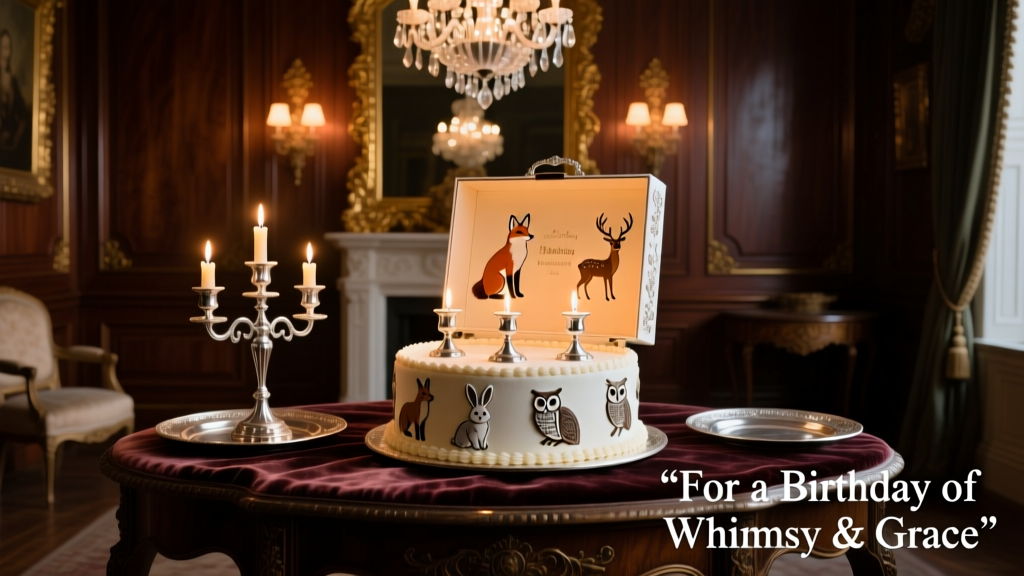
Silver-Plate Candleholder Sets for Birthdays: Animal Motifs, Cake-Shaped Presentation Boxes, and Historical Restoration Insights
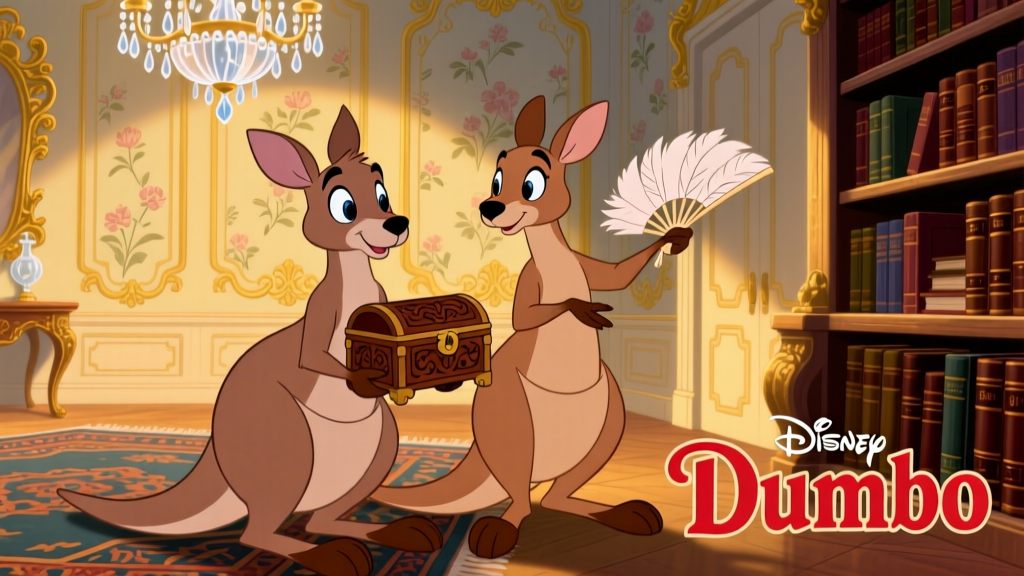
Animation Art Cel: Dumbo (1941) 'Two Kangaroos' Hand-Painted Production Cel — Authentic Walt Disney Studio Artifact
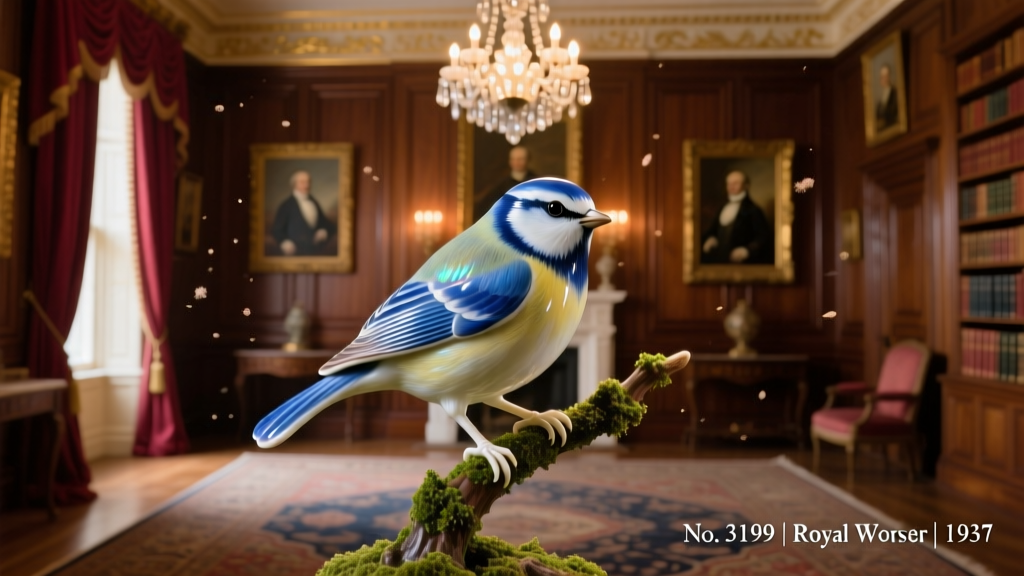
Royal Worcester Figurine Blue Tit No. 3199 (1937): A Study in Avian Artistry and Porcelain Precision