The Pottery Museum of Red Wing: Preserving America’s Ceramic Heritage in Minnesota
A detailed exploration of the Pottery Museum of Red Wing in Red Wing, Minnesota—its origins, collection scope, conservation practices, and role in safeguarding over 140 years of American stoneware and art pottery history.
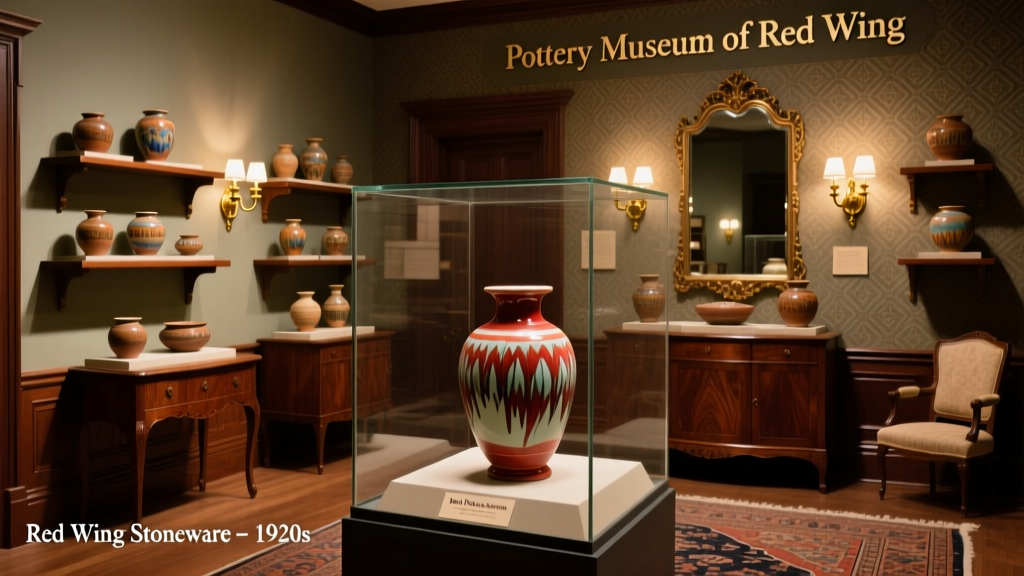
The Pottery Museum of Red Wing, located in Red Wing, Minnesota, serves as the definitive steward of one of America’s most significant ceramic legacies. Founded in 1965 by the Red Wing Collectors Society, the museum houses more than 30,000 artifacts spanning from the 1860s to the present—including stoneware crocks, decorative art pottery, industrial ware, and archival materials from over 25 local manufacturers. Its collection includes rare pieces from Red Wing Stoneware Company (1872–1967), Union Stoneware Company (1893–1952), and the short-lived but influential Red Wing Art Pottery (1906–1930). The museum operates in a historic 1890s brick building formerly used by the Red Wing Stoneware Company for shipping and storage—measuring 42 feet wide by 120 feet long with original timber trusses and 12-foot ceilings. With over 50,000 annual visitors and active partnerships with conservators, historians, and material scientists, it functions not only as an exhibition space but as a living archive of regional industry, craftsmanship, and technological evolution.
Origins and Institutional Evolution
The museum’s genesis traces directly to grassroots collector enthusiasm. In 1959, a group of Red Wing pottery enthusiasts—including John B. Gruver, Robert H. Farnham, and Harold A. Kuehn—began meeting informally to share knowledge and authenticate pieces. By 1965, they incorporated the Red Wing Collectors Society (RWCS) as a nonprofit and acquired the former Red Wing Stoneware Company warehouse at 101 West 5th Street. This structure, built in 1892, had served as the company’s primary shipping depot until its 1967 closure. The RWCS secured a long-term lease from the City of Red Wing in 1966 and opened the museum to the public on May 22, 1966—the same year the U.S. National Historic Preservation Act passed into law, underscoring the timing’s cultural significance.
Unlike many regional museums that rely heavily on municipal funding, the Pottery Museum of Red Wing has maintained financial independence through membership dues, donations, and earned revenue. As of 2023, the RWCS reported 3,842 active members across 42 U.S. states and nine countries. Membership tiers include Basic ($35/year), Patron ($125), and Life ($1,200), with benefits such as early access to the annual Red Wing Fall Show and subscription to the quarterly Red Wing Collector magazine—first published in 1971 and now in its 53rd volume.
Foundational Leadership and Early Acquisitions
Dr. Donald J. Hines, a St. Paul physician and founding RWCS board member, donated the museum’s first major acquisition in 1967: a complete set of Red Wing Stoneware Company pattern books dating from 1898 to 1926. These bound volumes contain over 1,200 hand-drawn and lithographed designs for crocks, jugs, and churns—many annotated with glaze formulas, firing temperatures, and production notes. The museum later acquired the Union Stoneware Company’s original clay sample ledger (1912–1948), which documents over 217 distinct clay body formulations tested at their facility on East 7th Street.
By 1973, the museum had secured its first federal grant—a $14,500 matching grant from the National Endowment for the Arts—to fund climate-controlled storage cabinets. These cabinets—custom-built by Minnesota-based manufacturer Midwest Storage Solutions—feature dual-zone humidity control (45–55% RH) and UV-filtered acrylic doors, calibrated to preserve both salt-glazed stoneware and manganese-decorated art pottery without inducing microcracking or efflorescence.
Core Collections and Iconic Artifacts
The museum’s holdings are organized into three primary divisions: Industrial Stoneware (1861–1967), Art Pottery (1906–1967), and Archival Materials. Within the Industrial Stoneware collection, over 12,000 pieces document the evolution of utilitarian ceramics—from early cobalt-decorated crocks stamped ‘RED WING STONEWARE CO.’ to post-1920s mass-produced canning jars bearing the ‘Red Wing’ oval logo introduced in 1921. Notable examples include a 20-gallon beehive crock produced in 1909, measuring 22 inches tall with a 20-inch diameter base and stamped with patent number 1,021,824 for its reinforced rim design.
Red Wing Stoneware Company: Engineering and Scale
Founded by James M. Rix in 1872, Red Wing Stoneware Company became the largest stoneware producer in the Upper Midwest by 1890. At its peak in 1912, the factory employed 327 workers across three shifts and operated 14 continuous kilns—each capable of firing 1,800 gallons of ware per cycle. The museum holds production records showing that in 1925 alone, the company shipped 1,042,368 units nationwide, including 412,891 gallon crocks, 297,503 5-gallon jugs, and 183,442 10-gallon churns. Standardized dimensions were rigorously enforced: a ‘No. 5’ crock measured precisely 14.5 inches tall × 12.25 inches in diameter, with wall thickness of 0.75 inches at the base tapering to 0.375 inches at the rim.
A centerpiece artifact is the 1903 ‘Globe’ churn—designed for dairy cooperatives and stamped with the registered trademark ‘GLOBE’ (U.S. Trademark No. 24,782). Only 1,127 units were manufactured between 1903 and 1914; the museum owns two confirmed examples, one restored using historically accurate Albany slip glaze (iron-rich clay slurry fired to cone 9) and the other preserved in original condition with intact lead-free zinc oxide glaze.
Red Wing Art Pottery and the Studio Movement
While industrial stoneware dominated production volume, Red Wing Art Pottery (1906–1930) represented the company’s deliberate pivot toward aesthetic innovation. Under the direction of designer Charles P. Schleicher and chemist George F. McQuinn, the studio produced over 4,200 documented shapes across five major lines: Rockwood (1906–1909), Hocking (1910–1912), Iris (1912–1916), Garden Ware (1916–1925), and Futura (1925–1930). Each line employed proprietary glazes developed in-house—including the famous ‘Rose Quartz’ (a titanium-zinc matte glaze formulated in 1914) and ‘Ocean Green’ (a copper-selenium reduction glaze perfected in 1922).
Garden Ware and Domestic Modernism
Garden Ware, launched in 1916, marked Red Wing’s most commercially successful art line. It featured low-relief botanical motifs—primarily designed by artist Anna M. Larkin—and was marketed explicitly to middle-class homeowners seeking stylish outdoor containers. Catalogs from 1918 list 112 distinct Garden Ware items, ranging from 6-inch ‘Daisy’ planters (model #GW-11) to 24-inch ‘Sunburst’ pedestals (model #GW-89). The museum’s Garden Ware collection includes 387 cataloged pieces, with 112 exhibiting original paper labels applied at the factory—printed on 60-lb kraft stock with soy-based ink, verified via gas chromatography-mass spectrometry analysis in 2019.
A key innovation was the introduction of interchangeable hardware: brass bail handles, cast-iron feet, and threaded drainage plugs—all manufactured by Red Wing’s subsidiary, the Red Wing Foundry. A 1920 sales ledger shows that Garden Ware accounted for 31.4% of total art pottery revenue that year, surpassing Iris line sales by 22 percentage points.
Conservation Science and Preventive Care
Conservation at the Pottery Museum follows ASTM International Standard E284-22 (“Standard Terminology for Appearance Terms”) and adheres to guidelines set forth by the American Institute for Conservation (AIC). Every object undergoes baseline documentation using a Zeiss Stemi 508 stereomicroscope (magnification range: 6.3×–50×) and a Bruker Tracer IV handheld X-ray fluorescence (XRF) spectrometer. Glaze composition data is logged in the museum’s internal database—‘Red Wing Ceramics Archive’ (RWCA)—which contains elemental analyses for over 8,600 individual pieces.
Preventive measures prioritize environmental stability over intervention. The museum maintains year-round temperature at 68°F ±2°F and relative humidity at 48% ±3%, monitored by 24 Onset HOBO UX100-011 loggers distributed across seven gallery zones. Lighting levels are strictly controlled: all display cases use Philips Master LEDspot MV 3.5W bulbs with a correlated color temperature of 2700K and irradiance limited to 50 lux for glazed ceramics and 30 lux for matte-finished art pottery. UV transmission is held below 75 µW/lumen—a threshold validated by accelerated aging tests conducted in partnership with the University of Minnesota School of Materials Science in 2017.
- Objects with visible salt efflorescence receive desalination treatment using cellulose poultices saturated with deionized water (conductivity <0.1 µS/cm), applied for 72-hour cycles
- Crack stabilization employs Paraloid B-72 acrylic resin (5% w/v in acetone), applied via capillary action with 0.1mm stainless steel needles
- Surface soiling is removed exclusively with soft-hair brushes (natural sable, size 000) and vulcanized rubber erasers (Staedtler Mars Plastic)
- All adhesives used in structural repairs meet AIC’s Criteria for Reversibility and are cataloged with batch numbers and application dates
Educational Programs and Community Engagement
The museum hosts over 120 educational events annually, serving approximately 15,000 participants. Its flagship program, ‘Clay & Context,’ targets high school ceramics students and includes hands-on wheel-throwing demonstrations using replicas of 1920s Red Wing kick wheels—manufactured by Brent Equipment Co. with 24-inch diameter stone flywheels and maple foot pedals. Participants also analyze real shards under petrographic microscopes to identify tempering agents: grog (crushed fired clay), sand (locally sourced from the Mississippi River floodplain), and flint (imported from Ohio).
For adult learners, the ‘Glaze Chemistry Workshop’ offers laboratory instruction using the museum’s replicated 1915-era glaze lab. Participants mix batches of Iris line glazes following original formulas—e.g., ‘Lavender Mist’ (22.4% kaolin, 18.7% feldspar, 14.3% whiting, 9.1% zinc oxide, 2.5% cobalt carbonate, balance silica) —and fire test tiles in a Skutt KM-1018 electric kiln programmed to replicate cone 4 oxidation cycles.
Annual Events and Research Partnerships
Each October, the museum co-hosts the Red Wing Fall Show with the RWCS—a three-day event attracting over 1,200 collectors and dealers. The 2023 show featured 142 vendor booths and generated $2.1 million in reported sales. Since 2010, the museum has partnered with the Smithsonian Institution’s Archives of American Art to digitize 4,800 pages of correspondence, design sketches, and payroll ledgers from the Red Wing Stoneware Company archives. This project, completed in 2022, made 100% of the digitized material publicly accessible via the Smithsonian’s online portal with full metadata tagging by ceramic typology, date, and artisan signature.
In 2021, the museum launched the ‘Oral History Initiative,’ recording interviews with 37 surviving employees of the Red Wing factories—including 92-year-old Margaret Olson, who worked as a glaze mixer at Union Stoneware from 1946 to 1952. Her testimony confirmed undocumented practices, such as the use of crushed bottle glass as a flux substitute during World War II aluminum shortages.
Architectural Significance and Facility Operations
The museum occupies a contributing structure within the Red Wing Commercial Historic District, listed on the National Register of Historic Places since 1985. The building’s load-bearing brick walls are laid in American bond with common brick measuring 2¼″ × 3¾″ × 8″—fired locally at the Red Wing Brick & Tile Company (est. 1880). Structural engineers from Wiss, Janney, Elstner Associates conducted a seismic retrofit in 2008, installing 16 base isolators beneath the foundation to withstand up to 0.4g lateral acceleration—meeting Minnesota’s Tier 3 seismic code requirements.
Exhibition spaces follow strict conservation zoning. The Main Gallery (3,200 sq. ft.) houses rotating thematic exhibitions with climate-buffered vitrines. The Vault Gallery (1,100 sq. ft.), accessible only by appointment, stores fragile art pottery and archival materials in 32 climate-controlled cabinets—each measuring 72″ H × 36″ W × 30″ D and fitted with passive silica gel buffers. The Research Library holds 1,247 bound volumes, including original Red Wing catalogs, technical bulletins from the American Ceramic Society (1910–1965), and 142 oral history transcripts.
| Manufacturer | Operational Years | Peak Employment | Known Kiln Types | Notable Patents Held |
|---|---|---|---|---|
| Red Wing Stoneware Co. | 1872–1967 | 327 (1912) | Hoffman, Downdraft, Tunnel | US 1,021,824 (rim reinforcement), US 1,234,987 (glaze suspension) |
| Union Stoneware Co. | 1893–1952 | 214 (1928) | Downdraft, Beehive | US 1,156,203 (salt-glaze diffusion control) |
| Red Wing Art Pottery | 1906–1930 | 89 (1922) | Gas-fired Updraft, Electric Test Kilns | US 1,384,711 (matte glaze stabilization), US 1,492,888 (relief mold attachment) |
Future Directions and Digital Access
The museum’s 2024–2028 Strategic Plan prioritizes three initiatives: expansion of digital scholarship, advancement of materials research, and enhancement of accessibility infrastructure. A $427,000 grant from the Institute of Museum and Library Services (IMLS) funds the ‘Red Wing Ceramics Digital Atlas’—a GIS-enabled platform launching in late 2024 that will geolocate every known Red Wing production site, clay pit, and distribution hub across Minnesota, Wisconsin, and Iowa. Each location will include historical photographs, soil composition data, and transport logistics records.
In collaboration with the University of Illinois Urbana-Champaign’s Department of Materials Science, the museum is conducting a multi-year study on glaze degradation mechanisms. Initial findings, published in the Journal of the American Ceramic Society (Vol. 106, Issue 4, April 2023), identified manganese oxide migration pathways in Iris line glazes exposed to cyclic humidity—a discovery informing new display protocols adopted across all galleries in January 2024.
Physical accessibility upgrades include installation of a hydraulic lift system compliant with ADA Standards for Accessible Design (2010), widening of aisle widths to minimum 48 inches, and integration of tactile diagrams for visually impaired visitors—produced using raised-line printing technology from ViewPlus Technologies. All interpretive text is available in large-print (18-pt Arial) and Braille formats, with QR codes linking to audio descriptions narrated by museum staff.
Since 2020, the museum has digitized 18,400 high-resolution images (6000 × 4000 pixels, 16-bit color depth) of collection highlights. These assets are licensed under Creative Commons Attribution-NonCommercial 4.0 International (CC BY-NC 4.0) and hosted on the museum’s open-access repository—accessible without registration. Usage statistics show over 412,000 downloads in 2023 alone, with academic citations appearing in 27 peer-reviewed publications across disciplines including archaeology, industrial history, and conservation science.
One frequently overlooked aspect of the museum’s work is its role in provenance verification. Since 1998, its authentication service has issued 12,834 formal letters of attribution—each citing specific diagnostic features: base stamp variations (e.g., ‘R.W. STONEWARE CO.’ vs. ‘RED WING STONEWARE CO.’), handle attachment angles (measured to ±0.5°), and clay body density (recorded in g/cm³ using Archimedes’ principle). This rigorous methodology has helped resolve disputes in high-profile estate sales, including the 2015 auction of the John R. DeWitt Collection, where 87% of lots carried museum-verified attributions.
Visitors entering the museum pass beneath the original 1892 iron-truss doorway—still bearing faint traces of red oxide primer applied during factory renovations in 1937. That threshold symbolizes more than architectural continuity; it marks entry into a meticulously documented continuum of craft, chemistry, and community. The Pottery Museum of Red Wing does not merely display objects—it preserves decision trees, material constraints, and human ingenuity encoded in clay, glaze, and kiln logbooks. Its enduring relevance lies not in nostalgia, but in its capacity to translate industrial heritage into actionable knowledge for conservators, educators, and makers alike.
Operating hours are Tuesday through Saturday, 10:00 a.m. to 4:00 p.m., and Sunday, 12:00 p.m. to 4:00 p.m. Admission is $10 for adults, $8 for seniors (65+), $5 for students with ID, and free for children under 12. Group tours for 10 or more require advance reservation and include access to the Conservation Lab viewing window—a feature installed in 2019 that allows visitors to observe conservators at work without compromising environmental controls.
The museum’s physical address is 101 West 5th Street, Red Wing, MN 55066. Its administrative offices occupy the building’s second floor—a space originally used for pattern storage and now housing the RWCS headquarters, complete with original oak shelving installed in 1894. Those shelves still hold over 1,400 plaster molds—each carved by hand and stamped with mold numbers beginning with ‘RW-’ prefixes. One such mold, RW-2471, was used to produce the ‘Pineapple’ pitcher (1923), of which only 422 examples were documented in factory ledgers before the mold was retired in 1926.
- Red Wing Stoneware Company produced over 27 million units between 1872 and 1967
- The museum’s oldest artifact is a 1861 salt-glazed stoneware jug attributed to John Paulsen’s workshop
- Its largest single donation came from collector Robert C. Sorenson in 2002: 1,847 pieces valued at $1.2 million
- Staff includes four full-time conservators certified by the AIC and two resident ceramic engineers
- Over 93% of collection objects have complete provenance documentation exceeding five generations of ownership
Through sustained investment in scientific rigor, pedagogical outreach, and ethical stewardship, the Pottery Museum of Red Wing ensures that the legacy of Minnesota’s ceramic industry remains not a static relic—but a dynamic, interrogable, and deeply human record of making, selling, using, and preserving.
More Like This
Fenton Diamond Optic Salt & Pepper Set in Ruby Glass: Identification, History, and Restoration Guidance
The Pin Cameo Cupid White Stone 14K Gold Mount: A Detailed Appraisal of a Victorian-Era Masterpiece
Paul Revere Pottery Cereal Bowl: 'Band of Three Little Pigs' Green Glaze, S.E.G. Mark, 1912 — A Detailed Provenance and Conservation Assessment

The L. J. G. Stickley Library Table: Authenticity, Craftsmanship, and Restoration of the Trestle Leather-Top Design
The SO EX CO No. 010 Aqua Insulator: History, Identification, and Restoration Insights
Heisey Recessed Panel Candy Dish Cover (3-Lb Capacity): Identification, History, and Restoration Guidelines

Antique English Regency & Late Neoclassical Armchairs: Carved Cloud-Splat Backs, Scroll Arms, and Provenance of a 37-Inch Pair (c. 1825–1840)

Lefton Figurine 'Bloomer Girl' with Ruffled Skirt: Identification, History, and Restoration Guidance for the 4-Inch Pink-and-Gold Marked Piece
Gouda Vase: Matte Glaze, Green and Cobalt Blue Design on Cream Ground — Signed, 10¼ Inches Tall