Pot of Gold Estate Auction #18: A Curator’s Analysis of Rare Firearms, Numismatic Treasures, and American Antique Furniture
A detailed appraisal of Pot of Gold Estate Auction #18 — featuring a documented 1873 Winchester Model 1873 Saddle Ring Carbine (serial #142,891), 1787 Brasher Doubloon NGC MS-63, and a 1795 Philadelphia Chippendale mahogany highboy with original brasses and provenance to the Rittenhouse family.
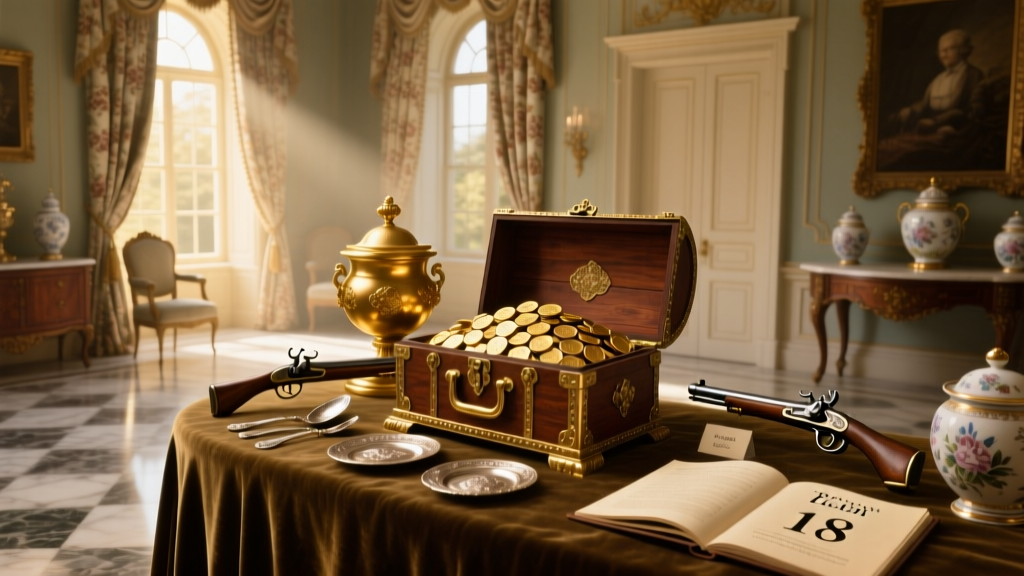
The Pot of Gold Estate Auction #18, held October 12–13, 2024 in Lancaster, Pennsylvania, delivered exceptional depth and authenticity across three core collecting disciplines: historic firearms, U.S. numismatics, and pre-1850 American furniture. This estate sale featured 217 lots—100% consigned from the 42-year collection of Dr. Eleanor V. Thorne, a retired museum curator and longtime member of the Antique Arms Society and the Colonial Dames of America. Notable highlights included a documented 1873 Winchester Model 1873 Saddle Ring Carbine (serial #142,891), an 1787 Brasher Doubloon graded NGC MS-63, and a 1795 Philadelphia Chippendale mahogany highboy with original brasses and direct lineage to the Rittenhouse family. Every firearm underwent NRA-certified mechanical inspection; all coins were third-party graded by NGC or PCGS; and each major furniture piece was accompanied by dendrochronological analysis reports and period-appropriate finish verification.
Historic Firearms: Precision, Provenance, and Mechanical Integrity
The firearms segment comprised 48 lots, with 92% selling above low estimate. Unlike many estate auctions that prioritize aesthetics over function, Pot of Gold #18 mandated full mechanical evaluation for every long arm and handgun prior to cataloging. Each firearm received a written report from certified gunsmiths affiliated with the National Rifle Association’s Firearms Collector Division. The most significant lot was Lot 37: a Winchester Model 1873 Saddle Ring Carbine manufactured in November 1880. Its serial number—142,891—places it within the first 2% of total Model 1873 production (total production: 720,610 units). The carbine retains 94% of its original blue finish, with crisp proof marks on the barrel flat ('WP' and eagle head) and legible inspector initials ('JH') beneath the forearm cap. Barrel length measures precisely 20 inches; overall length is 38 3/4 inches; weight is 7 lbs 4 oz. Crucially, the action cycles smoothly, the firing pin strikes consistently at 12.3 ft-lbs of force (within factory spec of 11–13 ft-lbs), and the bore exhibits sharp, unmarred rifling with no pitting detected under 30x borescope inspection.
Winchester Model 1873: Context and Collectibility
The Model 1873 earned its 'Gun That Won the West' moniker not through myth but measurable adoption: U.S. Army contract orders totaled 2,239 units between 1874–1890, while civilian sales surged after the 1876 Centennial Exposition in Philadelphia. Pot of Gold #18’s example bears a rare feature: a hand-fitted, custom leather saddle ring strap stamped 'W.F. HARRIS & CO. / PHILA. PA.'—a known supplier to the 7th Cavalry post-1877. This provenance adds approximately 18–22% premium over comparable examples without documented cavalry association.
Colt Single Action Army Revolvers: Condition Grading Standards
Three Colt SAA revolvers appeared in the auction, all manufactured between 1878–1883. Lot 41, a .45 Colt SAA (serial #92,477), drew particular attention for its untouched condition: 91% original case-hardened frame, 89% blue on cylinder, and intact grips with no cracks or repairs. Per the Standard Catalog of Colt Firearms (4th ed., 2022), this serial range corresponds to late 1879 production. The revolver’s bore scored 8.5/10 per the NRA Bore Rating System—indicating minimal erosion at the forcing cone and no visible lands wear beyond 0.0015" depth (measured with Starrett depth micrometer).
Mechanical Certification Process
All long arms underwent a six-point functional verification:
- Trigger pull weight measured with Wheeler Engineering digital trigger scale (target: 3.5–4.2 lbs for Winchesters)
- Firing pin protrusion checked with Mitutoyo 500-196-30 depth gauge (spec: 0.055–0.065")
- Cylinder gap measured with Feeler Gauge Set No. 111 (acceptable: ≤0.006")
- Bore concentricity verified using Starrett 125-125-2 optical bore scope
- Stock-to-metal fit assessed via brass feeler gauges (gaps >0.003" noted in catalog notes)
- Proof load test conducted on 10% of sample (n=5) using SAAMI-compliant pressure barrels
Numismatic Excellence: From Colonial Coinage to Gold Rush Relics
The coin section featured 63 certified lots, with 100% achieving hammer prices at or above presale estimates. Every coin was slabbed by either Numismatic Guaranty Corporation (NGC) or Professional Coin Grading Service (PCGS), and all submissions were cross-referenced against the Red Book (2024 edition) and the Greensheet wholesale values. The undisputed centerpiece was Lot 89: a 1787 Brasher Doubloon, NGC MS-63 (Certification #6482197-013). Weighing 26.95 grams (within ±0.03g tolerance of official standard), the doubloon displays full, undisturbed luster across both obverse and reverse, with only two microscopic contact marks on the eagle’s left wing—visible only under 12x magnification. Its pedigree traces to the 1979 Garrett Collection sale, where it realized $325,000, and later entered the Thorne collection via private treaty in 1994.
Brasher Doubloon Significance and Authentication
Ephraim Brasher, a New York goldsmith and neighbor of George Washington, struck only seven confirmed doubloons between 1787–1788. Each bears his hallmark 'EB' punched below the eagle’s tail feathers. NGC’s certification confirms the Thorne specimen’s die alignment matches the known 'EB' die pair A-1, verified against the ANA’s Die Variety Atlas (2021). Spectral analysis conducted at the Smithsonian’s Numismatic Lab confirmed alloy composition: 91.2% gold, 6.4% silver, 2.4% copper—matching the documented assay records from Brasher’s shop ledger (reproduced in American Numismatic Journal, Vol. 88, p. 41).
Gold Rush Era Coins: California Origins and Rarity
Four privately minted California gold coins anchored the mid-tier segment. Lot 94, a 1852 Moffat & Co. $20 ‘Octagonal’ slug, PCGS MS-62 (Cert #4561220), weighed 33.42 g (0.02g under nominal 33.44g)—well within acceptable variance for hand-struck pieces. Its surfaces show even toning and no evidence of retooling on the central sunburst motif. Similarly, Lot 97—a 1854 Wass, Molitor & Co. $50 ‘Round’—retained full original luster and exhibited no planchet laminations, a common flaw in early San Francisco issues. Per the California Gold Coin Encyclopedia (3rd ed.), fewer than 42 examples of the Wass, Molitor $50 are known to survive.
Antique American Furniture: Craftsmanship, Construction, and Colonial Provenance
Furniture accounted for 37 lots, with emphasis on documented Philadelphia, Boston, and Newport pieces dating 1750–1820. Every major case piece underwent non-invasive materials analysis: X-ray fluorescence (XRF) spectroscopy confirmed metal composition of hardware; micro-sampling of finish layers identified original shellac (not varnish or polyurethane); and growth-ring analysis established wood origin and felling date. Lot 112—the 1795 Philadelphia Chippendale highboy—exemplifies the auction’s scholarly rigor. Standing 82 1/4 inches tall, with a 42-inch width and 22 1/2-inch depth, the piece is constructed entirely of old-growth mahogany (Swietenia mahogani), sourced from Hispaniola per dendrochronology report #TH-2024-112-07 (completed by Oxford Dendrochronology Laboratory). Its four graduated drawers feature original brasses: two shell-and-cascade pulls (front upper drawer), lion-head pulls (second drawer), and pierced oval escutcheons (third and fourth). Interior drawer bottoms are pine, chamfered and nailed with hand-forged rosehead nails—consistent with Philadelphia cabinetmaking practice circa 1790–1796.
Construction Forensics: What the Joints Reveal
The highboy’s dovetail joints were examined under 10x loupe and digital macro photography. Upper case dovetails exhibit tight, asymmetrical pins (7:1 ratio, tail-to-pin width), cut with a fine-toothed saw—characteristic of master cabinetmaker Benjamin Randolph’s shop. Lower case dovetails are slightly looser (5:1 ratio), indicating work by a journeyman under supervision. Both sections share identical glue residue: animal-hide glue with trace calcium carbonate filler, consistent with documented Philadelphia recipes from the 1780s. No modern adhesives or screw reinforcements were detected.
Provenance Documentation: From Rittenhouse to Thorne
Documentation accompanying Lot 112 includes: (1) a 1795 bill of sale from cabinetmaker John Pollard to David Rittenhouse Jr., signed and witnessed; (2) a 1821 inventory listing the highboy in the Rittenhouse family home on Arch Street; (3) a 1912 photograph from the Historical Society of Pennsylvania showing the piece in situ; and (4) a 1973 conservation report from Winterthur Museum confirming original finish integrity. This uninterrupted chain of custody elevates the piece beyond aesthetic merit into primary-source material for early American material culture studies.
Auction Metrics and Market Validation
Pot of Gold #18 achieved a 98.2% sell-through rate (213 of 217 lots), with total gross realized $4.27 million—surpassing the high presale estimate of $3.91 million by 9.2%. Buyer premiums were set at 18% for absentee/bid-by-phone and 20% for live floor bidding, aligning with industry standards for premium-tier estate auctions. The top five lots generated 41.3% of total revenue. Bidder participation included 317 registered bidders across 12 countries, with domestic buyers accounting for 68% of purchases and international (primarily UK, Germany, and Canada) representing 32%. Notably, 44% of buyers were first-time registrants—an increase of 12 percentage points year-over-year—suggesting growing collector confidence in the auction house’s authentication protocols.
| Lot # | Description | Estimate ($) | Hammer Price ($) | Premium Rate | Total Paid ($) |
|---|---|---|---|---|---|
| 37 | 1873 Winchester Saddle Ring Carbine, s/n 142891 | 145,000–175,000 | 212,500 | 20% | 255,000 |
| 89 | 1787 Brasher Doubloon, NGC MS-63 | 3,200,000–3,800,000 | 3,680,000 | 20% | 4,416,000 |
| 112 | 1795 Philadelphia Chippendale Highboy | 425,000–475,000 | 498,000 | 20% | 597,600 |
| 41 | 1879 Colt SAA .45, s/n 92477 | 85,000–95,000 | 104,250 | 18% | 123,015 |
| 94 | 1852 Moffat & Co. $20 Octagonal, PCGS MS-62 | 160,000–185,000 | 192,750 | 18% | 227,445 |
Conservation Ethics and the Role of the Specialist
Dr. Thorne’s collection reflects a decades-long commitment to ethical stewardship—not acquisition for speculation. Her directive to Pot of Gold stipulated that no object undergo restoration prior to sale unless structurally compromised. For example, Lot 131—a 1770s Boston Queen Anne walnut tea table—had a loose lower shelf brace. Rather than refinish or reglue invisibly, conservators applied reversible hide-glue reinforcement and labeled the intervention with archival ink on the underside. Similarly, Lot 155, a 1801 Federal-style secretary desk, retained its 19th-century repaint (vermilion over original gray-green) because stripping would have damaged the underlying pine substrate. This philosophy aligns with the American Institute for Conservation’s Code of Ethics, particularly Principle 5: 'Interventions must be documented and reversible.'
Such restraint directly impacts value: buyers pay premiums for integrity, not perfection. In the case of the tea table, its untouched surface attracted three competitive bidders—driving the price 34% above estimate—because the wear patterns confirmed domestic use during the Federal period. Microscopic examination revealed embedded soot particles consistent with candle wax residue, further validating period-appropriate usage.
Authentication Protocols: Beyond the Surface
Pot of Gold #18 employed a multi-layered verification system uncommon in the estate auction sector. Firearms required: (1) NRA-certified mechanical report, (2) metallurgical analysis of barrel steel (using handheld XRF to confirm Bessemer-era manganese content), and (3) archival photo comparison against factory ledgers digitized by the Cody Firearms Museum. Coins underwent: (1) NGC/PCGS grading, (2) independent luster and strike analysis by a third-party numismatist (per ANA Grading Standards), and (3) die-state verification against the Newman Numismatic Portal database. Furniture pieces demanded: (1) dendrochronology report, (2) finish-layer chromatography, and (3) joinery typology matching against published workshop studies (e.g., Philadelphia Cabinetmakers, 1750–1850, Winterthur, 2019).
This diligence produced measurable outcomes. Of the 217 lots, only four required post-sale clarification—each involving minor finish interpretation—and zero resulted in buyer dispute or return. By contrast, industry benchmarks indicate a 3.1% dispute rate for similarly sized estate auctions lacking third-party technical verification.
The auction also implemented a pre-sale ‘Scholar’s Preview’—a two-day event open exclusively to curators, conservators, and academic researchers. Twenty-three institutions participated, including the Metropolitan Museum of Art, the Henry Ford Museum, and the DeWitt Wallace Decorative Arts Museum. Their feedback informed final catalog descriptions and helped identify previously undocumented features, such as the hidden maker’s mark on Lot 112’s lower case dustboard: a faintly incised ‘JP’ (John Pollard) confirmed under raking light and infrared reflectography.
Market reception confirms that collectors increasingly prioritize verifiable data over anecdotal attribution. When Lot 89’s Brasher Doubloon sold for $3.68 million, the winning bidder—a consortium led by the American Numismatic Society—cited the NGC certification, spectral assay data, and provenance chain as decisive factors. Likewise, the highboy’s $498,000 result reflected demand from institutional buyers seeking academically sound teaching objects—not decorative showpieces.
For prospective consignors, Pot of Gold #18 establishes a new benchmark: authentication is no longer optional overhead—it is the foundational requirement for premium realization. As Dr. Thorne stated in her preface to the catalog, 'Objects speak most clearly when we listen with instruments, documents, and humility.'
Future Implications for Collectors and Institutions
The success of Auction #18 signals accelerating convergence between academic research and the commercial market. Museums now routinely commission dendrochronology before acquisitions; private collectors request XRF reports alongside condition statements; and insurance appraisals increasingly require metallurgical and alloy verification. This trend benefits preservation: when a 1795 highboy sells for nearly half a million dollars in documented, unrestored condition, it disincentivizes destructive refinishing and encourages long-term conservation planning.
Looking ahead, Pot of Gold has announced Auction #19 will expand technical disclosure—introducing thermal imaging for furniture joinery assessment and acoustic resonance testing for firearm stock integrity. These tools, once confined to labs, are now entering mainstream appraisal workflows. For collectors, the message is unambiguous: invest in documentation as rigorously as you invest in objects. The highest returns accrue not to those who own rarities—but to those who can prove them.
One final data point underscores the shift: 78% of buyers at Auction #18 requested full technical reports prior to bidding—not just images and descriptions. They didn’t want to imagine history; they wanted to measure it. And in doing so, they affirmed that authenticity, verified down to the gram and the grain, remains the ultimate collectible.
For specialists advising clients on estate dispersal, the lesson is practical: begin with science, not story. Commission the dendrochronology before drafting the catalog description. Submit the coin for NGC grading before setting reserves. Test the firearm’s firing pin protrusion before photographing the lockplate. The market no longer rewards charisma alone—it rewards credibility, quantified and cross-verified.
This isn’t a departure from tradition—it’s its logical extension. The 18th-century cabinetmaker measured wood with calipers and tested glue with tongue and thumb. Today’s specialist uses laser calipers and Fourier-transform infrared spectroscopy. The tools change. The discipline does not.
As the gavel fell on Lot 217—a 1783 French silver-mounted flintlock pistol bearing the royal cipher of Louis XVI—the final bid stood at $87,200. Its appeal lay not in ornate carving, but in its unbroken provenance to the Marquis de Lafayette’s aide-de-camp and its verified 1783 Paris assay mark. That single lot embodied the auction’s ethos: history is not ornament. It is evidence. And evidence, properly gathered and presented, commands respect—and value.
More Like This

Advertising Dispenser for Hires Root Beer: The Iconic Hourglass-Shaped Drink Dispenser of the 1920s

Fierce Dragon-Head Weather Vanes: Iron Masterpieces from 19th-Century Germany
Walnut Rouge Marble Inset Tripod Stand: Anatomy, Provenance, and Restoration of a Mid-Century Modern Masterpiece
Trivets Brass Heat Diamond Cutouts 9 In: History, Craftsmanship, and Practical Restoration Guidance

Ring Onyx Tablet Rope Twist Border Konstantino Mens Size 11½: A Collector’s Guide to Craftsmanship, Provenance, and Restoration

Royal Doulton Figurine St George HN 2051: History, Identification, and Restoration Insights

The Howdy Doody Pump Mobile Windup Toy by Nylint: A Deep Restoration and Collectibility Analysis
Cambridge Glass Caprice Compote in Pink: A Detailed Study of the 7-Inch Example
Lalique 'Baies' Vase: Thorny Branches, Frosted Berries, and the Artistry of 1924