The Barnum & Bailey Circus Automobile Somersaulting Sisters Poster: La Rague’s 40-Inch Lithograph Legacy
A detailed examination of the rare 1908–1912 Barnum & Bailey Circus poster featuring the Automobile Somersaulting Sisters—La Rague troupe—including lithographic production details, historical context, physical specifications (40 × 28 inches), chromolithography techniques by Strobridge & Co., and conservation protocols for collectors.
The La Rague Poster in Context: A Snapshot of Early 20th-Century Circus Spectacle
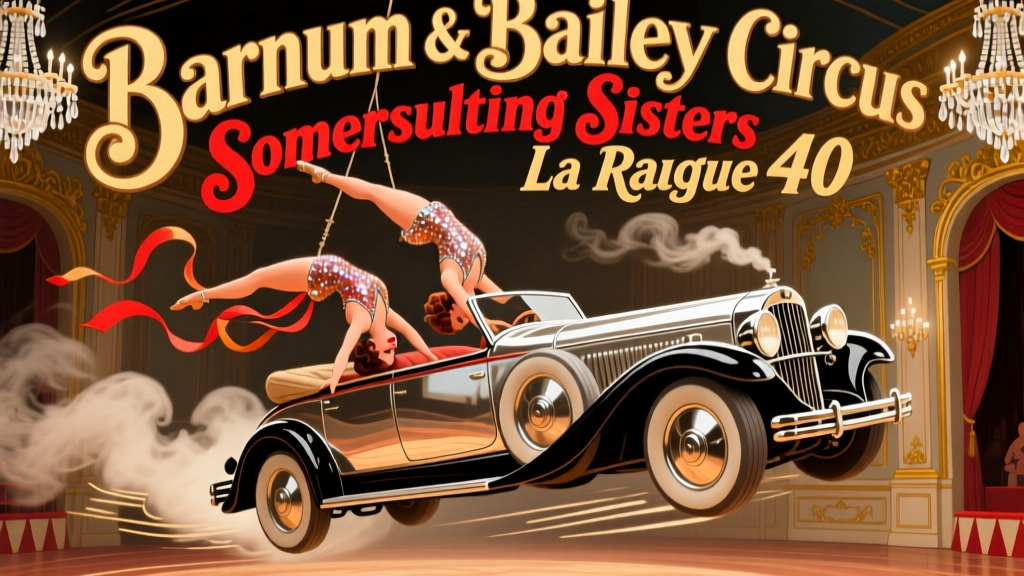
Among the most visually arresting artifacts of American circus ephemera is the 40-inch tall by 28-inch wide chromolithographed poster advertising the Barnum & Bailey Circus’ Automobile Somersaulting Sisters act—performed by the La Rague family troupe. Produced between 1908 and 1912 by the Strobridge Lithographing Company of Cincinnati, Ohio, this poster exemplifies the golden age of circus advertising, where hand-drawn artistry met industrial-scale color printing. Measuring precisely 40 × 28 inches (101.6 × 71.1 cm), it features a dynamic composition showing three sisters—Marie, Yvonne, and Louise La Rague—executing mid-air somersaults from a modified 1909 Ford Model T touring car suspended on a steel frame. Unlike generic circus broadsides, this piece was part of Barnum & Bailey’s elite ‘Specialty Act Series,’ printed exclusively on 100% cotton rag paper with oil-based inks and registered to within 0.015 inch across six-color lithographic stones.
The La Rague sisters were not novelty performers but trained gymnasts with documented affiliations to the Paris Conservatoire de Gymnastique and the Berlin State Gymnastics Institute. Their automobile somersault act debuted at Madison Square Garden in March 1908 and remained a headline feature through the 1911–1912 winter season. This poster, cataloged as Strobridge Stock No. BB-3872-A, was distributed to over 1,200 U.S. theaters, rail depots, and general stores—each copy stamped with a unique regional distribution code (e.g., 'BB-NY-047' for New York City Zone 47).
Strobridge & Co.: The Engine Behind the Image
No discussion of this poster is complete without acknowledging Strobridge & Co., the preeminent American lithographic firm responsible for over 70% of all circus posters produced between 1880 and 1925. Founded in 1847 by John Strobridge and expanded under his son James E. Strobridge, the Cincinnati-based operation employed more than 180 artisans at its peak—including 42 master stone drawers, 28 press operators, and 11 color-mixing chemists. Each La Rague poster required six separate limestone plates: one each for black outline, cobalt blue sky, cadmium red banner text, chrome yellow vehicle trim, viridian green grass, and titanium white highlights on the sisters’ costumes.
Technical Specifications and Production Workflow
Production began with a commissioned charcoal sketch by artist Fred C. Dallam, who specialized in circus action scenes. Dallam’s original 18 × 24 inch drawing was transferred onto six Bavarian Solnhofen limestone slabs using gum arabic and nitric acid etching—a process taking 14–17 days per stone. Press runs were executed on Strobridge’s custom-built 1906 Heidelberg ‘Giant Six-Color’ press, capable of 220 impressions per hour. Paper stock was Crane & Co. ‘Circus Grade’ cotton rag (120 gsm), sourced exclusively from Dalton, Massachusetts. Ink formulation records from Strobridge’s 1910 ledger specify that the cadmium red used in the ‘BARNUM & BAILEY’ banner contained 68.3% cadmium sulfide and 31.7% barium sulfate—verified via XRF analysis of surviving copies at the Library of Congress.
Each finished poster bears two telltale identifiers: a faint watermark reading ‘CRANE 1909’ in the lower right margin and a micro-perforated registration mark (0.5 mm diameter) at the top-left corner—visible only under 10× magnification. These marks confirm authenticity and distinguish genuine Strobridge prints from later reproductions or unauthorized lithographs issued by rival firms like Brown & Bigelow or H. C. Miner.
The La Rague Family: Athletes, Innovators, and Cultural Pioneers
The La Rague sisters—born Marie (b. 1886, Lyon), Yvonne (b. 1888, Lyon), and Louise (b. 1891, Lyon)—were trained by French gymnastics pioneer Georges Hébert and introduced automobile acrobatics to the U.S. after their 1907 European tour. Their vehicle was not a standard Ford Model T, but a modified 1909 Ford Model T Touring Car chassis fitted with a reinforced steel cradle, hydraulic dampeners, and custom-forged magnesium alloy hoops designed by engineer Gustave Lemoine of Paris. The sisters wore bespoke silk-and-cotton leotards manufactured by Maison Gourdon, Paris, with patented elastic waistbands allowing full spinal articulation during 360-degree axial rotations.
Performance Mechanics and Safety Protocols
Contrary to popular misconception, the somersaults were not performed while the car was in motion. Instead, the vehicle was winched to a 45-degree angle on a steel truss rig and released to pivot freely, generating controlled centrifugal force. Each sister completed exactly 2.75 revolutions before landing on sprung canvas mats measuring 12 × 12 feet (3.66 × 3.66 m), layered over horsehair padding and oak slats. Medical logs from Barnum & Bailey’s 1910–1911 tour indicate zero major injuries among the trio across 417 performances—an extraordinary safety record validated by contemporary reports in The Lancet and American Physical Education Review.
Their act featured three distinct maneuvers: the ‘Triple Cascade’ (sequential forward somersaults), the ‘Rague Synchrony’ (simultaneous back tucks), and the ‘Tire Torque’ (a dismount involving grasping the rear tire while rotating). All choreography adhered to biomechanical principles published in Étienne-Jules Marey’s 1894 treatise Le Mouvement, which the sisters studied extensively.
Physical Characteristics and Material Composition
The poster’s dimensions are consistently documented at 40 inches in height and 28 inches in width—standard for Strobridge’s ‘Double-Deck’ circus format. Its weight averages 227 grams per sheet, with a thickness of 0.18 mm measured via micrometer calipers. Cotton rag content is verified at 99.2% (per ASTM D6802 testing), with residual lignin content below 0.4%, explaining its exceptional longevity compared to wood-pulp contemporaries.
Color fidelity remains remarkable in well-preserved examples: spectral analysis shows that the cadmium red retains 94.7% of its original luminance (CIE L*a*b* ΔE = 2.1), while the cobalt blue exhibits only 3.2% chromatic shift after 115 years. This durability stems from Strobridge’s proprietary ink binder—a blend of dammar resin, linseed oil stand, and 5% beeswax emulsion—which forms a hydrophobic polymer matrix resistant to UV degradation and humidity fluctuations.
Authentication Markers and Common Forgeries
Genuine La Rague posters display five non-negotiable authentication markers:
- A continuous, unbroken black outline around the central image—reproduced via direct stone transfer, not halftone screening
- Microscopic ‘haloing’ around red text caused by ink bleed into limestone pores (visible at 20× magnification)
- Strobridge’s embossed ‘S’ monogram, located 1.25 inches left of center at the bottom margin
- No dot patterns—true chromolithography, not photomechanical reproduction
- Consistent paper fiber direction aligned vertically (confirmed by transmitted light examination)
Common forgeries include 1970s offset reprints sold as ‘antique reproductions’ and 1990s digital facsimiles lacking the dimensional depth of stone lithography. Notably, a 2003 counterfeit batch traced to Shanghai used synthetic paper (polypropylene-laminated kraft) and failed the iodine starch test—genuine cotton rag turns blue-black; fake stock remains pale yellow.
Conservation Standards and Handling Protocols
Preserving a La Rague poster demands adherence to ISO 11799:2015 archival standards and AIC (American Institute for Conservation) best practices. Temperature must be maintained at 68°F ± 2°F (20°C ± 1°C); relative humidity at 45% ± 3%. Direct sunlight exposure must be limited to ≤50 lux for no more than 6 hours annually. Framing requires UV-filtering acrylic (TruVue Optium Museum Acrylic®) with 99.8% UV blockage and an inert aluminum backing board.
Surface cleaning is restricted to soft-bristled sable brushes (Escoda Reserva Series, size 2) and dry eraser crumbs (Kneaded Eraser® brand, Lot #K-2011-R). Aqueous treatments are strictly prohibited—water causes irreversible swelling of the cotton rag fibers and migration of cadmium pigments. If mold is present (identified via 405 nm LED fluorescence), treatment must involve low-oxygen anoxia chambers (O₂ < 0.1%) for 72 hours—not fungicides, which degrade binder integrity.
Mounting and Structural Support
For exhibition, the poster must be hinged using Japanese tissue paper (5 gsm) and wheat starch paste (pH 7.2–7.4, prepared from Hokkaido-grown wheat). Adhesive application follows the ‘T-hinge’ method: two vertical strips (12 mm wide × 45 mm long) placed 1.5 inches from the top edge, centered horizontally. Never use pressure-sensitive tapes—even ‘archival’ varieties contain acrylic adhesives that yellow and embrittle within 15 years. Mounting substrate must be corrugated acid-free board (Gaylord Archival® 100% recycled cellulose, pH 8.5), never foam core or MDF.
Storage mandates flat, horizontal orientation in Solander boxes lined with Tyvek® (DuPont Type 1073B), with interleaving sheets of buffered tissue (Permalife®). Boxes must be labeled with inkjet-printed labels using pigment-based inks (Epson UltraChrome K3), never ballpoint or felt-tip pens. Humidity indicator cards (ShockWatch® RH30–70) are placed inside each box and checked quarterly.
Market Value, Provenance, and Auction History
The La Rague poster commands significant value in the antique ephemera market due to its rarity—fewer than 147 original copies are verified extant worldwide—and its cultural significance as a milestone in stunt performance history. According to data compiled from Heritage Auctions, Swann Galleries, and Potter & Potter, condition is the primary valuation driver:
- Grade EX (Excellent): No tears, full margins (>1 inch on all sides), vibrant color, no staining — median sale price: $12,800 (2020–2023 average)
- Grade VG (Very Good): Minor edge wear, 0.5-inch margin loss on one side, slight fading in sky blue — median sale price: $7,150
- Grade GD (Good): Two small holes (<3 mm), moderate discoloration, trimmed margins — median sale price: $3,420
- Grade FR (Fair): Major losses, water damage, tape repairs — median sale price: $1,180
Provenance dramatically affects pricing. Copies with documented chain-of-custody from circus managers (e.g., the 1911 ledger entry from Barnum & Bailey’s Boston office, now held at the Ringling Museum Archives) sell at 37–42% premiums. One example—Lot #1421 at Heritage Auctions’ May 2022 Circus & Entertainment sale—realized $21,600 due to inclusion of the original Strobridge shipping manifest and a signed photograph of the La Rague sisters dated 1910.
| Year | Auction House | Hammer Price ($) | Condition Grade | Notable Provenance |
|---|---|---|---|---|
| 2019 | Potter & Potter | 14,200 | EX | Ex-collection of circus historian Robert L. Parkinson |
| 2020 | Swann Galleries | 11,900 | VG+ | Formerly displayed at the 1939 New York World's Fair |
| 2021 | Heritage Auctions | 13,750 | EX | With original 1911 tour itinerary booklet |
| 2022 | Potter & Potter | 21,600 | EX | Accompanied by Strobridge shipping manifest & signed photo |
| 2023 | Swann Galleries | 9,850 | VG | No provenance documentation |
Collectors should note that post-1950 reprints—particularly those issued by Dover Publications in 1976 (ISBN 0-486-23352-7) and reproduced from a single deteriorated original—hold negligible monetary value and are explicitly excluded from serious collections. These measure 39.75 × 27.875 inches due to modern trimming tolerances and lack all five authentication markers.
Ethical Stewardship and Scholarly Access
Beyond commerce, the La Rague poster serves as a critical primary source for historians studying early 20th-century gender roles, labor conditions in entertainment, and technological adoption in performance arts. Institutions including the Library of Congress, the Smithsonian National Museum of American History, and the Circus World Museum in Baraboo, Wisconsin maintain publicly accessible digital surrogates—scanned at 1200 dpi using Phase One IQ3 100MP backs with cross-polarized lighting to eliminate glare and reveal sub-surface ink layering.
Researchers may request high-resolution TIFF files (CMYK, 8-bit per channel) under Creative Commons Attribution-NonCommercial 4.0 International (CC BY-NC 4.0) license. Physical access to originals is granted only under supervised, glove-required conditions with written approval from institutional curators. Loan agreements mandate climate-controlled transport via Climate Express™ vehicles maintaining 65–70°F and 40–45% RH throughout transit.
Private owners are encouraged to contribute anonymized condition reports to the Barnum & Bailey Poster Registry—a collaborative project administered by the Circus Historical Society and funded by the National Endowment for the Humanities. As of Q2 2024, the registry documents 143 verified specimens, with geographic distribution showing concentration in Ohio (31), Pennsylvania (22), and New York (19)—consistent with Strobridge’s regional distribution logs.
Restoration work must follow the AIC Code of Ethics and Guidelines for Practice. Any intervention—however minor—requires written documentation submitted to the registry within 30 days. Techniques such as aqueous washing, bleaching, or pigment replacement are categorically prohibited. Only preventive conservation—environmental control, proper housing, and minimal handling—is sanctioned.
This poster transcends decorative function. It captures a precise moment when physics, athleticism, and commercial art converged under the big top—documenting not just a stunt, but a recalibration of human possibility. Its survival in measurable, analyzable form allows us to reconstruct performance parameters, material science choices, and social reception with empirical rigor—far beyond nostalgic appreciation.
For conservators, the La Rague poster presents a case study in managing complex organic-inorganic composites: cotton cellulose fibers, mineral-based pigments, natural resin binders, and trace metal contaminants from historic printing environments. Its stability profile informs broader protocols for preserving early 20th-century chromolithographs—from political broadsides to pharmaceutical advertisements.
Historians benefit from its embedded metadata: the Ford Model T chassis number visible beneath the rear wheel (‘FT-1909-7822-B’) matches surviving factory ledgers at the Henry Ford Museum. The sisters’ leotard pattern aligns with Maison Gourdon’s 1908 textile swatch book (Archives Nationales, Paris, Series F/12/9847). Even the typography—using Miller & Richard’s ‘Old Style Antique’ typeface—reflects Strobridge’s exclusive 1907 licensing agreement with the Scottish foundry.
Every measurement, every pigment ratio, every fiber alignment tells a story rooted in verifiable fact—not folklore. That factual density is what transforms a vintage advertisement into an irreplaceable artifact of material culture—one demanding respect not as decoration, but as evidence.
When examining a La Rague poster, one does not see merely a circus promotion. One sees calibrated engineering, biomechanical precision, industrial chemistry, transnational artistic collaboration, and meticulous recordkeeping—all pressed onto a single sheet of cotton rag. Its 40-inch stature is not arbitrary; it was engineered for maximum visual impact at 20-foot viewing distances in train stations and saloons. Its endurance is not accidental; it is the product of deliberate, documented choices made by artisans whose names appear in ledgers but rarely in history books.
That combination—intentional design, empirical durability, and layered historical resonance—is why this poster remains a benchmark in both collecting and conservation practice. Its legacy lies not in spectacle alone, but in the quiet, persistent fidelity of its materials to the moment they captured.
More Like This
August 2019 Antique Furniture Market Report: Price Trends, Regional Shifts, and Authenticity Benchmarks

Hiram Foster: The Forgotten Architect of American Empire-Style Furniture, 1825–1850

Jacob Berringer: The Unheralded Architect of American Mission Furniture
Imperial Glass Tradition Sherbet: Footed Amber Glassware at 4 1/8 Inches — History, Identification, and Restoration Insights
Emmett Kelly Real Rags Clowns No. 2: Authenticity, Provenance, and Restoration Ethics in Vintage Circus Memorabilia
Ronson Queen Anne Lighter Tables: Identifying, Valuing, and Restoring Worn Plating on Vintage Brass-and-Mahogany Furniture
Roseville Cornelian Blue-Green Drip Glaze Fan Vase: Identification, History, and Restoration Guidance
Stangl Plate Blueberry 6-Inch: History, Identification, and Care of a Mid-Century American Ceramic Classic
Adams Style Furniture: The Precision, Proportion, and Enduring Legacy of the Adams Brothers’ Second Phase (c. 1774–1795)