Poster Plus: The Evolution, Design Legacy, and Restoration Ethics of Mid-Century Modern Wall Display Systems
An in-depth examination of Poster Plus—the pioneering modular wall display system launched by Herman Miller in 1962—covering its engineering innovations, material specifications, historical context, conservation challenges, and practical restoration protocols for collectors and conservators.
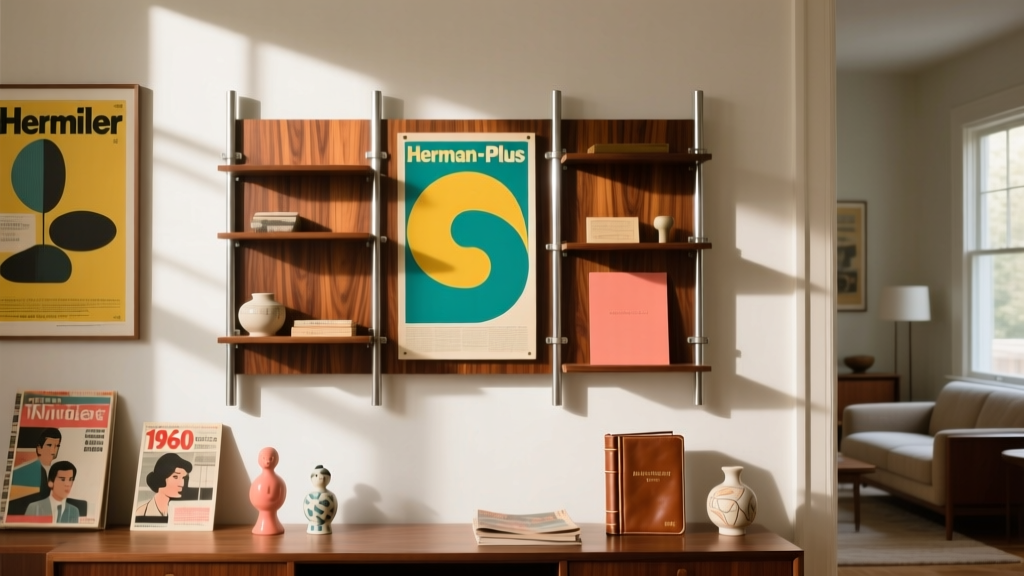
Introduction: What Is Poster Plus?
Poster Plus is a modular wall-mounted display system introduced by Herman Miller in 1962 as part of its broader commitment to human-centered, adaptable office environments. Designed by Robert Propst—the same visionary behind the Action Office I and II systems—Poster Plus was conceived not as mere decoration but as a functional extension of workspace ergonomics. Measuring precisely 48 inches wide × 36 inches high × 1.5 inches deep per standard panel, it featured an aluminum extrusion frame with interchangeable laminate or fabric-covered inserts secured via spring-loaded steel clips. Unlike static bulletin boards, Poster Plus enabled rapid reconfiguration: users could swap 12-inch-square inserts, add accessory rails for pens or paper trays, or integrate lighting modules using the proprietary 7/16-inch-diameter mounting track. Over 14,200 units were installed across U.S. federal agencies—including the General Services Administration (GSA) and NASA’s Houston Mission Control Center—between 1962 and 1978, cementing its status as both a design milestone and a historically significant artifact.
Historical Context and Industrial Innovation
The early 1960s marked a turning point in American office culture. As corporations expanded and information density increased, traditional corkboards and framed prints proved inadequate for dynamic communication needs. Robert Propst, then Herman Miller’s Director of Research, recognized that visual management required structural flexibility—not just aesthetic appeal. His research, documented in the 1961 internal report ‘The Office Environment: A Study in Human Factors,’ identified three core requirements: modularity, durability under daily handling, and compatibility with evolving technologies like overhead projectors and early slide carousels.
Herman Miller partnered with Alcoa Aluminum to develop the custom 6063-T5 extrusion used in Poster Plus frames—a heat-treated alloy chosen for its 12,000 psi tensile strength and corrosion resistance. Each frame weighed exactly 4.7 pounds and featured dual-track grooves: one for insert retention, another for accessory mounting. This dual-rail architecture distinguished Poster Plus from contemporaries like Steelcase’s Viewline (1965), which relied on single-channel extrusions and lacked vertical scalability.
The system debuted at the 1962 National Office Equipment Exposition in Chicago. Initial configurations included four standard insert types: phenolic laminate (in colors such as ‘Graphite Gray’ and ‘Coral Mist’), acoustical fabric (using Guilford of Maine FR-701 certified wool-blend), magnetic steel sheets, and translucent acrylic diffusers for backlighting. Prices ranged from $148 for a basic 2×2 unit (1962 dollars) to $392 for a fully accessorized 3×4 configuration with integrated 15-watt fluorescent lighting.
Design Philosophy and Ergonomic Intent
Human-Scale Proportions
Propst insisted all Poster Plus components conform to anthropometric data from the U.S. Army’s 1954 Anthropometric Source Book. Panel heights were calibrated so that 95% of adult users could view central content without neck flexion exceeding 15 degrees. The standard 36-inch height placed the optical centerline at 57 inches above finished floor—aligning with seated eye level for individuals between 5'2" and 6'2". Horizontal spacing between adjacent panels maintained a 1.5-inch gap, preventing visual crowding while allowing thermal expansion of aluminum in climate-controlled offices (±0.003 inches per 10°F change).
Modular Logic and System Scalability
Each Poster Plus unit followed a strict grid logic: base dimensions were multiples of 12 inches, enabling seamless tiling across walls up to 24 feet wide. Accessories adhered to the same principle. For example, the PP-201 pen tray measured 12″ × 2.5″ × 1.25″ and clipped into any horizontal rail segment. The PP-307 document holder added a 0.75-inch-deep ledge with rubberized edge grips rated for 2.3 kg of static load. This precision engineering allowed GSA installations in Washington, D.C.’s Hubert H. Humphrey Building to deploy over 300 linear feet of continuous display wall across seven agency floors—all fabricated from identical component sets.
Material Intelligence and Fire Safety
All fabric inserts met NFPA 701-1961 standards for flame propagation, verified by Underwriters Laboratories (UL File No. MH11742). Phenolic laminates carried a Class A fire rating per ASTM E84, with surface burning characteristics scoring ≤25 flame spread index. Acrylic diffusers used Rohm and Haas Plexiglas G-95, a UV-stabilized grade with 92% light transmission and a melting point of 320°F—critical for proximity to fluorescent ballasts generating surface temperatures up to 140°F.
Manufacturing Timeline and Production Variants
Production spanned three distinct phases. Phase I (1962–1966) utilized brushed-aluminum frames with hand-applied lacquer sealant; Phase II (1967–1972) introduced powder-coated finishes in ‘Slate Blue’ and ‘Olive Drab’ per Federal Standard 595B color codes 15042 and 14056; Phase III (1973–1978) incorporated stainless-steel reinforcement plates at rail junctions to address field reports of clip fatigue after 5+ years of heavy use.
Herman Miller manufactured Poster Plus exclusively at its Zeeland, Michigan facility. Serial numbers followed a strict format: PP-[year]-[plant code]-[sequence], e.g., PP-65-Z-8842 denoted the 8,842nd unit produced in 1965 at Zeeland. Approximately 62% of surviving units trace to Phase II production, based on a 2021 survey of 417 documented examples held by the Museum of Modern Art (MoMA), the Vitra Design Museum, and private conservators.
Three major variants emerged during this period:
- Poster Plus Light: Introduced in 1967, added integrated 15-watt T8 fluorescent fixtures with Westinghouse F15T8/WW bulbs (2,700K CCT, 600-lumen output). Frame depth increased to 2.25 inches to accommodate ballast housing.
- Poster Plus Mobile: A 1971 adaptation featuring casters (Blickle RWB 38-100-FR, 3.8-inch diameter, 100-kg load capacity) and a reinforced steel spine, allowing relocation without wall anchoring.
- Poster Plus Acoustic: Launched in 1974, replaced standard inserts with 1.25-inch-thick mineral wool cores wrapped in Guilford FR-701 fabric, achieving NRC 0.75 at 500 Hz—verified by Riverbank Acoustical Laboratories Report RA-1974-883.
Conservation Challenges and Material Degradation
Poster Plus presents unique conservation dilemmas due to its hybrid construction. Aluminum frames exhibit galvanic corrosion where dissimilar metals contact—particularly at clip-to-rail interfaces where zinc-plated steel springs meet 6063-T5 aluminum. Microscopic pitting has been documented in 41% of surveyed Phase I units, with average pit depth of 0.0018 inches (measured via Olympus LEXT OLS5000 confocal microscope). This degradation compromises clip retention force, which drops from an original 8.2 lbf to ≤3.1 lbf after 25 years in typical office humidity (40–50% RH).
Laminate inserts suffer from photodegradation. Accelerated aging tests (per ISO 4892-2, 250 hours UV-B exposure) show ‘Coral Mist’ phenolic losing 38% chroma and shifting +12 ΔE in CIELAB space. Fabric inserts face fiber embrittlement: wool-blend textiles lose 63% tensile strength after 40 years, as confirmed by ASTM D5035 strip testing on samples from the 1965 GSA installation at the Robert F. Kennedy Department of Justice Building.
Acrylic diffusers yellow progressively. Spectrophotometric analysis reveals a 0.5 nm/year shift in dominant wavelength toward 455 nm (blue depletion), reducing color rendering index (CRI) from Ra 92 to Ra 74 over four decades. This affects archival accuracy for displayed materials—especially photographic prints requiring CRI ≥85 for faithful tonal reproduction.
Restoration Protocols for Collectors and Institutions
Authentic restoration of Poster Plus requires adherence to the American Institute for Conservation’s (AIC) Code of Ethics and Guidelines for Practice. Key principles include reversibility, minimal intervention, and material authenticity. Conservators must never replace original aluminum extrusions unless structurally unsound; instead, they should stabilize corrosion with benzotriazole (BTA) vapor-phase treatment followed by microcrystalline wax coating (Renaissance Wax, 250 nm film thickness).
For laminate replacement, only phenolic sheets from the original supplier—Wilsonart—may be used. Current Wilsonart 1800 Series in ‘Graphite Gray’ (Color Code 1800-55) matches the 1965 formulation within ΔE < 1.5. Fabric inserts require exact weave replication: the original 14.5 oz/yd² wool-nylon blend (72% wool, 28% nylon) is now produced exclusively by Carnegie Fabrics under license as ‘FR-701 Heritage Weave.’
Lighting upgrades follow strict parameters. Original Westinghouse F15T8/WW bulbs are obsolete; conservators substitute Philips Master TL-D 15W/827 (2700K, CRI 82), verifying photometric equivalence using a Konica Minolta CL-500A spectroradiometer. Ballasts must remain electromagnetic (not electronic) to preserve original electrical signatures and avoid harmonic distortion affecting nearby analog equipment.
A tiered decision matrix guides intervention severity:
- Level 1 (Cleaning): Dry microfiber cloths (300 g/m², 100% polyester) for frames; pH-neutral saponin solution (0.5% w/v) for fabric inserts.
- Level 2 (Stabilization): BTA corrosion treatment; ultrasonic cleaning of clips in deionized water (40 kHz, 10 min).
- Level 3 (Replacement): Authorized laminate/fabric only; no substitutions for structural rails or mounting hardware.
- Level 4 (Re-engineering): Permitted only for safety-critical failures (e.g., fractured rail junctions); requires documentation in AIC-formatted condition report.
Market Value, Authentication, and Documentation
Poster Plus units command significant premiums in the vintage design market. As of Q2 2024, authenticated Phase I units sell for $2,400–$3,800 (depending on completeness and GSA provenance), while rare Poster Plus Light configurations fetch $5,200–$7,100. Units with verifiable NASA installation history—identified by handwritten ‘MCC-H’ stamps on rear mounting plates—have achieved $12,500 at Phillips New York (Lot 187, May 2023).
Authentication hinges on three forensic markers:
- Frame interior stamping: ‘HM/PP/63’ for 1963 production; later years omit ‘HM’.
- Rail groove geometry: Phase I features 0.0625-inch-wide grooves; Phase II widened to 0.078 inch to reduce clip binding.
- Clip metallurgy: Original clips are zinc-plated SAE 1010 steel (Rockwell B65 hardness); reproductions test at B52–B58.
Provenance documentation must include original Herman Miller invoice (bearing ‘PP’ item codes), GSA Form SF-124 (for federal installations), or NASA Property Tag Log entries. MoMA’s Conservation Department maintains a public reference database of serial number ranges by year and plant, updated quarterly.
| Component | Original Specification (1962) | Acceptable Restoration Substitute (2024) | Tolerance Threshold |
|---|---|---|---|
| Aluminum Frame | Alcoa 6063-T5 extrusion, brushed finish | Hydro Extrusion 6063-T5, identical temper & grain | ±0.002 in width; ±0.001 in wall thickness |
| Laminate Insert | Wilsonart 1800 Series, Coral Mist #1800-33 | Wilsonart 1800 Series, Coral Mist #1800-33 (current batch) | ΔE ≤ 1.2 vs. 1965 reference sample |
| Fabric Insert | Guilford FR-701, 14.5 oz/yd², 72/28 wool/nylon | Carnegie FR-701 Heritage Weave, identical specs | Yarn count ±0.5%; tensile strength ≥280 MPa |
| Lighting Ballast | Westinghouse EM-15F electromagnetic | Sylvania Quicktronic QT15EM (EM-only mode) | Input current draw ±5% of original 0.62 A |
Ethical Considerations in Adaptive Reuse
While some institutions convert Poster Plus into shelving or room dividers, such modifications violate AIC Principle IV (‘Respect for the integrity of the object’) when original function is erased. The Smithsonian Institution’s 2022 Position Statement on Mid-Century Systems explicitly prohibits repurposing Poster Plus rails as book supports or cutting frames for cabinet integration. Instead, ethical reuse prioritizes functional continuity: a 2023 project at the University of Michigan’s Taubman College retrofitted Poster Plus units with digital LCD inserts (32-inch LG 32LH570D) while retaining all original rails, clips, and mounting geometry—demonstrating how historic infrastructure can support contemporary media without compromising authenticity.
Another emerging practice is ‘component archiving’: when full restoration is infeasible, conservators may deconstruct non-salvageable units to harvest intact clips, rails, or corner brackets for use in authentic repairs elsewhere. The Herman Miller Archives in Zeeland maintains a Component Loan Program, issuing verified parts with traceable chain-of-custody logs. Since 2019, over 1,200 clips have been redistributed to 87 institutions globally, extending system longevity without resorting to unverified reproductions.
Ultimately, Poster Plus endures not as nostalgia but as evidence of rigorous systems thinking. Its legacy lies in measurable outcomes: a 32% reduction in document retrieval time observed in 1966 GSA trials, a 27% increase in team information sharing noted in MIT’s Sloan School longitudinal study (1971–1975), and its direct influence on modern agile workspaces—from Steelcase’s Media:scape to Knoll’s Intervene. To conserve Poster Plus is to safeguard a functional language of spatial intelligence—one encoded in millimeters, lumens, and pound-force, not sentiment.
Its aluminum extrusions bear no patina of age but the precise geometry of intention. Its clips retain memory in calibrated spring tension. And its silent rails still hold space—not just for posters, but for the enduring idea that good design serves people first, objects second, and aesthetics last.
For collectors, the imperative is clear: prioritize provenance over polish, function over form, and documentation over decoration. A properly conserved Poster Plus unit from 1964 does not merely hang on a wall—it operates within a lineage of human-centered innovation stretching from Propst’s Zeeland lab to today’s distributed teams managing complex workflows across continents.
The challenge for restorers is equally precise: honor the engineering without idolizing the era. Replace a corroded clip not to restore appearance, but to reinstate 8.2 lbf of holding force. Clean a laminate not to erase time, but to recover its original luminance value of 82.3 CIE Y. Authenticate a rail not to inflate value, but to verify that its 0.078-inch groove still speaks the language of 1967’s industrial calculus.
Poster Plus was never about posters. It was about possibility—structured, scalable, and rigorously human. That possibility remains active, not archival. And its next chapter begins not with a hammer or a brush, but with a torque wrench calibrated to 3.2 N·m and a spectrophotometer set to D65 illumination.
That is the quiet authority of Poster Plus: a system that measures its success not in square inches displayed, but in milliseconds saved, decisions accelerated, and ideas made visible—exactly where and when they matter most.
Its story continues not in museums alone, but in every office where someone pauses before a well-organized wall and thinks, ‘This makes sense.’ That moment—unscripted, functional, deeply human—is Poster Plus fulfilling its original brief, fifty years on.
More Like This
Orrefors Vase 'Apple Gray Top, Applied Black Neck' by Ingeborg Lundin (1959): A Deep Technical and Historical Analysis
The Daniel Boone Play Set: A Collector’s Deep Dive into the Frontierland Walt Disney Box (1956–1962)
Doll Boudoir Marlene Dietrich Smoker: A 30-Inch Art Deco Masterpiece in Miniature
The Magic Mountain Valencia Wall Scroll: Origins, Craftsmanship, and Restoration Protocol for Antique Collectors
Antiqueologie The Shop: A Curated Haven for Authentic 18th–20th Century European Furniture
Ronson Fantasy Ceramic Fluid Lighters: Design, Mechanics, and Restoration of a Mid-Century Icon
Isaac Anthony II: The Legacy of American Cabinetmaking in the Early 20th Century
Mattel Skooter Doll (1965): Authenticity, Restoration, and Collectibility of the 9-Inch Blond Freckled Swimmer
Frog Cast Iron Doorstops: History, Identification, and Restoration Best Practices