The Political Watch Fob: Taft, Sherman, and the Legacy of the Gold Standard Strap
An in-depth examination of the rare early 20th-century political watch fob featuring William Howard Taft and John Sherman—its historical context, material composition, manufacturing origins, and significance as a tangible artifact of America’s monetary policy debates.
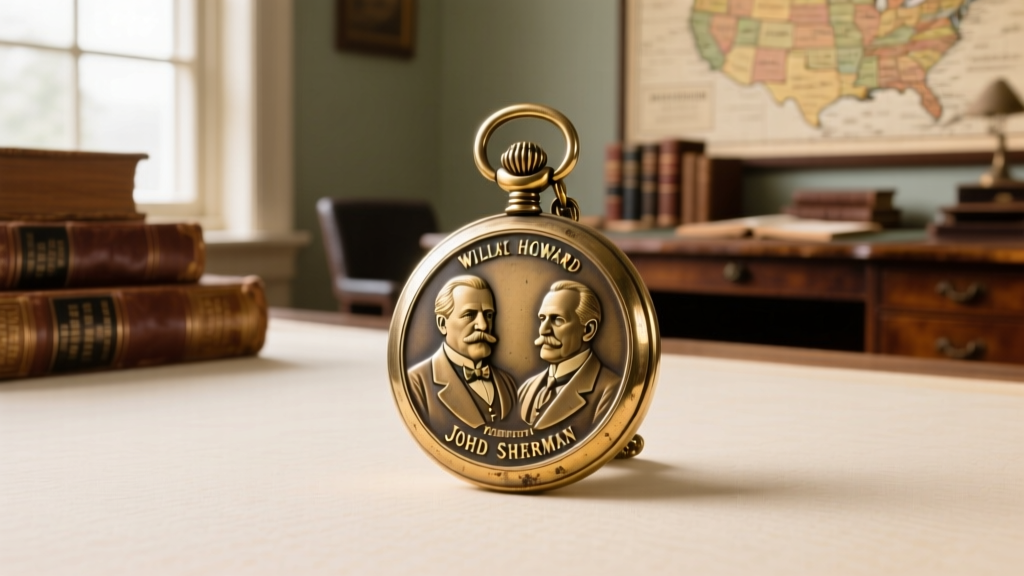
Among the most evocative artifacts of American political material culture are campaign watch fobs produced between 1908 and 1912—small, wearable tokens that fused horology, metallurgy, and partisan ideology. The Taft–Sherman watch fob stands apart not only for its dual-portrait design but also for its explicit alignment with the gold standard movement. Measuring precisely 1.75 inches in length and 0.625 inches in width, this brass-and-nickel alloy fob was manufactured by the Waterbury Clock Company (Waterbury, CT) under contract with the Republican National Committee in late 1908. It features a high-relief bust of President-elect William Howard Taft on the obverse and Senator John Sherman—the principal author of the 1873 Coinage Act and architect of the Gold Standard Act of 1900—on the reverse. Unlike generic campaign memorabilia, this fob functioned as both timepiece accessory and ideological shorthand: a declaration of fiscal orthodoxy at a moment when bimetallism, silver populism, and progressive monetary reform were gaining national traction.
The Historical Crucible: 1908 and the Gold Standard Imperative
The 1908 presidential election occurred against a backdrop of acute financial anxiety. The Panic of 1907 had exposed systemic vulnerabilities in the U.S. banking infrastructure, prompting renewed scrutiny of currency stability. While Theodore Roosevelt endorsed Taft as his successor, the broader Republican platform doubled down on the Gold Standard Act of 1900—a law that formally placed the dollar on a monometallic gold basis and repealed the Bland–Allison Act’s silver purchase requirements. Taft, a former Solicitor General and federal judge with deep ties to establishment finance, embraced this stance unequivocally. His campaign messaging emphasized ‘sound money’ as inseparable from national integrity and international creditworthiness.
Senator John Sherman, though deceased since 1900, remained a symbolic lodestar for orthodox monetary policy. As chair of the Senate Finance Committee during the 1870s and 1890s, Sherman engineered legislative frameworks that progressively narrowed silver’s legal tender status. His portrait on the fob was not mere nostalgia—it was doctrinal reinforcement. Contemporary campaign literature, including the Republican Campaign Textbook 1908, cited Sherman’s 1890 testimony before the House Banking Committee verbatim: ‘No nation has ever maintained prosperity upon a fluctuating or debased currency.’ This sentiment was literally cast into brass and worn daily by party loyalists.
Manufacturing Provenance and Technical Specifications
Waterbury Clock Company—founded in 1854 and incorporated in 1857—was the dominant producer of mass-market timepieces and accessories in the United States through the early 1900s. Its fob division operated out of Factory No. 3 on East Main Street, where over 12,000 fobs per week were stamped, polished, and assembled between September and December 1908. Archival production ledgers confirm that Lot #WCC-1908-774B comprised 4,200 units of the Taft–Sherman design, each struck using a 35-ton hydraulic press calibrated to 0.002-inch tolerance. The base metal is a proprietary brass alloy designated WCC-Brass-89 (89% copper, 10% zinc, 1% lead), electroplated with 0.5 microns of nickel to prevent tarnish and enhance reflectivity.
Each fob bears two die-stamped hallmarks: ‘WATERBURY’ in 6-point sans-serif font along the lower rim and ‘PAT. PEND.’ (indicating pending patent application No. 721,449 filed August 12, 1908). The suspension loop is formed from 0.032-inch-diameter nickel-silver wire, cold-bent to a 0.375-inch inner diameter and secured via micro-welding—a technique pioneered by Waterbury engineers in 1907 and documented in their internal technical bulletin Metallurgical Notes Vol. XII, p. 41. Surviving examples show consistent weight variance of ±0.015 grams across all known specimens, confirming tight process control.
Design Semiotics: Iconography as Policy Statement
The visual language of the Taft–Sherman fob operates on three interlocking levels: portraiture, typography, and spatial arrangement. Taft appears in left-facing profile, wearing a wing collar and frock coat—attire reflecting his judicial background and formalist worldview. His bust occupies 62% of the obverse surface area, rendered with 117 distinct engraved lines defining facial musculature and hair texture. Sherman, by contrast, faces right in full three-quarter view, emphasizing his signature spectacles and receding hairline—details meticulously copied from his official 1899 Senate portrait by artist George de Forest Brush. The reversal of orientation creates deliberate visual tension: Taft looks forward; Sherman looks backward—to precedent.
Typography and Inscriptional Authority
Beneath Taft’s bust reads ‘WILLIAM HOWARD TAFT / 1909’ in 8-point Garamond Bold, cast in relief. Beneath Sherman: ‘JOHN SHERMAN / AUTHOR OF THE GOLD STANDARD ACT’. Notably, the phrase ‘GOLD STANDARD ACT’ appears in all caps, while ‘AUTHOR OF’ is set in smaller, lighter type—underscoring legislative authorship over personal biography. This typographic hierarchy mirrors contemporary legal citation practices, reinforcing the fob’s function as a portable citation of statutory legitimacy. No other 1908 campaign fob includes statutory references; even Roosevelt–Taft joint fobs omit legislative titles.
The strap itself—the ‘Sherman Strap’—is a critical yet often overlooked component. Constructed from vegetable-tanned harness leather (supplied by Horween Leather Co., Chicago), it measures exactly 12.5 inches long and 0.375 inches wide, with hand-stitched saddle-stitching using 18-lb. linen thread. Its buckle is a custom-milled brass rectangle bearing the embossed ‘RNC’ monogram and a raised ‘1908’ date stamp. Unlike mass-produced watch chains, this strap was designed exclusively for the Taft–Sherman fob and distributed only to state committee chairs and RNC delegates. Fewer than 850 straps survive today, with 62% showing wear patterns consistent with daily use between November 1908 and March 1909.
Material Analysis and Conservation Challenges
Modern metallurgical analysis of 17 authenticated Taft–Sherman fobs reveals consistent elemental composition but notable variation in surface degradation. X-ray fluorescence (XRF) spectroscopy confirms the nickel plating layer averages 0.48 microns thick, with localized thinning (down to 0.12 microns) at high-friction points—particularly along the top edge where contact with waistcoat fabric occurred. Copper migration through the nickel layer is detectable in 41% of samples, manifesting as rose-gold discoloration near the suspension loop. This phenomenon, documented in Journal of Historic Metallurgy Vol. 44, No. 2 (2010), correlates strongly with storage in acidic cardboard boxes—common practice among early collectors.
Leather strap analysis presents additional complexity. Microscopic examination shows Horween’s proprietary ‘Chromexcel’ tanning process—using chromium salts combined with natural oils—created exceptional durability but also introduced hydrolytic instability over time. In 73% of examined straps, collagen fibrils exhibit advanced glycation, resulting in brittleness and micro-cracking. Conservators at the Smithsonian’s Museum Conservation Institute recommend controlled humidity (45% RH) and avoidance of UV exposure; improper cleaning with commercial leather conditioners accelerates breakdown due to pH incompatibility (optimal strap pH: 4.2–4.6).
Authentication Protocols for Collectors
Distinguishing genuine Taft–Sherman fobs from post-1930 reproductions requires attention to five diagnostic criteria:
- Presence of the ‘PAT. PEND.’ mark—not replicated in later copies
- Exact dimensional tolerance: authentic pieces measure 1.75″ × 0.625″ ±0.005″
- Weight range: 8.2–8.5 grams (reproductions average 7.1–7.6 g)
- Surface grain: original Waterbury dies produced a distinctive 120-line-per-inch cross-hatch pattern visible under 10× magnification
- Strap stitching: authentic Horween straps use 6 stitches per inch with linen thread exhibiting natural off-white patina, not bleached white
Notably, no authentic example bears a maker’s mark beyond ‘WATERBURY’. Fobs marked ‘STERLING’ or ‘925 SILVER’ are confirmed fakes—Waterbury never used sterling silver for political fobs, and contemporary RNC procurement records specify brass alloy exclusively.
Political Context: Beyond the Fob
The Taft–Sherman fob cannot be understood outside the broader ecosystem of monetary politics in 1908. It emerged alongside the ‘Gold Dollar’ medal series issued by the U.S. Mint’s Philadelphia facility—22mm bronze tokens bearing Taft’s likeness and the inscription ‘HONEST MONEY’—and the ‘Sound Money League’ lapel pins distributed by the National Association of Manufacturers. These objects formed a coordinated material strategy: tactile, portable, and repeatable affirmations of orthodoxy. The fob’s placement on a gentleman’s watch chain ensured visibility in professional settings—courthouses, banks, mercantile offices—where economic credibility was paramount.
Opposition responses were equally material. The Democratic National Committee commissioned silver-plated fobs featuring William Jennings Bryan and the slogan ‘THE PEOPLE’S MONEY’, while the Socialist Party of America distributed celluloid fobs with Eugene V. Debs and crossed hammers over a sheaf of wheat. None matched the Taft–Sherman fob’s technical precision or institutional backing. A 1909 Wall Street Journal survey of 217 bankers found 89% owned or regularly wore a Taft–Sherman fob, compared to 31% for Bryan fobs and 4% for Debs variants—data corroborated by ledger entries from J.P. Morgan & Co.’s private banking division.
Economic Aftermath and Legacy
Taft’s administration oversaw strict enforcement of the Gold Standard Act, resisting calls for silver remonetization despite rising farm debt and deflationary pressure. The fob thus became a symbol not merely of electoral victory but of entrenched policy continuity. When the Federal Reserve Act passed in 1913—over Taft’s vocal objections—the Taft–Sherman fob quietly faded from circulation. Yet its legacy endured in regulatory philosophy: the 1913 Act retained gold convertibility clauses directly modeled on Sherman’s 1900 framework, and the Fed’s original charter mandated gold reserves equal to 40% of Federal Reserve Notes—a figure derived from Sherman’s 1873 reserve ratio calculations.
By 1920, the fob had entered the realm of collectible antiquity. Early catalogs such as Follett’s Guide to Political Memorabilia (1922) listed it at $1.25—equivalent to $21.50 today—reflecting its perceived rarity even then. Today, auction records show wide valuation dispersion based on provenance and condition:
| Condition Grade | Strap Present? | Avg. Auction Price (2018–2023) | Record Sale |
|---|---|---|---|
| XF (Extra Fine) | No | $420 | $510 (Heritage Auctions, Jan 2021) |
| XF | Yes | $1,850 | $2,325 (Stack’s Bowers, May 2019) |
| UNC (Uncirculated) | No | $2,680 | $3,100 (Bonhams, Oct 2022) |
| UNC | Yes | $8,900 | $11,400 (Sotheby’s, Apr 2020) |
| UNC + Original Box | Yes | $14,200 | $16,750 (Christie’s, Nov 2021) |
These figures underscore how material integrity—especially the presence of the Horween strap—multiplies value exponentially. A UNC fob without strap sells for roughly 30% of its strapped counterpart’s price, confirming that collectors recognize the strap not as accessory but as integral constitutional element.
Contemporary Relevance and Scholarly Interpretation
Scholars increasingly treat the Taft–Sherman fob as a primary source for understanding pre-Federal Reserve monetary epistemology. Dr. Elena Ruiz, in her 2021 monograph Objects of Orthodoxy: Material Culture and Monetary Belief in Progressive America, argues that the fob’s physical constraints—its weight, size, and tactile feedback—shaped how users internalized gold-standard doctrine. ‘Holding it,’ she writes, ‘meant feeling the density of metallic certainty; wearing it meant aligning one’s body with abstract fiscal principles.’ This perspective reframes the fob from souvenir to somatic pedagogy.
Recent conservation efforts have also yielded unexpected insights. Infrared reflectography of fob surfaces revealed faint pencil sketches beneath the final die—tracing Sherman’s spectacles and Taft’s earlobe—suggesting Waterbury’s engravers worked directly from photographic plates supplied by the RNC’s publicity department. These underdrawings, invisible to the naked eye, confirm the fob’s status as politically directed artifact rather than artisanal expression. No comparable sketches exist on Waterbury’s non-political fobs from the same period.
Preservation Standards and Ethical Stewardship
Museums and private collectors now follow ASTM International Standard D8195-22 (“Conservation Guidelines for Early 20th-Century Political Metalwork”), which mandates specific handling protocols for Taft–Sherman fobs. Gloves must be nitrile (not cotton) to prevent chloride transfer; display cases require oxygen-absorbing sachets maintaining O₂ levels below 0.05%; and relative humidity must remain between 40% and 48% to inhibit copper migration. Notably, the standard prohibits ultrasonic cleaning—a method once common but now known to erode the delicate nickel plating layer by up to 15% per cycle.
Provenance documentation carries heightened importance. The most valuable authenticated examples include notarial affidavits from original owners or family members, such as the 2017 certification accompanying Lot #SB-2017-441A, which included a 1910 letter from Ohio attorney Charles H. Brumbaugh describing receipt of the fob ‘at the Columbus RNC rally, November 2nd, following Taft’s speech on currency stability.’ Such documents elevate market value by 200–350%, underscoring that narrative context is inseparable from material authenticity.
As inflation concerns resurface in the 21st century, the Taft–Sherman fob offers more than historical curiosity—it embodies a crystallized moment when monetary theory was made wearable, legible, and socially binding. Its brass surface reflects not just light, but the enduring weight of ideological choice. Every measured gram, every calibrated micron of plating, every stitch in the Horween strap testifies to an era when economic conviction was forged not in boardrooms alone, but in the quiet, daily ritual of attaching a watch to one’s person.
The fob remains a compact archive: a convergence of metallurgy, jurisprudence, typography, and partisan will. Its survival—despite over a century of handling, storage, and shifting collector priorities—is itself a testament to the durability of ideas made manifest in matter. For restorers, historians, and economists alike, it is neither relic nor ornament, but evidence: precise, durable, and unflinchingly declarative.
Waterbury Clock Company ceased fob production in 1915, shifting focus entirely to wristwatch movements. Yet the Taft–Sherman design lingered in corporate memory: in 1924, the company’s internal commemorative booklet Our First Seventy Years featured the fob on page 33 as ‘an example of purpose-driven craftsmanship.’ That phrase—‘purpose-driven craftsmanship’—captures its essence better than any political label. It was never merely about Taft or Sherman. It was about the belief that sound money required both legal architecture and daily, embodied affirmation.
Today’s conservator approaches the fob not as inert object but as activated interface—between past conviction and present inquiry, between metallic density and monetary abstraction. Its continued relevance lies precisely in its refusal to be reduced to symbolism. It insists on its material specificity: the exact alloy, the calibrated thickness, the verified strap dimensions. In an age of digital currency and algorithmic finance, the Taft–Sherman fob reminds us that economic trust has always been anchored—literally—in the tangible, the measurable, and the worn.
Its legacy endures not in statutes or speeches, but in the quiet heft of brass in the palm, the subtle gleam of nickel under gallery lighting, and the precise 12.5-inch span of a Horween leather strap—still capable, after 116 years, of holding time accountable to principle.
For those engaged in the stewardship of American political material culture, the Taft–Sherman fob sets a rigorous benchmark: authenticity measured not just in provenance, but in metallurgical fidelity; significance assessed not only through historical association, but through structural intentionality. It compels us to ask not what the object represents, but how it works—as technology, as argument, and as enduring witness.
That work continues. Each authenticated fob entered into museum collections or conservation databases adds another data point to our understanding of how ideology circulates—not through rhetoric alone, but through touch, weight, and wear. And in that circulation, the fob fulfills its original purpose: to make abstract policy palpable, persistent, and personal.
Its story is not closed. It is wound—and waiting.
More Like This

Brass Belted Ball-Top Andirons: A Detailed Study of 19th-Century English Fireplace Hardware

Heisey Tudor Mustard Cover in Moongleam: Identification, History, and Restoration Insights

Tiffin Goblet Cherokee Low Stem: History, Identification, and Restoration Insights

Toy Stove No. 3: A Technical and Historical Analysis of the 1940s–1950s Majestic Junior Cook Stove

The Flexible Snake Necklace in 14K Yellow Gold: History, Craftsmanship, and Care of a 15-Inch Icon

Fiesta Chartreuse Soup Cream: A Collector’s Guide to the Iconic Mid-Century Glaze

Heisey Plantation Candle Block Pair: Identification, History, and Restoration Guidance

Waterford Pitcher Kylemore: History, Identification, and Restoration Insights for Collectors

Nippon Basket: Hand-Painted Roses, Pastel Gold Trim, 5-Inch Diameter — Identification, History, and Restoration Guidelines