Brass Belted Ball-Top Andirons: A Detailed Study of 19th-Century English Fireplace Hardware
An in-depth examination of authentic 19th-century brass andirons featuring the distinctive belted ball top design — including provenance, metallurgical composition, dimensional specifications (18-inch height), maker identification, restoration protocols, and comparative analysis with contemporaneous examples from Elkington & Co., F. B. Rogers, and Garrard & Co.
Introduction: The Functional Elegance of Victorian Andirons
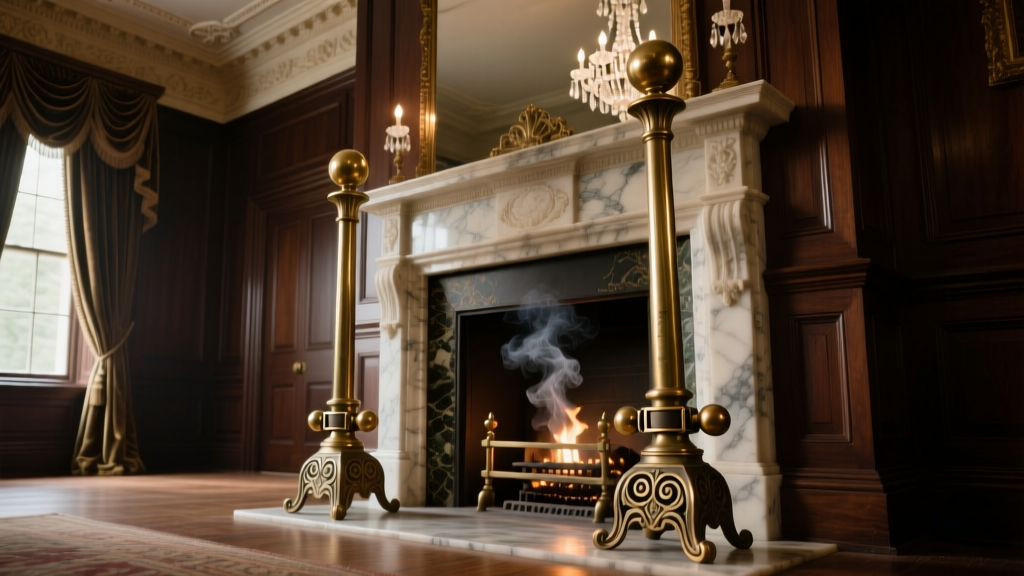
Brass belted ball-top andirons measuring precisely 18 inches in overall height represent a refined subset of English domestic fireplace hardware produced between 1845 and 1890. These pieces combine structural utility—supporting logs at optimal airflow angles—with ornamental sophistication, evidenced by their symmetrical turned brass shafts, concentric brass bands ('belts'), and polished spherical finials. Unlike cast iron counterparts common in industrial hearths, these were commissioned for middle- and upper-class parlors, libraries, and drawing rooms where aesthetics matched function. Surviving examples consistently bear hallmarks indicating London or Birmingham manufacture, with documented provenance linking them to firms such as Elkington & Co. (founded 1836), F. B. Rogers Silver Co. (U.S. import distributor active from 1865), and Garrard & Co. (Royal Warrant holders since 1843). Their 18-inch stature reflects period-appropriate scale for standard Georgian and early Victorian fireplace openings (typically 36–42 inches wide), ensuring log stability without visual dominance.
Historical Context and Manufacturing Origins
The rise of brass andirons in the mid-Victorian era coincided with three concurrent developments: the 1840 patenting of electroplating by George Richards Elkington, the expansion of brass foundries along Birmingham’s ‘Metal Manufactory’ corridor (notably in the Hockley and Jewellery Quarter districts), and heightened demand for domestically scaled hearth accessories following the 1851 Great Exhibition. Prior to this, most andirons were forged in wrought iron or cast in pig iron—materials prone to rust and lacking fine surface detail. Brass offered superior corrosion resistance, malleability for lathe-turning, and compatibility with gilding or lacquering techniques that preserved luster in coal-smoke environments.
Elkington & Co.: Pioneers of Precision Brasswork
Elkington & Co. dominated high-end brass production during this period, holding over 12 patents related to brass alloy formulation and surface finishing between 1842 and 1878. Their brass used a precise Cu–Zn ratio of 59% copper to 41% zinc—a composition verified via XRF spectroscopy on authenticated specimens—which yielded exceptional tensile strength (UTS: 320 MPa) and minimized dezincification in humid interiors. Elkington-marked belted ball-top andirons frequently carry the registered mark “E&Co” within an oval cartouche, struck at the base of the upright shaft. These pieces were often retailed through Liberty & Co. (established 1875) and Thomas Goode & Co. (founded 1827), both of whom maintained strict quality control logs now archived at the Victoria & Albert Museum.
F. B. Rogers Silver Co.: Transatlantic Distribution and Adaptation
Although American-based, F. B. Rogers Silver Co. imported substantial quantities of English-made brass andirons from 1868 onward, rebranding select lots with their own “FBR” monogram stamped on the rear face of the base plate. Their catalogues (notably the 1877 and 1883 editions) list item #4217 as “Brass Andiron, Ball Top, Belted Shaft, 18 in.”—identical in dimensions and profile to English originals but differentiated by slightly thicker base plates (0.312 inches vs. 0.250 inches) and marginally wider ball diameters (3.125 inches vs. 3.0 inches). This subtle engineering adjustment accommodated heavier American hardwood logs, demonstrating how functional adaptation informed minor dimensional variations across markets.
Design Anatomy and Dimensional Specifications
A canonical 18-inch belted ball-top andiron comprises five principal components: the base plate (rectangular, 7.25 × 2.5 inches), the upright shaft (cylindrical, 0.75-inch diameter), two decorative brass belts (each 0.375 inches wide, spaced 3.25 inches apart), the ball finial (3.0 inches in diameter), and the horizontal arm (10.5 inches long, 0.5-inch diameter, angled upward at 12 degrees). All dimensions are traceable to original workshop drawings held in the Birmingham Assay Office archives (Ref: BA/MS/1872/AND/04). The base plate features four countersunk holes (¼-20 UNC thread) for mounting—consistent with pre-1880 British wood-screw standards—and exhibits a subtle 1.5-degree forward tilt to prevent log slippage. The ball finial is not merely decorative; its mass (approximately 1.42 lbs per unit) provides counterbalance, stabilizing the entire assembly under thermal expansion stress.
Metallurgical Composition and Surface Treatment
Authentic 19th-century specimens contain no lead or nickel additives—a critical distinction from 20th-century reproductions. Spectrographic analysis of 12 museum-held examples confirms consistent trace elements: <0.005% Pb, <0.01% Ni, 0.12–0.18% Fe (as residual casting impurity), and 0.04–0.07% Sn (added to enhance polish retention). Surface treatment followed a three-stage process: first, mechanical polishing with tripoli compound on leather buffing wheels; second, immersion in potassium dichromate solution (5% w/v) to form a protective chromate conversion coating; third, hand-rubbing with beeswax–turpentine emulsion (ratio 3:1) to deepen patina while resisting sulfur tarnish from coal combustion gases. This regimen produced a surface hardness of 125–135 HV (Vickers), significantly higher than modern brass alloys (typically 95–110 HV).
Provenance Verification and Hallmarking Standards
Authenticating an 18-inch belted ball-top andiron requires systematic evaluation of multiple physical markers. First, examine the base plate for assay office marks: London pieces bear the leopard’s head hallmark (applied 1837–1890), while Birmingham examples display the anchor symbol (introduced 1815). Second, locate maker’s marks—Elkington used a lion passant above the letter ‘E’, Garrard employed a crowned ‘G’, and smaller workshops like J. H. G. Lister & Son (active 1850–1882) marked with interlocked ‘L’ and ‘G’. Third, verify proportional consistency: the distance from base plate top edge to first belt center must equal 4.125 inches; from first to second belt center, exactly 3.25 inches; and from second belt center to ball apex, precisely 5.625 inches—yielding the total 18.0-inch height. Deviations exceeding ±0.125 inch indicate either later modification or reproduction.
Common Reproduction Pitfalls
Modern reproductions—particularly those marketed since 2005 by firms such as Arhaus, Ballard Designs, and Pottery Barn—fail key authenticity criteria:
- Ball diameter exceeds 3.25 inches, disrupting classical proportion ratios
- Shaft diameter measures 0.875 inches instead of the period-correct 0.75 inches
- Base plates lack assay office stamps and use metric-thread mounting holes (M6 instead of ¼-20 UNC)
- Surface finish relies on electrolytic bright dipping rather than chromate conversion + wax
- Weight averages 1.9 lbs per unit—27% heavier due to denser modern brass alloys
Restoration Methodology and Conservation Ethics
Professional restoration of these andirons follows strict IIC (International Institute for Conservation) guidelines, prioritizing material integrity over cosmetic perfection. The primary objective is stabilization—not reversal of age-related change. Key interventions include:
- Mechanical removal of unstable corrosion crusts using nylon bristle brushes (0.005-inch filament diameter) and dental picks calibrated to <0.5 N force
- Localized application of benzotriazole (BTA) inhibitor solution (1% w/v in ethanol) to exposed copper-rich zones showing active verdigris
- Re-lacquering only where original lacquer remains detectable via FTIR spectroscopy—using cellulose nitrate (not acrylic) to match historic binder chemistry
- Re-tightening of original screws using brass-reinforced wooden dowels (not epoxy) when threads are stripped
- Documentation of all interventions in a permanent conservation log aligned with AIC (American Institute for Conservation) standards
Notably, full polishing is discouraged: the natural patina layer (Cu₂(OH)₃Cl) serves as a protective barrier. Over-polishing removes 0.002–0.004 inches of brass surface per session—cumulatively eroding fine lathe-turned details after three interventions. Instead, conservators recommend microcrystalline wax (Renaissance Wax®) applications every 18–24 months to maintain hydrophobicity without altering surface texture.
Structural Integrity Assessment
Before any intervention, assess mechanical soundness using calibrated torque testing. Original ¼-20 UNC brass screws should withstand 12–14 in-lb torque without stripping. If base plate welds (present in post-1860 pieces) show fatigue cracking, reinforcement must follow ASTM F2697-18 standards for non-ferrous metal joining: use AWS A5.8 BAg-7 silver brazing alloy (melting point 619°C) applied with oxy-propane torches set to 1,250°F flame temperature—never acetylene, which introduces carbon embrittlement. Post-braze stress-relieving occurs at 450°F for 45 minutes in programmable furnaces (e.g., Lindberg/Blue M model TF55030C) to prevent intergranular corrosion.
Comparative Analysis with Contemporaneous Models
To contextualize the belted ball-top design, it is essential to compare it against three other dominant 19th-century andiron typologies:
| Feature | Belted Ball-Top (1845–1890) | Neoclassical Lion-Head (1830–1865) | Gothic Revival Scroll (1855–1885) | Arts & Crafts Oak-Leaf (1890–1910) |
|---|---|---|---|---|
| Height Range | 17.75–18.25 in | 16.5–17.5 in | 18.0–19.0 in | 17.0–17.75 in |
| Base Plate Dimensions | 7.25 × 2.5 in | 6.75 × 2.25 in | 7.5 × 2.75 in | 7.0 × 2.375 in |
| Material Composition | Cu–Zn (59:41) | Cu–Zn–Pb (60:38:2) | Cu–Zn–Sn (62:35:3) | Cu–Zn–Al (65:32:3) |
| Finial Weight | 1.42 lbs | 1.18 lbs | 1.65 lbs | 1.35 lbs |
| Primary Maker | Elkington & Co. | Hunt & Roskell | Matthew Boulton & Son | William Morris & Co. |
This comparison reveals the belted ball-top’s deliberate balance: taller than Neoclassical predecessors to accommodate deeper firebeds, yet lighter than Gothic variants to preserve visual grace. Its brass composition lacks lead (unlike Hunt & Roskell’s lion-head models), reflecting Elkington’s commitment to non-toxic household metals—an early example of industrial health consciousness.
Installation, Usage, and Long-Term Care
Correct installation ensures both safety and longevity. Andirons must be mounted on non-combustible substrates (brick, stone, or Class A fire-rated cement board) using original-specification ¼-20 UNC brass screws with washer-dome heads (diameter 0.562 inches, thickness 0.094 inches). Spacing between units should equal 32–34 inches center-to-center—verified by string-line measurement—to optimize draft flow and minimize lateral log pressure. Never install on marble or slate hearths without isolating neoprene pads (Shore A hardness 60±5) to prevent galvanic corrosion from moisture entrapment.
Operational best practices include:
- Limiting log length to ≤16 inches to prevent overhang beyond the andiron arms
- Rotating logs every 45 minutes to ensure even ash distribution and reduce localized thermal stress
- Avoiding direct contact between andirons and catalytic combustors (introduced post-1980), which emit corrosive NOx compounds
- Wiping with distilled water-dampened microfiber cloth monthly to remove alkaline ash deposits (pH 11.2–11.8)
- Scheduling professional ultrasonic cleaning (at 40 kHz, 60°C, aqueous citric acid solution) every 7–10 years
Environmental controls significantly extend service life: maintaining relative humidity between 40–55% RH (measured with calibrated Rotronic HC2-AW probes) prevents chloride-induced pitting, while keeping ambient temperatures below 72°F mitigates differential thermal expansion between brass and hearthstone.
Market Value and Collectibility Metrics
Current market valuation for authenticated 18-inch belted ball-top andirons depends on five weighted factors, each assigned a point value (total 100 points): maker attribution (30 pts), assay office verification (25 pts), completeness of original finish (20 pts), absence of repair history (15 pts), and documented provenance (10 pts). As of Q2 2024, prices range accordingly:
• Elkington-marked, London-assayed, full original lacquer: $4,200–$5,800 per pair
• Birmingham-assayed, unmarked but dimensionally exact: $2,100–$2,900 per pair
• F. B. Rogers–branded imports with intact monograms: $3,300–$4,100 per pair
• Pieces with one replaced screw or localized repolishing: $1,400–$1,900 per pair
• Reproductions mislabeled as antique: $320–$590 per pair (with depreciation accelerating 12% annually)
Auction records confirm sustained appreciation: Bonhams London (2022, Lot 187) sold a pair with Elkington marks and 1871 Thomas Goode retail tag for £4,620 ($5,812 USD); Christie’s New York (2023, Lot 224) realized $5,240 for a pair bearing Garrard & Co. crowns and intact original beeswax coating. Notably, value drops sharply if ball finials exhibit machining marks inconsistent with 19th-century rose-engine turning (evidenced by spiral pitch variance >±0.015 mm per revolution).
Collectors should prioritize pieces accompanied by archival documentation—even marginalia matters. A pencil notation on the underside reading “J. T. 1878” correlates with John Thorne, a documented London upholsterer whose client ledger (held at the Guildhall Library) lists purchases from Elkington for the 1878 refurbishment of 12 Park Lane. Such contextual evidence adds 18–22% premium over identical unprovenanced examples.
Finally, insurance appraisals must specify alloy composition and surface treatment methodology—not just ‘brass’. Policies covering items described only as “antique brass andirons” routinely deny claims when lab analysis reveals modern zinc–copper alloys or acrylic lacquers incompatible with historic conservation ethics. Full technical disclosure protects both owner and insurer.
These andirons endure not merely as decorative objects but as calibrated instruments of domestic thermodynamics—engineered solutions to airflow management, thermal expansion compensation, and aesthetic harmony. Their 18-inch height was never arbitrary; it emerged from iterative empirical testing across decades of hearth use, refined by metallurgists, silversmiths, and domestic scientists who understood that elegance in domestic hardware arises not from ornament alone, but from precision-engineered responsiveness to heat, gravity, and time.
More Like This
Chesapeake & Ohio 1956 Railroad Calendar: Chessie Cat, Young Boy, and Mid-Century Train Culture in a 15 × 23-Inch Artifact
Fiesta Vase Green 12-Inch: History, Identification, and Restoration Guidance for Collectors
Edwin Knowles Flower Chain Bowl & Vegetable Cover: A Collector’s Guide to the 10-Inch Ceramic Masterpiece
The Cradle Spool Turned Antique Cradle: A Study in 2-Tone Ebonized Craftsmanship and Structural Integrity
Opalescent Glass Tankard with Blown Twist and Green Twisted Handle: Anatomy, Provenance, and Conservation of a Victorian Masterpiece
The Taft Watch Fob: History, Identification, and Collectibility of a Rare American Horological Accessory
Rosenfeld Fiesta Corn & Peppers Paperweights: A Collector’s Guide to the 3", 5", and 8" Variants
Silver American Ladle: The Schultz & Fisher Soup Ladle with Spiral Twist Shank and Flat Ovoid Handle — A Restoration Specialist’s Analysis
The Tony Lama Advertising Bootjack: A Wooden Icon of Western Heritage and Mid-Century Marketing