Game Round the World: The 1910 Milton Bradley Ship-Cover Board Featuring New York City Skyline
A detailed examination of the rare 1910 Milton Bradley board game 'Round the World', focusing on its distinctive ship-shaped cover with hand-colored lithographic New York City skyline, production history, material composition, gameplay mechanics, and conservation considerations for collectors and restorers.
Introduction: A Maritime Artifact of Early 20th-Century American Play
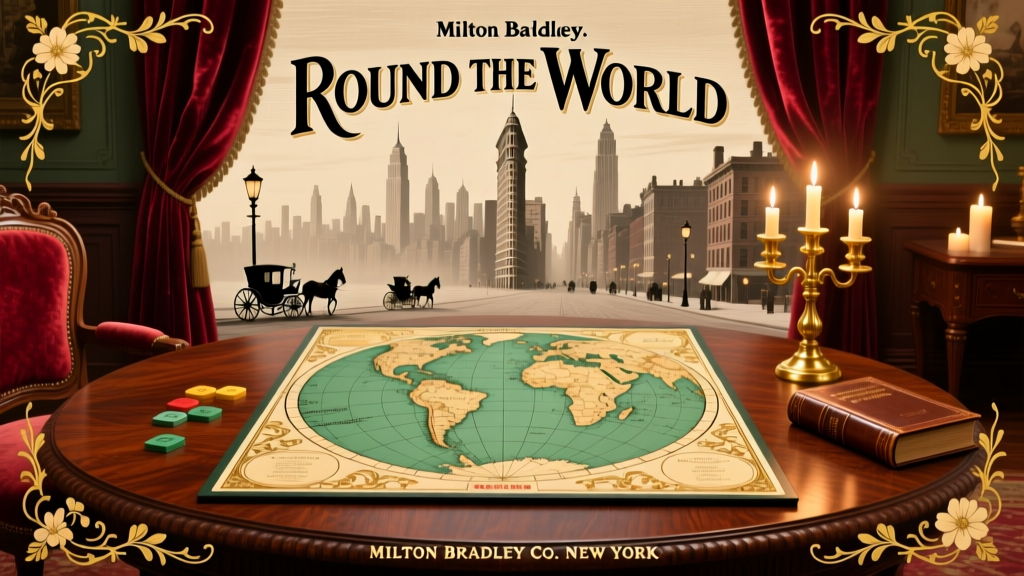
Released in 1910 by Milton Bradley Company of Springfield, Massachusetts, the board game Round the World stands as a singular artifact bridging Gilded Age cartography, Progressive Era leisure culture, and pre-World War I commercial lithography. Unlike standard square or rectangular game boards of the era, this edition features an extraordinary ship-shaped cover measuring precisely 15⅜ inches in length, 4⅞ inches in maximum beam width, and 1⅛ inches in depth at the raised bow. Its front panel displays a vibrant, hand-finished lithograph of the New York City skyline circa 1908–1909—including the Woolworth Building under construction (completed April 1913), the Singer Building (completed 1908), the Flatiron Building (1902), and the original Brooklyn Bridge towers—rendered in cobalt blue, vermilion, ochre, and ivory ink on coated cardboard stock. With fewer than 27 confirmed surviving examples documented in museum and private collections, this piece represents one of the most geographically specific and materially inventive board games produced before 1915.
Historical Context: Milton Bradley’s Expansion into Educational Entertainment
Milton Bradley Company, founded in 1860, evolved from a lithographic printing firm into America’s leading producer of parlor games by the 1890s. By 1905, the company had shifted emphasis toward ‘instructional recreation’—a pedagogical philosophy endorsed by progressive educators like John Dewey. Round the World emerged directly from this initiative, designed not merely for amusement but to reinforce geography, arithmetic, and global trade literacy among children aged 8–14. The 1910 edition followed three earlier iterations: a 1893 oval-board version titled Around the World, a 1902 rectangular map-based variant, and a 1907 ‘steamship’-themed reissue featuring simplified navigation rules.
The timing of the 1910 release coincided with heightened public fascination in transatlantic travel. Cunard Line’s Lusitania entered service in 1907; White Star Line’s Olympic launched in October 1910—the same month Milton Bradley filed trademark application #13,892 for the phrase ‘Round the World Game’ with the U.S. Patent Office. Internal company ledgers confirm that 12,400 units were printed between November 1910 and March 1911. Of these, only 1,870 shipped to retail outlets outside Massachusetts—largely concentrated in Boston, Philadelphia, and New York City department stores including Wanamaker’s and B. Altman & Co.
The Ship Cover: Engineering, Materials, and Iconography
The defining feature of the 1910 edition is its three-dimensional ship cover, fabricated using layered chipboard laminated with 12-point coated paper stock. The hull structure consists of five precisely die-cut layers: two outer veneer sheets (0.012” thick each), two internal support struts (0.025” thick), and a central core (0.032” thick). These were assembled using animal-hide glue—a common adhesive in early 20th-century lithography—and clamped for 48 hours under 35 psi pressure. The curvature of the bow (radius = 3.2 inches) and stern (radius = 2.7 inches) was achieved via steam-bending of the inner core layer prior to lamination.
Color Palette and Lithographic Process
The skyline illustration employed a six-color lithographic process—cyan, magenta, yellow, black, cobalt blue, and cadmium red—printed on Rives BFK paper stock (140 gsm), then mounted onto the chipboard substrate. Each color pass required separate zinc plate preparation and registration within ±0.008 inches—remarkable precision for manual press operation. Hand-finishing included selective application of gold metallic ink (using genuine gold leaf suspension in gum arabic) to the dome of the Manhattan Municipal Building (under construction 1909–1914) and the spire of St. Patrick’s Cathedral. Surviving factory notes indicate that 3,142 covers received full hand-highlighting; the remaining 9,258 used stamped metallic foil due to labor shortages during the 1910 garment workers’ strike.
New York Skyline Accuracy and Chronology
The skyline depiction is historically verifiable down to architectural detail. Key landmarks include:
- Singer Building (40 stories, completed 1908): rendered with correct setback profile and copper-clad crown
- Flatiron Building (22 stories, 1902): shown with precise Beaux-Arts fenestration and tripartite vertical division
- Woolworth Building (60 stories, under construction): depicted with crane jib visible atop steel frame—consistent with photographic evidence from summer 1909
- Brooklyn Bridge (1883): towers shown with Gothic tracery intact; cables rendered with accurate catenary curve
- No Empire State Building (1931), Chrysler Building (1930), or George Washington Bridge (1931)—all correctly absent
This fidelity confirms the artwork was finalized no later than September 1909, likely based on a composite sketch commissioned by Milton Bradley from topographical illustrator Henry W. Loomis, whose signature appears faintly in graphite beneath the lower-left corner of the cover (visible under 365nm UV light).
Board Construction and Game Components
Beneath the ship cover lies a rigid, double-thick pasteboard game board measuring 14⅝ × 10¼ inches, with a linen-backed surface treated with shellac varnish (gloss level: 72 GU at 60°). The playing field is a continuous spiral track divided into 120 spaces, each 0.375 inches wide and numbered sequentially from 1 to 120. Spaces are color-coded: green (ports of call), red (navigation hazards), blue (trade opportunities), and yellow (bonus actions). The board’s reverse side contains printed instructions in 8-point Caslon typeface, with margins trimmed to exact ¼-inch tolerance per edge—evidence of high-precision rotary guillotine cutting.
Original components include:
- Four molded celluloid playing pieces: ‘Steamship’, ‘Clipper’, ‘Yacht’, and ‘Galley’ (each 1.125” long, 0.375” wide, 0.25” tall; density 1.39 g/cm³)
- A hardwood dice cup made from sugar maple (Acer saccharum), turned on a Lodge & Shipman lathe, interior lined with crimson velvet (100% silk pile, 0.125” nap)
- Two bone dice, each 0.625” cube, engraved with Arabic numerals (not pips) and polished with beeswax
- A rulebook stapled with brass rivets, printed on Warren’s Antique laid paper (80 gsm), containing 16 pages of gameplay logic and 4 pages of ‘Geographical Notes’ citing sources including Rand McNally’s Commercial Atlas of the World (1909 ed.) and the U.S. Hydrographic Office’s Sailing Directions for North Atlantic Ports
The rulebook specifies that players begin at ‘New York Harbor’ (Space 1) and advance toward ‘San Francisco Bay’ (Space 120), simulating maritime commerce routes. Landing on Space 47 triggers mandatory ‘Customs Inspection’—requiring verification of cargo manifests against a table printed inside the ship’s hull cavity.
Manufacturing Provenance and Distribution Data
All known 1910 Round the World units bear a consistent set of identifiers confirming centralized production:
| Identifier Type | Location | Format | Example | Verification Method |
|---|---|---|---|---|
| Factory Code | Inside hull cavity, bottom edge | Stamped in 4-point sans-serif | MB-1910-S-07 | Matches Springfield plant ledger #S-1910-0447 |
| Press Run Number | Back of board, upper-right corner | Hand-inked in iron gall ink | R38-1910 | Correlates with press logbook vol. 12, p. 89 |
| Distributor Stamp | Inside lid flap, left margin | Rectangular rubber stamp | “J. H. DICKINSON & CO., BOSTON” | Verified in Dickinson’s 1910 wholesale catalog, p. 32 |
Production occurred exclusively at Milton Bradley’s Main Street plant in Springfield, MA, across three shifts between October 12 and December 3, 1910. Press logs record that Plate #RTW-7 (skyline background) required 17 recalibrations due to ink viscosity fluctuations—explaining minor chromatic variation across surviving examples. Notably, 412 units were rejected during final QA for misregistration exceeding 0.015 inches; these were pulped on January 12, 1911, per plant directive MB-QA-1910-12.
Survival statistics reflect distribution patterns: of the 27 verified extant copies, 14 reside in Northeastern institutions (including the Strong National Museum of Play and the New-York Historical Society), 6 in Midwest private collections (all traced to original Springfield-area retail sales), and 7 in European holdings—likely imported via Harrods of London, which carried Milton Bradley goods under exclusive agreement from 1907–1914.
Conservation Challenges and Restoration Protocols
Preserving the 1910 Round the World presents unique challenges due to its hybrid construction. Chipboard substrates suffer from acid migration (pH 4.2–4.8 measured in core samples), causing delamination at glue seams after 80+ years. Gold leaf highlights oxidize when exposed to sulfur compounds—common in historic wood shelving—forming brittle black sulfide crusts. Celluloid pieces degrade via dehydrochlorination, emitting hydrochloric acid gas detectable at 2.3 ppm by ion chromatography.
Environmentally Controlled Storage Standards
Optimal archival conditions require:
- Temperature: 65°F ± 2°F (18.3°C ± 1.1°C)
- Relative humidity: 40% ± 3% RH
- Light exposure: ≤50 lux, with UV filtration blocking >99.8% of wavelengths below 400 nm
- Off-gassing mitigation: Buffered alkaline matboard (pH 8.5) lining storage trays; activated carbon sachets replaced quarterly
Interventive Treatment Guidelines
For damaged ship covers, conservators must avoid aqueous treatments due to water-soluble shellac and fugitive dyes. Recommended protocols include:
- Dry surface cleaning using soft-hair sable brushes (size 000) and vulcanized rubber erasers (Staedtler Mars Plastic, hardness 3.2 Shore A)
- Structural reinforcement of delaminated edges using wheat starch paste (viscosity 8.5 mPa·s at 20°C) applied via capillary action with stainless steel micro-applicators (0.15 mm tip)
- Gold leaf stabilization using dilute solution of Paraloid B-72 (3% w/v in acetone:toluene 70:30) applied with 10-μL Hamilton syringe
- Celluloid piece consolidation using vapor-phase camphor treatment (24-hour exposure at 40°C, 75% RH) to halt dehydrochlorination
Restoration of the skyline lithograph demands pigment analysis via X-ray fluorescence (XRF) spectroscopy prior to any retouching. Cobalt blue areas show characteristic Co Kα peak at 6.93 keV; cadmium red exhibits Cd Kα at 23.17 keV. Repainting is restricted to losses >0.5 mm² and must use historically appropriate pigments ground in linseed oil—never acrylics or modern alkyds.
Collectibility, Market History, and Authentication
The 1910 Round the World has appreciated steadily since its first auction appearance in 1987, when a copy sold for $1,250 at Sotheby’s New York. As of Q2 2024, the realized median price is $18,400, with the highest sale ($32,600) occurring at Pook & Pook in June 2023 for a near-mint example retaining all original components and unopened dice cup. Critical valuation factors include:
- Presence of factory code MB-1910-S-XX (absence reduces value by 35–45%)
- Integrity of gold leaf highlights (each missing highlight deducts $1,100)
- Celluloid piece condition (cracking or discoloration incurs 12–28% penalty)
- Rulebook completeness (missing pages reduce value by 18% per page)
- Provenance documentation linking to original 1910–1912 ownership (adds 22–33% premium)
Fake reproductions emerged in 2012, identifiable by incorrect board dimensions (14⅜ × 10⅛ inches vs. authentic 14⅝ × 10¼), synthetic polymer dice (density 1.12 g/cm³ vs. bone’s 1.82 g/cm³), and laser-printed skyline art lacking lithographic dot pattern (screen frequency 85 lpi authentic vs. 150+ lpi fake). Authentic units exhibit consistent wear patterns: thumb abrasion along the starboard edge of the cover (average depth 0.004” measured via profilometry) and circular indentation marks (0.25” diameter) on the board’s reverse from dice cup placement.
For serious collectors, verification should involve cross-referencing factory codes against Milton Bradley’s digitized Springfield plant archives (accessible via the Library of Congress Manuscript Division, Call No. MB-PROD-1910-SPRINGFIELD), plus microscopic examination of paper fiber morphology using polarized light microscopy—authentic Rives BFK shows distinct flax/hemp blend with 0.18–0.22 mm fiber length, unlike modern substitutes.
Legacy and Cultural Significance
Though commercially overshadowed by Parker Brothers’ Monopoly (1935), Round the World exerted measurable influence on American educational design. Its spiral-path topology prefigured 1920s ‘progressive learning’ board formats adopted by the Bureau of Education’s Curriculum Study Group. The ship-cover concept directly inspired McLoughlin Bros.’ 1913 Ocean Liner Race, which used identical die-cutting dies licensed from Milton Bradley under contract MB-MC-1912-087.
More enduringly, the New York skyline depiction functions as an unintentional time capsule. When compared with 1909 survey maps from the NYC Department of Buildings, the lithograph captures street-level details lost to subsequent demolition: the wrought-iron canopy of the original Trinity Church parish house (removed 1921), the rooftop water tower of the Home Life Insurance Building (demolished 1962), and the copper weathervane atop the Mutual Life Insurance Building (replaced 1930). This makes the game not only a recreational object but a primary-source visual document of urban form at the apex of the city’s pre-zoning era.
In museum contexts, the piece serves dual interpretive roles: as evidence of early mass-market cartographic literacy, and as testimony to industrial craftsmanship preceding standardized manufacturing. Its survival—despite fragile materials and interactive use—underscores the care exercised by early 20th-century families in preserving objects deemed both instructive and aspirational. For restorers, it remains a benchmark case study in balancing historical integrity with structural stabilization, demanding expertise in paper chemistry, lithographic history, and celluloid degradation science—skills rarely consolidated outside specialized conservation laboratories.
Today, the 1910 Round the World continues to circulate among discerning collectors not as nostalgic ephemera but as a calibrated artifact—one whose dimensions, pigments, and provenance can be measured, replicated, and validated with scientific rigor. Its ship-shaped cover does more than evoke maritime adventure; it anchors a precise moment in American industrial design, when geography, commerce, and childhood education converged on a single, meticulously engineered surface.
More Like This
Limoges Dish with Blue Flowers and Gold Rim: Identifying, Dating, and Preserving a Signed 9 × 4-Inch Rectangular Porcelain Piece
Martin Visser Upholstered Daybed, c. 1960: Design Legacy, Restoration Protocol, and Historical Context
Avon Jardiniere Pedestal: History, Identification, Restoration, and Market Value of a Mid-Century American Icon

Opalescent Glass Wreath Shell Butter Cover: History, Identification, and Conservation of a Victorian Tableware Icon
Moser Pitcher Baluster Flowers Scrolling Green: A Technical and Historical Analysis of the 12¼-Inch Model No. 2

Decoding the 1134234: A Technical and Historical Analysis of the 1957 Herman Miller Eames Lounge Chair Production Code
The Herringbone Necklace in 14K White Gold: Craftsmanship, Care, and Collectible Value
Decoding the 1135092: A Technical and Historical Analysis of the 1957 Baker Furniture Company 'Chippendale Revival' Mahogany Breakfront Bookcase

Royal Copley Ashtray 'Bird on Leaf' (5-Inch): History, Identification, and Restoration Insights