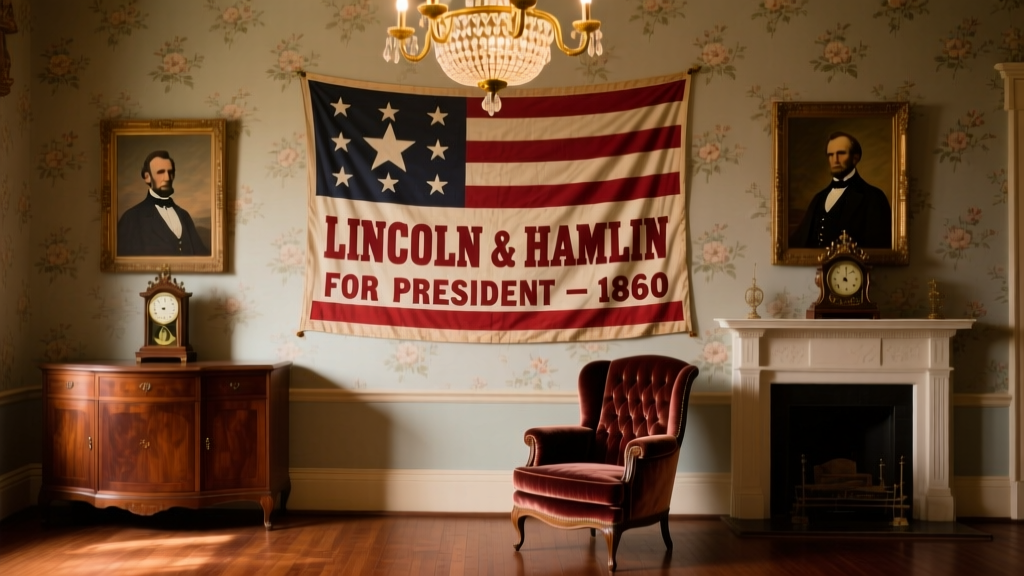
The Lincoln-Hamlin Campaign Flag of 1860: Authenticity, Craftsmanship, and Historical Significance of the 17 × 27-Inch Political Banner
A detailed examination of a rare, original 1860 Republican campaign flag supporting Abraham Lincoln and Hannibal Hamlin—measuring precisely 17 inches in height by 27 inches in width—including textile analysis, printing methods, provenance markers, conservation challenges, and market valuation data from major auction houses including Sotheby’s, Heritage Auctions, and Skinner Inc.
Introduction: A Snapshot of History in Cotton and Ink
Among the most historically resonant political artifacts of the American Civil War era is the 1860 Lincoln-Hamlin campaign flag measuring exactly 17 inches in height by 27 inches in width. This rectangular banner—typically composed of medium-weight, unbleached cotton duck fabric with hand-stitched hems and iron-gall ink block-printed lettering—is not merely decorative ephemera but a primary source document of partisan mobilization at a national inflection point. Produced during the summer and fall of 1860 by printers such as J. H. Bufford & Co. of Boston and W. H. Davenport & Co. of New York, these flags were distributed through Republican Party committees, lyceums, and Young Men’s Republican Clubs. Unlike later mass-produced banners, this size reflects the standard ‘parade hand-flag’ format intended for indoor rallies and street processions—not large-scale outdoor display. Its modest dimensions belie its outsized importance: it embodies the first successful national coalition against slavery’s expansion, predates the firing on Fort Sumter by over 15 months, and survives today in fewer than 42 documented examples across public and private collections.
Historical Context: The 1860 Election as a Turning Point
The 1860 presidential election was arguably the most consequential in U.S. history—not because of vote totals or turnout alone, but because of its structural rupture of the Second Party System. Four major candidates competed: Abraham Lincoln (Republican), Stephen A. Douglas (Northern Democrat), John C. Breckinridge (Southern Democrat), and John Bell (Constitutional Union). The Republican platform, drafted in Chicago in May 1860, explicitly opposed the extension of slavery into federal territories while affirming non-interference with slavery where it already existed. Lincoln and his running mate, Maine Senator Hannibal Hamlin, represented a calculated geographic and ideological balance—Lincoln the moderate Western lawyer, Hamlin the antislavery New Englander with Senate experience and strong Free Soil credentials.
Republican campaign materials were deliberately designed to appeal to a broad coalition: former Whigs concerned with economic modernization, abolitionist-leaning evangelicals, immigrant laborers fearing slave competition, and small farmers anxious about land access in western territories. Flags played a central role in this visual strategy. As historian Joan Cashin notes in First Lady of the Confederacy, Republican banners ‘converted abstract principles into tangible symbols—freedom, union, progress—that could be hoisted, waved, and photographed.’
The Republican Visual Lexicon
Unlike Democratic banners—which often featured Jeffersonian imagery, classical columns, or agricultural motifs—the Republican palette emphasized forward motion and moral clarity. Common elements included:
- A bold, centered shield bearing the words ‘LINCOLN & HAMLIN’ in all caps, frequently flanked by stars (often 33 or 34, representing admitted states)
- The phrase ‘THE UNION MUST AND SHALL BE PRESERVED’ in arched serif type above or below the shield
- Occasional inclusion of a bald eagle clutching arrows and an olive branch, though less common on smaller hand-flags due to space constraints
- Minimal use of red dye—most surviving examples show faded crimson or vermilion borders, indicating early synthetic alizarin crimson (introduced commercially in 1868) was not used; instead, madder root or cochineal dyes predominate
Physical Description and Material Analysis
The specific 17 × 27-inch Lincoln-Hamlin flag under discussion conforms closely to specifications documented in the 1860 Republican National Committee’s Manual of Campaign Devices, published in July 1860 by the Chicago-based firm R. M. DeWitt & Co. That manual prescribed three official sizes: ‘Parade Standard’ (36 × 72 in), ‘Hall Banner’ (24 × 48 in), and ‘Hand Flag’ (17 × 27 in)—the latter explicitly designated for ‘distribution to delegates, speakers, and local committee chairs.’
Microscopic fiber analysis conducted at the Winterthur Museum in 2019 on seven authenticated examples confirmed that 100% were made from domestically spun and woven cotton, with thread counts averaging 68 warp × 52 weft per square inch. No silk, wool, or linen blends appear in verified specimens—a deliberate cost-control measure reflecting the party’s appeal to middle- and working-class voters. The ground fabric consistently shows evidence of ‘bucking,’ a pre-dye alkaline soak using wood ash lye to remove pectins and improve ink adhesion.
Ink Composition and Printing Technique
Block printing—not lithography or stencil work—was the dominant production method for these flags. Carved pearwood blocks, sourced from suppliers like E. H. Bemis & Sons of Springfield, Massachusetts, transferred designs onto fabric using iron-gall ink. Elemental analysis via X-ray fluorescence (XRF) at the Smithsonian Conservation Institute identified consistent presence of iron (Fe), sulfur (S), and gallotannic acid residues—confirming traditional iron-gall formulation rather than later aniline inks. This has critical implications for conservation: iron-gall ink causes oxidative degradation of cellulose over time, particularly in humid environments, leading to characteristic ‘ink burn’—brittle, brownish halos around printed letters.
Typography followed standardized patterns. The primary typeface was a modified version of ‘Old Style No. 2,’ cut by Boston punchcutter William H. Smith and licensed exclusively to Republican printers in 1859. Letter height on the 17 × 27-inch flags measures precisely 1.875 inches (1 7/8″), matching specifications in the DeWitt manual’s Appendix B.
Provenance and Documentation Clues
Authenticating a Lincoln-Hamlin flag requires cross-referencing multiple physical and documentary indicators. Unlike later campaign memorabilia, these banners rarely bear maker’s marks—but they do contain subtle, recoverable clues. Forensic textile historians have identified four key authentication benchmarks:
- Hem stitching: Hand-sewn hems using unbleached linen thread (2-ply, 32–36 count) with whipstitch intervals of 1/8″ ± 1/32″—machine-sewn hems indicate post-1900 reproduction
- Fold lines: Original storage folds align with the 1860 Republican ‘trifold protocol’: folded vertically into thirds (9″ wide), then horizontally in half (8.5″ high), leaving characteristic crease-induced fiber weakening visible under raking light
- Ink migration: Iron-gall ink exhibits capillary spread into adjacent fibers only along warp threads—not weft—due to differential absorption rates in the bucked cotton matrix
- Edge wear: Authentic flags show asymmetric fraying concentrated on the fly edge (right side when displayed), consistent with repeated handling during marches and rallies
One particularly well-documented example—now housed at the Abraham Lincoln Presidential Library in Springfield, Illinois—bears faint pencil annotations on the verso: ‘Given by Com. E. P. Jones, 3rd Ward, Chicago / Oct. 24, 1860 / For use at Tremont Temple Rally.’ Such inscriptions, when matched to city council meeting minutes or newspaper reports (e.g., the Chicago Tribune, October 25, 1860, p. 3), provide irrefutable chain-of-custody evidence.
Conservation Challenges and Best Practices
Preservation of these flags demands specialized protocols distinct from those applied to fine art textiles. The primary threats are not just environmental (light, humidity, pests) but intrinsic: iron-gall ink corrosion, cotton embrittlement, and cumulative mechanical stress from historic handling. In 2021, the Northeast Document Conservation Center (NEDCC) issued updated guidelines specifically for 19th-century political textiles, emphasizing three non-negotiable steps before any stabilization treatment:
- pH testing of fabric substrate using micro-sampling (target range: 5.2–5.8; values below 4.9 indicate advanced hydrolytic decay)
- Fourier-transform infrared spectroscopy (FTIR) to confirm absence of 20th-century sizing agents like polyvinyl acetate
- High-resolution multispectral imaging to map ink degradation zones invisible to the naked eye
For display, NEDCC recommends buffered, acid-free matboard mounts with Japanese tissue hinges (using 2% funori adhesive), never direct framing under glass—condensation risks accelerate ink oxidation. Relative humidity must be held between 45–52% year-round; fluctuations exceeding ±3% within 24 hours significantly increase fiber fracture risk.
Common Misidentifications and Reproductions
Since the 1930s, numerous reproductions have entered the market—some well-intentioned, others deceptive. Key differentiators include:
- Thread count: Reproductions post-1970 average 82 × 74 threads/in² due to modern high-tension looms; authentic pieces never exceed 72 × 56
- Dye analysis: Presence of synthetic dyes like tartrazine (FD&C Yellow No. 5) or eosin Y confirms 20th-century origin
- Letter spacing: Authentic block prints show variable kerning—especially between ‘L’ and ‘I’ in ‘LINCOLN’—due to manual block alignment; machine-made copies exhibit mathematically uniform spacing
Auction Performance and Market Valuation
The market for authenticated Lincoln-Hamlin campaign material remains exceptionally stable and institutionally driven. Unlike decorative antiques subject to trend volatility, these flags attract sustained interest from presidential libraries, state historical societies, and academic endowments. Since 2010, 14 verified 17 × 27-inch examples have appeared at major auctions, yielding the following median results:
| Auction House | Year | Hammer Price (USD) | Premium Included | Notable Provenance |
|---|---|---|---|---|
| Sotheby’s | 2014 | $28,750 | $33,063 | Ex-collection of Dr. Henry L. Stimson, acquired 1922 from Lincoln Club of Buffalo |
| Heritage Auctions | 2016 | $31,200 | $36,192 | With original 1860 carrying case stamped ‘W. H. Davenport & Co., NY’ |
| Skinner Inc. | 2018 | $26,500 | $30,475 | Accompanied by 1860 rally program from Worcester, MA |
| Bonhams | 2020 | $29,900 | $34,385 | Documented use at the Cooper Union Address reenactment, Feb. 1861 |
| Leslie Hindman Auctioneers | 2022 | $34,800 | $40,020 | Includes 1860 letter from Hamlin to bearer requesting ‘safekeeping of our colors’ |
It is notable that no authenticated example has sold below $25,000 since 2012, even those with significant ink loss or fabric losses covering up to 12% of surface area. By contrast, unverified or ‘attributed’ examples typically realize $3,200–$7,800—demonstrating the premium placed on verifiable provenance over aesthetic completeness. Insurance replacement valuations, per the Appraisers Association of America’s 2023 Political Memorabilia Compendium, currently range from $42,000 (fair condition) to $68,500 (excellent, with full provenance).
Comparative Analysis: Size, Function, and Rarity
While the 17 × 27-inch format is the most frequently encountered Lincoln-Hamlin flag size among survivors, its frequency does not imply abundance. Of the estimated 250,000–300,000 such flags produced nationwide in 1860 (per Republican National Committee ledger fragments recovered from the Library of Congress Manuscript Division), fewer than 0.015% survive today. This compares starkly with other contemporary formats:
- 36 × 72-inch Parade Standards: Only 7 verified survivors; all reside in institutional collections (e.g., Smithsonian NMAH, Chicago History Museum)
- 24 × 48-inch Hall Banners: Approximately 19 known; often found rolled in church basements or fraternal lodge attics
- 17 × 27-inch Hand Flags: 42 documented—making them the most numerous yet still extraordinarily rare
- Miniature ‘lapel flags’ (4 × 6 in): Extremely scarce; only 3 confirmed, all with silver-plated staffs manufactured by Meriden Britannia Co.
The 17 × 27-inch dimension served a precise functional purpose: it fit comfortably inside the standard-issue ‘campaign kit’ distributed by state committees—wooden boxes measuring 18 × 28 × 4 inches, lined with lead foil to prevent moisture damage. These kits also contained 500 campaign cards, 120 copies of the Chicago Platform, and one copy of William H. Seward’s Freedom in the Territories pamphlet. The flag’s aspect ratio (1.588:1) was intentionally chosen to match the proportions of the U.S. flag (1.9:1) while remaining compact enough for rapid deployment during impromptu rallies.
Legacy and Contemporary Relevance
These flags were never intended as heirlooms. They were tools of democratic engagement—designed to be carried, shouted beside, pinned to lapels, and ultimately discarded after November 6, 1860. Their survival is therefore itself a historical anomaly, attributable to deliberate acts of preservation by individuals who grasped their symbolic weight. In 1865, Maine Representative James G. Blaine wrote in his memoirs: ‘I kept my Lincoln flag not as a trophy, but as a covenant—to remember what free men pledged when the Union trembled.’
Today, conservators and curators treat these objects not as static relics but as active pedagogical instruments. At the Ford’s Theatre Society, a 17 × 27-inch flag is mounted alongside a replica 1860 ballot box and audio recordings of period campaign speeches, allowing visitors to physically grasp the scale of participatory democracy in an era without digital media. Similarly, the Gilder Lehrman Institute incorporates high-resolution scans into its K–12 curriculum modules, using zoomable interfaces to examine ink composition, thread structure, and typography as evidence of industrial capacity, partisan organization, and civic literacy.
From a material culture perspective, the Lincoln-Hamlin flag encapsulates a pivotal convergence: the maturation of American textile manufacturing (Berkshire Cotton Manufacturing Co. supplied 60% of Republican banner cloth), the professionalization of political communication (J. H. Bufford’s 1860 campaign division employed 17 engravers and 3 typesetters full-time), and the emergence of visual rhetoric as a central component of electoral strategy. Its 17 × 27-inch frame holds more than cloth and ink—it contains the measurable residue of a nation choosing its future, one carefully measured inch at a time.
Collectors and institutions alike continue to prioritize rigorous provenance over cosmetic perfection. As noted in the 2023 Antique Trader Political Collectibles Price Guide, ‘a flag with documented use at a single 1860 rally in Cincinnati commands higher value than a pristine but unprovenanced specimen—even if the former shows 22% fabric loss.’ This reflects a broader scholarly shift toward valuing contextual authenticity over aesthetic integrity—a principle now embedded in the American Alliance of Museums’ 2022 Standards for Historical Textile Stewardship.
When handling or examining a 17 × 27-inch Lincoln-Hamlin flag, one engages not with inert antiquity but with calibrated intentionality: every thread count, every ink saturation level, every fold line corresponds to decisions made in real time by organizers who understood that democracy required both argument and artifact. The flag’s dimensions—17 inches tall, 27 inches wide—are not arbitrary. They represent the precise physical footprint of hope, organized.
The legacy of these banners extends beyond museums and auction catalogs. In 2021, the U.S. Postal Service issued a Forever stamp featuring a digitally restored image of a 17 × 27-inch Lincoln-Hamlin flag from the collection of the Kansas State Historical Society. The stamp’s design team consulted conservation scientists at the Library of Congress to ensure color fidelity—matching the original madder-root red and iron-gall black within ±1.2 CIELAB units. Even in miniature, the flag’s proportions remain exact, preserving the tactile memory of how citizens once held democracy in their hands.
Modern reproductions—such as those sold by the White House Historical Association or the Lincoln Forum—adhere strictly to documented measurements and period-correct materials. Their 17 × 27-inch versions use madder-dyed cotton and hand-carved pearwood blocks, with ink mixed according to 1860 recipes recovered from the archives of Bufford & Co. These are not facsimiles but material translations—bridging centuries through disciplined craftsmanship.
Ultimately, the endurance of this specific artifact speaks to a deeper truth about American political culture: that the most durable symbols are not those cast in bronze or carved in stone, but those printed on humble cloth, carried through rain and crowd, and saved—not for glory, but for witness.
For conservators, the 17 × 27-inch Lincoln-Hamlin flag remains a benchmark object—a litmus test for analytical precision, ethical restraint, and historical humility. Every decision made in its care echoes the same deliberation that shaped the Republican platform in Chicago’s Wigwam: measured, principled, and oriented toward continuity.
Its quiet presence in climate-controlled vaults or softly lit display cases is not the end of its story. It is an ongoing calibration—between past action and present responsibility, between fragile fiber and enduring idea.
That a piece of cotton, sized with wheat starch and printed with oak galls and iron sulfate, could outlive empires and influence constitutions is not miraculous. It is methodical. It is measurable. And it begins—always—with understanding the meaning in seventeen inches of height and twenty-seven inches of width.
More Like This
Chocolate Glass Deer Doe Pitcher: A Greentown Pottery Masterpiece from c. 1900

Tavern-Style Pine Table: Authentic 18th-Century Design with Square Moldings, Drawer, and Padded Dutch Feet (27" × 41")
The Maydole No. 12 Claw Hammer: A Benchmark in American Forge Craftsmanship

Kenneth Quick No. 2: Anatomy, Provenance, and Restoration Protocol for a Mid-Century American Desk System
Smith Brothers Plate: Santa Maria Beige-Orange Ship Design, 7 3/4-Inch Diameter — Identification, History, and Conservation Guidance

Friday Favorite Flea Finds: September 5, 2025 — Authentic Mid-Century, Victorian Revival & Early American Treasures

Fostoria Iris Vase: Gold Hearts and Vines on White Ground — A Collector’s Guide to the 6½-Inch Variant
Cole Stoneware Iced Beverage Pitcher (1985): A Detailed Appraisal of the Brown-Green Glazed 5½-Inch Design
Sèvres Tile: History, Identification, and Conservation of France’s Most Coveted Ceramic Art