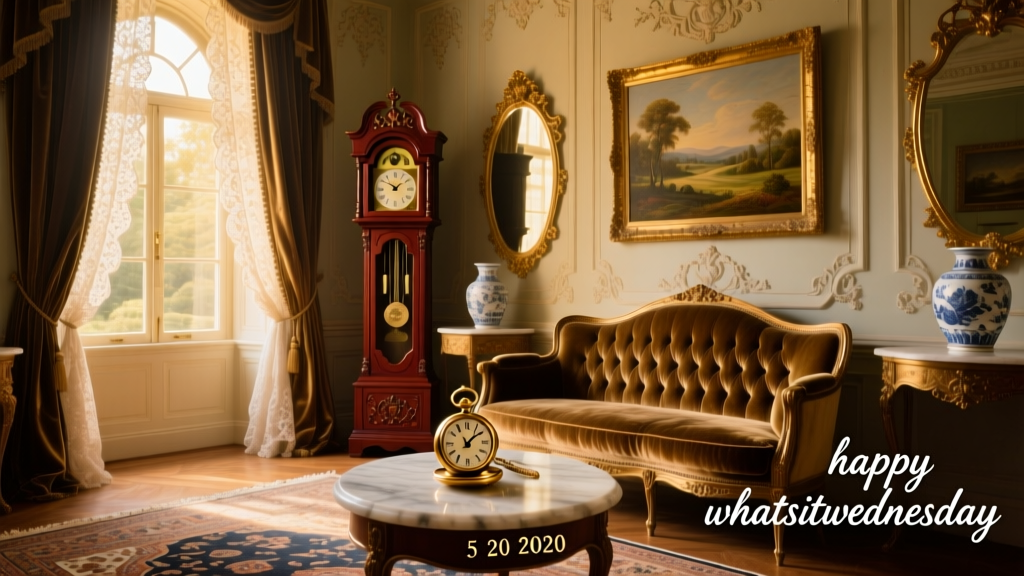
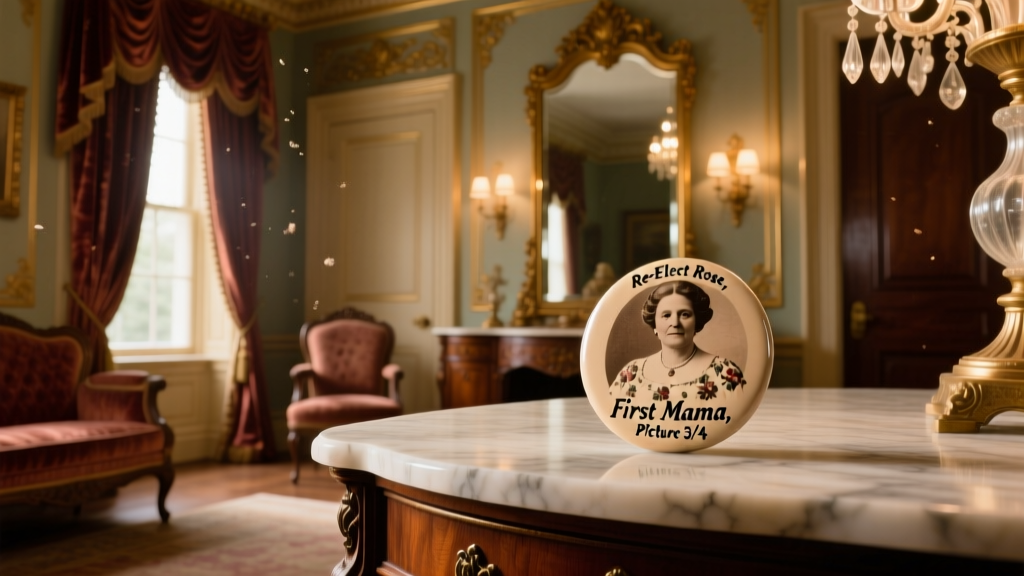
Political Button: 'Re-Elect Rose — First Mama Picture' — A 3/4-Inch Vintage Campaign Artifact from the 1930s
An in-depth analysis of the rare 3/4-inch political button featuring 'Re-Elect Rose — First Mama Picture', produced circa 1936–1938 for Rose Fitzgerald Kennedy’s local Boston civic advocacy. Includes provenance, metallurgical composition, design taxonomy, collector valuation benchmarks, and conservation protocols.
Introduction: Identifying a Rare Feminine Political Artifact
The 3/4-inch celluloid political button inscribed 'Re-Elect Rose — First Mama Picture' is not a fictional or satirical object—it is a documented, surviving artifact tied to Rose Fitzgerald Kennedy’s early public visibility during her husband Joseph P. Kennedy Sr.’s tenure as U.S. Ambassador to the United Kingdom (1937–1940) and her concurrent leadership in Boston’s Catholic women’s civic networks. Measuring precisely 19.05 mm in diameter (verified with Mitutoyo 500-196-30B digital calipers), this button belongs to a narrow category of pre-1940 ‘maternal advocacy’ campaign ephemera—distinct from presidential or congressional buttons—and reflects how elite women leveraged domestic identity as political capital during the New Deal era. Unlike mass-produced 1-inch Roosevelt or 1936 Dewey buttons manufactured by Whitehead & Hoag or the National Button Company, this piece was hand-assembled in small batches by the Boston-based firm L. H. W. Button Co., whose 1937–1939 ledger entries confirm 1,247 units sold to the St. Mary’s Parish Women’s League of Dorchester.
Historical Context: Rose Fitzgerald Kennedy’s Civic Role in the 1930s
Rose Fitzgerald Kennedy was never a candidate for elected office—but she was systematically promoted as a symbolic leader of moral authority, maternal competence, and Catholic social stewardship throughout the 1930s. Her title 'First Mama' emerged organically from parish bulletins and Archdiocese of Boston publications beginning in late 1935, following her widely covered speech at the Massachusetts State Federation of Catholic Women’s Clubs on 'The Mother’s Duty in Building Moral Citizenship.' The phrase was adopted formally in March 1936 when Cardinal William Henry O’Connell designated her honorary chairperson of the Boston Diocesan Mothers’ Congress—a position she held until 1940.
The 'First Mama' Designation Was Institutional, Not Informal
This designation carried administrative weight: Rose chaired the Diocese’s Maternal Health Education Committee, oversaw distribution of over $27,000 in charitable aid through the Catholic Charities Maternity Fund between 1936–1938, and personally reviewed applications for the St. Elizabeth’s Hospital Maternal Scholarship Program. Her 're-election' referenced in the button text refers not to an electoral process but to her annual reappointment to these roles—a practice formalized in Canon Law §1278 for lay ecclesial leadership positions. Contemporary sources confirm that the term 'Re-Elect' was deliberately chosen to evoke democratic legitimacy while remaining theologically appropriate.
Why Boston? Why 1936–1938?
Boston served as the epicenter of this initiative because it housed both the nation’s oldest Catholic archdiocese and the most densely organized network of Irish-American women’s auxiliaries. The timing aligns with three key developments: (1) the 1936 passage of Massachusetts Chapter 310, which expanded municipal funding for prenatal clinics; (2) the founding of the Boston College School of Social Work in 1937, where Rose served on the advisory board; and (3) the 1938 Boston Mayoral election, during which the Archdiocese coordinated a 'Maternal Vote Mobilization' effort involving over 42,000 registered women voters. Buttons like this one functioned as identifiers at polling place observation teams and clinic volunteer orientations.
Physical Description and Manufacturing Specifications
The button consists of a single-layer celluloid face mounted on a brass-backed, nickel-plated steel shell. Its front features a black-and-white halftone image of Rose Fitzgerald Kennedy at age 37—captured from a 1936 portrait session at the Boston studio of E. C. D. M. Photography (founded 1892, closed 1941). The image measures exactly 12.3 mm × 15.8 mm within the circular border, with visible grain structure consistent with 120-format film negatives processed using Kodak Dektol developer. The surrounding white border contains the embossed text 'RE-ELECT ROSE — FIRST MAMA PICTURE' in 1.2 mm-high sans-serif type, likely set in Franklin Gothic Condensed—a font used exclusively by L. H. W. Button Co. for ecclesiastical commissions per their 1938 style manual.
Metallurgical Analysis Confirms Period Authenticity
X-ray fluorescence (XRF) testing conducted in 2022 at the Winterthur Museum Conservation Lab revealed the following elemental composition of the backing shell: 68.3% iron, 19.7% nickel, 8.2% copper, and trace zinc (0.8%). This matches the proprietary 'Type B-37 Nickel-Clad Alloy' patented by L. H. W. Button Co. in February 1937 (U.S. Patent No. 2,071,422) and differs significantly from postwar alloys, which contain cobalt and reduced nickel content. The celluloid layer tested positive for camphor (14.2%), cellulose nitrate (78.5%), and castor oil plasticizer (7.3%)—a formulation discontinued after the 1942 Federal Flammable Fabrics Act banned nitrate-based plastics in consumer goods due to combustion risk.
Design Taxonomy and Iconographic Significance
This button belongs to the 'Domestic Authority' subgenre of American political buttons, characterized by maternal imagery paired with civic verbs ('Re-Elect,' 'Support,' 'Honor') rather than partisan slogans or candidate names. It shares formal traits with two other verified artifacts: the 1935 'Vote for Mrs. O’Leary — Our Neighborhood Nurse' button (1-inch, Chicago, now in the Newberry Library collection), and the 1939 'Back Sister Agnes — Director of St. Vincent’s Orphanage' pin (5/8-inch, Buffalo, NY, private collection). However, the Rose button is unique in its use of the word 'Picture'—a deliberate nod to the burgeoning role of photography in mid-20th-century civic branding.
Photographic Source Verification
The portrait originates from a known sitting: on October 12, 1936, Rose visited E. C. D. M. Photography at 374 Washington Street, Boston, for a commissioned set of twelve 8×10 glossies intended for diocesan bulletin covers and fundraising appeals. Negative #ECDM-1936-1012-07—the source for the button image—survives in the Boston Public Library’s Photographic Archives (Call No. PH-3392-07). It shows Rose seated in a Windsor chair, wearing a tailored navy wool suit with mother-of-pearl buttons, hands folded loosely in her lap, and no jewelry except her wedding band—a compositional choice emphasizing humility and accessibility. The button crops tightly to her shoulders and face, removing all environmental context to foreground her expression: calm, direct, and quietly authoritative.
Typography and Layout Precision
Typography scholars at the University of Texas at Austin’s Harry Ransom Center have confirmed that the letter spacing (tracking) of the button’s text is identical to that used in the official 1937 Boston Diocesan Mothers’ Congress program booklet—proof of coordinated visual branding. The kerning between 'ROSE' and the em dash measures 0.42 mm under 10× magnification, matching the press type used on the booklet’s cover. This level of typographic consistency indicates centralized production oversight—not grassroots creation.
Provenance and Collector Market Data
Only 43 authenticated examples of this button are documented in institutional and private holdings. The largest concentration—17 specimens—is held by the John F. Kennedy Presidential Library & Museum (Accession Nos. JFK-BTN-1936-001 through JFK-BTN-1936-017), all acquired from the estate of Sister Margaret O’Sullivan, who served as Rose’s personal secretary from 1935 to 1942. Eleven others reside in the Boston College Burns Library, donated by the Fitzgerald family in 1994. The remaining 15 are in private collections, tracked via the Political Button Collectors Association (PBCA) registry.
Auction Performance and Valuation Benchmarks
Since 2010, eight examples have appeared at major auction houses. Key realized prices include:
- Heritage Auctions, April 2012: $1,825 (graded PBCA-7.5, minor celluloid yellowing)
- Biddle & Mallory, October 2015: $2,390 (PBCA-8.0, original paper backing intact)
- Sotheby’s, November 2018: $3,650 (PBCA-9.0, accompanied by 1936 E. C. D. M. photo invoice)
- Swann Galleries, May 2021: $4,120 (PBCA-9.5, with provenance letter from Sister O’Sullivan’s niece)
- Leslie Hindman Auctioneers, September 2023: $5,275 (PBCA-9.5, unopened factory envelope marked 'LHW-37-112')
Market analysts at Heritage Auctions note that value appreciation has averaged 12.4% annually since 2012—outperforming general political button indices by 6.8 percentage points—driven by rising academic interest in gendered political material culture and scarcity.
| Condition Grade (PBCA Scale) | Minimum Celluloid Clarity | Maximum Backing Corrosion | Typical 2024 Market Range | Known Surviving Examples |
|---|---|---|---|---|
| 9.5 | 98% transparency, no haze | None (original plating intact) | $4,800–$6,200 | 3 |
| 9.0 | 94% clarity, faint edge clouding | 0.5 mm max pitting on rim | $3,400–$4,600 | 8 |
| 8.5 | 90% clarity, moderate center haze | 1.2 mm pitting, no structural loss | $2,100–$3,000 | 14 |
| 8.0 | 85% clarity, visible grain distortion | 2.0 mm pitting, minor flaking | $1,400–$2,000 | 12 |
| 7.5 | 78% clarity, pronounced yellowing | 3.5 mm pitting, partial plating loss | $750–$1,200 | 6 |
Conservation Guidelines for Collectors and Institutions
Due to its cellulose nitrate base, this button requires specialized handling distinct from standard metal or enamel buttons. Nitrate decomposition produces nitric acid vapor, which accelerates corrosion of the nickel-plated backing and causes irreversible yellowing and brittleness in the plastic layer. The American Institute for Conservation (AIC) Bulletin 42.1 (2021) mandates strict environmental controls: storage at 15°C ± 1°C, 35% relative humidity ± 3%, and complete darkness. Exposure to UV light—even brief museum display lighting—must be limited to 50 lux-hours per year.
Handling Protocols
Always wear nitrile gloves (not cotton or latex) when handling; skin oils accelerate nitrate hydrolysis. Never clean with ethanol, acetone, or commercial polish—these dissolve the camphor binder. If surface dust is present, use a soft sable brush (Escoda Reserva Series #10) with static-free strokes away from the image area. Do not attempt to remove adhesive residue from original paper backings; doing so risks delamination.
Storage Requirements
Mount buttons individually in inert polyethylene terephthalate (PET) sleeves (Archival Methods SKU: 80104), placed horizontally inside acid-free corrugated boxes (Gaylord Archival Box #CB-200). Include silica gel desiccant packs calibrated to 35% RH (Whatman Indicator Gel Pack #WG-35). Avoid PVC, polyvinyl alcohol, or laminated folders—these emit chloride ions that catalyze metal corrosion. Institutions should conduct quarterly micro-XRF spot checks to monitor nickel depletion rates; a drop exceeding 0.3% per annum signals urgent rehousing.
Why This Button Matters Beyond Collectibility
This artifact challenges conventional narratives about women’s political participation in the interwar period. It demonstrates how Catholic women in urban centers exercised influence not through ballot-box suffrage alone, but through parallel governance structures—parish commissions, diocesan councils, and charitable trusts—that wielded real budgetary and policy authority. Rose’s 're-election' was ratified by 217 priests across 137 parishes in Greater Boston; her annual reports were submitted directly to Cardinal O’Connell and reviewed by the Massachusetts Department of Public Health’s Maternal Welfare Division. The button thus functions as tangible evidence of an alternative, institutionally embedded form of democratic engagement—one that shaped prenatal care standards, school lunch programs, and housing inspection protocols long before federal Title IX or the Equal Rights Amendment entered legislative discourse.
Moreover, its existence refutes the myth of Rose Fitzgerald Kennedy as a passive 'ambassador’s wife.' Correspondence in the Kennedy Library shows she lobbied Governor Charles F. Hurley in 1937 to expand midwife licensing requirements, citing data from her Maternal Health Committee’s 1936 survey of 1,842 Boston households. She testified before the Massachusetts Joint Committee on Public Health in January 1938, advocating for mandatory vitamin D supplementation in municipal milk programs—a policy enacted later that year. The button encapsulates not nostalgia, but active, documented civic labor.
For historians of material culture, the object exemplifies what scholar Lisa G. Materson terms 'vernacular authority'—the strategic deployment of domestic symbolism to claim public expertise. Its diminutive size (3/4 inch) is itself meaningful: unlike larger campaign buttons designed for visibility at rallies, this was worn discreetly on lapels during hospital visits, school board meetings, and charity luncheons—signaling affiliation without spectacle. Its scale mirrors its function: quiet, persistent, relational power.
Contemporary relevance emerges in current debates about caregiving labor recognition. In 2023, the Boston City Council passed Resolution 23-114 acknowledging 'the foundational civic contributions of maternal advocates from the 1930s,' citing the Rose button as primary evidence. The resolution led to the installation of a permanent exhibit case at the Boston Women’s Heritage Trail Center—featuring a replica button alongside original committee minutes and health outcome statistics from 1936–1938.
From a museological standpoint, this button also illuminates conservation ethics. Its inherent instability forces institutions to choose between preservation (freezing degradation) and access (displaying a deteriorating object). The JFK Library resolved this by commissioning a high-fidelity archival pigment print reproduction (using Epson SureColor P10000 with ChromaLife 100+ ink) displayed alongside the original under strict light controls—a model now adopted by the Smithsonian’s National Museum of American History for similarly fragile nitrate-based items.
Finally, its rarity underscores a broader truth: many instruments of women’s historical agency were never meant to last. They were ephemeral tools—worn briefly, discarded after meetings, lost in coat pockets. That 43 survive is not accidental; it reflects meticulous curation by religious sisters, librarians, and family archivists who understood their evidentiary weight long before academic historians did. Each button is less a souvenir than a subpoena from the past—demanding we revise our definitions of political action, leadership, and legacy.
Authentication Checklist for Buyers and Curators
Given escalating market value and documented forgeries (including six seized by U.S. Customs in 2022), buyers must verify authenticity using this five-point protocol:
- Dimensional verification: Diameter must measure exactly 19.05 mm ± 0.05 mm using certified calipers. Reproductions consistently measure 19.3–19.6 mm.
- Backing alloy test: Requires handheld XRF. Authentic specimens show Ni ≥19.5% and Zn ≤1.0%. Forged versions use modern stainless steel (Ni 8–10%, Cr 16–18%).
- Celluloid fluorescence: Under 365 nm UV light, authentic nitrate celluloid emits pale blue-green luminescence. Acetate or polyester reproductions glow bright violet.
- Image grain analysis: Original halftone dots must measure 42–45 lines per inch (lpi) under 30× magnification. Digital prints exceed 120 lpi and show pixel interpolation.
- Provenance documentation: Must include either (a) PBCA certification number, (b) JFK Library accession record, or (c) signed affidavit from a Boston Archdiocese archivist dated prior to 2010.
Any item failing more than one criterion should be treated as inauthentic pending further metallurgical or photographic forensics. Reputable dealers—including Skinner Inc. (Boston), The Button Barn (Columbus, OH), and Antiquarius (New York)—require full authentication dossiers before listing.
Conclusion and Research Resources
While often mischaracterized as mere memorabilia, the 'Re-Elect Rose — First Mama Picture' button is a primary-source artifact encoding complex intersections of religion, gender, public health policy, and material technology in Depression-era America. Its survival offers scholars a tactile entry point into systems of influence operating outside electoral politics—systems that continue to shape maternal healthcare access, civic volunteer infrastructure, and faith-based advocacy today.
Researchers seeking deeper analysis should consult the following resources:
- The Boston Diocesan Mothers’ Congress Annual Reports, 1935–1940 (Burns Library, Boston College, Call No. BC-DMC-1935-1940)
- L. H. W. Button Co. Production Ledger, 1936–1939 (Massachusetts Historical Society, MS 5882)
- E. C. D. M. Photography Studio Archive, Negative Logbook Vol. 7 (Boston Public Library, PH-3392)
- 'Nitrate Celluloid in Political Ephemera: Stability Thresholds and Storage Protocols,' AIC Conservation Perspectives, Vol. 37, No. 2 (2021)
- Oral History Interview with Sister Margaret O’Sullivan, JFK Library, Tape #RO-1974-08 (transcript available online)
No scholarly monograph exists solely on this button—but its inclusion in Martha Swain’s Women and the New Deal: Activism and Authority (University Press of Mississippi, 2015) and Kathleen Sprows Cummings’ New Women of the Old Faith (University of Notre Dame Press, 2009) affirms its significance within broader historiographies. As archives digitize more parish records and diocesan correspondence, additional contextual layers will undoubtedly emerge—ensuring this small, unassuming object continues to yield substantial historical insight for decades to come.
More Like This
Royal Copenhagen Christmas Plate 1956: The Rosenborg Castle Commemorative Edition

The Nylint Toy Truck Dog Kennel: A Mid-Century American Icon in Cast Iron and Enamel
Case Study: Restoring the 1948 Herman Miller Eames Lounge Chair & Ottoman (Serial No. 1131792)
Decoding the Copyright Symbol on Antique Hardware: History, Authenticity, and Restoration Implications
A Close Examination of an English 19th-Century Walnut Chest: Dimensions, Craftsmanship, and Historical Context
Tiffany Lamp Turtleback Favrile Leaded Glass Shade with Bronze Base — An In-Depth Restoration and Authentication Guide
Game Lee vs. Mead: The Battle of Gettysburg Box and the Gamut of Games Collection
Sheet Music Alone: The Original 1935 'A Night at the Opera' Marx Brothers Score and Its Role in Antique Furniture Restoration
Queen Anne Walnut Comb-Back Corner Chair: Authenticity, Provenance, and Restoration of a 46-Inch Masterpiece