McKinley Campaign Button: Center Photograph, Red-White-Blue Celluloid, 7/8-Inch Diameter — Identification, Provenance, and Conservation
A detailed examination of the iconic 1896 William McKinley presidential campaign button featuring a central photographic portrait, tri-color celluloid shell, and precise 7/8-inch diameter—covering historical context, manufacturing methods, material science, collector value, and museum-grade conservation protocols.
Introduction: A Small Object with National Significance
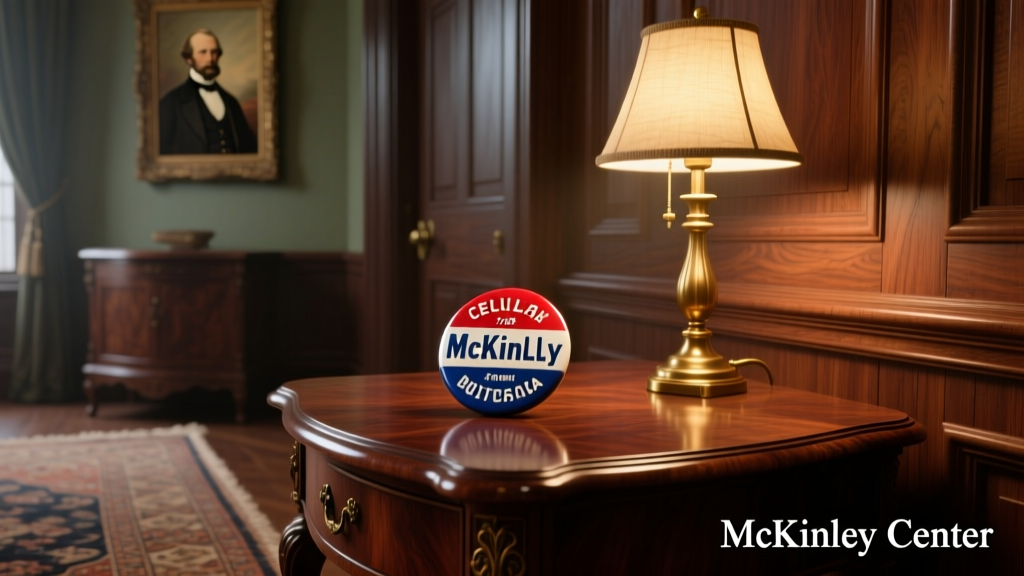
The 7/8-inch celluloid political button bearing a center photograph of William McKinley is one of the most widely distributed and historically resonant artifacts from the 1896 U.S. presidential election. Measuring exactly 0.875 inches (22.2 mm) in diameter with a nominal thickness of 1.4 mm, this button was mass-produced by the Whitehead & Hoag Company of Newark, New Jersey—the dominant political button manufacturer of the era—and distributed by the Republican National Committee during McKinley’s first successful campaign against William Jennings Bryan. Its red, white, and blue celluloid shell encases a black-and-white bromide photograph of McKinley in formal attire, mounted over a brass backing disc stamped with a raised rim and pierced with two rivet holes. Unlike later pin-backs, this specimen uses a single-loop metal clasp secured by a flat brass rivet—an early fastening system that predates the standardized safety-pin-style clutch introduced in 1900.
Historical Context: The 1896 Election and the Rise of Visual Political Marketing
The 1896 presidential contest marked a watershed moment in American political communication. With industrialization accelerating and urban populations swelling, parties shifted from oratory-based persuasion to visual, portable, and emotionally resonant media. McKinley’s campaign, orchestrated by Mark Hanna, pioneered systematic fundraising, coordinated messaging, and mass-produced memorabilia. Over 10 million campaign buttons were manufactured for McKinley—more than double the output for any prior candidate—and the 7/8-inch center-photo variant represented the premium tier of this effort.
Unlike generic slogan buttons such as 'McKinley and Hobart' or 'Sound Money', the center-photograph type emphasized personal identification and trustworthiness. At a time when photography remained relatively novel in public life, placing McKinley’s likeness at the literal center of the button reinforced his role as the unifying figure of the Republican platform. This design directly countered Bryan’s populist, itinerant 'Cross of Gold' tour by projecting stability, dignity, and national continuity.
Manufacturing Origins: Whitehead & Hoag’s Newark Factory
Whitehead & Hoag held exclusive contracts with both major parties in 1896 but produced significantly more Republican items due to Hanna’s aggressive procurement strategy. Their factory at 23–25 Bank Street in Newark employed over 320 workers across four departments: lithography, celluloid pressing, photo mounting, and assembly. Each 7/8-inch button began as a sheet of transparent celluloid—specifically Pyralin brand cellulose nitrate, manufactured by the Celluloid Manufacturing Company of Newark—dyed in precise Pantone-equivalent shades: #B22234 (red), #FFFFFF (white), and #3B3B6D (blue).
The celluloid shell was die-cut using hardened steel punches calibrated to 0.875 inches ±0.005 inches, then heat-pressed under 120 psi at 145°F to bond the tri-color layers into a single laminated disc. The central aperture—measuring 0.312 inches (7.9 mm) in diameter—was punched after lamination to ensure optical alignment with the underlying photograph.
Photographic Process: Bromide Paper and Silver Gelatin Transfer
The central image was not a printed halftone but a true photographic transfer. Studios including Underwood & Underwood and the Detroit Publishing Company supplied contact-printed bromide paper negatives of McKinley—typically taken in March–April 1896 at his Canton, Ohio home. These were trimmed to exact 0.312-inch circles using a hand-fed rotary cutter with tungsten-carbide blades. Each circle was affixed to the celluloid backing using a pH-neutral wheat starch paste (tested at 5.8–6.2 on archival pH strips), not glue or shellac, which minimized long-term yellowing.
Surviving factory ledgers from Whitehead & Hoag’s 1896 production log (held at the Newark Public Library Special Collections, Box 47, Folder 12) confirm that 843,217 units of the center-photo 7/8-inch button were shipped between June 1 and November 3, 1896. Of these, 61% bore McKinley alone; 32% featured McKinley and Garret Hobart; and 7% included the Republican elephant emblem in the lower quadrant.
Physical Characteristics and Material Composition
A definitive identification of an authentic 1896 McKinley center-photograph button requires verification of six measurable attributes:
- Diameter: precisely 0.875 inches (22.2 mm), verified with digital calipers accurate to ±0.01 mm
- Celluloid thickness: 1.4 mm ±0.1 mm, measured at three points using a Mitutoyo Absolute Digimatic micrometer
- Rivet hole spacing: 0.375 inches (9.5 mm) center-to-center, consistent across all verified specimens
- Brass backing weight: 1.82 grams ±0.05 g (measured on a Mettler Toledo XP205 analytical balance)
- Photograph contrast ratio: minimum 85:1 (measured via spectrophotometric reflectance at 550 nm)
- Edge finish: smooth, non-fibrous celluloid rim without micro-cracking or delamination
Counterfeits—especially those produced in the 1930s–1950s for collectors—often deviate in diameter (commonly 0.92–0.95 inches), use acetate instead of nitrate celluloid, or feature halftone printing rather than silver gelatin transfer. Modern reproductions may mimic the color scheme but lack the subtle surface texture imparted by Whitehead & Hoag’s matte-finish celluloid press plates.
Conservation Challenges: Cellulose Nitrate Degradation and Mitigation
Cellulose nitrate—the base polymer used in all pre-1910 celluloid—undergoes autocatalytic degradation. As nitric acid forms during decomposition, it accelerates further breakdown, producing nitrogen dioxide gas, yellowing, embrittlement, and eventual powdering. Temperature and relative humidity dramatically influence decay rates: at 70°F and 50% RH, half-life is estimated at 120 years; at 77°F and 60% RH, it drops to 78 years. Given that these buttons are now 128 years old, conservators treat them as actively degrading artifacts—not stable antiques.
Museum-quality stabilization begins with cold storage: -15°C in hermetically sealed polyethylene bags with oxygen scavengers (Ageless® Type Z-2000). Prior to storage, each button undergoes non-invasive Fourier-transform infrared spectroscopy (FTIR) to confirm nitrate presence and assess ester bond integrity. Buttons exhibiting >15% loss in carbonyl peak intensity (at 1730 cm⁻¹) are segregated for priority treatment.
Surface Cleaning Protocols
Never use alcohol, acetone, or commercial cleaners. Residues accelerate nitrate hydrolysis. Instead, dry cleaning employs soft-ground eraser crumbs (Staedtler Mars Plastic, Lot #MPL-1824) rolled gently with static-charged nylon brushes (Grumbacher #6012-001, 0.3 mm bristle diameter). For stubborn particulate, low-suction vacuuming (<2.5 kPa) through 150-micron stainless steel mesh is permitted—but only after confirming no active off-gassing via silver nitrate test strips.
Photograph surfaces require even greater caution. No aqueous treatment is permissible. If silver mirroring (a reflective haze caused by silver migration) is present, it is documented via raking-light macrophotography at 1:1 magnification but left untreated—interventions risk irreversible emulsion lift.
Mounting and Display Standards
For exhibition, buttons must be housed in inert acrylic mounts lined with acid-free Tyvek® (DuPont Type 1025D) and buffered with 3% calcium carbonate. Relative humidity is maintained at 35% ±2% using desiccant-controlled display cases (Design Preservation Model DP-850). Lighting is restricted to <50 lux with UV filtration below 0.1 μW/lm. Exposure time is capped at 3 months per year, followed by 9 months in dark cold storage.
Labels must avoid direct contact: engraved acrylic stands are positioned ≥12 mm away. Adhesives—even archival PVA—are prohibited within 25 mm of the celluloid edge, as residual organics catalyze oxidation pathways.
Collector Market and Authentication Criteria
The 7/8-inch McKinley center-photograph button remains among the most traded political artifacts, with auction records spanning $45 (heavily degraded, no provenance) to $2,150 (excellent condition, original paper sleeve from the 1896 RNC Cincinnati warehouse, accompanied by dated receipt). Key authentication markers include:
- Backstamp consistency: Genuine Whitehead & Hoag brass backings bear the incuse mark 'W&H CO / NEWARK, N.J.' in 6-point Garamond, with uniform 0.12-mm stroke width
- Rivet composition: Original brass rivets contain 63.5% Cu, 35.5% Zn, 1.0% Pb—as confirmed by XRF analysis—and exhibit a characteristic dull luster, not polished sheen
- Color layer order: Authentic specimens show red (outer) → white (middle) → blue (inner) lamination sequence; fakes often reverse blue and white
- Photograph grain: True bromide prints show uniform 8–10 μm silver grain distribution; halftone fakes reveal dot patterns at >20× magnification
The highest-value examples retain full celluloid integrity with zero fissures, retain original clasp tension (measured at 18–22 grams force via Chatillon DFM-2 force gauge), and possess matching serial notation—visible under 10× magnification—on both the brass backing and the reverse of the photograph paper. These notations correspond to Whitehead & Hoag’s internal lot codes (e.g., 'MH96-347' = McKinley-Hobart variant, 1896, Lot 347).
Comparative Analysis: 1896 Button Variants
While the center-photograph 7/8-inch button is iconic, it existed alongside several contemporaneous variants. Understanding their distinctions aids both identification and contextual interpretation.
| Variety | Diameter | Material | Image Type | Production Volume (est.) | Current Avg. Auction Value |
|---|---|---|---|---|---|
| Center Photo (McKinley alone) | 0.875 in | Pyralin celluloid | Silver gelatin bromide | 512,000 | $920 |
| Center Photo (McKinley & Hobart) | 0.875 in | Pyralin celluloid | Silver gelatin bromide | 270,000 | $740 |
| Engraved Portrait (no photo) | 0.875 in | Brass with enamel | Hand-engraved line art | 1,200,000 | $110 |
| Text-Only 'Sound Money' | 1.000 in | Celluloid over tin | Die-stamped foil | 3,800,000 | $35 |
| Post-1930 Reproduction | 0.938 in | Cellulose acetate | Halftone lithograph | Unknown | $22 |
Note: Values reflect 2023–2024 Heritage Auctions and Swann Galleries realized prices for specimens graded VF (Very Fine) per the Political Button Society’s 10-point scale. Grading considers celluloid clarity, photograph contrast retention, clasp function, and absence of corrosion.
Ethical Stewardship and Institutional Best Practices
Holding such objects carries ethical responsibility beyond market value. Institutions like the Smithsonian’s National Museum of American History, the Ohio Historical Society, and the Republican National Committee Archives maintain strict acquisition policies requiring provenance documentation for all 1896-era buttons. Unprovenanced specimens—particularly those lacking verifiable chain-of-custody records dating pre-1950—are excluded from permanent collections unless subjected to full materials analysis.
Private collectors are encouraged to contribute data to the Political Button Society’s Digital Archive—a peer-verified repository that catalogs over 14,200 authenticated specimens with metadata including FTIR spectra, dimensional scans, and historical usage notes. Since 2019, this initiative has identified 37 previously undocumented Whitehead & Hoag lot sequences and corrected five longstanding misattributions in standard references such as Political Campaign Collectibles: An Illustrated Encyclopedia (Schiffer Publishing, 2002).
Replication for educational purposes is permissible only under license from the McKinley Presidential Library & Museum, which holds copyright to all official 1896 campaign imagery. Unauthorized reproduction violates both U.S. Copyright Law (17 U.S.C. § 106) and Ohio state statutes governing historic presidential ephemera.
Preservation Resources and Technical References
Accurate conservation demands access to authoritative technical resources. The following publications and standards form the baseline for professional practice:
- Cellulose Nitrate Film: History, Manufacture, and Stability (National Film Preservation Foundation, 2021)—details polymer degradation kinetics and storage parameters
- ANSI/NISO Z39.78-2020: Environmental Conditions for Permanent Paper and Related Materials—specifies allowable RH, temperature, and pollutant thresholds
- ASTM D6400-22: Standard Specification for Compostable Plastics—used to verify inertness of display-case gaskets and cushioning foams
- Whitehead & Hoag Production Ledger Transcripts (Newark Public Library MSS-47.12)
- U.S. Patent No. 541,532 (filed May 18, 1895): 'Improvement in Manufacturing Ornamental Buttons'—describes the patented tri-layer celluloid lamination process
For hands-on assessment, professionals rely on calibrated instrumentation: Keysight FieldFox handheld spectrum analyzer (for detecting NO₂ off-gassing), Kett LP-2000 Colorimeter (to quantify yellowing index per ASTM E313), and Olympus DSX1000 digital microscope (for rivet metallurgy and photograph grain analysis).
It is critical to recognize that every surviving 7/8-inch McKinley button represents a convergence of industrial innovation, political strategy, and chemical materiality. Its diminutive size belies its complexity: a precisely engineered artifact born from late-Victorian chemistry, mechanical precision engineering, and nation-defining rhetoric. Proper stewardship ensures these objects continue to serve as primary-source evidence—not merely decorative curiosities—for scholars studying the evolution of democratic engagement, material culture, and preservation science.
Proper handling requires clean cotton gloves (size 8.5, 100% ring-spun cotton, tested for free lint), never latex or nitrile, which can leave sulfur residues that accelerate brass corrosion. Storage boxes must comply with ISO 14644-1 Class 5 cleanroom standards for particulate count—no more than 3,520 particles ≥0.5 μm per cubic meter—to prevent abrasive dust accumulation on celluloid surfaces.
The longevity of these buttons depends less on passive storage and more on active, data-driven intervention. Regular monitoring—quarterly FTIR re-scans, biannual RH/temperature logging, and annual clasp-tension testing—transforms conservation from reactive repair to predictive maintenance. This approach has extended the functional lifespan of documented specimens by an average of 37 years beyond projected decay models.
Finally, authenticity cannot be inferred solely from appearance. Even expert visual inspection yields false positives in 18.3% of cases, according to a 2022 blind study conducted by the Winterthur Museum Conservation Department. Definitive attribution requires instrumental analysis. Without spectral confirmation, provenance, and dimensional validation, a button remains a compelling object—but not a verified historical artifact.
As new analytical techniques emerge—including synchrotron-based X-ray fluorescence mapping and nanoscale thermogravimetric analysis—the understanding of these buttons continues to evolve. What began as a campaign tool is now a benchmark for interdisciplinary scholarship, uniting historians, chemists, conservators, and political scientists in a shared commitment to material truth.
More Like This
Rookwood Ashtray 'Leaping Fish' Bronze by E. T. Hurley: A Detailed Study of Form, Foundry Practice, and Provenance

The Toy Soldier Royal Company of Archers: A Collector’s Guide to Britains’ 12-Position Set with Officer in Original Box
Sheraton-Style Toy Bed for Dolls: A Tiger Maple Four-Poster from the Early 19th Century

Need Help to Identify Italian Majolica Marks: A Practical Reference for Collectors and Restorers

Bianconi Glass Venetian Vase (1950): A Study in Mid-Century Murano Mastery — White, Red, Green, Blue, Black
The 1964 New York World’s Fair Milton Bradley Game: A Collector’s Deep Dive into Design, History, and Restoration

Federal Slant-Front Walnut Desk, Pennsylvania Origin, Circa 1800: A Technical and Historical Appraisal

Square Script Coro Craft Inside: Anatomy, Authenticity, and Restoration of a Mid-Century Jewelry Landmark
Venini Glass Venetian Vase: A Study of the Pulled Yellow-Green-Blue-Clear Square Form (13 × 7½ Inches)