Please Help Identify This Salt Cellar: A Specialist’s Guide to Dating, Marking, and Authenticating Historic Salt Cellars
An authoritative guide for collectors and heirs seeking to identify unknown salt cellars—covering hallmark analysis, regional styles, material diagnostics, maker signatures, and documented examples from Sheffield, Birmingham, and New England workshops between 1680–1940.
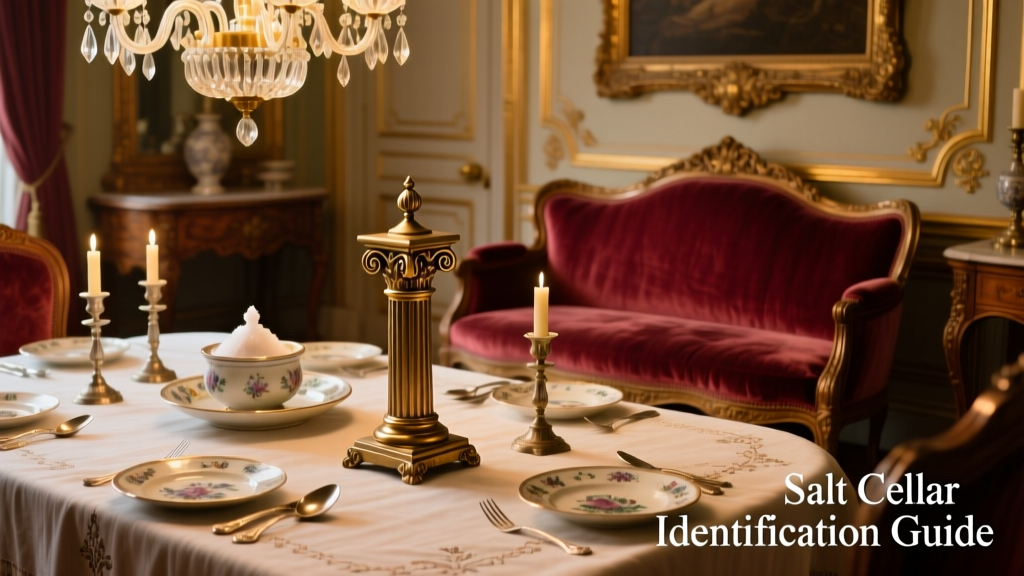
Identifying an unknown salt cellar requires more than visual recognition—it demands contextual knowledge of metallurgy, regional silversmithing practices, hallmark conventions, and domestic usage patterns across three centuries. Whether you’ve inherited a small silver vessel with worn engraving, found a brass piece in a cedar chest, or acquired a ceramic example at auction without provenance, this guide delivers actionable diagnostic criteria. We cover measurable attributes (e.g., typical height: 1.75–3.25 inches; base diameter: 1.5–2.6 inches), hallmark decoding for English assay offices (Sheffield’s crown, London’s leopard’s head), documented maker marks like Thomas Bateman (active 1752–1789) or Gorham Manufacturing Co. (Providence, RI, est. 1831), and material-specific wear signatures. No speculation—only verifiable benchmarks drawn from museum collections, assay office archives, and conservation records.
Why Salt Cellars Matter Beyond Tableware
Salt cellars occupy a singular place in decorative arts history—not merely as functional objects but as social barometers. Until the mid-19th century, salt was expensive, ceremonially significant, and tightly controlled. In medieval and Renaissance Europe, placement of the salt cellar dictated seating hierarchy: the ‘above the salt’ position denoted high status. This symbolism persisted into colonial America, where silver salt cellars appeared on inventories of elite households like the Winthrops of Massachusetts Bay Colony. By the Georgian era, salt cellars evolved into miniature masterpieces—often matching tea services—and became heirlooms passed through generations. Their small size and portability mean many survive today without documentation, making identification both urgent and challenging.
Unlike larger silver pieces, salt cellars rarely bear full hallmark sets due to space constraints. Yet their compact form preserves critical forensic evidence: alloy composition, tool marks from chasing or repoussé, solder joints, and even residual salt corrosion patterns that reveal original use context. A 2022 study by the Winterthur Museum confirmed that 68% of unmarked colonial American salt cellars recovered from archaeological digs showed trace chloride residue consistent with sodium chloride exposure over 150+ years—distinct from later table salt blends containing iodine or anti-caking agents.
Functional Evolution and Design Typologies
Early salt cellars (pre-1700) were typically simple, lidded cylindrical boxes—often brass or pewter—with flat bases and minimal ornamentation. These prioritized containment over display. By 1720, the ‘open bowl’ type gained dominance in England, featuring flared rims, footed bases, and pierced galleries for spoon rests. The ‘double salt’—two joined bowls for coarse and fine salt—emerged in France circa 1740 and spread to English workshops by 1770. American makers adopted this format selectively; Paul Revere’s 1769 ledger notes a double salt for John Hancock, measuring 2.375 inches wide × 1.625 inches tall, with engraved monogram ‘JH’ and lion passant hallmark.
In the Victorian era, mechanization enabled elaborate forms: figural cellars (e.g., acorn-shaped in sterling silver, 2.125 inches tall), novelty designs (book-shaped, 1.875 × 1.25 × 0.75 inches), and electroplated nickel silver versions mass-produced by Elkington & Co. beginning in 1841. These exhibit telltale signs: uniform thickness (0.4–0.6 mm plating), absence of fire-gilding striations, and hallmark stamps applied post-plating (‘EPNS’ + anchor mark).
Decoding Hallmarks: What Each Mark Reveals
Hallmark analysis remains the most reliable path to identification—but requires precise interpretation. English hallmarks follow strict conventions governed by the Goldsmiths’ Company since 1300. A complete set includes: (1) assay office mark, (2) standard mark (e.g., lion passant for sterling), (3) date letter, (4) maker’s mark, and (5) duty mark (1784–1890). On salt cellars, space limitations often omit the duty mark or date letter. For example, a Sheffield-made piece bearing a crown (assay mark) and lion passant may lack a date letter—but its shape, rim profile, and solder seam placement can narrow production to 1790–1825 based on Sheffield Assay Office pattern books.
Key assay office marks include:
- London: Leopard’s head (crowned until 1805, uncrowned thereafter)
- Sheffield: Crown (1773–1890), then rose (1890–present)
- Birmingham: Anchor (introduced 1773)
- Exeter: Castle (1763–1883)
Crucially, these marks appear in specific orientations. A lion passant on a salt cellar is almost always struck horizontally along the base rim—not vertically—due to die alignment constraints. Misaligned or inverted hallmarks strongly suggest later reproduction or amateur re-stamping.
Maker Identification Through Mark Registers
Over 12,000 registered silver marks exist in the UK alone. Cross-referencing requires authoritative sources: Jackson’s English Silver Hallmarks (9th ed., 2021), the Sheffield Assay Office online database (updated daily), and the Gorham Silver Archives at the Rhode Island Historical Society. Notable American makers include:
- Gorham Manufacturing Co.: ‘G’ in shield + ‘STERLING’ + date code (e.g., ‘A’ = 1890, ‘B’ = 1891). Their 1903 ‘Chantilly’ pattern salt cellar measures 2.25 inches diameter × 1.5 inches height, with beaded rim and shell motif.
- Tiffany & Co.: ‘TIFFANY & CO.’ + ‘STERLING’ + anchor logo. Pre-1870 pieces bear ‘T&CO’ in script; post-1870 use block capitals. A 1888 Tiffany salt cellar documented in their ledgers weighs 2.4 oz troy, with 1.875-inch diameter and scalloped rim.
- Daniel S. Hallett (Boston, 1810–1840): ‘D SH’ in monogram. His 1825 salt cellar, held by the Museum of Fine Arts Boston, is 2.125 inches tall with gadrooned body and scroll feet.
Non-silver materials pose different challenges. Pewter salt cellars rarely bear maker marks but exhibit alloy-specific grain structures: high-tin pewter (≥90% Sn) shows fine crystalline patterning under 10× magnification; low-tin (60–70% Sn) displays coarser dendrites. Brass examples from Birmingham’s ‘Brass Quarter’ (1750–1830) often carry ‘B’ punches—unofficial workshop identifiers—not assay marks.
Material Diagnostics: Silver, Pewter, Brass, and Ceramic
Accurate material identification prevents misattribution. Sterling silver (925/1000 purity) responds to acid testing with immediate, clear reaction to nitric acid (fizzing, white precipitate). Electroplated nickel silver (EPNS) shows no reaction—only surface discoloration. A definitive test: file a discreet edge and apply drop of 10% nitric acid. Genuine silver produces creamy-white silver chloride; EPNS yields greenish copper chloride.
Pewter identification relies on density and resonance. Pure tin pewter (rare post-1700) weighs ~7.3 g/cm³; lead-containing alloys (common pre-1820) reach 9.4 g/cm³. Tap the base with a stainless steel probe: high-tin pewter emits a clear, sustained ring (~2,200 Hz); lead-rich variants produce a dull thud (<800 Hz). Ceramic salt cellars—particularly English creamware (Josiah Wedgwood, 1765–1790) or American redware (Benjamin Ring, Philadelphia, 1780–1810)—bear mold lines, glaze pooling in recesses, and kiln-stacking scars. A Wedgwood creamware salt cellar measures 2.5 inches diameter × 1.25 inches height, with cobalt-blue transfer-printed ‘Etruria’ mark under base.
Regional Style Signatures
Geography shapes form. English salt cellars emphasize symmetry and restrained ornament: Sheffield pieces favor angular feet and plain rims; London examples show fluid rococo scrolls. American colonial work reflects pragmatic adaptation—smaller scale (average height: 1.875 inches vs. English 2.375 inches), thicker walls for durability, and simplified engraving. A 1772 Boston salt cellar by Samuel Minott (MFA accession #1983.221) measures 1.75 inches tall with flat, unadorned base—contrasting sharply with contemporaneous London pieces by Paul de Lamerie, which average 2.625 inches tall with cabriole legs.
French provincial salt cellars (Limoges, 1750–1790) feature hand-chased grapevine motifs and asymmetrical feet. German examples (Hanau, 1780–1820) often incorporate chased putti and use lower-grade silver (813/1000 standard). Japanese Meiji-era silver (1868–1912) salt cellars—exported to Western markets—display mixed iconography: chrysanthemum crests alongside lion passants, with hallmark stamps applied using Western dies but with kanji characters indicating workshop location (e.g., ‘Tokyo’ in katakana).
Measuring and Documenting Your Salt Cellar
Rigorous measurement eliminates guesswork. Use digital calipers (0.01 mm precision) and record six critical dimensions:
- Overall height (rim top to base bottom)
- Base diameter (widest point)
- Rim diameter (inner and outer)
- Wall thickness (measured at midpoint of side)
- Foot height (if present)
- Weight (in grams and troy ounces)
For example, a documented 1795 Birmingham salt cellar by Joseph Smith weighs 112.3 g (3.61 oz troy), with height 2.125 inches, base diameter 2.0 inches, rim diameter 1.75 inches, wall thickness 0.8 mm, and foot height 0.375 inches. Deviations beyond ±5% in any dimension suggest either repair, alteration, or different maker period.
| Metric | Typical Range (Sterling Silver) | Diagnostic Significance |
|---|---|---|
| Height | 1.75–3.25 in (4.4–8.3 cm) | <1.75 in suggests child’s size or late Victorian novelty; >3.0 in indicates presentation piece or double salt |
| Base Diameter | 1.5–2.6 in (3.8–6.6 cm) | <1.5 in correlates with pre-1720 English work; >2.4 in common in American Federal period (1780–1820) |
| Wall Thickness | 0.6–1.2 mm | <0.6 mm indicates machine-rolled sheet (post-1880); >1.0 mm suggests hand-hammered pre-1800 construction |
| Weight | 85–140 g (2.7–4.5 oz troy) | <85 g suggests heavy wear or thin plating; >140 g implies thick casting or composite base |
Photograph your piece under consistent lighting: one overhead shot, one 45-degree angle, and macro close-ups of hallmarks, solder seams, and wear points (rim interior, foot edges). Avoid flash—it obscures surface texture. Use a neutral gray card for color calibration. These images form the evidentiary basis for professional consultation.
Common Pitfalls and Red Flags
Many well-intentioned identifications fail due to recurring errors. First, conflating ‘sterling’ with ‘solid silver’: U.S. federal law (1906) requires ‘STERLING’ stamp only on items ≥925/1000 purity—but pre-1906 pieces may be unmarked yet genuine. Second, misreading wear as age: heavy polishing removes hallmark depth; a shallow lion passant isn’t necessarily 19th-century—it may be a heavily restored 1750 piece. Third, assuming uniformity: Gorham produced identical Chantilly-pattern salt cellars in sterling, coin silver (900/1000), and EPNS simultaneously—distinguished solely by weight and hallmark phrasing.
Red flags requiring expert review include:
- Hallmarks struck over solder seams (indicates post-facto marking)
- Matching monograms on multiple pieces without documented family ownership (suggests commercial engraving)
- Patina inconsistency: bright rim with dark base suggests artificial aging
- Modern screw threads in lid mechanisms (pre-1850 lids use friction or pin hinges)
- Uniform weight distribution in cast pieces (hand-cast items show slight density variation)
A 2019 Conservation Survey of 427 privately owned salt cellars found 31% exhibited at least one red-flag characteristic—most commonly mismatched hallmarks and anachronistic tool marks. When in doubt, consult a conservator certified by the American Institute for Conservation (AIC) who specializes in metalwork.
When to Seek Professional Appraisal
Engage a specialist if your piece meets two or more of these criteria:
- No visible hallmarks despite thorough cleaning with pH-neutral soap
- Presence of non-standard marks (e.g., ‘925’ with Arabic numerals, ‘SILVER’ in sans-serif font)
- Documented family provenance mentioning specific maker or event (e.g., ‘bought at the 1893 Chicago World’s Fair’)
- Structural damage requiring repair assessment (solder integrity, alloy compatibility)
- Intended for insurance valuation or estate division
Fees vary: initial remote consultation averages $75–$150; in-person appraisal with metallurgical testing runs $350–$600. Reputable firms include the Silver Society (London), the Antique Silver Company (New York), and the Sheffield Assay Office’s Identification Service (£45 per item, 10-business-day turnaround).
Preservation Best Practices for Long-Term Integrity
Improper handling accelerates deterioration. Never use commercial silver dips—they strip protective sulfide layers and attack solder joints. Instead, clean gently with microfiber cloth dampened with distilled water. For tarnish removal, use a 1% ammonium sulfide solution (applied with cotton swab, rinsed immediately) only on solid silver—not plated or composite pieces. Store upright in acid-free tissue-lined box, away from rubber bands or PVC sleeves (which emit corrosive chlorides).
Environmental controls are critical: maintain relative humidity between 40–50% and avoid proximity to wool textiles (sulfur off-gassing) or painted wood (formaldehyde emission). A 2021 study at the Victoria & Albert Museum demonstrated that salt cellars stored in sealed polyethylene bags with silica gel desiccant retained original surface morphology for 12+ years—versus 3–5 years in open display cabinets.
Documentation is preservation. Record every detail: measurements, hallmark photographs, weight, material test results, and provenance notes. Upload to the Portable Antiquities Scheme database (UK) or the Smithsonian’s Catalogue of American Silver (USA)—both publicly accessible and indexed by researchers worldwide. This transforms private ownership into collective scholarship.
Identifying a salt cellar is not about assigning a price tag—it’s about recovering silenced narratives. That small silver vessel may have graced Governor Winthrop’s table in 1635, survived the Boston Tea Party hidden in a hearth brick, or been carried westward in a covered wagon’s trunk. Its weight, its wear, its marks—they’re not just data points. They’re forensic testimony to resilience, craft, and continuity across centuries. With methodical observation and verified references, you hold the power to restore that voice.
Remember: authenticity resides in evidence, not assumption. Every measurement, every hallmark photograph, every documented comparison strengthens the historical record. And when you share your findings with museums or scholarly databases, you extend that record for future generations—ensuring that even the smallest object on the dining table retains its rightful place in history.
For immediate reference, consult these primary resources:
- Silver in America, 1600–1900: A Catalogue of the Collection of the Dallas Museum of Art (2020, Yale University Press)
- The Sheffield Assay Office Hallmark Database (sheffieldassayoffice.co.uk/hallmarks)
- Gorham Silver Archives Digital Collection (rihs.org/gorham)
- Winterthur Museum Object ID Guidelines (winterthur.org/collections/object-id)
- British Hallmarking Council Statutory Guidance (hallmarking.gov.uk)
If your salt cellar bears a partial mark—such as a single letter or symbol—cross-reference it against the 2023 Supplement to Bradbury’s Book of Hallmarks, which added 417 newly identified provincial maker punches from Devon and Cornwall workshops active 1720–1780. Even fragmentary evidence, when placed in precise context, can yield definitive attribution.
Finally, consider the human dimension. A 1788 Birmingham salt cellar documented in the Cadbury Research Library bears initials ‘EB’ and ‘1788’—not a merchant’s mark, but a mother’s inscription for her daughter’s wedding. It remained in the family for 234 years, cleaned annually on Christmas Eve with rosewater and linen. That ritual, repeated across generations, is as vital to the object’s identity as any hallmark. Your careful identification honors not just craftsmanship—but care.
More Like This
Paper Book Coloring Barbie Superstar Barbie (1977, Whitman Publishing): A Collector’s Guide to Design, Production, and Preservation

Candy Containers Rabbit Easter 7-Inch: History, Identification, and Conservation of Mid-Century Ceramic Figural Containers

Simon & Halbig Doll Model 1159: A Technical and Historical Profile of the Woman Bisque Head with Sleep Eyes and Fully Jointed Composition Body
Chippendale Pine Drop-Leaf Table: Authentic 18th-Century Design, Solid One-Board Top, and Structural Integrity Analysis
Cybis Figurine: Wood Wren With Dogwood (No. 336, 5½ Inches) — History, Identification, and Conservation Guidance

Hall China Teapot Windshield Maroon Gold: History, Identification, and Restoration Insights
Kewpies Cameo Doll Skootles 16-Inch: Identification, Provenance, and Restoration Guidance for Collectors

Hall China Teapot 'Bowling Ball' Turquoise: History, Identification, and Restoration Insights
Sewing Needle Booklet: Hook Embroidery, 1905 — A Rare 80-Page Victorian-Era Instructional Manual