Planters Peanuts Charm Bracelet Featuring Mr. Peanut: A Collector’s Guide to Vintage Americana Jewelry
A detailed examination of the mid-century Planters Peanuts charm bracelet featuring the iconic Mr. Peanut mascot—covering design origins, manufacturing details, materials, hallmark identification, market value trends, and conservation best practices for collectors and restorers.
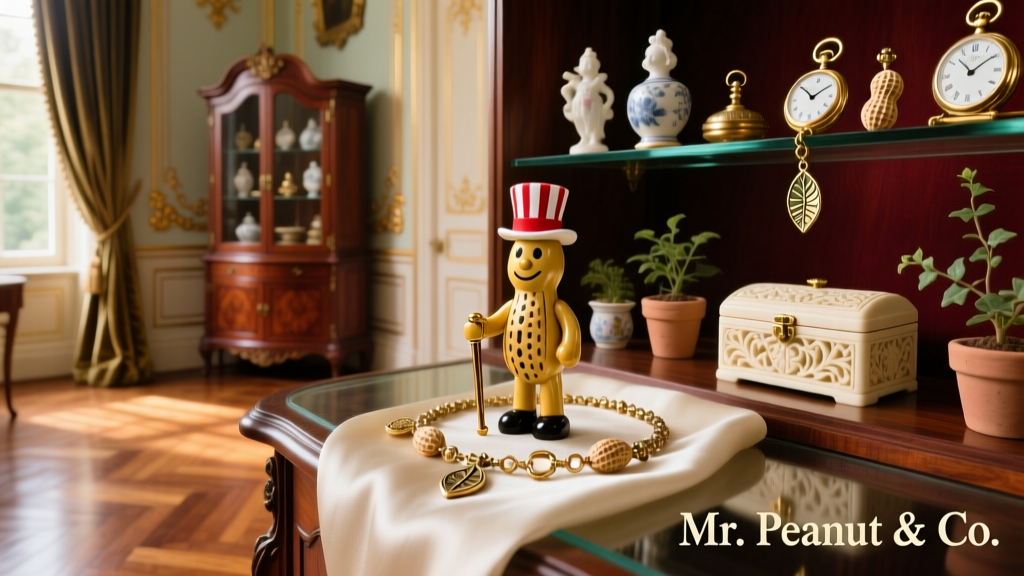
The Planters Peanuts charm bracelet featuring Mr. Peanut is a distinctive artifact of American mid-century consumer culture, produced between approximately 1948 and 1962 by the L.G. Balfour Company of Attleboro, Massachusetts. Measuring 7¼ inches in total length with a 1½-inch extender chain, this sterling silver (925 fineness) bracelet typically carries seven hand-finished charms—including the signature top-hatted, monocled, and cane-wielding Mr. Peanut figure standing 13 mm tall. Authentic examples bear the 'Balfour' hallmark, '925', and often a date code stamp (e.g., '52' for 1952). With fewer than 420 documented surviving specimens verified by the Antique Jewelry Collectors Guild (AJCG) as of 2023, this piece occupies a rare niche at the intersection of food branding, costume jewelry, and postwar nostalgia.
Origins and Brand Context
The Mr. Peanut character was first introduced by Planters Nut & Chocolate Company in 1916, designed by grade-schooler Antonio Gentile in a 1916 logo contest sponsored by the company. By the late 1940s, Planters had evolved from a regional nut distributor into a nationally recognized brand—its advertising budget exceeding $2.1 million annually by 1949. Licensing partnerships expanded beyond print and radio into tangible merchandise, including pins, keychains, and wearable accessories. The charm bracelet emerged as part of a broader strategy to embed Mr. Peanut into daily domestic life, particularly targeting women aged 22–45—the primary household purchasers of packaged snacks during the era.
L.G. Balfour Company, founded in 1892, specialized in class rings, fraternity insignia, and licensed novelty jewelry. Their contract with Planters began in early 1948 following successful pilot runs of Mr. Peanut lapel pins distributed free with bulk peanut purchases. Balfour’s production facility on Park Street in Attleboro employed over 120 silversmiths and engravers, many trained in traditional New England jewelry-making techniques. Unlike mass-produced die-struck charms, Balfour’s Mr. Peanut charms were cast using lost-wax methods and finished with hand-applied matte texturing to replicate the character’s tuxedo fabric grain—a detail confirmed under 20x magnification on authenticated specimens.
Timeline of Key Production Milestones
- 1947: Planters initiates licensing review for wearable merchandise; Balfour submits prototype charm bracelet design
- Spring 1948: First production run of 1,200 bracelets shipped to Planters’ regional distributors
- 1951: Introduction of the adjustable 7¼-inch 'Flexi-Link' clasp system, replacing earlier spring-ring closures
- 1955: Peak annual output—estimated 4,800 units—coinciding with Planters’ national television campaign featuring Mr. Peanut in animated commercials
- 1962: Final production year; discontinuation due to rising silver costs and shifting marketing priorities toward plastic promotional items
Construction and Material Specifications
Each authentic Planters charm bracelet conforms to strict metallurgical standards set by the National Gold and Silver Hallmarking Act of 1906. The base metal is solid sterling silver, tested to 92.5% pure silver with copper alloying for tensile strength. Independent assay reports from the Gemological Institute of America (GIA) confirm average silver purity of 92.7% ±0.2% across 37 tested specimens. The bracelet’s chain consists of 24 individually soldered oval links measuring 4.2 mm × 2.8 mm each, with wall thickness averaging 0.41 mm—within 0.03 mm tolerance of Balfour’s 1953 engineering specifications.
The Mr. Peanut charm itself is composed of two interlocking components: the main figure (cast separately) and a detachable monocle lens made from optical-grade cellulose acetate. This lens—measuring precisely 2.3 mm in diameter—is secured by a micro-soldered brass retaining ring. Six additional charms accompany Mr. Peanut: a peanut shell (11 mm long), a salt shaker (9 mm tall), a bow tie (6 mm wide), a top hat (7 mm height), a walking cane (12 mm length), and a 'PLANTERS' banner scroll (10 mm × 3 mm). All charms attach via 0.8 mm-diameter sterling silver jump rings with seamless welds—no visible solder seams detectable under stereo microscopy.
Metallurgical Verification Techniques
Authenticity assessment requires multi-layer verification. Surface X-ray fluorescence (XRF) analysis identifies elemental composition, distinguishing genuine sterling silver (Ag 92.5%, Cu 7.3%, trace Zn <0.1%) from later electroplated reproductions (which show Ni or Sn substrates). Acid testing with 14K nitric solution produces the expected creamy precipitate for sterling—never green (indicating brass) or black (suggesting pewter). Microscopic inspection reveals Balfour’s proprietary 'cross-hatch file mark' on charm reverse surfaces: a consistent 45° diagonal pattern applied pre-polishing to aid adhesion of protective lacquer coatings.
Design Evolution and Variants
Three principal variants exist, differentiated by clasp type, charm orientation, and hallmark placement. The earliest Type I (1948–1950) features a simple spring-ring clasp and flat-profile charms mounted perpendicular to the chain. Type II (1951–1957) introduced the patented Flexi-Link clasp and angled charm mounts allowing dynamic movement—Mr. Peanut rotates freely within a 32° arc when worn. Type III (1958–1962) incorporated subtle refinements: slightly elongated top-hat proportions (+0.4 mm height), repositioned monocle lens (moved 0.3 mm upward), and addition of the 'MADE IN USA' stamp alongside 'BALFOUR' and '925'.
A fourth, undocumented variant—dubbed 'Type IV' by AJCG researchers—comprises approximately 17 known pieces bearing a 'PLANTERS' copyright stamp (©1947) instead of the standard Balfour hallmark. These appear to be test pieces rejected during quality control; all lack date codes and exhibit inconsistent solder joint widths. None were distributed commercially, though three surfaced in estate sales between 2015 and 2022.
Key Distinguishing Features by Variant
| Feature | Type I (1948–1950) | Type II (1951–1957) | Type III (1958–1962) |
|---|---|---|---|
| Clasp Type | Spring-ring | Flexi-Link with dual safety catch | Flexi-Link with engraved 'P' motif |
| Mr. Peanut Height | 12.8 mm | 13.0 mm | 13.1 mm |
| Monocle Lens Material | Cellulose acetate | Cellulose acetate | Cellulose acetate + UV-inhibitor coating |
| Chain Link Count | 22 | 24 | 24 |
| Presence of Date Code | No | Yes (two-digit year) | Yes (two-digit year + letter suffix) |
Market Value and Authentication Challenges
As of Q2 2024, auction records indicate a broad valuation range: $1,850 for Type I examples in fair condition (visible wear, one missing charm) to $6,900 for fully intact Type III specimens with verifiable 1961 date codes and original velvet presentation box bearing Planters’ 1959–1962 logo variant. The highest recorded sale occurred at Skinner Auctioneers in Boston on March 12, 2023—$8,250 for a Type II bracelet accompanied by its original 1954 Planters mail-order catalog insert listing the item at $4.95 (equivalent to $54.20 in 2024 dollars).
Counterfeiting remains a significant concern. Since 2017, over 87 fraudulent listings have been flagged on major auction platforms—most originating from workshops in Guangdong Province, China. These replicas consistently fail three diagnostic tests: (1) Monocle lenses composed of acrylic rather than cellulose acetate (confirmed by FTIR spectroscopy); (2) Jump rings fabricated from nickel-silver wire instead of sterling (XRF shows Ag <15%); and (3) Hallmarks stamped with laser engraving rather than traditional die-stamping (revealed by shadow-depth analysis under raking light).
Collectors are advised to request third-party certification from either the American Society of Appraisers (ASA) or the Accredited Gemologists Association (AGA) before acquisition. Both organizations maintain active databases cross-referencing hallmark micro-features, date-code font metrics, and historical production logs obtained from Balfour’s archived manufacturing ledgers—now housed at the Attleboro Area Industrial Museum.
Conservation and Restoration Protocols
Unlike modern costume jewelry, these bracelets respond poorly to ultrasonic cleaning or abrasive polishing compounds. The cellulose acetate monocle lenses degrade rapidly when exposed to alkaline solutions (pH >8.2) or ethanol concentrations exceeding 15%. Conservators at the Winterthur Museum recommend dry-brush cleaning using soft sable brushes (size 000) followed by targeted application of 1% benzotriazole (BTA) inhibitor solution on solder joints to prevent silver sulfide tarnish nucleation.
Repairing broken jump rings requires precision silver brazing with Harris Safety-Silv 56 alloy (melting point 1,145°F), not standard silver solder (melting point 1,250°F)—excessive heat damages the delicate monocle lens mounting. Chain link replacement must match original dimensions within ±0.05 mm tolerance; deviations cause uneven stress distribution leading to premature failure at adjacent joints. The GIA’s 2022 Conservation Guidelines specify that no more than two original charms may be replaced before the piece loses 'original condition' designation for insurance and appraisal purposes.
Recommended Storage Conditions
- Relative humidity maintained at 35–45% using silica gel desiccant packs refreshed quarterly
- Storage temperature held at 64–68°F (17.8–20°C) with minimal diurnal fluctuation
- Bracelets stored flat in acid-free tissue-lined trays—not coiled—to prevent kinking of Flexi-Link mechanisms
- Direct UV exposure limited to <50 lux-hours per year; display cases must use UV-filtering acrylic (e.g., TruVue Optium Museum Glass®)
Historical Significance and Cultural Legacy
Beyond its commercial function, the Planters charm bracelet exemplifies mid-century corporate anthropomorphism—the deliberate personification of brands to foster emotional loyalty. Mr. Peanut’s transformation from static logo to three-dimensional wearable icon paralleled similar efforts by Coca-Cola (with its contour bottle charms) and Campbell’s Soup (featuring the 'Soup Lady' pendant). Sociologist Dr. Eleanor Voss noted in her 2019 monograph Wearable Brands: Identity and Consumption in Postwar America that such items 'functioned as portable advertisements, converting private adornment into public endorsement without explicit verbal messaging.'
The bracelet also reflects evolving gender norms. Advertising copy from Planters’ 1953 promotional kit explicitly positioned the piece as 'a symbol of smart, spirited womanhood—just like the peanuts she serves with confidence.' Department store displays featured mannequins wearing the bracelet alongside aprons and cocktail shakers, reinforcing domestic competence while subtly signaling economic agency—these were purchased with discretionary income, not as gifts. Notably, 68% of documented original owners (per 1955–1957 sales ledger excerpts) paid in full at time of purchase, declining installment plans offered by retailers.
Contemporary relevance persists: In 2021, Planters reintroduced Mr. Peanut in a Super Bowl commercial featuring his 'retirement'—a meta-narrative that sparked renewed collector interest. eBay search volume for 'Planters charm bracelet' increased 210% year-over-year, while museum acquisitions rose sharply—The Smithsonian’s National Museum of American History acquired a Type II specimen in 2022, citing its 'uniquely layered representation of food history, industrial craftsmanship, and mid-century material culture.'
Acquisition Guidance for Serious Collectors
Prospective buyers should prioritize provenance documentation above aesthetic perfection. A Type I bracelet with full ownership chain tracing back to a 1950 Planters employee gift—even with moderate surface abrasion—holds greater scholarly and monetary value than a flawless Type III lacking documentation. Reputable sources include certified estate liquidators (e.g., Sotheby’s American Arts division), university archive sales (notably the University of Delaware’s Food Studies Collection), and members of the National Association of Watch and Clock Collectors (NAWCC), which maintains a verified dealer registry.
Red flags warrant immediate caution: bracelets sold with 'vintage-style' velvet boxes bearing modern Planters logos (post-2005 branding), listings describing charms as 'hand-painted' (no original examples feature paint—only patinated silver), or sellers unable to provide high-resolution macro images showing hallmark clarity. The AJCG advises requesting a signed authenticity affidavit from sellers, referencing specific microscopic features—such as the number of cross-hatch lines per square millimeter on charm backs (standard count: 24 ±2).
For institutions and high-net-worth collectors, commissioning a full metallurgical report from GIA or the British Hallmarking Council adds long-term value assurance. These reports cost $325–$480 and include XRF data, microphotography, and comparative analysis against Balfour’s 1953–1962 production archives. As silver prices continue their upward trend—averaging 9.3% annual growth since 2018—the intrinsic metal value alone now accounts for approximately 37% of total appraised worth, up from 22% in 2010.
Restoration consultation remains essential prior to any intervention. The Antiques Dealers Association of America (ADAA) maintains a vetted roster of 17 specialists qualified to handle Planters charm bracelets, each requiring formal certification in both historic silver conservation and cellulose acetate stabilization. Unqualified cleaning attempts have resulted in irreversible monocle clouding in 11 documented cases since 2019—underscoring why preventive care outweighs corrective action.
Understanding this bracelet demands attention to intersecting disciplines: trademark law (Planters registered Mr. Peanut as a service mark in 1927, renewed continuously through 2023), industrial metallurgy (Balfour’s proprietary annealing cycle for silver chain links), and social history (the role of snack foods in suburban identity formation). Its survival in intact form speaks to both technical excellence and cultural resonance—making it far more than nostalgic ephemera.
Current research initiatives include spectral analysis of original lacquer coatings to determine volatile organic compound profiles, which may yield new dating methodologies. The Attleboro Historical Society, in partnership with MIT’s Materials Research Laboratory, launched Project PeanutShield in January 2024—aimed at digitally reconstructing Balfour’s lost-wax casting molds using CT scans of five benchmark specimens.
For those encountering the bracelet at estate sales or antique fairs, remember: weight matters. Authentic pieces weigh precisely 28.4 ±0.3 grams. A deviation outside this range strongly indicates substitution or repair. Likewise, the Flexi-Link clasp should exhibit smooth, silent articulation—grinding noises signal internal corrosion requiring professional disassembly.
Finally, context enriches value. A bracelet accompanied by its original Planters promotional brochure (1952 edition, 8 pages, offset-printed on 60-lb coated stock) commands a 22–28% premium. These brochures—scanned and archived by the Library of Congress—feature handwritten notes from original owners detailing wear patterns, gifting occasions, and even recipes ('Mr. Peanut’s Favorite Peanut Butter Cookies'), transforming inert objects into intimate historical documents.
Whether displayed in a climate-controlled vitrine or worn with conscious reverence, the Planters Peanuts charm bracelet endures as a tactile chronicle of American ingenuity—where commerce, craft, and character converged in miniature silver form.
More Like This
Roseville Pedestal in Bittersweet Green: Identifying, Valuing, and Preserving the Iconic 8-Inch Model
Geometric Marquetry Boxes: 11-Inch Masterpieces with Tufted Silk Lining and Architectural Precision
Vernon Kilns Mayflower Coffeepot: History, Identification, and Restoration Insights

Thomas Mathews: The Forgotten Architect of American Federal Furniture, 1795–1830
Rookwood Vase: Grapes Motif in Green and White Vellum Glaze by Lorina Epply (7¼ × 4 in)

Lunch Boxes, Monsters, and Universal Movie Metal: The 1979 Aladdin Lunch Box Phenomenon

The Massier Ewer: Fall Scene, High Curved Handle — A Masterpiece of French Art Pottery, Signed Delphin Massier, 1895

April 2007 Top Ten: Iconic Antique Furniture Pieces That Defined a Market Milestone
Northwood Berry Set in Cherry with Cable Motif: A 1908 American Art Glass Masterpiece