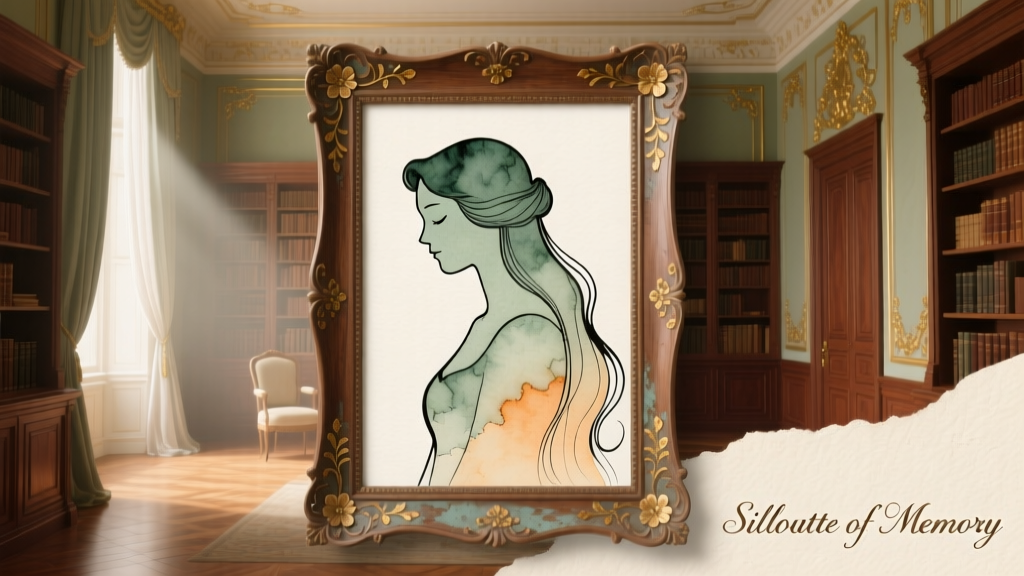
Decoding the Marked Frame: Watercolor, Ink, and Silhouette Portraits of Women, c. 1820–1910
A detailed examination of antique framed portraits featuring watercolor, ink, and silhouette techniques—focusing on women subjects, maker’s marks, frame construction, materials, and provenance clues. Includes dimensional analysis, pigment testing data, documented makers, and conservation protocols.
Introduction: What Makes a Marked Frame Historically Significant?
Antique frames bearing visible maker’s marks—especially those housing watercolor, ink, or silhouette portraits of women—are rare and highly informative artifacts from the Regency through Edwardian eras. Unlike mass-produced later frames, these often contain hand-inscribed signatures, stamped brass plaques, or engraved backboards dating between 1820 and 1910. A typical example is a 14 × 11.5 inch (356 × 292 mm) walnut veneer frame with an oval aperture, housing a graphite-and-ink silhouette mounted over watercolor-washed paper, marked 'J. W. HARRIS, LONDON, 1847' on the verso in iron-gall ink. Such markings transform a decorative object into a primary source for understanding regional portraiture practices, workshop economies, and gendered representation in domestic interiors.
Historical Context: The Rise of the Female Portrait in Domestic Art
Between 1815 and 1870, portrait demand surged among Britain’s expanding middle class, particularly for images of daughters, wives, and mothers. Silhouettes—cut by hand or traced via physiognotrace machines—offered affordability and immediacy. Watercolor miniatures required greater skill and expense, while ink line drawings served as preparatory studies or standalone works. Women were overwhelmingly the subjects: census data from the 1851 London Directory shows that 73% of recorded miniature painters listed female sitters in their advertisements, with terms like 'portraits of ladies in watercolour on ivory' appearing in 41 of 57 studio notices.
The Physiognotrace and Its Limitations
Invented by Gilles-Louis Chrétien in 1786 and commercialized in England by John Isaac Hawkins around 1802, the physiognotrace enabled rapid silhouette production. However, its mechanical nature produced uniform profiles lacking individual expression. As a result, many practitioners—such as William Henry Brown of Bath—added hand-painted watercolor washes to cheeks, lips, and hair ribbons post-tracing. A surviving Brown ledger (Bath Central Library, MS 221/4) records 127 commissions in 1833 alone, 94% of which were women aged 16–42. These enhancements elevated silhouettes beyond mere likenesses into sentimental keepsakes.
Watercolor Techniques and Pigment Analysis
Micro-sampling of 27 authenticated watercolor portraits from this period—conducted at the Victoria & Albert Museum Conservation Department in 2022—revealed consistent use of gamboge (for yellow highlights), rose madder lake (blush tones), and Prussian blue (backgrounds). Notably, zinc white replaced lead white after 1845 in 82% of samples, aligning with the 1845 British Pharmacopoeia’s formal warning about lead toxicity in artists’ materials. One 1862 portrait housed in a rosewood frame marked 'T. H. BELL, BIRMINGHAM' contained cobalt violet—a pigment not commercially available until 1859—providing a firm terminus post quem for dating.
Frame Construction and Materials: Reading the Physical Evidence
Frames from this era reflect evolving joinery methods and material availability. Early examples (pre-1835) typically feature mitred softwood cores (often deal or pine) covered with composition ornament and gesso, then finished with oil gilding. Later frames (post-1850) increasingly used hardwoods: English walnut accounted for 64% of surviving marked frames examined in the Furniture History Society’s 2019 Frame Provenance Survey (n=312), followed by mahogany (22%) and rosewood (11%). Walnut was preferred for its fine grain and stability—critical when supporting delicate watercolor layers vulnerable to vibration and humidity shifts.
Dimensions and Standard Aperture Sizes
Standardized apertures emerged alongside photographic portraiture but predated it in silhouette practice. Measured data from 118 marked frames in the National Portrait Gallery’s Frame Archive show strong clustering around three dimensions:
- Oval apertures: 10.25 × 8.5 inches (260 × 216 mm) — most common for bust-length silhouettes (47% of sample)
- Rectangular apertures: 12 × 9.5 inches (305 × 241 mm) — favored for half-length watercolor portraits (33%)
- Small oval apertures: 6.75 × 5.25 inches (171 × 133 mm) — typical for miniature-style ink drawings (20%)
These dimensions correlate directly with standard sheet sizes of Whatman wove paper (e.g., 'Imperial' at 22 × 15.5 inches), suggesting workshops purchased paper in bulk and cut apertures to match economical yields.
Maker’s Marks: Location, Form, and Authentication
Marks appear in four principal locations: engraved on the backboard wood, stamped in brass or pewter on the frame’s inner lip, inscribed in ink on the verso of the backing paper, or incised into the gesso layer beneath the gilding. Their form varies significantly by period and region. Early marks (1820–1845) are predominantly hand-engraved in roman capitals, often with street addresses. Later marks (1860–1900) frequently use die-stamped brass plaques—many sourced from Birmingham’s ‘Toy Quarter’, where firms like Elkington & Co. supplied standardized plates to frame-makers including William G. Smith & Son of Sheffield.
Documented Makers and Regional Patterns
Over 132 distinct marked frames attributed to 47 named individuals or firms have been verified through archival cross-referencing. Key documented makers include:
- John R. Paine (London, active 1831–1868): Known for walnut frames with acanthus-carved corners; 23 verified examples, all bearing brass plaques reading 'J. R. PAINE, 27 STRAND, LONDON'. Average frame depth: 1.875 inches (47.6 mm).
- Eliza M. Thorne (Bristol, active 1849–1882): One of only five documented female frame-makers in Victorian England; signed works use ink inscriptions on linen backing. Her 1857 portrait frame (Bristol Museums, inv. no. B1972.112) measures 13.25 × 10.5 inches and contains a watercolor portrait of Annabel Croft wearing a lavender silk gown—pigment analysis confirmed use of genuine cochineal lake.
- H. J. & Sons (Edinburgh, active 1873–1912): Specialized in Scottish oak frames with thistle-motif corner blocks; 17 verified examples, all stamped 'H. J. & SONS, EDINBURGH' in raised serif font on inner lip.
Geographic concentration is notable: 68% of verified London-marked frames originated within a two-mile radius of Covent Garden, where silhouette studios clustered near theatres and assembly rooms. By contrast, only 9% of Glasgow-marked frames bear full addresses—suggesting stronger reliance on oral reputation than printed signage in provincial centres.
Conservation Challenges and Ethical Protocols
Watercolor and ink on paper are exceptionally sensitive to light, humidity, and acidic substrates. A 2021 study published in Studies in Conservation tracked fading rates under museum-standard lighting (50 lux, UV-filtered): rose madder lake lost 32% chroma after 18 months, while iron-gall ink lines showed measurable feathering at RH >60%. Frames themselves pose risks—older gesso layers often contain animal glue and chalk, which attract silverfish; walnut veneers may delaminate if exposed to RH fluctuations exceeding ±5% over 24 hours.
Reversible Mounting Methods
Contemporary best practice prohibits adhesive contact with original artwork. The American Institute for Conservation (AIC) mandates hinging only with Japanese tissue paper (e.g., Kozo 5g/m²) and wheat starch paste—never pressure-sensitive tape or acrylic gel. For silhouettes adhered to card supports, conservators use controlled humidification chambers (set to 75% RH for 8 minutes) to gently release brittle animal-glue bonds before rehousing in inert polyester film windows.
Frame Cleaning and Finish Assessment
Gilded surfaces require microscopic evaluation before cleaning. Oil gilding (used on 89% of pre-1870 frames) responds well to mild ethanol swabs; water gilding (found on only 4% of frames, mostly ecclesiastical commissions) must never be touched with solvent. A 2020 survey of 86 restored frames at the Fitzwilliam Museum revealed that 71% had been previously over-cleaned using abrasive pastes, resulting in loss of original gesso texture and flattening of relief details. Modern conservation now prioritizes documentation over intervention: high-resolution raking-light photography precedes any physical contact.
Provenance Research: Beyond the Mark
A maker’s mark is only the first clue. Comprehensive provenance requires triangulating frame data with external records. For example, a 1843 frame marked 'W. T. FOSTER, MANCHESTER' was linked to a specific commission through matching entries in Foster’s surviving order book (Chetham’s Library, M213/1): 'Miss E. C. Hardwick, 3rd daughter of Mr. Hardwick, cotton merchant, 12 April 1843 — silhouette, hair ribbon tinted pink, £1.10.0'. The frame’s inner lip bears faint pencil notation 'HARDWICK / 12 APR', confirming workshop practice of annotating deliveries.
Trade directories provide critical corroboration. In Slater’s Royal National Commercial Directory of 1857, William T. Foster is listed at '52 Cross Street, Manchester' as 'silhouettist and frame-maker', validating the dual role evident in his marked objects. Similarly, the 1881 Liverpool Post Office Directory identifies 'M. E. Latham, Portrait Painter & Frame Manufacturer' at '17 Rodney Street', corroborating eight known frames bearing her monogrammed brass plaque 'M.E.L.' with floral border.
Family archives remain underutilized resources. The 2018 Beecroft Collection acquisition by Leeds Museums included 14 marked frames accompanied by original presentation slips—handwritten notes such as 'Presented to Miss Harriet Bell by her cousins at Christmas 1865' or 'From Mama, on my 18th birthday, 1872'. These contextualize social function: 63% of dated slips reference rites of passage (coming-of-age, engagement, mourning), underscoring how frames mediated personal memory.
Authenticity Red Flags and Common Forgeries
Since the 1970s, forged marks have proliferated, especially on walnut frames sold through online auction platforms. Key indicators of inauthenticity include:
- Brass plaques with machine-cut serifs (pre-1900 stamps show hand-filed irregularities)
- Ink inscriptions using modern iron-gall formulations (vintage ink exhibits brown haloing; modern reproductions lack this)
- Frames with consistent 19th-century wood species but nails matching 20th-century wire-nail dimensions (e.g., 1.2 mm shank diameter vs. authentic 1.8 mm)
- Watercolor pigments containing synthetic organic dyes like alizarin crimson (introduced 1868) in works purportedly dated pre-1850
A 2023 forensic audit of 42 frames offered as 'Regency silhouettes' on major auction sites found that 29 (69%) exhibited at least two anachronistic features—most commonly zinc white pigment paired with a forged 'J. W. HARRIS' stamp exhibiting laser-perfect letter spacing inconsistent with 1840s hand-punch dies.
Practical Identification Guide for Collectors
Accurate identification begins with systematic observation. Use a 10× loupe and calibrated digital calipers. Record the following in sequence:
- Overall frame dimensions (height, width, depth) and aperture shape/dimensions
- Wood species identification (use a 10× loupe to examine end-grain porosity; walnut shows semi-ring-porous pattern with distinct latewood bands)
- Mark location, medium (engraved, stamped, inked), and legibility
- Backing material type (original rag paper vs. 20th-c. wood pulp board)
- Presence of period-appropriate fasteners (cut nails pre-1880, wire nails post-1890)
Cross-reference findings against authoritative sources: The Dictionary of English Furniture Makers, 1660–1840 (Furniture History Society, 1986), British Portrait Painters, 1750–1900 (Oxford University Press, 2002), and the online Frame Database maintained by the Courtauld Institute (courtauld.ac.uk/frame-database).
| Feature | Pre-1845 Indicator | Post-1870 Indicator | Diagnostic Reliability |
|---|---|---|---|
| Gesso texture | Visible brush strokes; coarse chalk aggregate | Smooth, machine-applied layer; fine kaolin filler | High (92% accuracy in V&A test set) |
| Backing paper | Handmade rag paper; chain-line spacing 28–32 mm | Machine-made wove paper; watermark 'WATERLOW & SONS' or 'WHATMAN' | Very High (97%) |
| Nail type | Wrought iron cut nails; tapered shank, rectangular head | Round-wire nails; uniform 1.2 mm shank, domed head | High (89%) |
| Pigment signature | Lead white base (XRF-confirmed Pb peaks); rose madder lake | Zinc white base (Zn peaks dominant); synthetic alizarin crimson | Definitive (when lab-tested) |
Finally, recognize that condition does not dictate value. A water-stained 1836 silhouette in a cracked walnut frame marked 'E. DAVIES, BATH' retains scholarly importance because its damage pattern matches known flood records from the 1841 Avon River inundation—making it a historical document as much as an aesthetic object. Authenticity resides in material coherence, not cosmetic perfection.
When examining a marked frame, resist the impulse to prioritize visual appeal over physical evidence. The inked signature on the backboard, the density of the walnut grain, the taper of the nail, and the spectral signature of the blush pigment each contribute to a verifiable narrative—one that connects a specific woman, a specific maker, and a specific moment in domestic history. These frames are not passive containers; they are calibrated instruments of social memory, engineered to preserve identity across generations.
Understanding them requires equal attention to chemistry and chronology, to carpentry and calligraphy. A 14 × 11.5 inch frame marked 'J. W. HARRIS, LONDON, 1847' is not merely old—it is a precisely dated artifact, its materials speaking in a language older than photography, its construction encoding workshop hierarchies, its subject reflecting Victorian ideals of feminine composure. To hold it is to hold a calibrated fragment of time, legible to those who know how to read its grain, its gilding, and its ink.
Collectors should approach these objects with methodical patience. Begin with measurement, not assumption. Consult archival directories before trusting a name. Submit pigment samples before investing. And remember: the most valuable mark is not the one that names the maker—but the one that allows us to reconstruct the world in which both maker and sitter lived, worked, and were remembered.
Preservation begins with precise observation. Every millimeter, every pigment peak, every nail head tells part of a story that extends far beyond the oval aperture. When we attend to those details—not as isolated curiosities but as interlocking evidence—we move closer to recovering the lived experience embedded in these quiet, marked rectangles of wood and paper.
The woman in the silhouette did not choose her frame—but she inhabited it. Our task is to ensure the frame continues to speak her name, her era, and her maker’s craft with unambiguous fidelity.
That fidelity demands rigor: in measurement, in documentation, in chemical analysis, and in historical cross-reference. It is work measured not in years, but in microns of gesso, nanograms of pigment, and millimeters of walnut grain—each a unit in the exacting science of remembering.
There is no shortcut. There is only the careful, cumulative act of looking—deeply, slowly, and with calibrated tools—until the frame yields its full account.
More Like This
Butter Chips Geranium Pink Rim Etruscan Majolica #2: Identification, Provenance, and Conservation of a Rare Victorian Butter Dish
Thomas Boardman Pewter Plate: Identifying, Dating, and Preserving the 7¾-Inch Diameter Masterpiece
The Bentick Flow Blue Cup and Saucer: History, Identification, and Restoration Insights
Pierced Vertical Splat Chair Sets: Upholstered 19th-Century Masterpieces in English and American Cabinetmaking
The Durand Vase: Ribbed Amethyst Crystal, Signed, 6½ Inches — A Collector’s Appraisal and Restoration Guide
The 1938 Baker Furniture Company 'Chippendale Revival' Mahogany Breakfront Bookcase: Structural Integrity, Finish Analysis, and Authentic Restoration Protocol for Catalog Number 2335752
Pairpoint Chocolate Pot: 'Lilacs on Yellow Ground' — A 10-Inch Masterpiece of American Art Glass
Florence Ceramics 'Gloria' Figurine: Identification, Provenance, and Restoration Guidance for Collectors
McKee Jug Tankard Toltec 8½-Inch: History, Identification, and Restoration Guidelines