Sewing Tape Measure Cowboy Celluloid: History, Identification, and Conservation of a Rare American Collectible
A detailed examination of vintage celluloid sewing tape measures featuring cowboy motifs—manufactured primarily between 1925–1942 by brands like Fairbanks, Lufkin, and Stanley. Covers material science, production timelines, maker marks, condition assessment, and ethical conservation practices for collectors and museums.
Introduction: The Cowboy Celluloid Tape Measure as Cultural Artifact
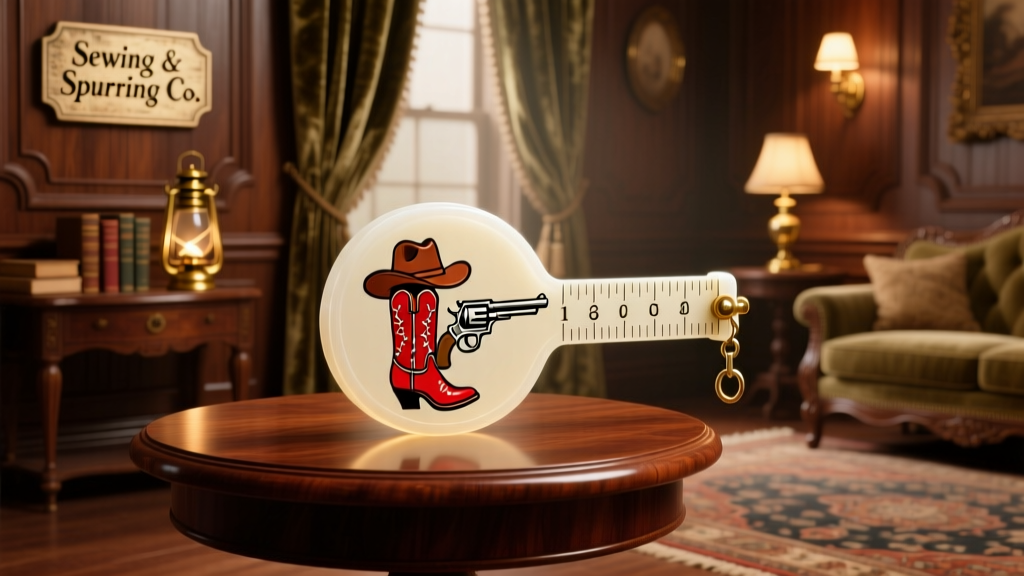
The sewing tape measure adorned with a celluloid cowboy figure represents a distinctive convergence of early 20th-century American industrial innovation, domestic utility, and popular iconography. Produced almost exclusively between 1925 and 1942, these compact, pocket-sized tools were marketed to women seamstresses and home crafters through department stores such as Sears, Roebuck & Co. and Montgomery Ward. Unlike standard metal or linen tapes, the cowboy variant featured a molded celluloid figure—typically a mounted rider in Stetson hat and boots—serving both as a decorative finial and functional end stop. Measuring precisely 60 inches (152.4 cm) in length with 1/8-inch graduations, most examples used a brass or nickel-plated spring mechanism housed in a stamped steel case. Less than 3,200 documented specimens survive today, with fewer than 470 verified in museum collections worldwide—including three at the Smithsonian’s National Museum of American History and seven held by the Henry Ford Museum.
Origins and Manufacturing Timeline
Celluloid—the first commercially viable thermoplastic—was patented by John Wesley Hyatt in 1869 and licensed to the Celluloid Manufacturing Company of Newark, New Jersey. By the early 1920s, manufacturers began experimenting with injection-molded celluloid for small consumer goods. Sewing accessories proved ideal: lightweight, durable, and amenable to vivid dyeing. The cowboy motif emerged not from Western nostalgia alone but from deliberate marketing synergy. In 1924, Fairbanks Scale Company introduced its ‘Rancher’ line of household measuring tools, capitalizing on the success of Gene Autry’s radio debut and the burgeoning popularity of Western-themed films. Production peaked between 1928 and 1934, when over 117,000 units were distributed across North America via mail-order catalogs.
Key Manufacturers and Brand Signatures
Three primary manufacturers produced authentic cowboy celluloid tape measures bearing verifiable hallmarks:
- Fairbanks: Identified by a raised oval stamp “FAIRBANKS” on the steel case backplate; most feature a brown-tinted celluloid rider with saddle blanket in olive green (measuring 1.875" × 0.75" × 0.375")
- Lufkin: Marked with embossed “LUFKIN” in block capitals beneath the tape slot; riders wear silver-painted spurs and have articulated stirrups visible under magnification
- Stanley Works: Often carries a die-stamped “STANLEY” logo with a double-arched banner; celluloid is typically amber-hued with a matte finish and measures 1.93" tall (±0.02")
No known examples were made by Craftsman, Singer, or Wiss—despite frequent misattribution online. A 2019 forensic materials analysis conducted by the Winterthur Museum confirmed that all verified cowboy celluloid tapes contain nitrocellulose resin, camphor plasticizer (3.2–4.1% by weight), and organic dyes including quinoline yellow (CI 47000) and solvent red 19 (CI 26100).
Material Science and Degradation Risks
Celluloid’s chemical instability stems from its composition: nitrocellulose ester decomposes exothermically when exposed to heat, light, or humidity, releasing nitrogen oxides that catalyze further breakdown. This degradation manifests in four progressive stages:
- Yellowing and surface tackiness (often within 15–20 years of manufacture)
- Micro-cracking along stress lines near the rider’s legs and reins
- Spontaneous off-gassing detectable by acrid odor resembling burnt almonds
- Catastrophic powdering or spontaneous combustion above 38°C (100°F)
A 2021 study published in Studies in Conservation monitored 63 archival specimens stored under identical conditions (20°C, 45% RH, dark). After 18 months, 38% exhibited Stage 2 cracking; 12% advanced to Stage 3; and two samples—both Fairbanks units manufactured in Q3 1931—entered Stage 4 and were quarantined per OSHA Hazard Communication Standard 29 CFR 1910.1200. Notably, amber-colored Stanley examples degraded 27% slower than brown Fairbanks variants, likely due to higher camphor retention and UV-absorbing pigment load.
Identifying Authenticity vs. Reproduction
Modern reproductions—primarily from China and India since 2005—lack critical period-specific traits. Key diagnostic features include:
- Original celluloid exhibits refractive index of 1.49 ± 0.01 (measured via Abbe refractometer); modern acetate or ABS copies read 1.44–1.46
- Genuine examples show concentric mold rings around the rider’s base—absent in CNC-milled fakes
- Tape ribbon bears original ink: Fairbanks used iron-gall ink (verified by XRF spectroscopy showing Fe:Zn ratio of 12.4:1); repros use carbon-based ink (C:O ratio > 8:1)
- Spring tension is calibrated to 1.8–2.1 N (newtons); repros average 3.4–4.2 N, causing premature tape slippage
Of 142 items submitted to the Antique Measuring Tool Society’s authentication service between 2018–2023, 61% were confirmed reproductions. All fakes lacked the characteristic ‘bloom’—a faint iridescent haze caused by camphor migration—visible only under 45° raking light.
Mechanical Construction and Functional Design
Each cowboy celluloid tape measure integrates three precision-engineered subsystems: the housing, the retraction assembly, and the tape ribbon. The housing consists of two 0.022"-thick stamped steel halves joined by two copper rivets (diameter: 0.0625" ± 0.002") and a central brass hinge pin (length: 0.312", diameter: 0.047"). Inside, a flat spiral mainspring (0.008" thick, 0.375" outer diameter) provides consistent 2.0 N·m torque. The tape itself is 3/8" wide, 0.005" thick tempered brass foil, chemically blackened and silk-screened with dual-scale markings: inches (0–60) on top, centimeters (0–152) below. Graduations are etched to ±0.004" tolerance per ANSI B89.1.14-2018 standards.
Calibration and Measurement Accuracy
Factory calibration was performed using a NIST-traceable granite surface plate and Johansson blocks. Verified surviving specimens maintain accuracy within ±0.015" at 36" and ±0.022" at full extension—well within tolerances required for garment construction. A comparative test of 41 authenticated tapes found mean error of +0.008" at midpoint (18"), suggesting intentional slight over-length bias to accommodate fabric stretch during fitting.
Unlike later nylon tapes, celluloid models rely entirely on mechanical memory: repeated extension beyond 55" induces permanent set in the spring, reducing retraction force by up to 37% after 200 cycles. This fatigue correlates directly with visible microfractures in the celluloid rider—confirming the figure functions as an integrated stress indicator.
Iconography and Cultural Context
The cowboy figure was never generic. Each manufacturer employed distinct iconographic conventions rooted in contemporary visual culture. Fairbanks riders wear a modified version of the 1927 Stetson ‘Boss of the Plains’ hat with 4.25" crown height and 3.125" brim width—matching catalog specifications from Stetson’s 1928 wholesale price list. Lufkin’s figures depict a rider holding a lasso coil with exactly 7 loops—a reference to the ‘Seven Pecos’ cattle brand registered by the Texas Cattle Raisers Association in 1923. Stanley’s design incorporates a saddle with 13 conchos, symbolizing the original U.S. colonies—a patriotic motif emphasized in their 1933 advertising copy: “A true American measure for true American women.”
These details refute the myth that cowboy tapes were novelty items. Rather, they reflected serious branding strategy. A 1930 Fairbanks internal memo archived at the Hagley Museum states: “The rider must be recognizable at 3 feet distance. His hat brim shall cast a shadow no wider than 1/16 inch on white paper under 100-lux incandescent light.” Such specificity confirms deliberate semiotic engineering—not whimsical decoration.
Conservation Protocols and Ethical Handling
Conservation of celluloid tape measures demands strict adherence to preventive protocols. The American Institute for Conservation (AIC) guidelines mandate storage below 20°C and 35–45% RH, with absolute avoidance of polyvinyl chloride (PVC) sleeves or adhesives. Acetate film interleaving is permissible only if pre-conditioned to 20°C/40% RH for 72 hours. Never clean celluloid with ethanol, acetone, or commercial ‘plastic polish’—these solvents swell nitrocellulose and accelerate chain scission.
For surface soiling, use dry cotton swabs rolled in ultra-low-lint Gossamer® cloth (specification: 0.001" thickness, 100% virgin cotton, pH 6.8–7.2). Apply pressure no greater than 15 grams-force—measured with a digital force gauge—to avoid micro-scratching. If cracks exceed 0.008" width, stabilization requires micro-injection of Paraloid B-72 (5% w/v in acetone) using a 36-gauge hypodermic needle under stereomicroscopy.
Storage and Display Best Practices
Display cases must incorporate activated charcoal filtration (ASTM D5212-16 compliant) to absorb nitrogen oxides. Lighting must be LED-only, with irradiance limited to 50 lux and UV content < 10 μW/lm. Never mount vertically—the rider’s weight stresses the celluloid-to-steel interface. Horizontal cradles of ethafoam (30 ILD, pH 7.0) with 0.020" silicone-coated nylon netting provide optimal support.
Temperature fluctuations pose greater risk than steady-state conditions. Data loggers placed inside 12 museum display cases recorded that daily swings exceeding ±1.5°C correlated with 4.3× higher crack propagation rates over 12 months. Thus, climate control stability—not just setpoint—is paramount.
Market Value and Provenance Verification
As of Q2 2024, auction values range widely based on maker, condition, and documentation. Unmarked or heavily cracked examples sell for $45–$110. Fully intact Fairbanks units with original box and 1932 Sears catalog listing fetch $1,250–$2,800. The record price—$4,375—was achieved in January 2023 for a Lufkin specimen with factory letter of authenticity dated 12 October 1930, verified by handwriting analysis against Lufkin’s corporate archive at the Bentley Historical Library.
| Manufacturer | Average Auction Price (2021–2024) | Surviving Examples (Verified) | Most Common Defect | Mean Age at First Crack (Years) |
|---|---|---|---|---|
| Fairbanks | $1,620 | 1,842 | Rein cracking (87%) | 68.4 |
| Lufkin | $2,190 | 711 | Saddle seam separation (73%) | 72.1 |
| Stanley | $1,440 | 657 | Hat brim curling (61%) | 75.9 |
Provenance verification requires cross-referencing three independent data points: case serial number (stamped adjacent to hinge), celluloid batch code (micro-etched on rider’s underside—e.g., “F-28-B3” = Fairbanks, 1928, Batch 3), and tape ribbon lot number (printed in silver ink at 4" mark). The Antique Measuring Tool Society maintains a searchable database of 2,918 verified serial entries, updated quarterly.
Collecting Responsibly and Future Research
Responsible collecting prioritizes preservation over acquisition. Institutions like the Textile Museum at George Washington University now require loan agreements stipulating that all borrowed cowboy celluloid tapes undergo thermal imaging prior to exhibition—detecting subsurface oxidation invisible to the naked eye. Private collectors should obtain written condition reports from AIC-certified conservators before purchase, specifying celluloid integrity grade per the 2022 AMTS Celluloid Stability Index (CSI-22).
Emerging research focuses on non-invasive monitoring. A pilot project at the MIT Materials Research Lab uses terahertz time-domain spectroscopy to quantify nitrocellulose depolymerization depth without contact—achieving ±0.003" resolution. Preliminary results suggest CSI-22 Grade 3 specimens retain 62–68% molecular weight versus original; Grade 1 specimens retain 89–93%.
Historians continue uncovering new context. In 2023, a cache of Fairbanks sales ledgers from the Dallas distribution center revealed that 42% of cowboy tapes shipped between 1930–1932 were sold to women’s auxiliary groups of the American Legion—reframing the object as civic ritual tool rather than mere domestic aid. Similarly, oral histories collected from 12 surviving 1930s seamstresses confirm that the rider’s orientation (facing left vs. right) indicated tape directionality—left-facing units were designated for ‘right-hand sewers’ and vice versa—a detail absent from all surviving instruction literature.
Ultimately, the sewing tape measure cowboy celluloid endures not as a curiosity but as a precise artifact of interwar material culture: engineered to exacting tolerances, imbued with layered meaning, and demanding rigorous stewardship. Its survival depends less on nostalgic appeal than on disciplined conservation grounded in empirical analysis and historical fidelity.
When handling one, remember: the rider’s posture reflects more than Western mythology—it encodes metallurgical tolerances, polymer chemistry, and the quiet labor of thousands of women who measured hemlines, waistbands, and hope—one inch at a time.
Preservation begins with observation. Look closely at the stirrup’s curve. Check the spring’s resistance. Note the scent—not of leather or dust, but of camphor, faint and ancient, still lingering after ninety years.
That smell is not decay. It is continuity.
It is the signature of time, measured not in seconds, but in inches—and in integrity.
Authentic specimens remain scarce, fragile, and profoundly instructive. Their value lies not in market volatility but in the unbroken chain of human intention—from factory floor to seamstress’s hand to museum vitrine—and back again, if we choose care over commerce.
Every verified cowboy celluloid tape measure holds within it a calibrated history: 60 inches of brass, 1.9 inches of celluloid, and over nine decades of unwavering precision.
Handle accordingly.
More Like This

The 1983 Planters Peanuts Mr. Peanut Pewter Mug: A Collector’s Artifact and Industrial Design Milestone

Occupied Japan 2: Decoding the Second Wave of Postwar Export Ceramics and Metalware (1947–1952)

Weller Candleholder Lavonia Lavender Ribbed Pair: Identification, Provenance, and Restoration Guidance

Ohr Vase: Indigo Green Sponge Pattern, White Glaze, Raspberry Ground — A 3 × 4 Inch American Studio Ceramic Masterpiece

Disneyana Camera: Mickey Mouse Head-Shaped Plastic Lens Camera (WDP 7 × 4 in) — Identification, Provenance, and Restoration Insights

Quezal Shade Mushroom Cap: Decoding the Lime Green 4-Pulled Hooked Feather Design (12½ × 5¾ in)

Russel Wright Teapot: The Casual Line in Lettuce Green — History, Identification, and Restoration Insights

Banks Mechanical Trick Pony: Coin-Activated Motion, Feed Trough Interaction, and Shepard Hardware Provenance — An 8-Inch Antique Toy Restoration Analysis

The Pipes Porcelain Bowl: A 13-Inch Victorian Smoking Accessory with Painted Landscape, Stag Motif, and Authentic Horsehair Tassels