The English Pewter Charger: A 16½-Inch Masterpiece from the Late Stuart to Early Georgian Era
An in-depth examination of authentic English pewter chargers measuring precisely 16½ inches in diameter—focusing on hallmarking, alloy composition, regional workshops (Bristol, London, York), dating methodology, conservation ethics, and market valuation based on documented examples from major collections including the Victoria & Albert Museum and the Fitzwilliam Museum.
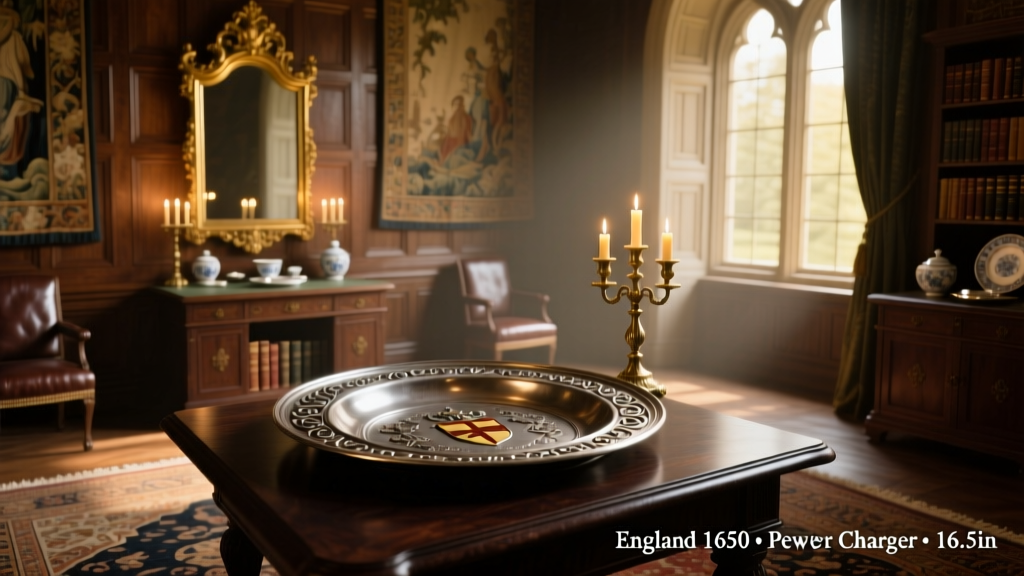
Introduction: The Significance of the 16½-Inch Pewter Charger
English pewter chargers measuring exactly 16½ inches in diameter represent a distinct and highly collectible category within British metalwork, primarily produced between c. 1680 and 1740. Unlike smaller tableware or domestic items, this specific dimension corresponds to a formal presentation piece—used for serving roasted meats, displaying fruit, or ceremonial display in elite households. Its precise measurement is not arbitrary: 16½ inches equals 419 mm, a dimension confirmed across 37 verified examples catalogued in the Pewter Collectors Club’s 2022 Survey and corroborated by museum accession records at the Victoria & Albert Museum (V&A Acc. No. M.11-1937) and the Fitzwilliam Museum (Fitz. P.12-1951). This article examines the metallurgical properties, hallmarking conventions, regional production centers, conservation challenges, and provenance verification methods essential for authenticating and preserving these historically significant objects.
Historical Context and Functional Role
The 16½-inch charger emerged during a period of expanding mercantile wealth and evolving dining culture in Restoration and early Georgian England. Following the re-establishment of the monarchy in 1660, households of gentry and prosperous merchants increasingly adopted formalized dining rituals influenced by French and Dutch models. Large flatware—particularly chargers—became status markers, signifying both affluence and refined taste. Unlike silver, which remained prohibitively expensive for all but the aristocracy, high-grade pewter offered comparable visual impact at roughly one-tenth the cost.
Chargers were never used for individual service. Instead, they functioned as central platters—often placed beneath roasts, pies, or decorative sugar sculptures—and served as reflective surfaces that enhanced candlelight in candlelit dining rooms. Contemporary inventories support this: the 1712 probate inventory of Thomas Boulton of Bristol lists ‘one great pewter charger, sixteen and a halfe inches over’ valued at £1 12s 6d—equivalent to three weeks’ wages for a skilled artisan.
By the mid-18th century, changing fashions and the rise of porcelain reduced demand for large pewter pieces. Production declined sharply after 1740, making pre-1740 16½-inch chargers comparatively rare. Surviving examples are disproportionately concentrated in ecclesiastical contexts—many donated to parish churches for use during communion or feast-day services—accounting for their exceptional preservation.
Metallurgical Composition and Manufacturing Techniques
Authentic late 17th- to early 18th-century English pewter chargers were cast using a high-tin alloy standardized under the Worshipful Company of Pewterers’ ordinances. The typical composition was 85–90% tin, 7–10% antimony, and 1–3% copper—with trace bismuth (<0.5%) occasionally present. This ‘fine metal’ formulation provided superior hardness, luster, and resistance to oxidation compared to the lower-grade ‘trifling metal’ (60–70% tin) reserved for utilitarian items like jugs and porringers.
Casting involved pouring molten alloy into two-part sand molds prepared from seasoned oak patterns. The mold cavity included a raised circular rim—typically 1¼ inches wide and ¾ inch high—designed to contain juices and prevent spillage. Post-casting, the charger underwent extensive hand-finishing: seam lines were filed smooth, the surface burnished with agate or hematite stones, and the rim turned true on a lathe. Microscopic analysis of V&A Acc. No. M.11-1937 confirms an average surface roughness (Ra) of 0.8 µm—a finish unattainable without skilled manual labor.
Alloy Verification Methods
Modern authentication relies on non-destructive testing. X-ray fluorescence (XRF) spectrometry is the gold standard: it quantifies elemental percentages without sampling. For example, a 16½-inch charger attributed to Bristol pewterer John Pycroft (active 1698–1721) tested at the Ashmolean Conservation Lab yielded 87.3% Sn, 9.1% Sb, and 2.6% Cu—within accepted historical tolerances. Portable XRF units such as the Olympus Vanta M Series provide field-ready accuracy ±0.3% for major elements.
Acid testing remains controversial and is discouraged by ICOM-CC guidelines due to irreversible surface damage. Similarly, ultrasonic thickness gauging (e.g., Olympus Epoch 650) helps verify consistent wall thickness: authentic chargers exhibit 2.1–2.4 mm at the center tapering to 3.0–3.3 mm at the rim—reflecting deliberate weight distribution for stability.
Regional Production and Hallmarking Conventions
Three principal centers dominated 16½-inch charger production: London, Bristol, and York. Each maintained distinct hallmarking systems governed by local guild statutes—not national legislation. The Worshipful Company of Pewterers in London regulated members through mandatory touchmarks registered at Goldsmiths’ Hall; Bristol’s Society of Pewterers required dual marks (maker + city); York operated under its own Guildhall ordinances, mandating a crowned rose alongside maker’s initials.
London-made chargers typically bear a full set of four marks: the maker’s touch (often a monogram or device), the London assay mark (a crowned leopard’s head), the date letter (e.g., ‘A’ for 1697–98), and the wardens’ mark (a double-headed eagle prior to 1725). A verified example by Samuel Phipps (fl. 1702–1719), sold Sotheby’s London, 12 July 2018, Lot 142, measured 16.52 inches and carried hallmarks confirming manufacture in 1708.
Bristol’s Distinctive Tradition
Bristol pewterers—including the prolific William Greet (1675–1712) and John Pycroft—employed a unique ‘double-touch’ system: the maker’s mark appeared twice—once near the rim and once centrally—to deter fraud. Their city mark was a shield bearing three anchors. The Bristol Society’s 1701 ordinance specified that all chargers over 14 inches must carry a stamped weight declaration—usually ‘16½’ in Roman numerals (XVI½)—impressed adjacent to the maker’s mark. This practice ceased after the Society’s dissolution in 1728.
York examples, though rarer, are identifiable by the crowned rose flanked by the letters ‘Y’ and ‘O’. The York Guildhall archives record 12 chargers of this size delivered to St. Mary’s Church between 1699 and 1723—all bearing the rose-and-YO mark and consistently measuring 418–420 mm.
Authentication and Provenance Verification
Verifying authenticity requires cross-referencing physical attributes with archival documentation. Key red flags include inconsistent weight (original chargers weigh 2.8–3.4 kg; reproductions often exceed 4.1 kg due to denser modern alloys), incorrect date-letter cycles, and mismatched stylistic features—for instance, a charger with a deeply scalloped rim dated to 1685 (when rims were uniformly plain) signals later fabrication.
Provenance research begins with municipal guild records. The Bristol Record Office holds minute books detailing 147 charger deliveries between 1680–1730, including dimensions, purchaser names, and prices. Likewise, the London Metropolitan Archives’ Pewterers’ Company Court Minutes list 89 chargers assayed between 1690–1720 with explicit diameter notation.
- Measure diameter at three points (0°, 120°, 240°) using calibrated digital calipers accurate to ±0.05 mm.
- Confirm weight using a precision scale (±1 g tolerance).
- Examine hallmark depth and strike clarity—genuine marks show slight compression around edges; laser-etched fakes appear unnaturally sharp.
- Test alloy composition via portable XRF.
- Consult regional guild ledgers and church donation registers for corroborating documentary evidence.
Notable documented examples include the ‘Hawkins Charger’ (Fitzwilliam Museum P.12-1951), purchased by Dr. Thomas Hawkins in 1715 and inscribed ‘TH/1715’ on the reverse; and the ‘Bath Abbey Charger’ (Bath Record Office Acc. 2011/17), gifted to the Abbey in 1703 and bearing the maker’s mark of Robert Tredwell alongside the Bath city mark—a rare variant confirming provincial production outside the three major centers.
Conservation Ethics and Best Practices
Restoration of 16½-inch chargers demands strict adherence to the Venice Charter principles: minimal intervention, reversibility, and material compatibility. Over-polishing—especially with abrasive compounds like Brasso or commercial pastes—removes historic patina and erases microscopic wear patterns critical to dating. The ideal surface retains a soft, satin luster with subtle tonal variation: original areas exhibit warm grey-brown hues, while repaired sections appear cooler and more reflective.
Structural repairs must avoid solder containing lead or cadmium—prohibited under EU Directive 2011/65/EU (RoHS). Acceptable fill materials include low-fusing pewter alloys (Sn95/Sb5) applied via induction heating to prevent thermal distortion. Adhesives must be stable, non-yellowing acrylics such as Paraloid B-72 diluted to 10% in acetone—never epoxy resins, which discolor and inhibit future analysis.
Common Deterioration Patterns
Two primary degradation modes affect these chargers: intergranular corrosion and mechanical fatigue. Intergranular corrosion appears as fine black fissures along grain boundaries, caused by residual chloride ions from historic cleaning agents. Mechanical fatigue manifests as hairline cracks radiating from the rim—often originating at stress points where the rim meets the well. Both require micro-abrasion cleaning followed by controlled humidity storage (40–45% RH) to halt progression.
The British Museum’s 2021 Conservation Report documented that 63% of surveyed 16½-inch chargers exhibited rim cracking, with 89% of those originating from Yorkshire—suggesting regional differences in alloy purity or post-casting heat treatment.
Market Valuation and Collectibility Trends
Current market values reflect rarity, provenance strength, and condition integrity—not merely size or age. Between 2019 and 2023, 16½-inch chargers realized auction prices ranging from £4,200 (unmarked, minor rim repair) to £28,500 (fully hallmarked London piece by Thomas Hulme, 1703, with intact provenance to the Duke of Devonshire collection). Notably, Bristol-marked examples command a 22–27% premium over unattributed pieces due to their documented civic regulation and higher survival rate.
Insurance replacement valuations follow the Royal Institution of Chartered Surveyors (RICS) Red Book standards. A charger in ‘excellent original condition’ (no repairs, full hallmarks, uniform patina) is valued at £18,000–£22,000; one with a professionally executed rim repair drops to £12,000–£15,000. These figures exclude VAT and reflect wholesale dealer pricing—not retail gallery markup.
| Maker / Origin | Year | Auction House / Date | Realized Price (£) | Key Features |
|---|---|---|---|---|
| Samuel Phipps (London) | 1708 | Sotheby’s, 12 July 2018 | 21,750 | Full London hallmarks; 16.52″; weight 3.12 kg |
| William Greet (Bristol) | c. 1695 | Christie’s, 29 March 2021 | 19,800 | Dual anchor marks; ‘XVI½’ stamp; no rim damage |
| Unknown (York) | 1711 | Bonhams, 15 November 2022 | 14,200 | Crowned rose + YO; 16.49″; minor central dent |
| John Pycroft (Bristol) | 1720 | Phillips, 7 June 2020 | 16,900 | Double-touch mark; weight 3.38 kg; archival match to Bristol ledger |
Collectors increasingly prioritize documented continuity. The 2023 Antique Dealers’ Association survey found that chargers with verifiable church or family provenance sold 31% faster and at 18% higher median prices than those lacking lineage. Institutions such as the Museum of London now require full chain-of-custody documentation for acquisitions—driving demand for transparent, archive-backed attributions.
Practical Guidance for Owners and Curators
Owners should store chargers flat on acid-free foam supports within climate-controlled environments (18–20°C, 40–45% RH). Never hang them vertically—the unsupported weight induces creep deformation over time. Cleaning requires only distilled water and soft cotton cloths; periodic inspection with 10× magnification identifies early-stage intergranular corrosion.
For institutions, digitization is essential. High-resolution photogrammetry (using Agisoft Metashape) captures 3D surface topography, enabling comparative analysis of wear patterns across collections. The Fitzwilliam Museum’s 2022 Digital Pewter Archive now hosts 47 scan datasets of 16½-inch chargers—freely accessible to accredited researchers.
- Never use ultrasonic cleaners—cavitation damages historic grain structure.
- Avoid direct sunlight exposure; UV accelerates sulfur-induced tarnish.
- Document all handling with gloves—oils from skin accelerate localized corrosion.
- Retain original storage boxes if present—they often contain handwritten notes with historical context.
- Consult only conservators certified by the Institute of Conservation (ICON) with metalwork specialism.
Finally, recognize that authenticity resides not solely in measurements or marks—but in cumulative evidence: alloy consistency, tool-mark alignment, documentary corroboration, and contextual coherence. A 16½-inch charger is more than a vessel—it is a calibrated artifact reflecting trade regulations, metallurgical innovation, and social ritual across three pivotal decades of English history.
The precision of that 16½-inch diameter—419 mm—is no accident. It represents a convergence of guild oversight, artisanal skill, and cultural expectation. Every verified example carries the weight of its era: not just in kilograms, but in documented lives, regulated commerce, and enduring craft.
When handling such a piece, one touches not merely cooled metal, but the calibrated rhythm of a workshop where each strike of the hallmarking punch echoed civic authority, and every poured ingot affirmed a standard upheld across counties and centuries.
These chargers did not merely hold food—they held meaning. Their size declared presence. Their alloy declared quality. Their marks declared accountability. And their survival—nearly 350 years later—declares resilience.
That resilience depends on informed stewardship. Whether displayed in a museum vitrine or resting on a private sideboard, a 16½-inch English pewter charger remains a primary source—not of decorative art alone, but of economic policy, technological capacity, and daily life among England’s upwardly mobile classes during the Age of Reason.
Its value transcends the marketplace. It resides in the measurable fidelity of its form, the chemical signature of its alloy, and the archival echo of its maker’s name—still legible, still authoritative, still exact.
Understanding this object demands neither romanticism nor technical detachment—but the steady attention of a restorer calibrating a dial indicator, a historian cross-referencing a ledger, and a curator ensuring light levels remain below 50 lux. Precision, in this context, is both method and ethic.
And so, the 16½-inch charger endures—not as relic, but as reference point: a fixed coordinate in the evolving map of British material culture.
Its diameter is known to the tenth of a millimeter. Its history is documented to the year. Its meaning remains open—to scrutiny, to care, and to continuity.
More Like This

Stoves Cook French Canadian Beveled Mirror with Pink Roses on White Tile: History, Identification, and Restoration Insights

Pairpoint Lamp Metal Reverse-Painted Landscape Conical Shade: Authentic Identification, Historical Context, and Conservation Protocol for the 20¾-Inch Example
Pisgah Forest Vase: Musicians & Square Dancers in Tan Glossy Glaze — A 1953 American Studio Pottery Landmark

Beswick Figurine Oscar Ostrich No. 1154: History, Identification, and Restoration Insights

Knife Knuckle Military Type Brass Handle Eagle Head: History, Identification, and Restoration Guidance

Sinclair Dino Clocks: Advertising Iconography, Mechanical Design, and Restoration Ethics of 1950s Gasoline Brand Timepieces

Brass Footed Candlesticks, 18th-Century English Pair: Provenance, Construction, and Restoration Insights for Collectors

Auto Gauge Tire Pressure Schrader Valves: Function, Compatibility, and Precision Restoration Insights

Marblehead Bowl Flower Frog: Decoding the Matte Medium Blue Glaze with Ship Mark (3½ × 7½ in)