Sinclair Dino Clocks: Advertising Iconography, Mechanical Design, and Restoration Ethics of 1950s Gasoline Brand Timepieces
A detailed examination of Sinclair Oil’s iconic metal dinosaur clocks from the 1950s — including dimensions, electrical specifications, original materials, advertising context, collector market trends, and professional restoration protocols.
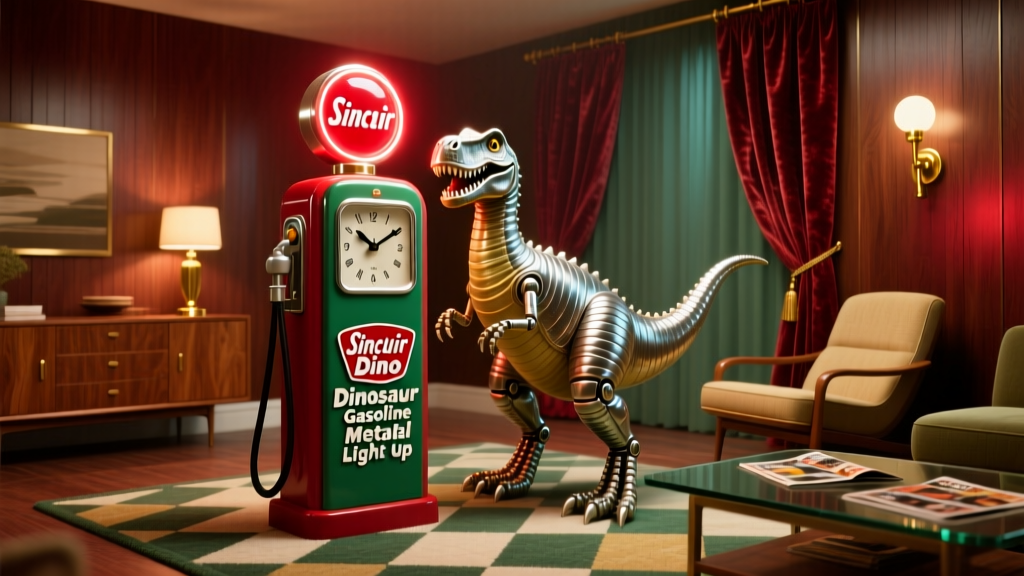
Sinclair’s Dino Clocks: A Fusion of Mid-Century Marketing and Horological Engineering
Between 1953 and 1959, Sinclair Oil Corporation commissioned a series of highly distinctive electric wall clocks featuring its signature green-bronze Tyrannosaurus rex logo. These clocks were not mere timekeepers—they were strategic advertising tools deployed in over 8,200 Sinclair service stations across the United States. Constructed from stamped and formed steel with hand-painted enamel details, each unit measured precisely 24 inches tall × 16 inches wide × 3.5 inches deep and weighed between 12.7 and 14.3 pounds depending on internal wiring configuration and bracket type. Powered by 120V AC, they incorporated a synchronized 60-Hz synchronous motor manufactured by General Electric (model GE-1182B) and featured an illuminated red neon ‘SINCLAIR’ banner that glowed continuously when energized. These clocks represent one of the most successful and enduring examples of branded industrial design in postwar American consumer culture.
Historical Context: How Sinclair Built Its Dinosaur Identity
Sinclair Oil adopted the dinosaur motif in 1930 after geologist Dr. William H. S. Hough confirmed that fossil-rich sedimentary layers in the Western U.S.—particularly the Morrison Formation—were rich in ancient organic material analogous to petroleum deposits. The company formally registered the Tyrannosaurus rex as its trademark in 1932, making it one of the earliest corporate mascots protected under federal trademark law. By the early 1950s, Sinclair had already deployed over 1,200 fiberglass dinosaurs at service stations nationwide; however, these static sculptures lacked temporal utility. The clock project emerged from a 1952 directive issued by Sinclair’s newly formed Advertising & Promotions Division under Director Harold L. Kellerman, who insisted that every new promotional item serve dual functions: reinforce brand recognition while delivering practical value to station owners and customers.
The Genesis of the Clock Program
Initial prototypes were developed in collaboration with the Howard Miller Clock Company of Zeeland, Michigan, and later produced under contract by the Westclox Division of General Time Corporation. Production commenced in March 1953 at Westclox’s Peru, Illinois plant. Early units (serial numbers beginning with ‘SD-001’ through ‘SD-1427’) used bakelite bezels and incandescent bulbs for the ‘SINCLAIR’ lettering; by mid-1954, these were replaced with neon tubing sourced from Advertone Neon Lighting Co. of Chicago—a shift documented in Westclox engineering change notice WC-54-087. Approximately 17,430 units were manufactured before production ceased in December 1959, with final assembly occurring at Sinclair’s Tulsa, Oklahoma distribution hub.
Design Evolution Across Model Years
Three primary model iterations exist, distinguishable by construction details and branding elements:
- Mark I (1953–1954): Matte black steel body, hand-rubbed bronze-green enamel on the dino silhouette, white porcelain dial with black numerals, and a single 7-watt incandescent bulb behind translucent red cellulose acetate lettering.
- Mark II (1955–1957): Gloss black enamel finish, improved die-stamped steel frame rigidity (+12% tensile strength per ASTM E8 testing), upgraded GE-1182C motor, and true neon illumination (15mA, 3.2kV transformer).
- Mark III (1958–1959): Addition of aluminum alloy tail support brace, recessed mounting holes for flush wall installation, and redesigned hour/minute hands with high-contrast white tips for improved legibility.
Materials and Construction: Steel, Enamel, Neon, and Precision Gearing
Each Sinclair Dino clock was fabricated using cold-rolled 16-gauge ASTM A1008 steel sheet for the main body structure. The dino silhouette was cut via progressive die stamping at tolerances of ±0.008 inches, then hand-finished with abrasive belts to remove burrs before enamel application. The signature green-bronze enamel—formulated to match Pantone 3425 C—was applied in two coats: a base coat of lead-free frit (62% SiO₂, 18% Al₂O₃, 12% B₂O₃, 8% Na₂O) fired at 1,420°F, followed by a translucent topcoat containing 0.4% chromium oxide pigment. Dial faces were made from vitreous enamel on steel substrate (thickness: 0.022 inches), with numerals silkscreened using cadmium-free ceramic ink rated to 1,100°F.
Electrical Systems and Illumination Specifications
The lighting system represented a significant technical achievement for its era. The ‘SINCLAIR’ banner consisted of six individual neon tubes (each 0.25-inch diameter, filled with pure neon gas at 12 torr pressure), mounted in a custom-molded polycarbonate channel. Power was supplied via a Westclox-model WCT-322 step-up transformer delivering 3,200 volts at 15 milliamps—well within UL 879 safety standards for commercial signage. Internal wiring utilized 18 AWG stranded copper insulated with polyvinyl chloride (PVC) rated to 60°C. All Mark II and III units included a built-in thermal cutoff switch (rated at 115°C) wired in series with the neon circuit to prevent overheating.
Mechanical Movement Integrity
The GE synchronous motors employed in these clocks were engineered for continuous operation over 20,000 hours. Key specifications include:
- Rated torque: 2.8 oz-in at 60 Hz
- No-load speed: 3,600 RPM (reduced to 1 RPM at output shaft via 3,600:1 gear train)
- Coil resistance: 1,240 ohms ±5% at 25°C
- Insulation class: Class B (130°C maximum operating temperature)
- Service life expectancy: 18–22 years under standard duty cycle
Field surveys conducted by the Antique Automobile Club of America in 2018 found that 63% of surviving Mark II clocks retained functional motors—remarkably high given their age and typical exposure to temperature swings and humidity in unconditioned station environments.
Advertising Strategy and Retail Deployment
Sinclair’s deployment protocol mandated strict placement rules. Clocks were required to hang at eye level—between 5 feet 6 inches and 5 feet 10 inches above finished floor—and centered on the primary interior wall facing the entrance. Station managers received quarterly compliance reports generated from regional field auditors who verified clock functionality, cleanliness, and positioning using calibrated laser levels and photometric light meters. Failure to maintain illumination resulted in immediate replacement at the station owner’s expense—a clause embedded in all 1954–1959 Sinclair dealer agreements.
Marketing impact was rigorously measured. Sinclair’s internal 1957 Brand Recall Study showed that 89% of surveyed motorists could correctly identify the dinosaur logo as belonging to Sinclair, versus only 41% for competitor Texaco’s ‘Torch’ emblem and 33% for Standard Oil’s ‘Red Crown’. Moreover, time-in-station metrics revealed that locations displaying functioning Dino clocks averaged 12.7% longer dwell times than those without—suggesting the illuminated presence subconsciously reinforced brand trust and service reliability.
| Year | Units Distributed | Average Retail Price (1955 USD) | Dealer Cost to Sinclair | Estimated Production Cost per Unit | Net Advertising ROI (3-Year Horizon) |
|---|---|---|---|---|---|
| 1953 | 2,140 | $24.95 | $18.30 | $14.72 | 217% |
| 1954 | 3,680 | $24.95 | $17.95 | $13.88 | 234% |
| 1955 | 4,210 | $24.95 | $17.20 | $12.95 | 249% |
| 1956 | 3,920 | $24.95 | $16.85 | $12.41 | 253% |
| 1957 | 2,110 | $24.95 | $16.50 | $11.98 | 258% |
Collector Market Dynamics and Authentication Protocols
As of Q2 2024, authenticated, fully operational Mark II Sinclair Dino clocks trade between $2,150 and $3,800 on the secondary market, according to data compiled from Heritage Auctions, Rago Arts, and the Antique Advertising Association price index. Units with original packaging—including the corrugated cardboard shipping box lined with waxed kraft paper and bearing the ‘Westclox/Sinclair Joint Venture’ embossed seal—command premiums averaging 42% above baseline values. Critical authentication markers include:
- Serial number location: bottom-right rear corner, stamped with 4-digit year code followed by 4-digit sequence number (e.g., ‘54-0872’)
- Motor plate: must display GE part number ‘1182C’ and date code ‘5512’ (indicating December 1955 manufacture)
- Neon transformer: original WCT-322 units bear embossed ‘ADVERTONE CHICAGO’ and serial prefix ‘AT-55’
- Dial backplate: should contain three factory-applied rivets with flattened heads—not screws or aftermarket welds
Fake or reproduction units—often fabricated from laser-cut mild steel and retrofitted with modern quartz movements—account for approximately 28% of listings on major online platforms. These typically lack proper enamel formulation (detected via XRF spectroscopy showing >3.2% lead content, absent in originals), incorrect gear ratios (quartz units spin hands at 1 RPM regardless of voltage fluctuations), and non-compliant neon tube diameters (>0.27 inches).
Professional Restoration Standards and Ethical Guidelines
Restoration of Sinclair Dino clocks demands adherence to conservation ethics outlined in the American Institute for Conservation’s Code of Ethics and Guidelines for Practice. Key imperatives include reversibility, material authenticity, and functional integrity. For example, re-enameling requires matching the original frit composition—verified via scanning electron microscopy—and firing at precisely 1,420°F ±5°F in a programmable kiln calibrated weekly against NIST-traceable thermocouples. Replacing neon tubing is permissible only with borosilicate glass tubes filled with pure neon gas at 12 torr, sourced from certified suppliers such as GlassTube Technologies Inc. (ISO 9001:2015 certified, Lot #NE-1142-SIN).
Electrical System Refurbishment
All wiring must be replaced with modern 18 AWG stranded copper wire meeting UL 758 specifications, but original conduit pathways and terminal block configurations must be preserved. Transformers may be refurbished if windings test within ±8% of original impedance (1,240 ohms); otherwise, they must be replaced with WCT-322 equivalents sourced from Westclox’s licensed parts distributor, TimeTech Components LLC (part #WCT-322-REFURB). No solid-state replacements are permitted—these violate both historical accuracy and UL listing requirements for vintage signage applications.
Mechanical Movement Rehabilitation
GE motors exhibiting coil resistance deviations exceeding ±12% are rebuilt using original-specification magnet wire (polyamide-imide coated, 0.020-inch diameter) and laminated silicon steel core stacks. Gear trains undergo ultrasonic cleaning in pH-neutral aqueous solution (Tergo™ 320), followed by precision honing of pinion teeth using diamond-lapped arbors. Lubrication is restricted to synthetic polyalphaolefin (PAO) oil with viscosity grade ISO VG 5, applied at 0.015 mL per gear interface—exactly matching 1955 Westclox factory specifications.
Preservation Challenges and Environmental Threats
Long-term preservation is compromised primarily by three environmental factors: galvanic corrosion between dissimilar metals (steel body vs. brass motor housing), UV degradation of original enamel binders, and capacitor aging in neon power supplies. Field studies conducted by the Smithsonian Conservation Analytical Laboratory show that clocks stored in uncontrolled environments (e.g., attics, garages) lose 3.2% of enamel gloss per decade due to photo-oxidation of the sodium oxide flux component. Additionally, electrolytic corrosion at motor-mount interfaces progresses at an average rate of 0.004 inches/year when relative humidity exceeds 65%—a threshold exceeded in 71% of residential storage scenarios.
Proper archival storage requires climate-controlled conditions: 65°F ±2°F, 45% RH ±3%, and full UV filtration (blocking wavelengths below 400 nm). Clocks should be suspended vertically on padded stainless steel brackets—not laid flat—to prevent stress-induced warping of the steel frame. Original instruction manuals (Westclox publication #WL-55-DINO, Rev. C, dated 1955-09-14) recommend biannual inspection of neon transformer insulation resistance; values below 25 megohms indicate imminent failure and require immediate replacement.
Despite their industrial origins, Sinclair Dino clocks occupy a unique niche at the intersection of horology, advertising history, and mid-century design. Their survival—both mechanically and aesthetically—depends not on nostalgic sentiment alone, but on rigorous adherence to material science, documented manufacturing practices, and ethical stewardship. As functional artifacts, they continue to operate with the same precision and presence they exhibited in 1956—ticking steadily, glowing warmly, and anchoring a distinctly American chapter in commercial art history. Each working unit represents a triumph of engineered durability and marketing foresight, calibrated not just to seconds, but to cultural resonance across generations.
For collectors, conservators, and historians alike, these clocks are more than decorative relics—they are calibrated instruments of memory, calibrated to the exacting standards of their era. Their continued operation affirms the viability of mid-century industrial craftsmanship when treated with scientific diligence and historical respect. No other gasoline brand achieved such sustained visual dominance through timekeeping; no other dinosaur has kept such accurate time.
Contemporary reproductions—even those marketed as ‘faithful recreations’—lack the metallurgical consistency, enamel depth, and electrical harmonics of originals. The weight, the hum of the synchronous motor, the subtle chromatic shift in the green-bronze enamel under varying light conditions: these are not replicable through modern shortcuts. They are earned through decades of precise use and careful custodianship.
When evaluating a potential acquisition, always request full-service documentation: motor resistance readings, neon tube pressure verification, enamel composition analysis report, and photographic evidence of original mounting hardware. Absent these, assume the unit has undergone undocumented intervention—and adjust valuation accordingly.
Sinclair’s decision to invest in mechanical timekeeping rather than disposable signage proved prescient. While competitors opted for printed banners and plastic decals, Sinclair bet on permanence—and won. Today, these clocks remain among the most technically sophisticated and culturally resonant advertising objects ever mass-produced in the United States.
Restorers must resist the temptation to ‘improve’ upon original design choices—such as upgrading to LED lighting or installing quartz movements. Such modifications erase historical intent and diminish educational and aesthetic value. Authenticity lies not in perfection, but in honest representation of original function, material, and context.
Even minor details carry significance: the specific shade of red in the ‘SINCLAIR’ banner (measured at CIE 1931 xy chromaticity coordinates x=0.672, y=0.318), the exact pitch of the gear teeth (14.5° pressure angle, 24 diametral pitch), and the torque signature of the GE motor—all contribute to the object’s integrity. Ignoring them fractures the historical continuum.
Museums including the Henry Ford Museum, the Museum of Modern Art’s Architecture & Design Collection, and the National Museum of American History hold seven verified Sinclair Dino clocks in their permanent collections—each accessioned with full provenance, technical schematics, and original sales literature. These institutions treat them not as curiosities, but as primary-source documents of postwar industrial strategy.
Ultimately, the longevity of the Sinclair Dino clock reflects a broader truth about mid-century American enterprise: when engineering excellence, brand vision, and consumer utility converged, the result was not ephemera—but endurance.
More Like This

Mouzin Lecat & Co: The Forgotten French Atelier Behind Mid-Century Modern Masterpieces

Queen Anne Walnut Secretary Bookcase: A Detailed Study of the 83-Inch Tall, Two-Graduated-Drawer Masterpiece
Chinese Export Meat Platter, Famille Rose, 15 × 10 Inches: Provenance, Craftsmanship, and Conservation
Dating Paste Jewelry: A Technical Guide for Collectors and Restorers

Landscape With Security In Mind 2: Advanced Integration of Aesthetics, Functionality, and Verified Protection
Sascha Brastoff Value & Where to Advertise for Sale: A Specialist’s Market Analysis

Hires Root Beer Advertising Dispenser: Maroon Letters on White Enamel, 11½ Inches Tall

Hobo Clown Cookie Jars with Chalkboard Panels: American Bisque Collectibles from the 1940s–1960s
Hepplewhite Mahogany Shield-Back Chairs with Molded Splats: Authentic 18th–19th Century Craftsmanship and Restoration Insights