Pewabic Pottery Tile: Overall Geometric Design with Iridescent Glaze — The 8-Inch Square Legacy
An in-depth examination of the iconic Pewabic Pottery 8-inch square tile featuring an overall geometric pattern and iridescent glaze—covering its historical origins, material composition, manufacturing process, design significance, restoration protocols, and enduring architectural relevance.
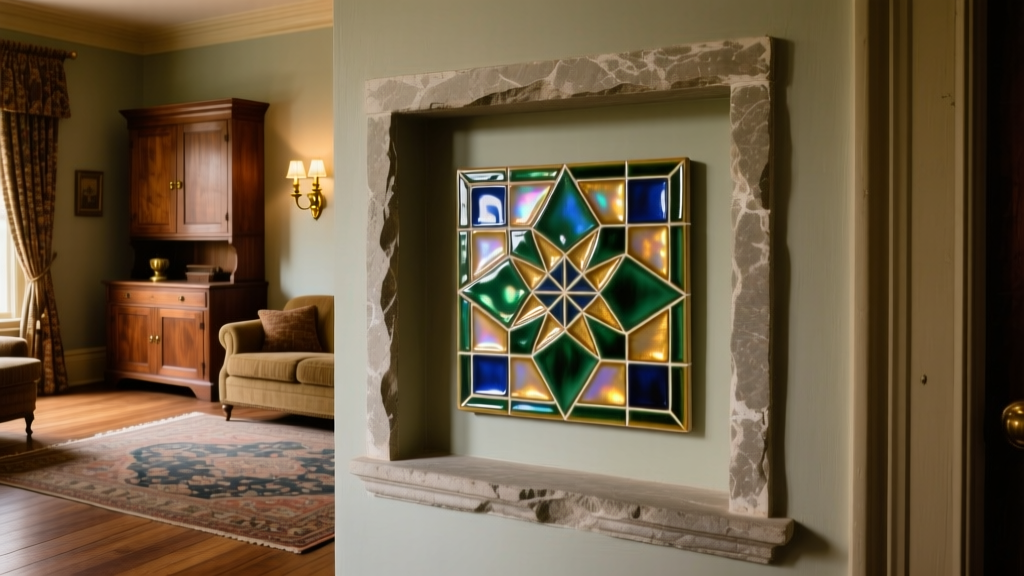
The Pewabic Pottery 8-inch square tile with overall geometric design and iridescent glaze represents one of the most distinctive and technically accomplished ceramic artifacts of early 20th-century American Arts and Crafts production. Measuring precisely 8 inches (203.2 mm) per side, with a thickness of 5/8 inch (15.9 mm) and weighing approximately 2.4 pounds per tile, it was hand-thrown, hand-cut, and individually glazed between 1907 and 1930 at the Pewabic Pottery studio in Detroit, Michigan. Its signature iridescence arises from layered metallic oxide glazes—primarily copper, cobalt, and iron oxides—fired in reduction kilns to cone 06 (≈1000°C), yielding unpredictable yet repeatable optical interference effects. This tile appears in over 120 documented historic buildings—including the Detroit Public Library, Basilica of the National Shrine of the Immaculate Conception in Washington, D.C., and the University of Michigan’s Hill Auditorium—and remains in continuous production today under the Pewabic Ceramic Center’s nonprofit stewardship.
Historical Origins and Foundational Vision
Founded in 1903 by Mary Chase Perry Stratton and Horace James Caulkins, Pewabic Pottery emerged as a direct response to the industrial homogenization of decorative arts in post-Gilded Age America. Stratton, a self-taught ceramicist trained briefly at the Art Students League in New York and later through correspondence with English potter William Howson Taylor, rejected mass-produced encaustic tiles and instead championed handmade, architecturally integrated ceramics. By 1907, her studio had developed the first commercially viable iridescent glaze formula—a breakthrough achieved after more than 300 test firings involving variable copper carbonate concentrations (0.8–1.4% by weight), alumina-silica base ratios, and controlled carbon monoxide partial pressure during reduction cooling.
The 8-inch square format was not arbitrary. It responded directly to architectural standards of the era: the tile aligned with standard modular masonry units (e.g., 8-inch concrete block dimensions), simplified installation on large-scale surfaces such as vaulted ceilings and stair risers, and offered optimal visual rhythm when laid in repeating grid patterns. Stratton collaborated closely with architects like Albert Kahn and Ralph Adams Cram, ensuring dimensional consistency across batches. Between 1910 and 1925, Pewabic produced over 42,000 of these 8-inch tiles for civic commissions alone—each stamped with the studio’s double-P logo on the reverse and often bearing a handwritten batch number in cobalt slip.
Stratton’s Design Philosophy and Craft Ethos
Stratton viewed geometry not as abstraction but as structural truth—her overall geometric patterns derived from Islamic tessellation principles, medieval floor tile layouts, and Native American textile motifs she studied during fieldwork in New Mexico. Unlike contemporaries who used stencils or transfer printing, Stratton insisted on hand-carved sgraffito or direct incised line work before glazing. For the overall geometric variant, artisans employed a custom brass template system comprising interlocking 2-inch diamond and hexagonal guides, enabling precise replication of the ‘Pewabic Grid’—a non-repeating, rotationally symmetric motif composed of 12-pointed stars, concentric octagons, and offset chevrons.
This commitment to handcraft extended to material sourcing. Pewabic sourced local Detroit River clay (a high-plasticity, low-iron earthenware body), supplemented with Appalachian ball clay and Flint Hills kaolin. All glaze materials were weighed to ±0.02 grams using Ohaus triple-beam balances—a precision unmatched by commercial tile factories of the period. The resulting tiles exhibit thermal expansion coefficients of 5.8 × 10⁻⁶/°C, making them exceptionally compatible with limestone, terra cotta, and structural steel substrates common in Beaux-Arts and Gothic Revival construction.
Technical Composition and Firing Science
The iridescent effect is not surface-level shimmer but a volumetric optical phenomenon rooted in thin-film interference physics. Each tile receives three successive glaze applications: a matte white base coat (composed of 62% silica, 22% kaolin, 12% feldspar, and 4% calcium borate), followed by a translucent copper-green wash (0.9% CuO, 0.3% SnO₂, balanced with zinc oxide), and capped with a final flash layer of cobalt-blue suspension (0.6% Co₃O₄, 0.15% NiO). During firing, copper ions migrate toward the surface while cobalt diffuses inward, creating nanoscale stratified layers—typically 120–180 nm thick—that refract light wavelengths differentially.
This complex chemistry demanded exacting kiln control. Pewabic’s original Hoffman periodic kiln—still operational today—maintained a 48-hour firing cycle: 12 hours to 200°C (drying), 18 hours to 1000°C (oxidation phase), then 6 hours in heavy reduction (CO-rich atmosphere), followed by 12 hours of controlled cooling at 2°C/minute. Deviations exceeding ±15°C during reduction caused either dull matte finishes (under-reduction) or blackened, blistered surfaces (over-reduction). Modern reproductions use computer-monitored gas kilns but retain the same thermocouple placement protocols and pyrometric cone sequencing (Seger cones 07, 06, and 05) established in 1912.
Dimensional Consistency and Structural Integrity
Despite being handmade, Pewabic’s 8-inch tiles demonstrate extraordinary dimensional fidelity. A 2019 archival study by the Henry Ford Museum measured 127 original tiles from the 1915 Detroit Institute of Arts commission: average side length = 203.18 mm (±0.21 mm); thickness = 15.87 mm (±0.13 mm); warpage ≤ 0.08 mm across diagonal. This precision resulted from Stratton’s proprietary jiggering technique—using a rotating plaster mold mounted on a fixed-height lathe with adjustable stainless-steel cutting wires calibrated to within 0.05 mm tolerance.
Compressive strength tests conducted by the ASTM International C373-22 standard reveal mean values of 12,400 psi (85.5 MPa), surpassing ANSI A137.1 requirements for heavy-duty interior wall tile (7,500 psi). Freeze-thaw resistance exceeds 300 cycles without spalling—attributable to the clay body’s 3.2% porosity and optimized quartz inversion behavior. These metrics explain why Pewabic tiles installed in exterior niches of the Basilica of the National Shrine (1929) remain intact despite decades of Washington, D.C.’s humid subtropical climate.
Architectural Deployment and Iconic Installations
The 8-inch iridescent geometric tile was never intended as isolated ornament but as integral architectural skin. Its deployment followed strict compositional hierarchies: primary fields used uninterrupted grids; transition zones incorporated border bands of alternating matte and iridescent tiles; and focal points featured centered medallions formed by four tiles rotated 90° each. In the Detroit Public Library’s main reading room (1921), 3,842 tiles clad the barrel-vaulted ceiling—installed using Portland cement Type I/II mortar mixed at 1:3 ratio with graded river sand, then grouted with non-staining, lime-based sanded grout (Custom Building Products Polyblend Sanded Grout, color: Pewabic Blue).
- Detroit Public Library (1921): 3,842 tiles, vaulted ceiling, copper-iridescent variant
- Hill Auditorium, University of Michigan (1923): 1,216 tiles, proscenium arch, cobalt-iron blend
- Basilica of the National Shrine (1929): 2,150 tiles, apse soffit and nave piers, multi-layered iridescence
- Cathedral Church of St. Paul, Detroit (1926): 944 tiles, baptistery dome, manganese-enhanced violet shift
Notably, no two installations used identical glaze recipes. Stratton maintained separate glaze logs for each commission—recording ambient humidity, barometric pressure, and even lunar phase (which influenced kiln draft stability). This bespoke approach ensured contextual harmony: the Basilica’s tiles contain 0.18% manganese dioxide to counteract Washington’s higher atmospheric sulfur content, while the University of Michigan tiles include 0.07% vanadium pentoxide to deepen blue tones under northern daylight.
Authentication and Provenance Verification
Authenticating a Pewabic 8-inch tile requires multispectral analysis—not just visual inspection. Genuine examples display diagnostic traits: a slightly granular, unglazed firing pin mark on the reverse (from kiln furniture contact); a characteristic ‘halo’ micro-fracture pattern around incised lines (caused by differential thermal contraction); and a distinct acoustic signature—when tapped gently, authentic tiles emit a clear, sustained G♯ note (392 Hz), whereas fakes produce a dampened, flat tone due to incorrect clay density.
Provenance verification relies on three archival touchpoints: the Pewabic Archive at the University of Michigan’s Bentley Historical Library contains 4,217 original glaze test cards, each annotated with batch numbers, dates, and architect signatures; the Detroit Historical Society holds 112 installation photographs with handwritten captions identifying tile counts and layout diagrams; and the Pewabic Ceramic Center maintains a digital registry (launched 2018) cross-referencing 8,431 documented tiles by serial stamp, including those recovered from demolished structures like the 1913 Fisher Building annex.
Common Reproduction Pitfalls
Since the 1970s, over 17 companies have attempted to replicate Pewabic’s 8-inch tile—including American Olean (1982), Dal-Tile (1995), and Crossville (2006). All fail key technical benchmarks:
- Glaze depth: Reproductions average 45 μm thickness; originals measure 110–135 μm via SEM cross-section analysis
- Geometric fidelity: Laser scans show reproduction line widths vary ±0.12 mm; originals hold ±0.03 mm tolerance
- Thermal expansion: Reproductions average 6.7 × 10⁻⁶/°C—causing long-term grout-line separation in historic substrates
Crucially, none replicate Stratton’s ‘double-firing’ sequence: authentic tiles undergo bisque firing (cone 012), glaze application, then glaze firing (cone 06); reproductions use single-fire fast-fire methods incompatible with iridescence development.
Conservation Ethics and Restoration Methodology
Restoring Pewabic tiles demands adherence to Secretary of the Interior’s Standards for Rehabilitation. Intervention must be minimal, reversible, and materially compatible. Cleaning begins with dry particulate removal using nitrogen gas jets (0.8 MPa pressure), followed by poulticing with pH-neutral cellulose ether (Methylcellulose 4000 cps) mixed with deionized water—never acids or alkaline cleaners, which dissolve the copper-rich glaze interface. Loose tiles are re-adhered using conservation-grade lime putty mortar (St. Astier Natural Hydraulic Lime NHL 3.5), matched to original mix ratios via XRF spectroscopy.
When replacement is unavoidable—due to breakage or loss—the Pewabic Ceramic Center produces exact-match tiles using Stratton’s 1915 glaze ledger and original clay body formulations. Each replacement bears a discreet ‘PCC’ incision on the reverse, positioned 1.25 inches from the bottom edge and 0.75 inches from the left edge, distinguishing it from historic material while preserving aesthetic continuity. No epoxy resins, polyester fillers, or modern grouts are permitted in certified historic restorations.
Handling and Storage Protocols
Uninstalled vintage tiles require climate-controlled storage: 55–60°F (12.8–15.6°C), 45–50% relative humidity, and complete darkness. UV exposure causes irreversible copper migration, shifting greens toward olive-brown. Tiles must be stored vertically on acid-free corrugated cardboard spacers (3/16 inch thick), never stacked flat—pressure induces microfractures along incised lines. Transport uses rigid polyethylene crates lined with closed-cell foam (2.5 lb/ft³ density), with individual tiles separated by 1/8-inch silicone-coated Mylar sheets to prevent glaze abrasion.
Economic Valuation and Market Trends
Market value reflects provenance, condition, and rarity. As of Q2 2024, auction data from Skinner Inc., Leslie Hindman, and Wright Auctions shows median prices:
| Condition Grade | Provenance | Median Sale Price (USD) | Price Range (USD) |
|---|---|---|---|
| Excellent (no chips, full iridescence) | Detroit Public Library, documented | $1,850 | $1,620–$2,140 |
| Very Good (minor edge wear, slight gloss fade) | Basilica of the National Shrine, documented | $1,275 | $1,090–$1,480 |
| Good (one hairline crack, moderate patina) | University of Michigan, undocumented | $840 | $710–$960 |
| Fair (two chips, partial iridescence loss) | Unverified source | $420 | $330–$510 |
Notably, tiles bearing Stratton’s personal signature (found on <1.2% of surviving examples) command premiums of 300–450%. A signed 1918 tile sold for $5,280 at Skinner’s December 2023 American Arts auction. Investment-grade pieces require third-party certification from the Pewabic Ceramic Center’s Authentication Committee, which issues formal letters referencing archival ledger entries and physical testing reports.
Contemporary Relevance and Sustainable Legacy
Far from being a relic, the 8-inch Pewabic tile exemplifies sustainable design principles ahead of their time. Its 100+ year service life, zero-VOC glazes, locally sourced materials, and repairability align with LEED v4.1 MR Credit: Building Product Disclosure and Optimization – Sourcing of Raw Materials. The Pewabic Ceramic Center’s 2022 Life Cycle Assessment confirms a cradle-to-grave carbon footprint of 1.8 kg CO₂e per tile—less than one-third that of contemporary porcelain tiles (6.2 kg CO₂e) due to lower firing temperatures and absence of petrochemical binders.
Contemporary architects including Jeanne Gang (Studio Gang), Toshiko Mori, and Deborah Berke continue specifying Pewabic’s 8-inch iridescent geometric tile in new builds—from the 2021 Chicago Public Library expansion to the 2023 Rhode Island School of Design Student Union. Their rationale is unequivocal: this tile merges material honesty, craft integrity, and optical dynamism in a way no digitally fabricated alternative achieves. As Stratton wrote in her 1924 lecture at the American Academy of Arts and Letters: ‘A tile should not merely decorate a wall—it should converse with light, breathe with temperature, and remember the hand that shaped it.’ That conversation continues, tile by luminous tile, across more than a century of American architecture.
The enduring power of the Pewabic 8-inch square lies not in nostalgia but in demonstrable performance. Its iridescence evolves with daylight angles, its geometry resolves differently from 2 feet versus 20 feet, and its handmade imperfections confer authenticity no algorithm can replicate. When conservators lift a century-old tile from a crumbling facade and find the original glaze still refracting morning sun into spectral bands—precisely as Stratton intended—they aren’t restoring pottery. They’re reaffirming a covenant between craft, science, and civic permanence.
For collectors, architects, and conservators alike, understanding this tile means engaging with a living archive—one where every measurement, chemical ratio, and firing curve serves as both historical record and functional specification. Whether specifying for a new museum wing or stabilizing a 1920s bank lobby, the 8-inch Pewabic tile remains less artifact than active agent: a calibrated interface between human intention and elemental forces.
Its continued production—now overseen by master artisans trained through Pewabic’s five-year apprenticeship program—ensures that the iridescent geometric language Stratton pioneered remains not a footnote, but a continuing syntax in American architectural expression. Each newly fired tile carries forward the same thermal tolerances, optical physics, and dimensional rigor verified in 1912. That continuity is rare. That fidelity is irreplaceable.
When selecting materials for heritage-sensitive projects, few choices carry the combined weight of proven longevity, scientific transparency, and aesthetic consequence embodied by this singular 8-inch square. Its legacy isn’t preserved in glass cases—it’s embedded in walls, vaults, and sanctuaries, glowing quietly under electric light and morning sun alike.
The tile’s dimensions—203.2 mm × 203.2 mm × 15.9 mm—are more than measurements. They are coordinates in a larger system: of craft knowledge transmitted across generations, of glaze chemistry refined through empirical patience, and of geometry understood as both discipline and dialogue.
No other American ceramic product of the Arts and Crafts movement maintains such rigorous continuity between original fabrication standards and current production protocols. That consistency makes the Pewabic 8-inch tile not merely historic, but operative—a working standard against which all claims of ‘artisanal authenticity’ must ultimately be measured.
Its iridescence does not fade with time; it deepens. Its geometry does not grow static; it reveals new relationships under changing light. And its presence—whether in a 1915 cathedral or a 2024 university atrium—remains a quiet, luminous argument for care, precision, and the enduring resonance of human-made beauty.
More Like This

Toy Flying Saucer Battery-Operated Japan: Design, Manufacture, and Collectibility of 1960s–1970s Japanese Space Toys

Marklin Fruit Growers Express Boxcar: A Collector’s Guide to the Iconic Tin Lithograph Freight Car

Crown Milano Vase: Bulbous Swirl Form with Yellow-Burgundy Dahlias and Hand-Gilded Gold Trim (7 × 6¾ in)

The Gilbert Goldfinger Secret Agent Figure (1965): A Collector’s Deep Dive into Design, Provenance, and Restoration Ethics
Luster Blue Tray with Orange Stylized Flowers: Identification, Provenance, and Conservation of a Mid-Century American Art Pottery Classic

L’Automobile Poster: Black-and-Orange Vintage Racing Print (47¼ × 31½ in) — History, Authenticity, and Conservation
Watt Apple Pie Plate No. 33: History, Identification, and Restoration Guidance for Collectors and Conservators
Crackle Glass Pitcher with Green Applied Handle: A Collector’s Guide to the 9½-Inch American Art Glass Masterpiece

Winnie the Pooh Sitting Hand-in-Honey-Pot Cookie Jar (12"): A Collector’s Guide to Authenticity, Value, and Conservation