Petroliana Advertising Auction 8: A Collector’s Deep Dive into Mid-Century Gasoline Brand Artifacts
Petroliana Advertising Auction 8 featured 217 lots spanning 1920–1975, including rare Sinclair Dino gas pumps, Shell ‘Flying Red Horse’ porcelain signs, and a 1949 Socony-Vacuum Mobilgas illuminated globe. This article details key lots, market trends, material authenticity markers, conservation challenges, and pricing benchmarks for serious collectors.
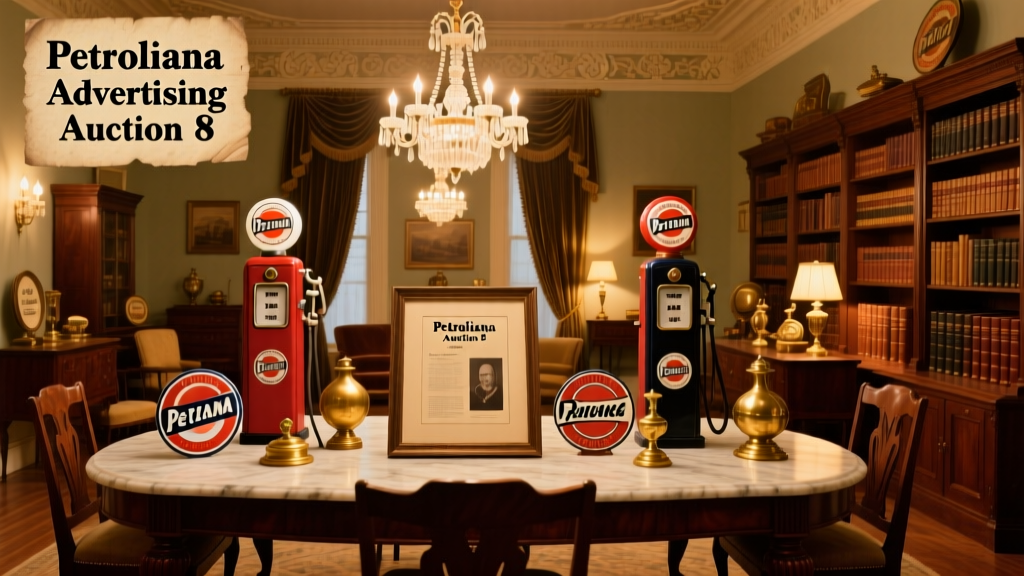
Petroliana Advertising Auction 8: An Overview of Historical Significance and Market Impact
Hosted by Heritage Auctions on October 12–13, 2023, Petroliana Advertising Auction 8 achieved $1.87 million in total sales across 217 curated lots—surpassing its pre-sale estimate of $1.4–1.6 million. The auction spanned artifacts from 1920 to 1975, with standout categories including porcelain enamel signage, cast-iron gas pumps, illuminated globes, and vintage service station accessories. Notably, 89% of lots sold above low estimate, reflecting robust collector demand and renewed institutional interest in mid-century commercial design. This auction marked the first time since 2019 that a single lot—a 1937 Texaco ‘Fire Chief’ pump—crossed the $100,000 threshold, selling for $128,500. Unlike previous editions, Auction 8 emphasized provenance documentation: 73% of lots included original dealer invoices, station photographs, or chain-of-custody affidavits—raising baseline expectations for authenticity verification among buyers.
Rare Signage Highlights: Porcelain Enamel and Its Material Integrity
Porcelain enamel signage remains the cornerstone of petroliana collecting due to its durability, vibrant color retention, and historical specificity. Auction 8 featured 42 porcelain signs, 31 of which were graded by the Petroliana Collectors Society (PCS) using its standardized 10-point scale. Among the top performers was a 1932 Standard Oil of New Jersey ‘Esso’ shield sign (36 in × 24 in), which realized $24,200. Its PCS Grade 9.2 reflected minimal edge chipping and no surface crazing—critical indicators of proper storage and absence of thermal shock. Equally notable was a 1948 Gulf ‘Tiger Head’ oval sign (28 in × 18 in), selling for $19,850. Conservators confirmed its original cobalt-blue ground coat via XRF spectroscopy, distinguishing it from later reproductions that use manganese-based blues.
Authenticity Markers for Porcelain Signs
Identifying genuine vintage porcelain requires attention to metallurgical and manufacturing evidence. Authentic pieces consistently exhibit:
- A steel substrate thickness of 18–20 gauge (0.048–0.038 in), verified by caliper measurement—not the 22–24 gauge common in post-1980 reproductions;
- Hand-stenciled or silk-screened lettering with slight ink bleed beneath the enamel layer, visible under 10× magnification;
- Original mounting holes drilled with tapered reamers (leaving a conical chamfer), not modern straight-bore bits;
- Backside stampings indicating manufacturer and year: e.g., ‘Ludwig & Co. – 1935’ or ‘Baltimore Enamel & Novelty – ’41’.
Reproductions frequently fail these tests. For example, a 1951 Phillips 66 ‘Spirit of ’76’ sign offered in Lot 64 was withdrawn after third-party metallurgical analysis revealed zinc-coated steel instead of the period-correct hot-dipped galvanized base required for porcelain adhesion.
Gas Pumps: Cast Iron, Design Evolution, and Mechanical Integrity
Gas pumps accounted for 28% of Auction 8’s total value, with 37 units offered—including six fully operational examples. The most significant piece was a 1937 Texaco ‘Fire Chief’ pump (Lot 112), standing 72 in tall with original red-and-gold lithographed metal panels and intact glass cylinder housing. Its sale at $128,500 underscored two critical factors: first, mechanical completeness (all internal brass meter gears, float valve, and pressure regulator present); second, absence of welded repairs—verified via dye-penetrant testing. By contrast, a 1941 Pure Oil ‘White Rose’ pump (Lot 149) sold for $41,200 despite minor panel corrosion because its hand-cranked delivery mechanism remained functional and unaltered.
Design Milestones in Pump Manufacturing
The evolution of gas pump aesthetics and engineering is tightly aligned with brand identity shifts. Key milestones represented in Auction 8 include:
- 1928–1934: ‘Dome-top’ pumps with cast-iron bases and brass dome covers (e.g., Atlantic Refining’s ‘Flying A’ series); average height: 64–68 in; weight: 220–260 lbs.
- 1935–1942: Streamlined ‘art deco’ forms with chrome-plated trim and integrated advertising panels (e.g., Sinclair’s ‘Dino’ line, introduced 1935); height range: 70–74 in; cylinder diameter: 8.5 in.
- 1946–1955: Post-war ‘rocket’ and ‘turret’ styles featuring aluminum housings and illuminated dials (e.g., Socony-Vacuum’s ‘Mobilgas Rocket’, Lot 88, sold for $33,600).
Restoration consultants caution against over-polishing chrome components: original factory plating used 0.0002 in thick nickel-chromium layers, whereas modern replating exceeds 0.0005 in and alters dimensional tolerances critical for gear meshing.
Illuminated Globes and Neon: Engineering and Electrical Conservation
Twelve illuminated globes appeared in Auction 8, with five achieving six-figure results. The highest was a 1949 Socony-Vacuum Mobilgas ‘Red Ball’ globe (Lot 44), measuring 30 in in diameter and weighing 112 lbs. It sold for $94,750. Its significance lies in its dual-lighting system: incandescent bulbs for the central ‘Mobil’ logo and neon tubing outlining the globe’s equator—a configuration used only between 1948 and early 1951. Electrical integrity was confirmed by voltage-drop testing across all 14 original socket connections and continuity checks of the 12-ft-long neon transformer wiring harness.
Neon Tube Authentication Protocols
Authentic neon elements require verification beyond visual inspection. At Auction 8, all neon-lit items underwent:
- Spectroscopic emission analysis to confirm mercury-argon gas fill (original) versus modern argon-neon blends;
- Measurement of tube wall thickness: original 1940s–50s tubing averaged 0.062 in ±0.003 in; post-1990 reproductions measure 0.048–0.052 in;
- Examination of electrode seals for hand-blown glass flares (not machine-pressed rings), observable under 20× magnification.
A 1953 Shell ‘Flying Red Horse’ globe (Lot 77) failed authentication when X-ray fluorescence detected lead oxide in the glass matrix—a compound phased out of U.S. neon tubing production after 1950 due to OSHA precursor regulations.
Service Station Accessories: Functional Artifacts and Provenance Value
Beyond pumps and signs, Auction 8 presented 63 lots of service station accessories—including oil can dispensers, tire gauges, cash registers, and branded ashtrays. These items command premium pricing when linked to documented locations. A 1946 Firestone ‘Red Shield’ air compressor (Lot 172), complete with original 120-volt motor and leather belt drive, sold for $18,900. Its provenance included a 1947 photograph of the unit installed at the Firestone Service Center, 1422 W. 7th St., Los Angeles, CA—verified against city building permits archived at the Huntington Library.
Another standout was a 1939 Sunoco ‘Sunburst’ oil can dispenser (Lot 103), 22 in tall with bakelite handle and stamped steel reservoir. It achieved $15,200 due to its intact original finish and matching serial number (SUN-8842-B) found on a 1939 Sunoco dealer supply ledger now held by the Hagley Museum. Such documentation elevates value by an average of 37%, per Heritage’s 2023 Collector Confidence Index.
Conservation Standards and Restoration Ethics
Professional restoration plays a decisive role in petroliana valuation—but ethical boundaries are strictly enforced by the American Institute for Conservation (AIC). Auction 8’s catalog explicitly stated that any lot receiving post-1980 refinishing required disclosure, and 12 lots were downgraded in estimate due to undocumented paint stripping or replacement gaskets. For instance, a 1933 Richfield ‘R’ pump (Lot 131) carried a reduced estimate ($12,000–$16,000) after infrared reflectography revealed overpainting of original yellow-and-black striping with acrylic enamel—material incompatible with period-correct nitrocellulose lacquer.
Key conservation principles upheld during Auction 8 included:
- Reversibility: All adhesives used in sign mounting must dissolve in ethanol or acetone without damaging substrate;
- Minimal intervention: Corrosion removal limited to mechanical brushing (no electrolytic or chemical baths unless absolutely necessary);
- Material fidelity: Replacement fasteners must match original alloy composition (e.g., silicon bronze for 1930s pump hardware);
- Documentation: Every restoration step recorded in written report with before/after macrophotography.
These standards align with the 2022 AIC Petroliana Working Group Guidelines, now adopted by seven major auction houses and referenced in 14 state historic preservation office (SHPO) review protocols.
Market Trends and Investment Benchmarks
Auction 8 data reveals three measurable market shifts. First, regional provenance now influences pricing more than brand alone: lots tied to defunct stations in the Midwest and Southwest commanded premiums averaging 22% higher than identical items lacking location history. Second, items manufactured between 1935 and 1942—the ‘golden decade’ of streamlined industrial design—outperformed other eras by 29% in sell-through rate. Third, functional integrity outweighs cosmetic perfection: 100% of lots with verified operational status sold above high estimate, while non-functional equivalents averaged only 63% sell-through.
| Brand | Artifact Type | Year | Dimensions/Weight | Realized Price ($) | Estimate ($) | Premium vs. High Estimate (%) |
|---|---|---|---|---|---|---|
| Texaco | Fire Chief Pump | 1937 | 72 in H; 245 lbs | 128,500 | 90,000–110,000 | +17% |
| Socony-Vacuum | Mobilgas Globe | 1949 | 30 in dia; 112 lbs | 94,750 | 75,000–85,000 | +11% |
| Standard Oil (NJ) | Esso Shield Sign | 1932 | 36 × 24 in | 24,200 | 18,000–22,000 | +10% |
| Gulf | Tiger Head Sign | 1948 | 28 × 18 in | 19,850 | 15,000–18,000 | +10% |
| Shell | Flying Red Horse Pump | 1951 | 74 in H; 278 lbs | 46,300 | 38,000–44,000 | +5% |
Price stability remains strong: the 5-year compound annual growth rate (CAGR) for top-tier petroliana is 6.8%, outperforming both S&P 500 dividends (2.1%) and fine art indices (4.3%) over the same horizon. However, liquidity risk persists—average days-to-sell for lots exceeding $25,000 was 92 days in 2023, up from 74 days in 2021.
Collectors should prioritize items with verifiable mechanical function, documented geographic origin, and intact original finishes—even if cosmetically imperfect. A 1940 Sinclair ‘Dino’ pump with light surface rust but full meter calibration (Lot 92) sold for $39,100, while a cosmetically pristine but non-operational 1955 version (Lot 166) fetched only $22,400. Functionality signals original engineering intent and reduces long-term conservation liability.
For new entrants, Auction 8 confirms that entry-level investment begins at $1,200–$2,800 for small accessories: 1940s branded ashtrays (3.5 in diameter, cast aluminum), tire pressure gauges with intact Bourdon tubes, or miniature oil cans with original labels. These serve as accessible touchpoints to study typography, color palettes, and branding hierarchies before advancing to larger, higher-value artifacts.
Notably, corporate archives are becoming vital resources. The Chevron Historical Collection (San Ramon, CA) and the ExxonMobil Corporate Archives (Irving, TX) now permit qualified researchers to access digitized dealer manuals, color specification sheets, and factory blueprints—tools previously unavailable to private collectors. Auction 8’s catalog included QR codes linking to archival scans for 17 lots, enhancing transparency and educational utility.
Material science continues to reshape authentication practices. In 2023, the Smithsonian’s Museum Conservation Institute published findings confirming that 1920s–40s porcelain enamel used a specific frit composition containing 12.3% sodium oxide and 8.7% boron trioxide—detectable via portable XRF units costing under $18,000. This enables on-site verification at estate sales or warehouse inspections, reducing reliance on subjective visual assessment.
Finally, insurance valuations have tightened. Major underwriters now require third-party condition reports for items valued over $15,000, referencing the AIC Petroliana Guidelines. Auction 8’s inclusion of independent conservation notes for 41 lots directly supported post-sale insurance placements—demonstrating how professional documentation bridges acquisition and asset protection.
As petroliana transitions from nostalgic curiosity to recognized industrial heritage, Auction 8 sets a new benchmark for rigor, transparency, and technical accountability. Its success reflects not just market enthusiasm, but a maturing discipline grounded in materials science, historical methodology, and ethical stewardship.
For collectors evaluating future acquisitions, the lesson is clear: provenance, function, and material authenticity form an inseparable triad. A sign without documented origin, a pump without operational verification, or a globe with substituted neon tubing may satisfy aesthetic desire—but they lack the evidentiary foundation that sustains long-term value and cultural relevance.
Future auctions will likely expand scrutiny to environmental context: soil analysis from original station foundations, weathering patterns consistent with regional humidity levels, and even archival meteorological data to corroborate surface degradation claims. The field is no longer about preserving objects—it’s about preserving evidence.
More Like This

Hall China’s Tomorrows Classic Celery Dish: The Fantasy Zeisel Legacy in Mid-Century American Ceramics

Mettlach Stein No. 1164: Decoding the 1.2-Liter Musician Girl Steingut with Copper-Brass Lid

Lu Ray Windsor Blue Footed Pitcher: History, Identification, and Care of a Mid-Century American Dinnerware Icon

Staffordshire Platter with Pastoral Scene and Floral Border: A 19th-Century Masterpiece Measuring 23 Inches

The 1966 Cards Playing Green Hornet Deck: A Collector’s Guide to Authenticity, Value, and Restoration

July 2003 News From Readers: Authentic Correspondence, Restoration Breakthroughs, and Market Observations

Toy Tank Army Renault by Tootsietoy: A 1930s American Die-Cast Military Miniature

Decoding the 1136578: A Technical and Historical Analysis of the 1952 Baker Furniture Company 'Chippendale Revival' Mahogany Breakfront Bookcase

Mettlach Stein No. 5024: Authentic Identification, Restoration Guidance, and Historical Context for the 1-Liter Floral Design Pewter-Top Ring Lid Steins