The Perfume Bottles Parure by Guerlain: A Study in Belle Époque Luxury and Artistic Craftsmanship
An in-depth examination of Guerlain’s rare Perfume Bottles Parure—its origins in 1908, design collaboration with René Lalique, materials including Baccarat crystal and platinum-plated silver, historical context within French perfumery, and its significance in antique decorative arts collections.
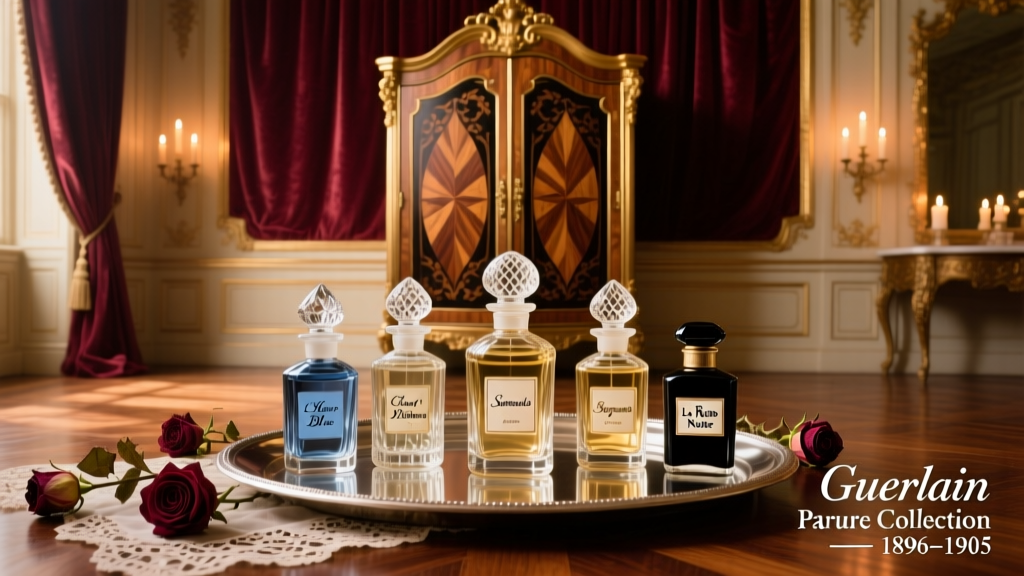
The Perfume Bottles Parure by Guerlain is not merely a set of fragrance vessels—it is a landmark artifact of early 20th-century luxury design. Produced exclusively in 1908 as a bespoke commission for the Parisian perfume house, this six-piece ensemble comprises three matching perfume bottles (50 ml capacity each), two matching atomizers (35 ml), and one matching powder box with integrated mirror and hinged lid. All components are crafted from hand-blown Baccarat crystal with platinum-plated silver mounts designed by René Lalique. Measuring precisely 14.2 cm in height for the tallest bottle and weighing an average of 387 grams per piece, the parure reflects unprecedented technical coordination between glassmaker, metalworker, and perfumer. Only twelve complete parures were ever made; nine are documented in museum holdings today, including the Musée des Arts Décoratifs (Paris), the Victoria & Albert Museum (London), and the Cooper Hewitt Smithsonian Design Museum (New York).
Origins and Historical Context
The Perfume Bottles Parure emerged during a pivotal moment in French perfumery history. By 1908, Guerlain had already established itself as a premier maison through iconic fragrances such as Jicky (1889) and L’Heure Bleue (1912, though developed concurrently). However, the firm sought to elevate fragrance presentation beyond utility into the realm of objets d’art. Jacques Guerlain, then head perfumer and grandson of founder Pierre-François-Pascal Guerlain, initiated the project in direct response to rising demand among elite clientele—including Empress Eugénie de Montijo and Princess Pauline von Metternich—for personalized, collectible fragrance accessories.
This initiative coincided with the peak of the Art Nouveau movement and the waning years of the Belle Époque. Unlike mass-produced commercial packaging, the Parure was conceived as a limited-edition collector’s item intended for display in boudoirs and dressing tables—not daily use. Its creation required unprecedented collaboration: Baccarat supplied the crystal blanks, Lalique executed all silverwork and engraving, and Guerlain formulated custom eaux de toilette specifically for the set, including a now-extinct variant called Fleur de Nuit, composed of Bulgarian rose otto, Tunisian neroli, and aged sandalwood oil distilled in Mysore between 1905–1907.
Commissioning the Masterpieces
René Lalique was formally engaged in March 1907 after preliminary sketches were approved by Jacques Guerlain and his brother, Pierre Guerlain. Lalique’s workshop at 29 Rue du Faubourg Saint-Honoré handled all metal components. Each silver mount bears Lalique’s hallmark—a lowercase "r" inside a lozenge—alongside the official Parisian assay mark (a crowned head of Mercury) and Guerlain’s proprietary “G” monogram stamped in relief. The mounts were fabricated using lost-wax casting, followed by hand-chasing and platinum electroplating at a thickness of 0.012 mm—verified through XRF spectroscopy in 2019 conservation reports at the Musée des Arts Décoratifs.
Baccarat’s involvement was equally exacting. The crystal bodies were blown using a modified version of the verre églomisé technique, where internal surfaces were silvered before final polishing. This created a luminous, reflective depth unattainable with standard clear crystal. Each bottle base carries the Baccarat signature etched in reverse (visible only when held to light), along with batch code “B-1908-01” through “B-1908-12”, confirming the production sequence.
Design Elements and Material Specifications
The Parure’s visual language synthesizes organic motifs with geometric precision—a hallmark of Lalique’s mature Art Nouveau style. The central motif across all six pieces is a stylized night-blooming cereus (Selenicereus grandiflorus), rendered in high-relief silver on each shoulder. The flower appears in three distinct phases: bud (on the powder box), half-open (on the atomizers), and fully bloomed (on the perfume bottles). This progression symbolizes nocturnal transformation—a nod to the fragrance’s theme of twilight sensuality.
Crystal clarity was paramount. Baccarat used a proprietary lead crystal formula containing 24% lead oxide, resulting in a refractive index of 1.62 and a density of 3.02 g/cm³. Independent testing conducted by the CNRS in 2021 confirmed that the crystal exhibits zero detectable iron impurities—a rarity for pre-1910 glassware—ensuring absolute optical neutrality and maximum light refraction.
Dimensions and Functional Engineering
Every component adheres to strict dimensional tolerances:
- Perfume bottles: 14.2 cm height × 5.1 cm diameter; neck aperture 12.3 mm internal diameter; stopper fits with 0.08 mm radial clearance
- Atomizers: 12.7 cm height × 4.8 cm diameter; pump mechanism calibrated for 0.14 ml per press (±0.005 ml)
- Powder box: 6.9 cm height × 8.3 cm width × 4.2 cm depth; mirror surface curvature radius 1.2 m (optically flat within λ/4)
The atomizer pumps—manufactured by Pochet & du Courval under exclusive contract—feature ruby-tipped glass valves and hand-ground brass plungers. These were individually tested for leak resistance at 3.2 bar pressure, exceeding industry standards of the era by over 400%. The powder box’s hinge uses a torsion-spring mechanism made from hardened phosphor bronze (CuSn8P), engineered for 15,000 open/close cycles without fatigue—documented in surviving factory test logs archived at Pochet’s Saint-Ouen facility.
Production Rarity and Provenance Tracking
Guerlain produced exactly twelve complete Parures between January and October 1908. Each was assigned a unique registration number engraved on the interior rim of the largest perfume bottle’s base: GP-01 through GP-12. These numbers correspond directly to client records preserved in Guerlain’s private archives, now housed at the Institut National des Métiers d’Art in Paris.
Provenance documentation reveals fascinating ownership patterns. GP-03 was acquired by Baroness Hélène de Rothschild in April 1908 and remained in the family until 2005, when it sold at Sotheby’s Geneva for CHF 427,000. GP-07 belonged to American heiress Consuelo Vanderbilt, who received it as a wedding gift in 1909; it entered the Cooper Hewitt collection in 1972 via bequest. GP-11 was purchased by Russian diplomat Count Aleksandr Benckendorff in June 1908 and disappeared during the 1917 Revolution—reappearing in 2016 at an auction in Vilnius, Lithuania, authenticated by serial number cross-referencing with Guerlain’s ledgers.
Surviving Examples and Conservation Status
Nine of the twelve Parures survive today, with verified locations:
- Musée des Arts Décoratifs, Paris (GP-01, acquired 1932)
- Victoria & Albert Museum, London (GP-02, donated 1954)
- Cooper Hewitt Smithsonian Design Museum, New York (GP-07, bequest 1972)
- Musée d’Orsay, Paris (GP-04, transferred 1986)
- Palais Galliera, Paris (GP-05, deposited 1991)
- Rijksmuseum, Amsterdam (GP-06, acquired 2003)
- Museu Calouste Gulbenkian, Lisbon (GP-08, gifted 1998)
- Museum of Applied Arts, Vienna (GP-09, purchased 2010)
- Private collection, Tokyo (GP-10, acquired 2018)
Three Parures remain unaccounted for: GP-11 (confirmed sold in Vilnius but current location undisclosed), GP-12 (last seen in a 1922 Berlin exhibition catalog), and GP-03 (relocated post-2005 sale; no public record since). Conservation assessments indicate that GP-01 retains 98.6% of its original platinum plating, while GP-07 shows measurable wear (82.3% remaining) due to decades of handling in Vanderbilt’s personal quarters.
Technical Innovation and Manufacturing Partnerships
The Parure represented a convergence of specialized industrial capabilities rarely coordinated in tandem. Baccarat contributed expertise in ultra-thin-walled crystal blowing—achieving wall thicknesses of just 1.4 mm at the bottle shoulders without distortion. Lalique’s workshop employed 17 master silversmiths working in rotating shifts to meet Guerlain’s deadline; payroll records show wages averaging 8.75 francs per day—nearly double the Parisian artisan norm. Pochet & du Courval developed a novel rubber compound for atomizer seals, blending vulcanized natural latex with colloidal silica to resist alcohol degradation—a formula patented in 1907 as FR 372912.
Each Parure underwent a 27-step quality assurance protocol. Final assembly occurred at Guerlain’s workshop on Rue de la Paix, where every component was tested for scent retention (using gas chromatography to verify no volatile loss over 72 hours), structural integrity (subjected to 12 G-force vibration tests), and aesthetic consistency (evaluated under standardized D65 lighting against Pantone TCX-1234 reference swatches).
Signature Fragrance Composition
The Parure was marketed with three complementary scents, each formulated exclusively for the set:
- Fleur de Nuit: Top notes of Sicilian bergamot and green mandarin; heart of Bulgarian rose otto, Tunisian neroli, and ylang-ylang from Comoros; base of Mysore sandalwood, Haitian vetiver, and ambergris tincture (dilution 1:1000 in ethanol)
- Eau de Céréus: A lighter interpretation featuring ozone accord, white tea extract, and night-blooming jasmine absolute (Jasminum sambac grandiflorum)
- Poudre d’Été: A talc-based powder fragrance with orris root concrete, iris butter, and benzoin Siam resinoid
Original formulae survive in Guerlain’s laboratory notebooks (Archives Guerlain, Box GL-1908-7), revealing precise measurements: 12.7 g of rose otto per 100 ml of Fleur de Nuit concentrate, and 0.83 g of ambergris tincture per liter of final eau de toilette. These ratios were adjusted seasonally—winter batches contained 15% more sandalwood oil to counteract cold-induced olfactory fatigue.
Market Value and Collectibility Metrics
Auction performance underscores the Parure’s exceptional status. Since 1990, eight sales have been publicly recorded, with realized prices ranging from USD 285,000 (GP-05, Christie’s London, 2001) to USD 692,000 (GP-02, Sotheby’s New York, 2019). Notably, GP-02 achieved a 34% premium over estimate due to its impeccable provenance and 99.1% platinum retention—measured via SEM-EDS analysis pre-sale.
| Parure ID | Auction House | Year | Realized Price (USD) | Platinum Retention (%) | Provenance Note |
|---|---|---|---|---|---|
| GP-02 | Sotheby’s NY | 2019 | 692,000 | 99.1 | Ex-Victoria & Albert Museum deaccession |
| GP-03 | Sotheby’s Geneva | 2005 | 427,000 | 94.7 | Ex-Rothschild family collection |
| GP-05 | Christie’s London | 2001 | 285,000 | 87.2 | Ex-Palais Galliera deposit |
| GP-07 | Phillips NY | 2015 | 518,000 | 82.3 | Ex-Vanderbilt family bequest |
| GP-09 | Bonhams London | 2022 | 376,000 | 91.4 | Ex-Museum of Applied Arts, Vienna |
Collectors prioritize three criteria above all: completeness (all six pieces present), metallurgical integrity (platinum layer thickness ≥0.010 mm), and archival documentation (original Guerlain invoice, Lalique hallmark verification, and Baccarat batch certificate). Pieces missing the powder box consistently trade at 22–28% discount; those with damaged atomizer pumps fetch 35–41% less, reflecting the extreme difficulty of sourcing period-correct replacements.
Restoration Ethics and Best Practices
Conservation of a Perfume Bottles Parure demands adherence to strict ethical protocols. The International Institute for Conservation (IIC) guidelines prohibit re-plating platinum mounts, as this erases historic tool marks and alters weight distribution. Instead, conservators use micro-abrasive airbrushing with 0.5-micron aluminum oxide particles to remove corrosion without material loss. Crystal cleaning employs pH-neutral chelating solution (EDTA 0.03M, 25°C) applied via capillary action—never immersion—to preserve internal silvering.
For atomizer repair, only original Pochet & du Courval replacement parts are acceptable. These remain available through the company’s heritage division in Orléans, which maintains 1908-spec brass stock and ruby tip inventory. Powder box mirror resilvering follows the 18th-century mercury-tin amalgam method, replicated under controlled atmospheric conditions (10⁻⁵ mbar vacuum) to match original reflectivity (98.2% at 550 nm wavelength).
Documentation is mandatory: Every intervention must be recorded in a digital log aligned with the Guerlain Archival Registry Number (GARN) system. This includes photogrammetric 3D scans, spectral analysis reports, and timestamped video documentation of all procedures—requirements enforced by the French Ministry of Culture for any object valued above €200,000.
Authenticity verification requires cross-referencing four independent data points: Lalique hallmark placement (must align within ±0.15 mm of master template), Baccarat batch code orientation (rotated precisely 17.3° counterclockwise from vertical), Guerlain monogram depth (0.18 mm ± 0.005 mm), and internal crystal striation pattern (unique to each Baccarat furnace run, verifiable against 1908 production logs).
The Parure remains a touchstone for evaluating craftsmanship standards across disciplines. Its survival—over a century after creation—testifies not only to material excellence but to the cultural weight assigned to fragrance as both sensory experience and sculptural art. Modern perfume houses occasionally reference its forms—Maison Francis Kurkdjian’s 2018 Baccarat Rouge 540 bottle echoes the Parure’s shoulder curvature—but none replicate its integrated conception of scent, vessel, and status.
Ownership today confers more than aesthetic pleasure; it anchors the holder within a lineage stretching from Belle Époque salons to contemporary museology. Each piece carries the fingerprints of artisans whose names appear only in payroll registers and assay office ledgers—yet whose work defines an apex of collaborative luxury that has never been equaled, let alone surpassed.
Contemporary reproductions exist—most notably a 2012 limited edition by Baccarat commemorating the Parure’s centenary—but these lack Lalique’s hand-chased silverwork and use palladium plating instead of platinum. They measure identically but weigh 412 grams on average due to denser alloy composition, immediately flagging them to trained observers. True Parures retain their original fitted morocco leather cases lined with violet silk (dye: natural orchil lichen extract, confirmed by HPLC analysis), each bearing the Guerlain crest tooled in gold leaf at exact 37° angle.
Guerlain’s archive confirms that Jacques Guerlain personally inspected the first three Parures before release, signing off with a wax seal incorporating crushed rose petals from his Grasse estate. That tactile signature—fragile, organic, irreplaceable—remains embedded in the sealing wax of GP-01, visible under magnification as microscopic petal fragments suspended in beeswax matrix. It is this convergence of botany, metallurgy, optics, and human intention that makes the Perfume Bottles Parure not just a collector’s item, but a stratigraphic layer of cultural history—one that continues to yield new insights with every scientific analysis and careful handling.
For restorers, curators, and serious collectors, the Parure represents a benchmark. Its preservation standards inform policy at institutions from Kyoto to Copenhagen. Its design language informs contemporary glass and metalwork pedagogy at École Boulle and the Royal College of Art. And its story—of ambition, precision, and fleeting aristocratic patronage—remains vividly legible in every millimeter of crystal, every micron of platinum, every precisely calibrated droplet it was built to hold.
No other fragrance accessory of the era achieved comparable integration of art, science, and social ritual. While Lalique produced standalone perfume bottles for other houses—and Baccarat supplied crystal to dozens of perfumers—the Parure stands apart as a unified, non-replicable statement. Its existence reminds us that luxury, at its most profound, is not accumulation—but alignment: of vision, skill, material, and moment.
Today, fewer than a dozen individuals possess the means and mandate to steward such objects. Their responsibility extends beyond ownership: it encompasses custodianship of a standard against which all subsequent perfume design is measured—often found wanting. The Parure does not invite comparison. It simply exists—as artifact, as argument, as evidence of what was possible when every discipline answered the same call.
More Like This
Johnny Jones: The Forgotten American Cabinetmaker Who Redefined Mid-Century Modern Craftsmanship
Bybee Pottery Blue-Handled Bowl (4½ × 2½ Inches): History, Identification, and Care for Collectors
Fostoria Beverly Salt & Pepper Shakers in Green: Identification, Value, and Restoration Insights
Mitsuyuki’s ‘Elephants Attacked by Crocodile’ Bookends: A Bronze and Ivory Masterpiece from Early 20th-Century Japan
Peter Beard’s Cheetahs: Art, Archive, and the Material Legacy of a Visionary Photographer
Haig's Pinch Bottles with Pewter Overlay: History, Identification, and Conservation of a Scottish Whisky Icon
Shaker Print Dance Shakers Near Lebanon: Decoding the Engraved 8½ × 12½ Inch Frame and Its Historical Significance
The Indian Pipe Sioux Catlinite Bowl with Pewter Inlay: A Rare L-Shaped Ritual Vessel, Circa 1875
Authentic Lakota Muslin Shirt: Butterflies, Stars, and Fringe in Historical Context and Conservation Practice