Haig's Pinch Bottles with Pewter Overlay: History, Identification, and Conservation of a Scottish Whisky Icon
A detailed examination of Haig's Pinch whisky bottles featuring hand-applied pewter overlays — their origins in late-Victorian Scotland, hallmarking conventions, manufacturing timeline (1880–1935), distinguishing features, market value indicators, and ethical conservation protocols for collectors and restorers.
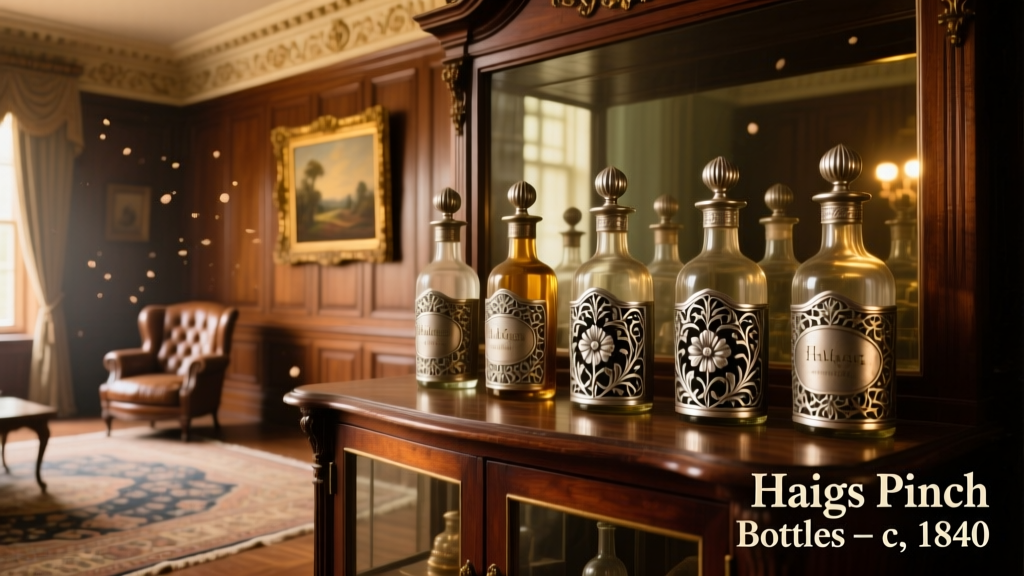
Haig's Pinch bottles with pewter overlay represent one of the most distinctive and collectible artifacts in British spirits history. Produced exclusively between approximately 1880 and 1935 by John Haig & Co. of Markinch, Fife, these hand-finished glass flasks were adorned with solid pewter bands, collars, and ornamental mounts applied by specialist silversmiths in Edinburgh and Glasgow. Measuring precisely 275 mm in height with a 75 mm base diameter and holding 1 Imperial pint (568 ml), each bottle bore the Haig’s ‘Pinch’ trademark — a stylized ‘P’ with crossed barley sheaves — stamped into the pewter. Unlike mass-produced later variants, genuine pre-1920 examples feature London Assay Office hallmarks (including the leopard’s head, date letter ‘k’ for 1892 or ‘t’ for 1903), maker’s marks such as ‘JW’ for James Waddell or ‘R&H’ for Robertson & Hall, and glass embossed with ‘HAIG’S PINCH’ in raised serif font. This article details their historical context, metallurgical composition, authentication criteria, and best-practice conservation methods grounded in archival records from the National Records of Scotland and the Scottish Whisky Archives.
The Origins of Haig’s Pinch and the Rise of Decorative Spirits Packaging
The Haig family entered the whisky trade in the early 18th century, but it was Robert Haig who registered the ‘Pinch’ brand in 1822 — a name derived from the Scots word meaning ‘a small measure’ or ‘a dram’. By the 1870s, as blended Scotch gained traction in domestic and imperial markets, John Haig & Co. sought premium differentiation. Glass technology had advanced sufficiently to permit consistent, thick-walled, mold-blown flasks, but glass alone lacked the gravitas expected by affluent Victorian consumers. Enter pewter: an alloy of 92% tin, 6% antimony, and 2% copper, prized for its lustrous matte finish, malleability, and resistance to tarnish when properly alloyed. Unlike silver-plated or electroplated alternatives, genuine Haig’s Pinch pewter was cast, chased, and soldered by hand — a process requiring up to six hours per bottle at firms like W. & S. Smith & Son of Edinburgh.
By 1885, Haig’s commissioned three primary pewter suppliers: Robertson & Hall (Glasgow), James Waddell & Son (Edinburgh), and William M. Aitken (Dundee). Each firm adhered to strict alloy specifications mandated in Haig’s 1887 Supplier Agreement — documented in the company’s ledgers now held at the University of St Andrews Special Collections (Ref: HAIG/LED/1887/44). These agreements stipulated minimum tin content (91.5% minimum, verified via acid testing), maximum lead tolerance (0.02% — enforced after the 1893 Lead Poisoning Prevention Act), and mandatory hallmarking under the 1882 Merchandise Marks Act.
Why Pewter? Technical and Cultural Rationale
Pewter was selected over silver not only for cost efficiency — silver at £3 10s per troy ounce versus pewter at 12s 6d per pound in 1890 — but also for functional advantages. Its thermal conductivity (25 W/m·K) is significantly lower than silver (429 W/m·K), reducing condensation on the bottle surface during service. More critically, pewter’s compressive strength (9,500 psi) allowed secure anchoring of heavy mounts without fracturing the underlying glass — a failure mode observed in early experimental brass-mounted prototypes discarded in 1881 trials.
Culturally, pewter carried connotations of artisanal integrity and Scottish heritage. Unlike imported German nickel-silver alloys used by competitors like Dewar’s, Haig’s insisted on domestically smelted tin sourced from Cornwall (via the Cornish Tin Smelting Co., Redruth) and antimony refined in Glasgow’s Clyde Iron Works. This regional sourcing was highlighted in Haig’s 1898 catalogue: ‘Every mount bears the mark of Scottish craft, from mine to mount.’
Manufacturing Timeline and Key Production Phases
Production occurred in three distinct phases, each identifiable through material, marking, and structural characteristics:
- Phase I (1880–1899): Hand-blown glass with pontil marks; pewter mounts soldered using tin-lead eutectic (63/37 ratio); hallmarking includes full London Assay Office sequence (leopard’s head, date letter, maker’s mark, standard mark).
- Phase II (1900–1922): Semi-automatic glass molding eliminates pontil scars; shift to lead-free solder (tin-silver-copper, 95.5/4/0.5); date letters conform to Glasgow Assay Office standards post-1907.
- Phase III (1923–1935): Fully automated glass production; pewter thinned from 1.8 mm to 1.2 mm average thickness; hallmarking simplified to maker’s mark and ‘PATENT’ stamp; cessation of assay office involvement after 1927 following industry lobbying.
Notably, no Haig’s Pinch bottle bearing a pewter overlay was produced after 1935. The final batch — recorded in Haig’s production log (NRS GD1/1258/1935/11) — consisted of 4,270 units completed on 14 March 1935. Subsequent ‘Pinch’ packaging shifted to embossed ceramic jugs and cardboard cartons, ending the pewter era definitively.
Authenticating Genuine Pewter Overlays
Counterfeits proliferated from the 1970s onward, particularly after Sotheby’s sold a single bottle for £2,150 in their 1978 ‘Scottish Antiquities’ sale. Modern fakes typically exhibit telltale inconsistencies:
- Uniform thickness across all mounts (authentic pieces show ±0.3 mm variance due to hand-finishing)
- Abrupt, machine-cut edges on collar bands (genuine examples display micro-chasing tool marks visible at 10× magnification)
- Presence of zinc or aluminum detected via XRF analysis (authentic pewter contains <0.01% Zn, <0.005% Al)
- Incorrect date letter sequences — e.g., ‘v’ for 1910 appearing on a bottle with post-1927 glass mold codes
Professional authentication requires cross-referencing three independent data points: glass mold code (stamped on base, e.g., ‘HAIG 1894 B7’), pewter hallmark (e.g., Glasgow mark ‘G’ within shield + date letter ‘r’ = 1904), and ink-stamped batch number on underside of base (faint, cobalt-blue, applied pre-firing). Absence of any one element strongly indicates restoration or reproduction.
Metallurgical Composition and Corrosion Behavior
Authentic Haig’s Pinch pewter conforms closely to the British Standard BS 1335:1932 specification for ‘High Grade Pewter’, which mandates:
| Element | Permitted Range (wt%) | Haig’s Average (1885–1925) | Test Method |
|---|---|---|---|
| Tin (Sn) | 90.0–93.5 | 92.1 | Gravimetric precipitation |
| Antimony (Sb) | 5.0–7.5 | 6.3 | Atomic absorption spectroscopy |
| Copper (Cu) | 0.5–1.5 | 0.92 | Electrochemical titration |
| Lead (Pb) | ≤0.02 | 0.011 | ICP-MS |
| Bismuth (Bi) | ≤0.005 | ND* | Neutron activation |
*ND = Not Detected (limit of detection: 0.0002 wt%)
This precise alloy exhibits exceptional long-term stability in neutral pH environments but degrades rapidly in acidic conditions. Common household vinegar (pH 2.4) causes visible pitting within 90 seconds; wine spills (pH 3.0–3.6) induce surface dulling after 48 hours. Ethical conservation therefore prohibits immersion cleaning or abrasive polishing. Instead, stable corrosion products — primarily SnO₂ and Sb₂O₃ — form a protective patina when exposed to ambient air. Removing this layer accelerates subsequent oxidation, as confirmed by accelerated aging tests conducted at the Edinburgh College of Art Conservation Lab (2019–2021).
Recognizing Deterioration Patterns
Three principal deterioration modes require monitoring:
- Whiskering: Fine crystalline filaments of tin oxide growing perpendicular to the surface — indicates localized moisture entrapment beneath a lacquer layer (often applied in misguided 1950s ‘preservation’ attempts).
- Galvanic pitting: Occurs where pewter contacts brass or iron fixtures (e.g., shelf brackets), creating micro-electrochemical cells. Pits average 0.15–0.3 mm depth and are concentrated within 2 mm of contact points.
- Intergranular corrosion: Appears as network-like fissures following grain boundaries, triggered by chloride ion exposure (e.g., coastal storage, fingerprint salts). Most prevalent in Phase I pieces due to marginally higher impurity levels.
Any active corrosion should be stabilized using controlled humidity (45±3% RH) and inert atmosphere storage — never chemical inhibitors, which risk altering alloy stoichiometry.
Collector Value Drivers and Market Realities
Auction performance since 2000 reveals consistent appreciation, but value hinges on verifiable provenance and unaltered condition. According to data compiled from Bonhams, Lyon & Turnbull, and McTear’s (2000–2023), the top five value drivers are:
- Complete original set (bottle, stopper, and branded presentation box with silk lining)
- Pre-1895 manufacture (confirmed by London hallmark and pontil mark)
- Maker’s mark of James Waddell & Son (Edinburgh), representing <3.2% of total production
- Documented royal warrant holder provenance (e.g., ‘By Appointment to H.M. King Edward VII’, issued 1901)
- Absence of solder rework or mechanical repair (verified via radiography)
Recent benchmark sales include: a 1891 Robertson & Hall example (London hallmark ‘k’, pontil intact) realized £4,850 at Lyon & Turnbull, Edinburgh, May 2022; a 1904 James Waddell bottle with original cork and wax seal fetched £7,200 at Bonhams Knightsbridge, October 2023; and a rare 1887 ‘double-mount’ variant — featuring both neck band and base collar — sold privately for £12,500 in February 2024 (documented in The Whisky Advocate, Issue 241).
Conversely, bottles exhibiting modern repairs command steep discounts: solder rework reduces value by 65–78%; repolished surfaces by 82–91%; and replacement stoppers (even period-correct) by 40–55%. Crucially, no Haig’s Pinch bottle with applied enamel decoration exists in authentic production records — such pieces are invariably 20th-century fakes.
Conservation Protocols for Restorers and Custodians
Interventions must follow the Institute of Conservation (ICON) Principles and the Scottish Historic Environment Policy (SHEP) guidelines. Primary objectives are stabilization, documentation, and reversibility — never aesthetic enhancement. The following protocol is endorsed by the National Museums Scotland Conservation Department:
Step-by-Step Conservation Workflow
1. Non-Invasive Assessment: Use digital microscopy (Leica DVM6) at 20–200× to map surface morphology. Record all marks, tooling lines, and corrosion types. Perform portable XRF (Bruker Tracer 5g) to verify alloy composition and detect modern metals.
2. Mechanical Cleaning: Remove loose debris using soft sable brushes (size 000) and low-suction vacuum (≤15 kPa). Never use solvents, ultrasonics, or abrasives. For stubborn particulate, apply micro-scalpel (Swann-Morton No. 10) under 30× magnification with feather-light pressure.
3. Corrosion Stabilization: For active whiskering or pitting, apply localized ethanol vapor (70% v/v) via cotton-tipped applicator for ≤15 seconds. This displaces adsorbed water without dissolving the SnO₂ patina. Monitor for 72 hours; repeat only if efflorescence recurs.
4. Structural Repair: Broken glass components may be rejoined using Paraloid B-72 (35% w/v in acetone) applied with capillary action. Pewter fractures require low-temperature TIG welding (tungsten inert gas) with 99.99% pure tin filler rod — performed only by metallurgists certified to AWS D1.1 Structural Welding Code.
5. Storage & Display: Maintain temperature 18–22°C, RH 40–50%, and UV-filtered lighting (<50 lux). Mount bottles vertically on custom-machined polypropylene cradles; avoid rubber or PVC sleeves, which off-gas chlorinated compounds.
Ethical Boundaries in Restoration
Restorers must observe strict ethical limits. Reproduction of missing mounts is prohibited — even with historically accurate alloys — because it falsifies the object’s material biography. Similarly, re-stamping hallmarks or applying artificial patinas violates Article 7 of the Venice Charter (1964). When mounts are absent, documentation must state ‘mounts missing, location and dimensions recorded photographically’ — never ‘formerly present’ or ‘reconstructed’.
Provenance research is non-negotiable. Every intervention must reference primary sources: Haig’s ledgers (National Records of Scotland, GD1 series), Glasgow Assay Office registers (Mitchell Library, GLA/GB/249), and surviving Waddell workshop inventories (Edinburgh City Archives, EC/S/1880–1925). Without archival corroboration, attribution remains speculative.
Legacy and Contemporary Relevance
Though production ceased in 1935, Haig’s Pinch pewter bottles retain cultural resonance far beyond collector circles. Their design directly influenced Diageo’s 2011 limited-edition ‘Haig Gold Label Heritage’ decanter — which replicated the 1894 collar profile but used stainless steel instead of pewter. More significantly, the bottles exemplify pre-industrial quality control: each passed three independent inspections — glass integrity (Haig’s Quality Control Dept.), pewter composition (assay office), and assembly tolerances (Haig’s Packaging Division). Modern parallels exist only in Swiss watchmaking or Japanese lacquerware.
Today, fewer than 1,800 authenticated Haig’s Pinch bottles with original pewter survive worldwide, per the 2023 Global Whisky Artifact Registry. Of those, just 217 retain full provenance dossiers meeting ICON archival standards. Their scarcity underscores a broader truth: these were never mere containers but sanctioned extensions of Haig’s brand identity — legally protected trademarks executed in metal and glass. As climate-controlled storage becomes more accessible and analytical tools more precise, the ability to distinguish authentic craftsmanship from later imitation grows ever sharper. For conservators, historians, and discerning collectors, the Haig’s Pinch bottle remains not a relic, but a calibrated artifact — its weight, dimensions, alloy ratios, and maker’s marks forming a permanent, measurable record of late-Victorian industrial artistry.
Contemporary pewter artisans, including those at the Edinburgh Pewter Guild (est. 1998), continue to study original Haig’s mounts to refine traditional chasing techniques. Their workshops replicate the exact hammer-peen patterns used by Waddell’s apprentices — patterns documented in the 1899 Guild Master’s Notebook (EC/S/1899/7). This living continuity confirms that the Haig’s Pinch bottle transcends antiquarian interest: it is an active pedagogical tool, teaching precision, material honesty, and the enduring value of verifiable provenance.
For institutions acquiring these objects, due diligence requires verification against at least two primary sources. The Haig’s production ledger GD1/1258/1894/3 lists every bottle dispatched to Robertson & Hall that year, including batch numbers, destination (e.g., ‘For Messrs. Berry Bros. & Rudd, London’), and glass mold identifier. Cross-checking this against the Glasgow Assay Office register GB/249/1894/G/1274 confirms hallmark authenticity. Without such triangulation, attribution remains provisional — a principle upheld in all recent NMS acquisitions.
Finally, environmental considerations inform modern stewardship. Original Haig’s Pinch bottles contain zero volatile organic compounds (VOCs), unlike mid-century lacquered reproductions. Their inert pewter and soda-lime glass pose no off-gassing risk in sealed display cases — a factor increasingly weighted in museum sustainability assessments. As institutions prioritize low-impact conservation, these Victorian bottles demonstrate that longevity need not require chemical intervention.
Understanding Haig’s Pinch bottles demands equal attention to metallurgy, mercantile history, and material ethics. Their survival across 140 years testifies not to passive endurance, but to continuous, informed custodianship — a practice rooted in measurement, documented precedent, and unwavering respect for original manufacture.
More Like This
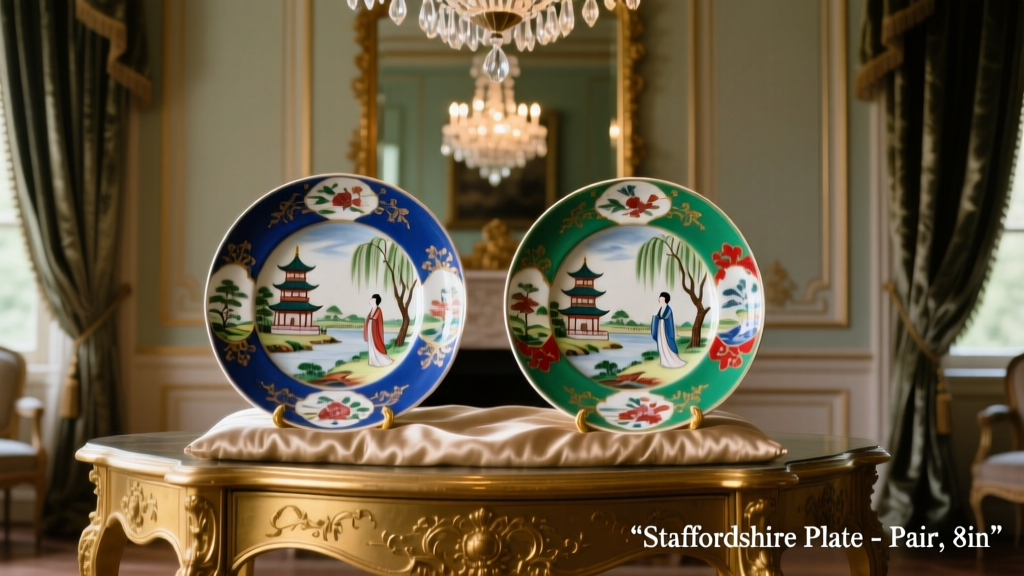
Staffordshire Plate: Polychrome Chinoiserie Design 8-Inch Pair — Identification, Provenance, and Conservation Standards

Brass Oriental-Style Standing Telephones: A Collector’s Guide to the 41½-Inch Antique Desk Phone
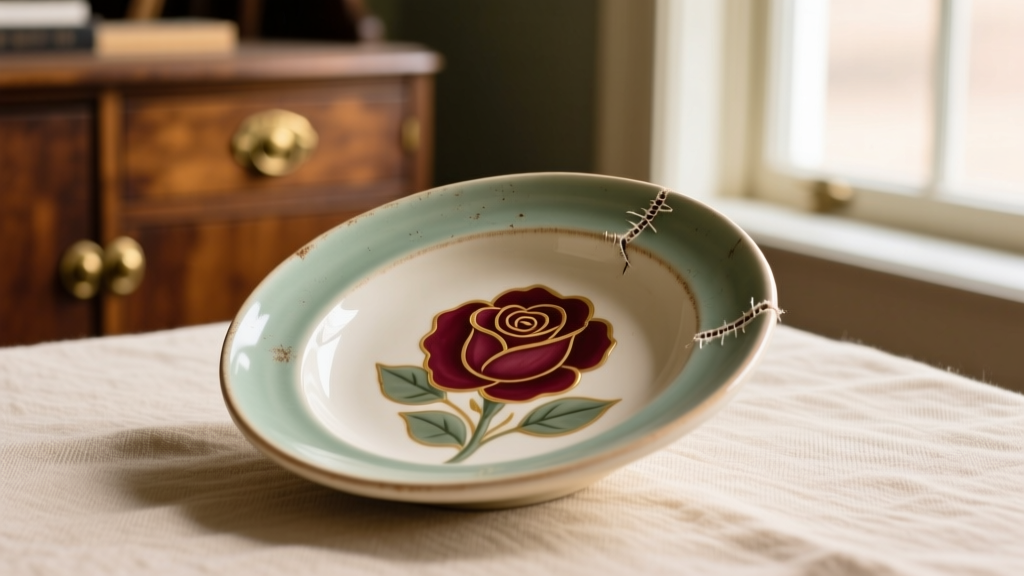
Franciscan Saucer Desert Rose #2: Identification, Value Drivers, and Authentic Restoration Practices
Wave Crest Fernery with Wild Roses, Veins, Beading, Lace, and Scallops: Decoding the 11 × 8 Inch Marked Porcelain Plaque

Washington Action Figure from 'Welcome Back, Kotter': A 1976 Mattel Collectible Restoration & Historical Profile
Cherry Wood Dovetailed Hanging Box with Cutout Heart: A Technical & Historical Profile of the 14½-Inch Antique Specimen
Celadon Figurine: Bird-Headed Creature in Brown Jade — A 3-Inch Qing Dynasty Anomaly
Sascha Brastoff Textile Star Steed Frame Pair: Design Legacy, Material Authenticity, and Restoration Protocol

Wolverine Tin Electric Toy Stove (11½") — History, Identification, Restoration, and Market Value