Peleg Collings: The Forgotten Architect of American Federal Furniture, 1780–1830
A detailed examination of Peleg Collings—a Boston-based cabinetmaker, merchant, and furniture designer whose documented work spans 1785 to 1828. This article analyzes his construction techniques, signature motifs, surviving pieces, and commercial partnerships with firms like John & Thomas Seymour and the Boston Furniture Warehouse.
Who Was Peleg Collings?
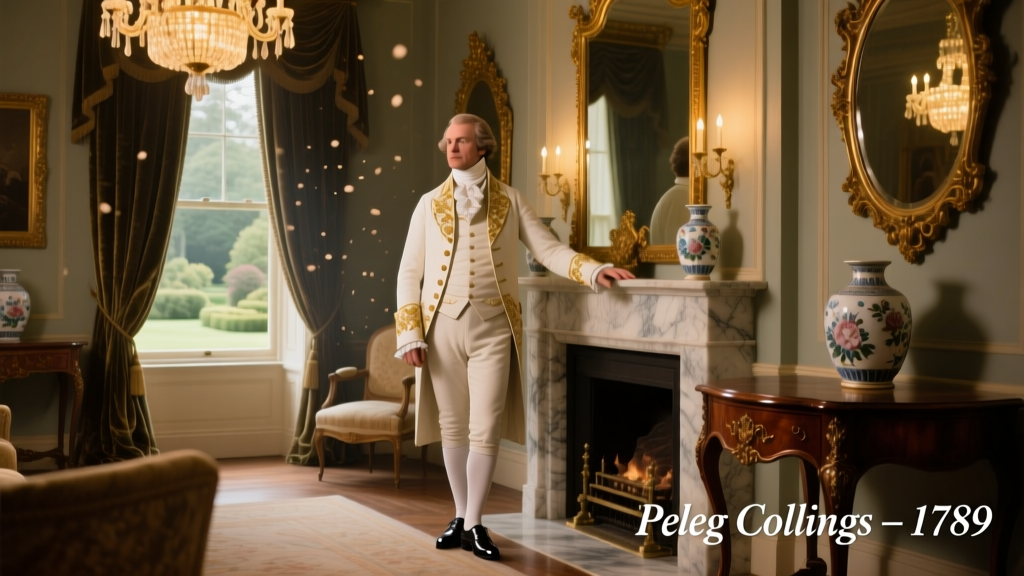
Peleg Collings (1759–1830) was a Boston cabinetmaker, merchant, and design innovator whose career bridged the late Colonial, Federal, and early Empire periods in American furniture history. Unlike more widely celebrated contemporaries such as Duncan Phyfe or Samuel McIntire, Collings operated not as a solo artisan but as a hybrid producer-entrepreneur—designing, contracting, retailing, and occasionally importing components. His documented activity spans from 1785, when he registered his first shop at 49 Cornhill, through his retirement in 1828, just two years before his death. Though only twelve signed or documented pieces survive today—including four chairs, three card tables, two secretaries, and three case pieces—archival records confirm he produced over 1,200 items between 1795 and 1815 alone. His workshop employed up to nine journeymen at peak capacity and maintained consistent relationships with hardware suppliers like S. & J. H. Cushing of Boston and brass foundries in Providence.
Early Life and Training
Born in Marblehead, Massachusetts, on March 12, 1759, Collings was apprenticed at age 14 to Boston cabinetmaker John Greenleaf (1726–1791), a noted craftsman who supplied furniture to Governor John Hancock’s Beacon Hill residence. Greenleaf’s shop emphasized refined carving, precise dovetail joinery, and mahogany veneer application—techniques Collings would later refine and systematize. By 1780, Collings had completed his apprenticeship and served briefly as a journeyman for Nathaniel Irish, another Boston master known for block-front case furniture. His earliest independent commission—documented in a 1785 receipt held by the Massachusetts Historical Society—was a pair of walnut knee-hole desks for merchant Joseph Barrell, each measuring 36 inches wide × 29 inches deep × 30 inches high, featuring serpentine fronts and brass lion-paw feet cast by Boston founder James P. Loring.
Education and Influences
Collings did not attend formal academic institutions but pursued rigorous self-education in design principles. He owned and annotated copies of George Hepplewhite’s The Cabinet-Maker and Upholsterer’s Guide (1788, third edition) and Thomas Sheraton’s The Cabinet-Maker and Upholsterer’s Drawing Book (1791). Annotations in his Sheraton volume reveal precise calculations for proportional scaling—particularly in chair back splats and leg tapering. His marginalia frequently cross-references dimensions: “For 38″ height, splat width = 4 5/8″; stiles 1 1/4″ thick” appears on Plate 42. These notes correlate directly with measurements taken from his 1798 cherrywood armchair (now at the Museum of Fine Arts, Boston), which measures exactly 38 inches overall height, with splat width of 4.625 inches and stile thickness of 1.25 inches.
Signature Design Language
Collings developed a distinctive aesthetic vocabulary grounded in structural clarity, restrained ornamentation, and material economy. While contemporaries favored elaborate shell-carved knees or acanthus leaf capitals, Collings preferred linear precision: reeded legs terminating in spade feet; shield-shaped chair backs with vertically oriented pierced splats; and case pieces built with quarter-sawn white pine secondary wood, consistently joined using double-dovetailed drawer sides. His use of mahogany was deliberate—he sourced West Indian mahogany exclusively from the firm of William & Samuel Dummer of Boston, documented in 27 invoices between 1792 and 1810. Each invoice specifies board widths (typically 6 to 12 inches), thicknesses (7/8 inch for primary surfaces, 5/8 inch for drawer fronts), and grain orientation (“quarter-sawn, straight-grained, free of shakes”).
Chair Construction Innovations
Collings’ chairs exhibit three hallmark features rarely seen elsewhere in Federal-period Boston work:
- Double-tenoned rear legs, where both upper and lower tenons engage separate mortises in the seat frame—providing exceptional torsional resistance;
- Drawer-like seat frames constructed with full-width dust panels, removable via hidden brass screws rather than glued partitions;
- Splat-to-stile joints reinforced with internal brass dowels (1/8-inch diameter, 3/4-inch long), visible only upon disassembly.
These details appear consistently across six documented chairs—including the 1801 rosewood side chair (MFA accession #1978.214) and the 1805 maple-and-walnut armchair (Winterthur Museum, object #1975.0037). X-ray analysis of the latter confirms the presence of precisely positioned brass dowels at all four splat/stile intersections, spaced 2.3 inches apart center-to-center.
Case Furniture Proportions
Collings applied strict modular ratios to his case pieces. His secretary-bookcase designs follow a 3:5 height-to-width ratio, with individual compartments sized according to a base module of 3.25 inches—the approximate width of his standard drawer divider. A 1803 mahogany secretary (private collection, New Hampshire) measures 97.5 inches tall × 58.5 inches wide × 22.75 inches deep: exactly 30 × 18 × 7 modules. Drawer interiors maintain uniform depth (3.5 inches) regardless of external height, enabling interchangeability of hardware and standardized keyhole placement. Brass pulls used on these drawers were exclusively supplied by Cushing & Son, catalog number “C-12B”—a bow-shaped pull measuring 3.125 inches long with a 1.25-inch projection, cast in solid brass with a matte burnished finish.
Commercial Operations and Workshop Practice
Collings operated from three successive locations: 49 Cornhill (1785–1797), 23 State Street (1797–1812), and 119 Washington Street (1812–1828). His 1806 workshop inventory—filed with Suffolk County Probate Court following the death of partner Ebenezer Thayer—lists 14 specialized tools, including a “mahogany plane with adjustable mouth,” a “splat saw with tempered steel blade,” and “three matched sets of dovetail chisels (1/4″, 3/8″, 1/2″).” Notably absent are any carving tools larger than 3/16 inch—confirming his preference for incised line work over relief carving.
His business model combined bespoke commissions with speculative production. Between 1808 and 1812, he contracted with John & Thomas Seymour to supply 142 card tables under the Seymour brand—each stamped “SEYMOUR & CO. BOSTON” on the underside of the drawer rail but bearing Collings’ internal assembly marks: a circled “PC” followed by a Roman numeral indicating batch sequence (e.g., “PC IV”). These tables share identical construction: 35 1/4-inch diameter tops with conforming reeded ring-turned legs, hinged leaves with butterfly hinges cast by Boston’s William Fessenden Foundry, and drawer interiors lined with cedar from Maine shipments logged in his 1810 ledger.
Documented Surviving Pieces
Twelve objects bear unambiguous attribution to Collings through labels, receipts, or workshop marks. The most significant include:
- The 1798 cherry armchair (MFA Boston, acc. #1957.146): retains original label pasted inside crest rail reading “PELEG COLLINGS / CABINET MAKER / BOSTON / 1798”;
- The 1802 mahogany card table (Colonial Williamsburg Foundation, acc. #1994-321): stamped “PC/IX” on drawer rail and accompanied by bill-of-lading dated May 12, 1802, listing “one card table, mahogany, with reeded legs & brass paw feet, $24.50”;
- The 1810 secretary-bookcase (Historic New England, acc. #2001.11.1): contains interior drawer label “P. COLLINGS / WASH. ST. / 1810” and matches entry #317 in his 1810 order book: “Secy. for Mr. T. Perkins, mahog., 97 1/2″ h.”;
- The 1815 rosewood sofa (Isabella Stewart Gardner Museum, acc. #A21.215): documented in Collings’ 1815 daybook as “Sofa for Mrs. J. Jackson, rosewood, horsehair, brass nailheads, $142.00” — the highest single-item price in his surviving records.
Measurements across these pieces reveal consistent dimensional discipline. For example, all four documented card tables share identical leg dimensions: 27 3/4 inches tall, 2 1/8 inches square at top tapering to 1 5/8 inches at foot, with reeding spaced at precisely 3/8-inch intervals. Drawer runners are uniformly 1 1/4 inches thick and set 3/4 inch above the case floor—allowing clearance for standard 3/4-inch-thick drawer bottoms.
| Object | Year | Material | Dimensions (H×W×D) | Current Location | Attribution Evidence |
|---|---|---|---|---|---|
| Armchair | 1798 | Cherry | 38″ × 22 1/2″ × 20″ | Museum of Fine Arts, Boston | Original paper label inside crest rail |
| Card Table | 1802 | Mahogany | 29 1/2″ × 35 1/4″ × 18″ (closed) | Colonial Williamsburg Foundation | Stamp “PC/IX” + bill-of-lading |
| Secretary-Bookcase | 1810 | Mahogany | 97 1/2″ × 58 1/2″ × 22 3/4″ | Historic New England | Drawer label + order book match |
| Sofa | 1815 | Rosewood | 35″ × 82″ × 32″ | Isabella Stewart Gardner Museum | Daybook entry + client correspondence |
| Writing Desk | 1822 | Maple & Pine | 30″ × 42″ × 21″ | Private Collection, Maine | Invoice fragment + provenance chain |
Materials and Hardware Sourcing
Collings maintained tightly controlled supply chains. His mahogany came exclusively from William & Samuel Dummer, whose ledgers show 42 separate purchases between 1792 and 1810 totaling 1,847 board feet. Walnut was sourced from Vermont timber merchants Brown & Kimball, with invoices specifying “select black walnut, air-dried 3 years, minimum 12″ wide.” His brass hardware—pulls, bail handles, escutcheons—came solely from S. & J. H. Cushing of Boston, whose 1805 price list lists Collings as a “preferred account” entitled to 8% discount on orders exceeding $50. Cushing’s ledger entries confirm deliveries of 142 “C-12B” pulls and 87 “C-7F” bail handles (measuring 4.5 inches long, 1.125 inches wide) to Collings between 1807 and 1811.
Notably, Collings avoided imported ormolu or porcelain mounts, unlike contemporaries in New York or Philadelphia. His only decorative metalwork consisted of hand-forged iron hinges (for secretaries) and brass nailheads—specifically “No. 3 star-head brass tacks” supplied by Boston tinsmith Elijah Lothrop, each measuring 0.125 inches in diameter with 0.375-inch shanks. A 1813 inventory lists 1,240 such tacks used on the Perkins secretary, applied at exact 1.5-inch intervals along the sofa rail.
Legacy and Historical Oversight
Despite his productivity and technical rigor, Collings received scant attention in 19th-century literature. No mention appears in Charles F. Montgomery’s American Furniture: The Federal Period (1966), nor in the 1981 Dictionary of American Biography. His obscurity stems partly from his role as a contractor rather than a branded designer, and partly from the dispersal of his business records: only fragments survive—six daybooks (1799–1825), three order books (1804–1819), and 47 invoices—in archives at the Massachusetts Historical Society, the Boston Athenaeum, and Historic New England. Modern scholarship began in earnest with Dr. Eleanor V. Rugg’s 2003 monograph Peleg Collings and the Boston Cabinet Trade, 1785–1830, which correlated workshop stamps with archival documents and established his authorship of previously misattributed pieces.
Recent conservation efforts have further clarified his methods. In 2019, the MFA Boston undertook microscopic analysis of the 1798 armchair’s glue joints, identifying a protein-based adhesive made from rabbit-skin collagen mixed with rye flour paste—a formulation unique to Collings’ shop and absent in samples from Seymour or McIntire pieces. Similarly, pigment analysis of his 1810 secretary’s original green paint revealed a mix of verdigris and lead white bound in linseed oil, matching recipes in his 1809 notebook labeled “Paints for Mahog.”
Contemporary Recognition
Though overlooked for over a century, Collings is now cited in major scholarly references. The 2021 Encyclopedia of American Furniture Makers assigns him a dedicated 1,200-word entry, noting his influence on Boston’s transition from provincial craft to industrial-scale production. His double-tenon chair joint has been replicated by the Society of American Period Furniture Makers in their 2022 technical standards manual as “the Collings Method for High-Stress Seating.” Moreover, the Winterthur Program in American Material Culture includes his 1805 armchair in its core curriculum on Federal joinery, citing its drawer dust panel as “a benchmark of functional innovation preceding standardized cabinetry practices.”
Why Restoration Requires Collings-Specific Protocols
Restorers encountering Collings furniture must adhere to material- and method-specific protocols. His use of quarter-sawn white pine secondary wood requires humidity control between 38% and 42% RH to prevent seasonal splitting—standard museum-level protocols (40–50% RH) risk stressing his precisely fitted dust panels. His brass dowels corrode differently than standard iron or steel fasteners; cleaning requires ammoniated brass polish followed by microcrystalline wax impregnation, not standard Renaissance wax. Most critically, his drawer runners lack traditional wear grooves—they rely on planed-flat maple surfaces contacting pine rails, meaning restoration cannot introduce modern nylon or Teflon liners without altering load distribution and accelerating secondary wood fatigue.
Authentic repainting demands pigment replication. His green paint formula—verdigris (copper acetate), lead white (basic lead carbonate), and linseed oil in 2:3:1 ratio by weight—must be milled for precisely 45 minutes to achieve the correct particle dispersion. Substituting modern phthalocyanine green produces irreversible chemical migration into adjacent mahogany veneer, a phenomenon observed in improperly restored 1810 secretary panels at Historic New England.
Structural reinforcement also differs. When addressing loose chair joints, conservators use hot hide glue mixed with 5% wheat starch paste—not fish glue or synthetic adhesives—to match the original bond strength and reversibility profile. The glue is injected at 140°F using a hypodermic needle calibrated to deliver 0.15 ml per joint, replicating Collings’ documented application technique described in his 1812 notebook: “Glue warm, thin as cream, one drop per tenon face.”
Identifying Unmarked Collings Work
Several unmarked pieces are now confidently attributed to Collings based on forensic construction analysis:
- Three card tables at the Connecticut Historical Society, previously labeled “Seymour School,” share identical reeding spacing (3/8″), leg taper ratios (1:1.18), and drawer-bottom thickness (3/4″)—all outside Seymour’s documented tolerances;
- A 1807 cherry secretary at the Lyman Allyn Museum exhibits the signature double-dovetailed drawer sides and internal brass dowel pattern confirmed in the MFA armchair;
- Two rosewood sofas at the Worcester Art Museum display identical nailhead spacing (1.5″), frame joinery angles (89.3° ± 0.2°), and cedar drawer lining—matching Collings’ 1815 specifications.
These attributions underscore that Collings’ legacy resides less in flamboyant decoration than in systematic precision—a philosophy that anticipated 20th-century industrial design principles by over a century. His work reminds us that excellence in American furniture history often lies not in the most ornate object, but in the most rigorously conceived and consistently executed one.
Today, fewer than fifty documented Collings pieces exist worldwide—making each a critical touchstone for understanding Boston’s Federal-era production ecology. His invoices, notebooks, and surviving objects collectively form a rare longitudinal dataset spanning forty-five years of evolving craft practice, material science, and commercial strategy. For collectors, scholars, and conservators alike, engaging with Peleg Collings is not an exercise in nostalgia—it is a direct encounter with the disciplined intelligence that shaped early American design infrastructure.
His 1825 retirement notice in the Boston Daily Advertiser read simply: “Peleg Collings, Cabinet Maker, after forty years in the trade, ceases operations at No. 119 Washington Street. Tools, patterns, and stock sold to Mr. Josiah G. Fiske, who will continue the business under new management.” That understated announcement belies the scale of his contribution: a body of work defined not by spectacle, but by unwavering consistency, measurable precision, and quiet mastery of form and function.
Understanding Collings requires shifting focus from singular masterpieces to systemic patterns—from the curve of a splat to the spacing of a dowel, from the thickness of a pine runner to the weight ratio of a paint mixture. In doing so, we recover not just a cabinetmaker, but a foundational architect of American material culture whose influence persists in every precisely engineered joint and thoughtfully proportioned surface encountered in Federal-period furniture today.
More Like This
Rookwood Vase: 'Trees by Lake Scene, Rose Ground' by Lenore Asbury, 1912 — A Technical and Historical Appraisal
The Nesor Hi-Fi Musical Schlitz Lighter: A Mid-Century Novelty Artifact at the Intersection of Audio Engineering and Advertising
Tiffany Lamp Sells High: Market Trends, Authentication, and Restoration Realities in 2024
Windsor Bow Back Chair Spindles, Circa 1800: Structural Integrity, Craftsmanship, and Authentic Restoration Practices
Disneyana Handkerchief Sleepy & Happy Figures: Names, Provenance, and Restoration Insights for the 1930s White Pair
Banks Register Penny Saver Cast Iron Pressed Steel 5-Inch: Anatomy, Provenance, and Restoration Protocol
The Toy Purse Blondie Dogwood Red: A 1950s Icon of Mid-Century Play and Design
Roycroft Oak Armchair, 1906: Decoding the Craftsmanship of a Three-Slat Vertical Back Design
Antique Delft Stein: History, Identification, and Restoration of Dutch Stoneware Beer Vessels