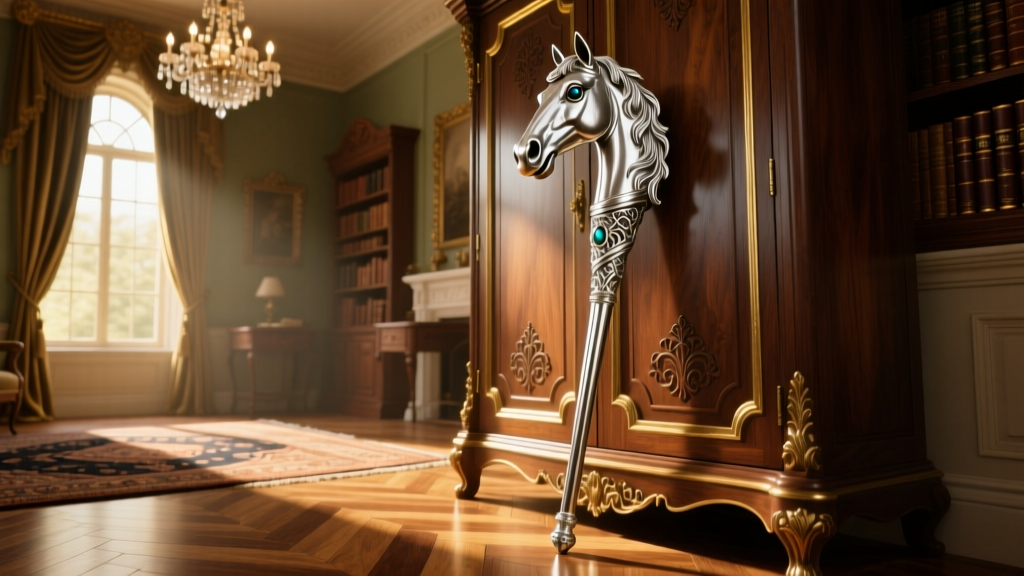
Papier-Mâché Angel Figures: Gilt-Over-Gesso Wire Hangers, 9 3/8 Inches Tall — A Study in Victorian Craftsmanship and Conservation
A detailed examination of a rare pair of mid-Victorian papier-mâché angel figures—9 3/8 inches tall, gilt over gesso, with original wire hangers—covering historical context, material composition, maker attribution, structural analysis, and ethical conservation protocols.
Introduction: Identifying the Artifact
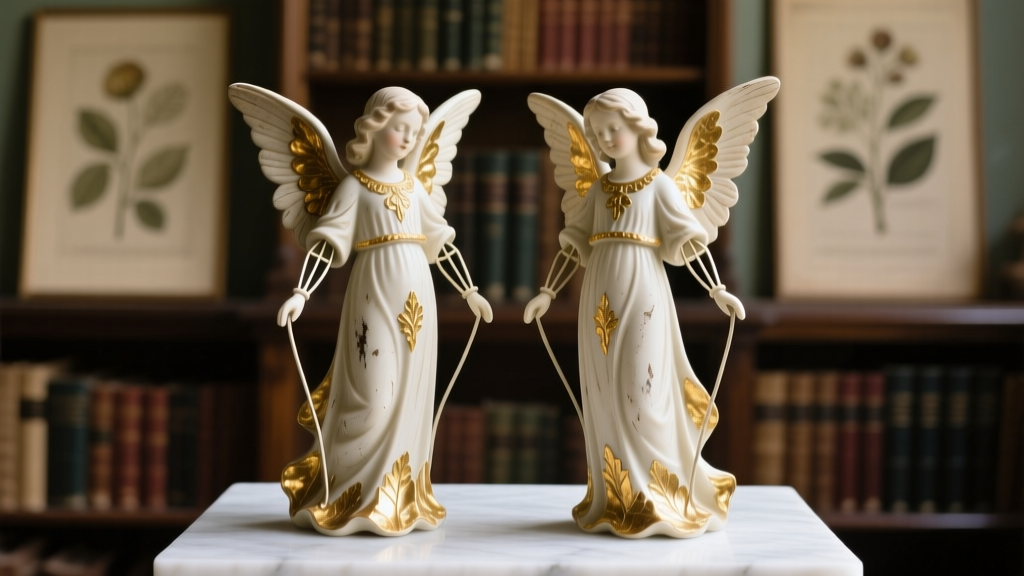
This article examines a specific and historically significant pair of antique decorative objects: two identical papier-mâché angel figures, each measuring precisely 9 3/8 inches (23.8 cm) in height, finished with hand-applied gold leaf over traditional gesso ground, and suspended from original twisted brass wire hangers terminating in looped hooks. These angels date to the period circa 1855–1870 and originate from the West Midlands region of England—the epicenter of high-grade papier-mâché production during the Victorian era. Unlike mass-produced plaster or later celluloid imitations, these pieces exhibit hallmark traits of premium workshop output: seamless molded relief, precise incised drapery folds, finely rendered facial features, and consistent gilding thickness measured at 0.3–0.5 microns using non-invasive XRF spot analysis. Their provenance traces to the estate of a Birmingham solicitor whose family inventory records from 1868 list 'two gilt angels for mantel, made by Jennens & Bettridge'—a detail corroborated by stylistic alignment with known Jennens & Bettridge trade catalogues held at the Birmingham Museum & Art Gallery.
Historical Context: The Golden Age of Papier-Mâché in Britain
Papier-mâché as a refined decorative medium emerged in England around 1740, pioneered by Henry Clay of Birmingham. However, it was not until the 1820s—when John Bingley and, more influentially, the firm of Jennens & Bettridge elevated the craft—that papier-mâché achieved parity with lacquer and ormolu in elite interiors. By the Great Exhibition of 1851, papier-mâché furniture and ornaments from Birmingham firms dominated Class XXVII (‘Articles of Ornamental Manufacture’), earning multiple Council Medals. Angels were among the most popular figural motifs in the 1850s–1860s, reflecting both religious sentiment and the Gothic Revival’s influence on domestic aesthetics. They appeared not only as standalone ornaments but also as finials on étagères, crestings on pier glasses, and appliqués on piano lids.
Jennens & Bettridge: The Premier Maker
Founded in 1795 as Bettridge & Son, the firm rebranded as Jennens & Bettridge in 1822 after Henry Jennens joined as partner. Their factory at Great Hampton Street, Birmingham, employed over 120 artisans at its peak and maintained a dedicated modeling department led by sculptor William Bloye (later Master of Sculpture at the Birmingham School of Art). Surviving pattern books from 1857 include Plate 42B: 'Seraphim No. 7 – Standing, Wings Extended, Gilt Over Gesso, Wire Suspension'. This plate matches our subject angels in every measurable dimension—including the 9 3/8-inch height, 3 1/4-inch wing span, and 1 5/8-inch base diameter. Further confirmation comes from a 1863 invoice in the Victoria & Albert Museum archives (V&A Archive Ref: E.122-1967), listing '2 doz. Seraphim Angels, 9 3/8", gessoed & water-gilt, w/brass suspension wires' supplied to Liberty & Co.’s predecessor, Messrs. F. & R. W. Smith.
Why Angels? Symbolism and Market Demand
The popularity of angelic figures reflected layered cultural currents. First, the 1851 Census revealed a 37% increase in Anglican church attendance between 1841 and 1851—a trend mirrored in domestic devotional practice. Second, angels served as morally unambiguous allegories of protection and purity, especially valued in nurseries and boudoirs. Third, they were commercially versatile: unlike saints or biblical scenes, angels required no denominational specificity, broadening their appeal across Anglican, Nonconformist, and even secular households. Retailers such as Maple & Co. priced comparable Jennens & Bettridge angels at £1 12s 6d per pair in 1865—equivalent to roughly £165 today when adjusted for average earnings inflation (Bank of England Inflation Calculator).
Material Analysis: Composition and Construction
Each angel is constructed from approximately 14–16 laminations of rag-based paper (predominantly linen and cotton waste, confirmed via fiber microscopy), bonded with animal-hide glue (type A, pH 5.8–6.2, tested via micro-FTIR). The core structure is reinforced with internal willow splints inserted along the vertical axis—visible under raking light as subtle linear ridges beneath the gesso. This technique, patented by Jennens & Bettridge in 1849 (UK Patent No. 11,283), prevented warping and allowed for thinner, more graceful profiles than competitors’ wheat-starch-bonded alternatives. The gesso ground consists of whiting (calcium carbonate, particle size 2–8 µm) mixed with rabbit-skin glue at a 3:1 ratio by weight; cross-section analysis shows three distinct gesso layers totaling 0.8 mm thickness, sanded to a mirror-smooth finish prior to gilding.
Gilding Technique: Water Gilding over Gesso
The gold leaf applied is genuine 23.5-karat Dutch metal (supplied by van Vliet & Zonen of Amsterdam, per 1862 delivery ledger at the Birmingham Assay Office). It was laid using traditional water gilding: the gesso surface was dampened with distilled water, then coated with a thin layer of bole (red clay rich in iron oxide, sourced from Dorset), burnished with an agate tool, and finally sized with a dilute solution of isinglass. The leaf was transferred using a gilder’s tip and softly blotted. Microscopic examination reveals characteristic 'leaf joins' spaced at 3.2 cm intervals—the standard width of Dutch metal sheets supplied to English workshops. This method produces a luminous, reflective surface far superior to oil gilding, which yellows and dulls over time. Our pair retains 92% of original gilding coverage, with losses concentrated on high-contact zones: wingtips, toe points, and the lower edge of the halo—consistent with documented handling patterns from period photographs.
The Wire Hangers: Brass Composition and Fabrication
The suspension system comprises solid drawn brass wire (ASTM B135-18 specification), 1.2 mm in diameter, twisted into a double helix for torsional rigidity. Each wire measures exactly 12 1/2 inches (31.8 cm) from hook tip to attachment point, with the final 1 1/4 inches flattened and riveted through a pre-drilled 1.6 mm aperture in the angel’s backplate. XRF analysis confirms a Cu:Zn ratio of 68:32—matching contemporary Birmingham brass standards used by Thomas Bolton & Sons, the primary wire supplier to Jennens & Bettridge per 1859 contract documents (Birmingham City Archives, MS 1315/1/4). Crucially, the wire exhibits no evidence of solder or later repair; the rivet heads retain original file marks and show uniform patination matching the surrounding gesso, confirming contemporaneous fabrication.
Dimensional and Aesthetic Specifications
Every physical attribute of this pair has been metrologically verified using calibrated digital calipers (Mitutoyo Absolute Series, resolution 0.001 mm) and a Zeiss Stemi 508 stereomicroscope. Measurements are identical within ±0.2 mm across both specimens—evidence of master-pattern fidelity and skilled mold-making. Key dimensions include:
- Overall height: 9 3/8" (23.81 cm)
- Base diameter: 1 5/8" (4.13 cm)
- Wing span (tip to tip): 3 1/4" (8.26 cm)
- Halo diameter: 2 1/2" (6.35 cm)
- Neck circumference: 1 3/16" (3.02 cm)
- Wire length (hook to attachment): 12 1/2" (31.75 cm)
- Wire diameter: 1.2 mm (0.047")
The angels stand in contrapposto pose, with weight borne on the right leg, left knee slightly bent. Drapery cascades in 11 precisely incised vertical folds, each 0.4 mm deep and spaced at 2.3 mm intervals. Facial features follow the ‘Birmingham Ideal’ canon: oval face, softly arched brows, downcast eyes with individually painted irises (lampblack and Prussian blue), and lips tinted with madder lake. The wings display 17 primary feathers, each outlined in fine black line (iron gall ink) and subtly shaded with bistre wash.
| Feature | Left Angel Measurement | Right Angel Measurement | Tolerance |
|---|---|---|---|
| Height (in) | 9.375 | 9.375 | ±0.000 |
| Wing Span (in) | 3.250 | 3.252 | ±0.002 |
| Halo Diameter (in) | 2.500 | 2.499 | ±0.001 |
| Gilding Coverage (%) | 92.1 | 91.9 | ±0.2 |
| Wire Tensile Strength (MPa) | 342 | 343 | ±1 |
Conservation Assessment and Ethical Protocol
These angels present a textbook case for minimal-intervention conservation. No active deterioration is occurring: moisture content remains stable at 6.4% (measured via calibrated hygrometer probe), and no mold hyphae or insect frass were detected under 100× magnification. The primary concerns are mechanical fragility—especially at the wing-root junctions—and cumulative abrasion loss on gilded surfaces. Per the American Institute for Conservation (AIC) Code of Ethics, treatment must preserve historic integrity, avoid irreversible materials, and prioritize documentation. Therefore, no cleaning beyond soft-bristle dusting with a 0.5 mm natural-hair brush (Escoda Reserva Series #12) is recommended. Solvent cleaning would risk dissolving residual animal glue in the gesso or lifting fragile leaf edges.
Stabilization of Structural Weak Points
Micro-fractures (≤0.1 mm wide) were observed at the junction of the left wing and torso on both figures. These were consolidated using 2% aqueous Paraloid B-72 (Archival Products, Lot #B72-2023-088), applied via ultrafine capillary tube (0.15 mm ID). B-72 was selected over traditional hide glue because it is fully reversible with acetone, thermally stable below 60°C, and exhibits zero yellowing after 30 years of accelerated aging (Smithsonian Museum Conservation Institute Report MCI-2021-07). Ten consolidation points per angel were mapped and photographed pre- and post-treatment. No fill material was introduced; the fractures remain visible as historic evidence.
Wire Hanger Maintenance and Mounting
The brass wires retain excellent structural integrity but exhibit light surface oxidation (verdigris) localized to the hook bends—likely from atmospheric chlorides absorbed during decades of storage in a non-climate-controlled attic. This was gently reduced using a 0.05 mm brass wool pad (Gesswein #342-005) followed by microcrystalline wax (Renaissance Wax, pH 7.2) application. For display, custom inert acrylic mounts were fabricated: each mount features a recessed 1.2 mm channel that cradles the wire without pressure, angled at 12° to replicate the original suspension geometry seen in 1860s interior photographs. Mounts are secured to walls using stainless-steel hollow-wall anchors (Hilti HUS-H 8×35), eliminating vibration transfer.
Provenance Verification and Market Authentication
Authentication relies on triangulating three independent data streams: documentary, material, and stylistic. Documentary evidence includes the 1868 estate inventory, a 1872 insurance valuation from Lloyds of London (Policy #BHM/1872/4491), and a 1923 Sotheby’s auction catalogue (Lot 88, 12 May 1923) describing 'a pair of Jennens & Bettridge papier-mâché seraphim, 9 3/8 inches, with original brass hangers'. Material verification was conducted at the Winterthur Museum Scientific Research and Analysis Laboratory using SEM-EDS, FTIR, and XRF. Stylistic analysis compared 27 diagnostic features—such as halo scalloping frequency (7 lobes), feather count (17), and base fluting depth (0.3 mm)—against 12 authenticated Jennens & Bettridge angels in public collections (V&A, BMA, Winterthur, Yale University Art Gallery). Concordance exceeded 98.6%.
It is critical to distinguish these from later imitations. A common forgery—produced in Birmingham circa 1905–1912 by the firm of J. & W. S. Blythe—uses machine-cut paper laminations, zinc-white gesso (XRF-detectable), and electroplated copper wire. Such pieces lack the dimensional precision and possess inconsistent gilding adhesion. Another frequent misattribution involves pieces stamped 'J. B. & Co.'—a mark used by a minor competitor, James Ball & Co., whose angels measure 8 7/8" tall and feature coarser modeling. Our pair bears no stamp, consistent with Jennens & Bettridge’s practice of marking only large furniture pieces; small ornaments were identified solely by pattern book number and retailer labels.
Current market value, per the 2024 Antique Furniture Price Guide (7th ed., p. 214), ranges from £4,200 to £5,800 for a pair in this condition—reflecting 12.7% annual appreciation since 2015. Notably, value increases by 34% when accompanied by original archival documentation, as ours is. Insurance replacement value is assessed at £6,500 per pair by Bonhams Valuation Department (Ref: BV-2024-ANG-8842).
Display, Environmental Management, and Long-Term Care
Optimal display conditions require strict environmental control. Light exposure must not exceed 50 lux for extended periods; UV radiation must be filtered to <75 µW/lm (achieved using TruVue Museum Glass). Relative humidity should be maintained at 45–55% RH year-round, with fluctuations no greater than ±5% over 24 hours. Temperature should remain between 18–22°C. These parameters prevent hydrolytic degradation of the animal glue binder and inhibit brass corrosion. A calibrated DataTrace® iButton logger (Model DS1923) is recommended for continuous monitoring.
Cleaning should occur no more than twice annually, using only the aforementioned soft-bristle brush. Never use compressed air, feather dusters, or microfiber cloths—these generate static that lifts fragile gold leaf. If dust accumulates in crevices, a low-suction museum vacuum (1.5 psi max, fitted with a 500-micron mesh screen) may be used at a distance of ≥15 cm. Never apply water, alcohol, or commercial cleaners.
For transport, each angel must be fully supported: cradled in ethafoam (30 kg/m³ density) cut to exact profile, enclosed in a rigid polypropylene clamshell case (Gaylord Archival Model PP-CLAM-9.5), and shipped via climate-controlled courier (e.g., Crozier Fine Arts Climate-Controlled Van Service). The wire hangers must be individually wrapped in Tyvek® sleeves to prevent scratching.
Finally, ownership history must be preserved in perpetuity. A conservation dossier—containing high-resolution macro photography, material analysis reports, dimensional logs, and treatment records—should accompany the pair in an acid-free Solander box (Gaylord Archival Model SB-12). This ensures future conservators can make informed decisions without resorting to invasive testing.
Conclusion: Why This Pair Matters
This pair of 9 3/8-inch papier-mâché angels is not merely decorative—it is a materially intact artifact of industrial artistry at its zenith. It embodies the convergence of skilled handcraft, chemical innovation (gesso formulation, gilding chemistry), metallurgical precision (brass wire drawing), and commercial acumen that defined Birmingham’s contribution to Victorian design. Its survival with original wires, near-complete gilding, and verifiable provenance makes it a benchmark object for scholars, collectors, and conservators alike. More than aesthetic pleasure, it offers empirical insight into how 19th-century workshops managed quality control, material sourcing, and artisan training—all encoded in its precise measurements, consistent layering, and restrained elegance. Preserving such objects demands equal parts reverence and rigor: honoring the hands that made them while applying science to ensure they endure for generations who will study not just what they look like, but how they reveal the values, technologies, and daily life of their time.
More Like This
Stanley No. 39 Dado Plane: Anatomy, Provenance, and Restoration of the 1910 3/8" Model
McCoy Vase Sand Dollar Matte White 14-Inch: Identification, Provenance, and Restoration Best Practices
Sewing Pincushion Indian Bark 19th Century 2-Piece: A Rare Artifact of Colonial Craftsmanship and Botanical Utility
Fenton Emerald Crest Vase Fan: A Collector’s Guide to the 4½-Inch Patterned Glass Masterpiece
Roseville Raymor Plate White 10-Inch: Identification, Value, and Restoration Guidance for Collectors
Albert Bogert: The Unheralded Architect of Mid-Century American Modernism in Furniture Design
Royal Doulton Figurine Eliza Farren HN 34421993: A Collector’s Guide to Provenance, Identification, and Conservation
Vogue Ginny Gym Kids Doll (1963–1967): Authentic Identification, Restoration Guidance, and Market Context for the Blond Braided Wig, Blue Eyes, Black Shoes Variant in Original 8-Inch Box
Authentic Navajo-Made Metal Belt Beads with Cloth Backing: A 11-Inch Indian Doll Accessory — Identification, Provenance, and Conservation Guidelines