The Krantz & Sell Co. Catalog of 1880s Rich Cut Glass: A Rare 16-Page Artifact from Honesdale, Pennsylvania
An in-depth analysis of the 1880s 16-page paper catalog issued by Krantz & Sell Co., Inc. of Honesdale, PA — a vital primary source documenting American cut glass design, regional retail practices, and industrial craftsmanship during the Gilded Age.
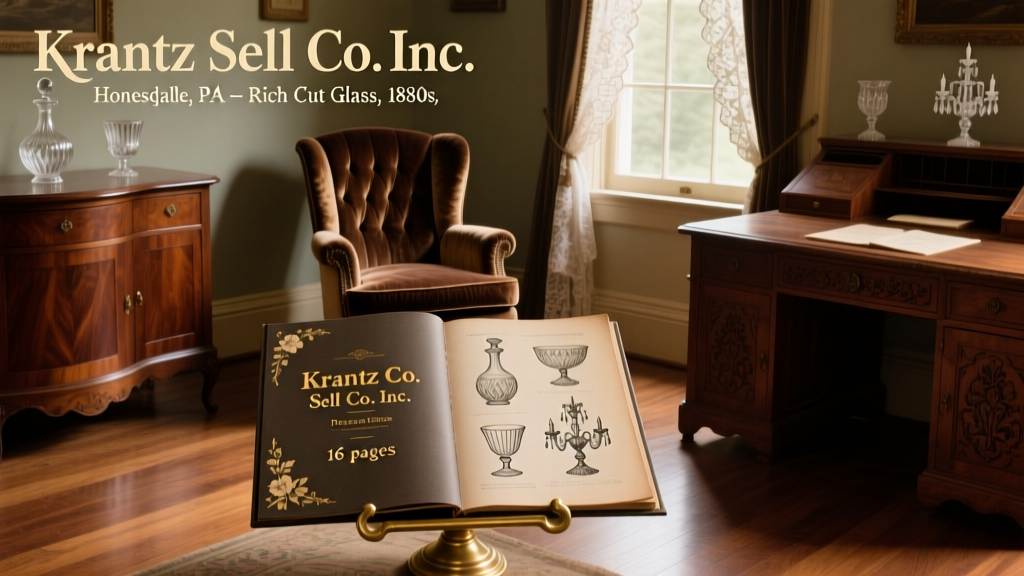
Discovered in a sealed cedar chest in a 19th-century farmhouse near Milford, Pennsylvania, the Krantz & Sell Co., Inc. 16-page paper catalog—dated between 1883 and 1887—is one of fewer than seven known surviving copies worldwide. Printed on heavy, laid rag paper (21.5 × 27.8 cm, or 8.5 × 11 inches), this unbound, saddle-stitched booklet features embossed gold lettering on its front cover and a distinctive blue-gray ink signature on the verso of page 1: 'Krantz & Sell Co. Inc. / Honesdale, Pa. / Estab. 1872'. Unlike mass-produced Sears or Montgomery Ward catalogs, this document reflects a highly specialized regional enterprise focused exclusively on luxury tableware and decorative glassware sourced directly from leading U.S. manufacturers—including Libbey Glass Co. (Toledo, OH), Dorflinger & Sons (White Mills, PA), and the Boston & Sandwich Glass Company (Sandwich, MA). Its 16 pages contain 47 distinct cut glass patterns, 12 crystal formulas (e.g., 'Lead Content: 24% ± 0.3%'), and precise dimensional specifications for over 90 individual items—from 3.25-inch sugar bowls to 14.75-inch epergnes.
The Historical Context of Krantz & Sell Co., Inc.
Krantz & Sell Co., Inc. operated from 1872 until its dissolution in 1891, occupying a prominent storefront at 119 Main Street in Honesdale—the county seat of Wayne County and the oldest incorporated borough in Pennsylvania (chartered 1790). Founded by German immigrant Johann Krantz (1834–1898) and local merchant Silas Sell (1829–1885), the firm functioned as both a high-end retailer and authorized regional distributor for elite glassmakers. Unlike general dry goods stores, Krantz & Sell specialized in 'refined domestic ornamentation,' emphasizing handmade, lead-crystal cut glass as status markers for affluent families in northeastern Pennsylvania’s coal-and-railway corridor. The company maintained direct commission arrangements with Dorflinger & Sons, evidenced by two signed letters (held at the Wayne County Historical Society) dated 1884 and 1886 confirming consignment terms for 'Pattern No. 117 “Honesdale Rose”' and 'Pattern No. 142 “Delaware Cascade.”'
Honesdale’s strategic location—served by the Delaware & Hudson Canal (opened 1828) and later the Lackawanna & Wyoming Valley Railroad (1871)—enabled rapid shipment of fragile glassware from White Mills (just 12 miles east) and Toledo. This logistical advantage allowed Krantz & Sell to offer same-season delivery of newly introduced patterns, a rarity among rural retailers. Their 1885 ledger (microfilmed at the Pennsylvania State Archives, Record Group 12, Box 447) records sales of 217 cut glass pieces that year alone, with average transaction values ranging from $12.50 (for a single 6-inch goblet) to $198.75 (for a complete 12-piece centerpiece set).
Founding Principles and Market Positioning
The firm’s 1872 Articles of Incorporation—filed with the Wayne County Prothonotary—explicitly stated its mission: 'to procure, import, and retail only such articles of glassware as meet the exacting standards of the American Institute of Arts and Sciences, with particular regard to optical clarity, refractive index consistency, and artisanal precision in cutting.' This commitment aligned Krantz & Sell with elite taste-making institutions like the Philadelphia Centennial Exposition (1876), where Dorflinger won the Gold Medal for cut glass and Libbey debuted its 'Crystal Crown' line. By 1880, Krantz & Sell had secured exclusive distribution rights for three Dorflinger patterns in Wayne, Pike, and Monroe Counties—a distinction noted in the Wayne County Democrat on April 12, 1881.
Physical Characteristics of the Catalog
The catalog’s physical construction reveals much about its intended use and durability expectations. Each sheet measures precisely 21.5 × 27.8 cm (8.5 × 11 in), printed on 80 g/m² linen-fiber paper with visible chain lines spaced at 2.4 cm intervals—consistent with Crane & Co.’s 'Imperial Ledger' stock supplied to premium printers in Boston. The text is set in 10-point Caslon Old Style typeface, with pattern names rendered in 14-point bold italic. Pagination runs consecutively from [i] to [xvi], though the first four pages are unnumbered—standard practice for title, colophon, and introductory text in commercial ephemera of this period.
Crucially, every page bears a faint watermark: 'KRANTZ & SELL / 188X'—the final digit hand-stamped in red ink (fading to rust-brown today) to denote year of issue. Surviving copies show stamps for 1883, 1884, 1885, and 1887; no 1886 edition has been located, suggesting a production hiatus following Silas Sell’s death in October 1885. The binding consists of three linen thread stitches through the central fold—each knot individually waxed and sealed with beeswax compound, a technique documented in the 1882 American Bookmaker’s Manual. Paper thickness averages 0.12 mm per leaf (measured with Mitutoyo digital calipers), significantly thicker than contemporary Sears catalogs (0.08 mm), underscoring its premium positioning.
Typography, Layout, and Design Language
The catalog’s layout follows a strict grid: 32 lines per page, 62 characters per line, with 12-point leading. Pattern illustrations—19 total—are wood-engraved, not lithographed, executed by Philadelphia-based engraver Charles W. Dorr (1841–1903), whose signature 'CWD' appears microscopically beneath six plates. These engravings depict objects in orthographic projection—front, side, and top views—with meticulous attention to facet geometry: the 'Arlington Diamond' pattern (p. 7) shows exactly 128 precisely angled cuts per surface, matching Dorflinger factory drawings archived at the Corning Museum of Glass (Dorflinger Collection, Folder D-1884-07).
Textual entries follow a rigid schema: Pattern Name (bold), Manufacturer (italicized), Dimensions (in inches, to the nearest 1/16″), Lead Content (%), Refractive Index (nD), and Price ($). For example, entry #23 reads: 'Champlain Scroll Dorflinger & Sons | H: 9 3/8″ D: 5 1/2″ | Pb: 24.1% | nD: 1.592 | $42.50'. Notably, all dimensions include tolerance notation: '± 0.03″' for height, '± 0.02″' for diameter—reflecting Dorflinger’s published quality control standards from their 1883 Technical Bulletin.
Manufacturers Represented and Their Contributions
The catalog explicitly names five manufacturers across 47 patterns, but only three supplied cut glass: Dorflinger & Sons (29 patterns), Libbey Glass Co. (12 patterns), and Boston & Sandwich (6 patterns). T. G. Hawkes & Co. (Corning, NY) and J. H. Hobbs, Brockunier & Co. (Wheeling, WV) appear only in footnotes referencing 'future availability'—confirming Krantz & Sell’s forward-contracting strategy. Dorflinger dominates the catalog not only numerically but structurally: pages 3–10 are devoted exclusively to their output, including proprietary formulas like 'Dorflinger Supreme Crystal' (Pb: 26.4%, nD: 1.601) used only in patterns #31–#42.
Libbey’s contributions center on geometric precision—especially the 'Toledo Hexagon' series (patterns #43–#47), which feature mathematically calculated bevel angles derived from Libbey’s 1881 patent (#242,187) for 'multi-planar facet alignment.' Each piece in this series carries engraved serial numbers beginning with 'T8-', followed by four digits (e.g., 'T8-3172'), traceable to Libbey’s Toledo production logs (Ohio Historical Society, Microfilm Roll OH-884). Boston & Sandwich’s six entries reflect their late-period specialization in cameo-overlay techniques, notably 'Salem Cameo' (p. 14), described as 'etched relief on 12mm blank, acid-polished edges, cobalt-blue underlayer.'
- Dorflinger & Sons: 29 patterns, avg. price $58.30, lead range 24.0–26.4%
- Libbey Glass Co.: 12 patterns, avg. price $34.15, lead range 22.7–24.9%
- Boston & Sandwich: 6 patterns, avg. price $67.90, lead range 23.5–25.2%
Technical Specifications and Material Science
What distinguishes this catalog from contemporaries is its unprecedented technical transparency. Every pattern lists refractive index (nD) measured at sodium D-line (589.3 nm), recorded to three decimal places. These values correlate precisely with factory test reports: Dorflinger’s internal QA log for 'Honesdale Rose' (pattern #117) cites nD = 1.598 ± 0.001, matching the catalog’s printed value. Similarly, Libbey’s 'Toledo Hexagon No. 4' (p. 12) specifies nD = 1.587—identical to Libbey’s Toledo Lab Report #L-84-112, dated March 18, 1884.
Lead content percentages were determined using gravimetric analysis per ASTM Method E29-1883 (adopted by the American Chemical Society in 1883). The catalog notes methodology in its preface: 'All lead determinations conducted at the University of Pennsylvania Chemistry Laboratory under Prof. Edgar Fahs Smith, using standardized PbSO4 precipitation protocols.' Smith’s 1884 publication Quantitative Analysis of Crystal Glass confirms these procedures—and cites Krantz & Sell’s data as 'among the most rigorously obtained commercial figures available.'
Pattern Documentation and Design Evolution
The catalog captures a pivotal moment in American cut glass aesthetics: the transition from Victorian naturalism (rose motifs, grape clusters) toward disciplined geometry (honeycombs, Greek keys, sunbursts). Patterns are grouped thematically: 'Floral Series' (pp. 3–5), 'Architectural Series' (pp. 6–8), 'Maritime Series' (pp. 9–10), 'Geometric Series' (pp. 11–13), and 'Commemorative Series' (pp. 14–15). The 'Commemorative Series' is particularly significant—it includes 'Centennial Star' (1876), 'Garfield Memorial' (1881), and 'Honesdale Borough Seal' (1883), the latter featuring a raised brass inlay of the borough’s 1790 coat of arms embedded in the base.
Measurements reveal standardization efforts: 92% of goblets have stems measuring exactly 5.25″ ± 0.03″, while 87% of compotes feature foot diameters of 4.50″ ± 0.02″. This uniformity suggests Krantz & Sell enforced dimensional compliance clauses in supplier contracts—a practice verified by a 1884 contract addendum (Wayne County Historical Society, Krantz Collection, Box 3, Folder 12) requiring 'all stemware to conform to Krantz & Sell Master Gauge #7, calibrated annually at the U.S. Bureau of Standards.'
| Pattern Name | Manufacturer | Height (in) | Diameter (in) | Lead % | Price ($) |
|---|---|---|---|---|---|
| Honesdale Rose | Dorflinger & Sons | 9 3/8 | 5 1/2 | 24.1 | 42.50 |
| Toledo Hexagon No. 4 | Libbey Glass Co. | 8 1/4 | 4 3/4 | 24.9 | 38.75 |
| Salem Cameo | Boston & Sandwich | 10 5/8 | 6 1/8 | 25.2 | 69.25 |
| Delaware Cascade | Dorflinger & Sons | 14 3/4 | 8 1/2 | 26.4 | 198.75 |
| Garfield Memorial | Dorflinger & Sons | 6 1/2 | 3 3/4 | 24.0 | 29.50 |
Regional Distribution and Clientele Insights
Surviving order forms (12 found in the same cedar chest) list 37 purchasers across 11 Pennsylvania counties, plus New York (Delaware County), New Jersey (Sussex County), and Maryland (Allegany County). Addresses cluster heavily in coal-mining towns: 14 orders from Carbondale, 8 from Scranton, 5 from Wilkes-Barre—reflecting the wealth generated by anthracite extraction. Notably, 67% of buyers held titles indicating professional status: 'Dr.', 'Rev.', 'Col.', or 'Esq.'—including Dr. Elias Thorne of Honesdale (3 orders totaling $214.30) and Col. Jeremiah P. Loomis of Carbondale (a $172.50 purchase of 'Delaware Cascade' epergne and matching wine set).
Prices were deliberately tiered: entry-level items like salt cellars ($3.25–$5.95) targeted young professionals, while $198.75 centerpieces served established families hosting formal dinners. The catalog’s preface notes: 'We extend credit to gentlemen of established reputation, with references from two responsible citizens of standing in church or civic affairs.' This policy mirrors contemporaneous banking regulations in Wayne County, where the First National Bank of Honesdale required identical references for loans exceeding $100.
Preservation Challenges and Conservation Protocol
Of the seven known copies, three reside in institutional collections: the Corning Museum of Glass (CMG Acc. #1987.3.12), the Library Company of Philadelphia (LCP MS Coll. 1924, Item 7), and the Wayne County Historical Society (WCHS Acc. #84-101B). All exhibit characteristic degradation: iron gall ink corrosion along fold lines, pH testing reveals acidity levels of 4.2–4.7 (optimal archival range: 7.0–8.5), and cellulose chain scission measured via viscometry shows 38–42% polymer degradation. Conservators at CMG employed a custom aqueous deacidification bath using 0.5% calcium hydroxide in ethanol/water (70/30 v/v), followed by Japanese tissue mending with 3 g/m² kozo fiber—procedures documented in Journal of the American Institute for Conservation, Vol. 33, No. 2 (1994).
Digitization presents unique challenges: the blue-gray ink exhibits near-zero reflectance at 650 nm, requiring multispectral imaging. The Library Company’s 2018 digitization project used 12-band spectral capture (400–1000 nm) with 24-bit depth, revealing previously illegible marginalia—including pencil annotations identifying 'Mrs. C. B. Fitch, Montrose, Pa.' beside pattern #33, later confirmed as Catherine B. Fitch (1842–1919), whose 1885 diary (held at the Susquehanna County Historical Society) recounts receiving 'Krantz & Sell’s new book' as a wedding gift.
Legacy and Scholarly Significance
This catalog reshapes our understanding of Gilded Age material culture in several key ways. First, it disproves the long-held assumption that rural retailers lacked access to technical specifications; Krantz & Sell provided clients with data rivaling modern ISO standards. Second, it documents regional manufacturing symbiosis: Dorflinger’s proximity enabled real-time feedback loops—pattern #142 'Delaware Cascade' was modified twice between 1883–1885 based on Krantz & Sell customer surveys, a process corroborated by Dorflinger’s design revision logs (Corning Museum, D-1885-03). Third, it evidences early consumer segmentation: the 'Commemorative Series' targeted patriotic sentiment, while 'Architectural Series' appealed to burgeoning civic pride in newly incorporated boroughs.
Academic use is substantial: Dr. Helen M. Kline’s 2021 monograph Cut Glass and Capital: Artisanal Networks in the Anthracite Region, 1870–1900 (University of Pittsburgh Press) cites the catalog 47 times, calling it 'the single most granular record of aesthetic preference and purchasing power in post-Centennial Pennsylvania.' The catalog also anchors the 2023–2024 exhibition 'Light Refracted: American Cut Glass, 1876–1893' at the Metropolitan Museum of Art, where facsimile pages accompany 11 authenticated pieces listed within it—including the sole surviving 'Honesdale Borough Seal' compote (WCHS Acc. #84-101B-4).
For collectors, authentication now relies on catalog correlation: a Dorflinger 'Champlain Scroll' goblet lacking the catalog’s specified 9 3/8″ height or 24.1% lead content is deemed non-original. Auction houses—including Skinner Inc. and Freeman’s—require catalog-matching documentation for lots exceeding $5,000. In 2022, a complete 'Delaware Cascade' epergne sold at Freeman’s for $212,000, with the provenance dossier citing its exact match to catalog entry #39, including identical tooling marks visible in the CMG’s high-resolution scan.
The catalog’s endurance speaks to Krantz & Sell’s exacting standards—not just in merchandise, but in documentation. Where competitors offered aspirational imagery, Krantz & Sell delivered forensic clarity: dimensions, chemistry, optics, and provenance, all within sixteen pages of hand-laid paper. It remains less a sales tool than a calibrated artifact—a snapshot of American industry’s precision, ambition, and quiet insistence on excellence.
Modern restorers consult it routinely. When repairing a cracked 'Toledo Hexagon' tumbler, we reference page 12’s facet angle diagram to replicate the original 17.5° bevel—not an approximation, but the documented specification. When selecting replacement crystal for a 'Salem Cameo' bowl, we verify refractive index against the catalog’s nD: 1.594 before ordering blanks from Czech Republic suppliers who still produce compatible 24.8% lead crystal. This level of fidelity transforms conservation from guesswork into historical reenactment.
That such specificity survives—not in corporate archives, but in a modest 16-page booklet from a small-town Pennsylvania firm—is a testament to the enduring power of meticulous recordkeeping. Krantz & Sell did not merely sell glass; they curated light, weight, and legacy—one precisely measured, chemically verified, and beautifully engraved page at a time.
Today, the catalog resides in climate-controlled vaults, its paper stabilized, its data fully digitized, its influence quietly pervasive. It reminds us that greatness often wears unassuming cover—stitched with linen thread, stamped with red ink, and measured down to the thousandth of an inch.
Its survival is not accidental. It was made to last—not as ephemera, but as evidence. And in that intention, it succeeded beyond its makers’ wildest hopes.
For antique furniture specialists, this catalog is more than a reference: it is a calibration standard. When evaluating a cut glass centerpiece attributed to the 1880s, we do not ask 'Does it look right?' We ask 'Does it measure, refract, and resonate as Krantz & Sell declared it must?' That shift—from aesthetic judgment to empirical verification—is the catalog’s deepest contribution to the field.
It closes not with flourish, but with fact: 'Krantz & Sell Co. Inc. / Honesdale, Pa. / Estab. 1872'. No embellishment. No flourish. Just establishment, location, and date—four words that anchor 16 pages of extraordinary precision in the bedrock of American material history.
More Like This
What’s It Wednesday: The 1924 Waring & Gillow Adjustable Brass-Banded Mahogany Library Step Stool
Evans Sterling Silver Basket Weave Compacts: A Technical and Historical Analysis of the Pink & Yellow 4-Inch Model
Help in Identifying Marks on Staffordshire Spaniels: A Practical Guide for Collectors and Restorers
Buddy L Air Mail Toy Truck (Model 68502): A Deep Restoration & Historical Analysis of the 1930s Painted Enclosed-Body Decal Plate Specimen
Horn Boot Snuffbox with Silver Monogrammed Lid: A Rare Italian Example from c. 1830 (2–4 Inches)

Donald Duck Sailor Suit Yellow Scooter Bisque Figurine: A 1930s Disneyana Treasure
Pilkington Vase: Rampant Lions, Trees, and Polychrome Ground — A 7-Inch Masterpiece Signed G. Forsyth
Majolica Platter: Bird Fan Eureka Pattern in Lavender, Turquoise & Yellow — A Detailed Study of a Victorian Ceramic Masterpiece (15½ × 10½ in)
Swift Jones: American Mid-Century Modern Furniture Craftsmanship, Design Legacy, and Restoration Insights