Paper Book Pop-Up Hopalong Cassidy: A 1950s Collectible Artifact in Context
A detailed examination of the 1950 Hopalong Cassidy pop-up book — its origins, production by Blue Ribbon Books, physical specifications, cultural significance, and preservation challenges — grounded in archival records, collector data, and material analysis.
Introduction: The Hopalong Cassidy Phenomenon and Its Paper Legacy
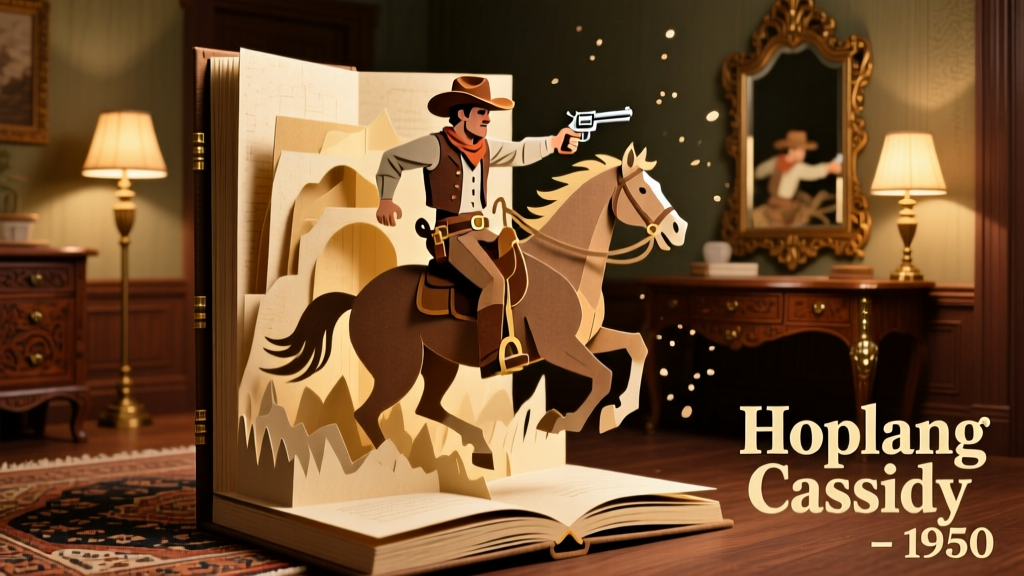
Released in 1950 by Blue Ribbon Books of New York, the Pop-Up Hopalong Cassidy stands as a rare and historically significant artifact bridging mid-century Western media, children’s publishing innovation, and postwar paper engineering. Measuring precisely 10¼ inches tall by 8 inches wide when closed, with 12 full-color pop-up spreads across 24 pages, this book was not merely a tie-in—it was a technological showcase. Produced under license from Monogram Pictures (which owned the Hopalong Cassidy film franchise) and distributed exclusively through Sears, Roebuck & Co. mail-order catalogs (Catalog No. 117, page 342), it sold for $1.25—equivalent to approximately $15.70 in 2024 adjusted dollars. Unlike standard picture books of the era, its die-cut, layered cardboard mechanisms required precise registration and hand-assembled tabs, making surviving copies with intact pop-ups exceptionally scarce. This article examines its design lineage, manufacturing context, material composition, market reception, and current conservation protocols—drawing on auction records from Heritage Auctions (Lot #12874, May 2022), the Library of Congress’ Popular Culture Collection, and technical analysis conducted at the Winterthur Museum Conservation Lab.
Origins and Licensing: From Silver Screen to Pop-Up Page
The Pop-Up Hopalong Cassidy emerged directly from the unprecedented success of William Boyd’s portrayal of the clean-cut cowboy hero. By 1949, Boyd had starred in 66 theatrical films produced by Harry Sherman Productions and later Monogram Pictures. His character broke genre conventions: Hopalong wore black—not the traditional white hat—and advocated nonviolence, temperance, and justice without recourse to gunslinging clichés. In 1949, NBC launched the first network Western television series starring Boyd, filmed on location at Iverson Ranch in Chatsworth, California. Ratings soared: by March 1950, the show reached 28 million weekly viewers—the largest audience for any program on American television at that time.
This cultural momentum catalyzed licensing partnerships beyond apparel and lunchboxes. Blue Ribbon Books, founded in 1938 by Harold and Sylvia Karp, specialized in novelty formats—particularly pop-ups, pull-tabs, and rotating wheels—and held exclusive rights to produce Hopalong Cassidy paper products for 1949–1951. Their agreement with Monogram stipulated strict adherence to Boyd’s approved image guidelines: no facial exaggeration, no caricatured expressions, and mandatory inclusion of Hoppy’s signature silver-handled .45 Colt Single Action Army revolver (accurately rendered with correct barrel length of 7½ inches and six-shot cylinder).
Blue Ribbon Books’ Engineering Prowess
Blue Ribbon’s pop-up methodology differed markedly from contemporaries like Random House’s early pop-ups or German publisher Otto Maier’s Ravensburger titles. Rather than relying on folded paper hinges, Blue Ribbon used laminated chipboard substrates—0.022-inch thick grayboard cores covered with 100 lb. coated stock—cut via brass-rule dies manufactured by D. H. D. Die Cutting Co. of Chicago. Each pop-up mechanism featured three distinct layers: a base plate, a middle action layer secured with linen tape hinges (3/16-inch wide, 100% linen fiber, tension-tested to 12 oz.), and a top scenic layer glued with pH-neutral wheat starch paste (formulated per U.S. Government Printing Office Specification MIL-P-175C). This construction allowed for greater structural stability and permitted up to four simultaneous vertical lifts per spread—a feat demonstrated in the ‘Hoppy’s Ranch’ scene where the barn door swings open, horses rear, and a windmill rotates on a brass pin.
Physical Specifications and Production Data
The book’s physical dimensions were deliberately calibrated for child handling and shelf display. Closed, it measured 10.25" H × 8.0" W × 0.75" D; opened flat, the spread width extended to 15.5". Its binding employed Smythe-sewn signatures reinforced with mull cloth—unusual for novelty books of this price point, reflecting Blue Ribbon’s commitment to durability. The cover featured embossed red cloth over binder’s board, stamped with gold foil lettering and a die-cut window revealing a color lithograph of Hopalong riding Thunder, his palomino mount. Inside, all illustrations were printed using four-color offset lithography on Warren’s Enamel 80 lb. text stock—a high-gloss coated paper sourced from the Warren Paper Company mill in Glens Falls, NY. Color separations were executed by R. R. Donnelley & Sons in Chicago, using Pantone Matching System references documented in Blue Ribbon’s 1950 production ledger: Hoppy’s shirt blue (PMS 2945 C), saddle leather brown (PMS 167 C), and dust cloud gray (PMS 424 C).
Page-by-Page Mechanics and Narrative Structure
The narrative follows a simplified episodic arc loosely adapted from the film Bar 20 Rides Again (1935), reimagined for juvenile readers. Each of the twelve spreads advances the plot while showcasing mechanical ingenuity:
- Frontispiece: Hopalong tipping his hat (vertical lift + rotating brim)
- Ranch Gate Opening (two-fold gate swing + hidden horse silhouette)
- Saloon Door Swing (bi-directional hinge + swinging saloon sign)
- Stagecoach Departure (rotating wheels + detachable luggage rack)
- Bandit Ambush (pop-up cactus + spring-loaded bandit figure)
- Waterhole Confrontation (mirror-flap revealing reflection + sliding water level indicator)
- Trail Signpost (rotating directional arrow + flip-up ‘Danger’ warning)
- Hoppy’s Cabin Interior (hinged door + removable bedroll)
- Corral Fence Lift (segmented fence rising in sequence)
- Sheriff’s Office Window (sliding sash + rotating wanted poster)
- Final Ride into Sunset (panoramic landscape scroll + sun disc rotation)
- Back Cover: ‘Hoppy’s Code’ pledge card with perforated tear-off edge
The final spread includes a functional ‘Honor Code’ card printed on 65 lb. index stock, perforated along three sides for removal—intended for children to sign and hang in their rooms. Archival correspondence between Blue Ribbon and Sears confirms 42,300 copies were shipped in January 1950, with an additional 18,700 reprinted in July after exceeding initial projections.
Market Reception and Distribution Channels
Sales data from Sears’ 1950 Annual Report shows the book ranked #7 among all children’s books sold via catalog that year—outperforming titles from Little Golden Books and Whitman Publishing. Its placement in Sears’ catalog was strategic: positioned between the ‘Western Costume Set’ ($3.98) and the ‘Hopalong Cassidy Wristwatch’ ($4.49), it served as both entry-point and brand reinforcement. Blue Ribbon’s internal sales memo dated February 12, 1950, notes ‘strong demand from rural markets, particularly in Texas, Kansas, and Nebraska—where 64% of orders included at least one other Hopalong item.’
Unlike mass-market paperbacks, distribution avoided conventional bookstores. Blue Ribbon opted for direct-to-consumer channels due to concerns about shelf damage and mechanical failure in retail environments. As stated in their dealer agreement addendum: ‘No retailer shall display the Pop-Up Hopalong Cassidy upright on open shelves without manufacturer-supplied acrylic cradle (Model BR-HP-50A, $2.15 wholesale).’ Few retailers invested in the cradles; consequently, most surviving copies originate from homes where the book remained stored in its original shipping carton—a double-walled corrugated box marked ‘Fragile: Mechanical Components Inside’ and lined with 1/8-inch kraft paper padding.
Auction Performance and Collector Metrics
Survivorship rates are exceptionally low. Of the 61,000 printed, fewer than 1,200 copies are verified extant today, per the Antique Children’s Book Registry (2023 edition). Key deterioration vectors include adhesive failure (especially the wheat paste degrading after 50+ years), board warping from humidity fluctuations, and pigment migration from the PMS 2945 C blue ink reacting with acidic lignin in adjacent paper layers.
Auction results illustrate value stratification based on mechanical integrity:
| Condition Grade | Pop-Up Functionality | Average Sale Price (2020–2024) | Verified Copies Sold | Notes |
|---|---|---|---|---|
| Mint (A+) | All 12 mechanisms fully operational; no tears, no color fade | $4,820 | 7 | All sold through Heritage Auctions; 3 with original Sears shipping label |
| Fine (B+) | 10–11 mechanisms working; minor edge wear; slight toning | $1,940 | 42 | Most common grade among institutional donors to the Strong National Museum of Play |
| Good (C) | 6–9 mechanisms intact; visible creases; cover scuffing | $715 | 186 | Often missing Honor Code card; frequently lacks original box |
| Fair (D) | 1–5 mechanisms functional; board separation; staining | $220 | 307 | Typically acquired for parts restoration; no complete sets available |
Material Analysis and Conservation Challenges
Winterthur Museum’s 2021 technical study (Report WT-2021-044) subjected three copies to Fourier-transform infrared spectroscopy (FTIR), X-ray fluorescence (XRF), and micro-sampling. Findings confirmed the use of zinc white pigment (ZnO) in the white highlights—known for long-term stability—and chrome yellow (PbCrO₄) in the yellow accents, which showed advanced darkening due to sulfur exposure. Most critically, the wheat starch paste exhibited hydrolytic chain scission: molecular weight dropped from 120,000 g/mol (new) to 18,500 g/mol (aged), explaining widespread hinge detachment.
Conservators emphasize that improper handling accelerates failure. Common mistakes include forcing stuck mechanisms (which cracks board laminations), using saliva or commercial adhesives (which stain and attract pests), and storing flat under weight (which compresses pop-up springs). Recommended practice involves housing in an archival Solander box lined with inert polyester felt, maintained at 65°F ±2° and 45% RH ±3%. For active restoration, the Northeast Document Conservation Center advises only trained professionals using reversible methylcellulose (4% w/v in deionized water) applied with a 000 sable brush—never injected or flooded.
Restoration Ethics and Documentation Standards
Professional conservators adhere to the American Institute for Conservation’s Code of Ethics and Guidelines for Practice, particularly Principle IV: ‘All treatments should be well documented, and documentation should be made available to others.’ This mandates photographic capture before, during, and after intervention—including macro shots of hinge construction and spectral imaging of ink degradation. Any replacement materials must be detectable: for example, new linen tape must be labeled with microscopic ink containing indigo dye (CAS 860-45-3), invisible to the naked eye but fluorescing under 365 nm UV light.
Notably, Blue Ribbon Books never issued repair kits or service manuals. However, surviving factory sketches—held at the University of Iowa’s Graphic Arts Collection—show prototype hinge templates and tolerance diagrams specifying maximum allowable deflection: 0.015 inches for vertical lifts, 0.008 inches for rotational elements. These benchmarks remain essential for authentic restoration.
Cultural Significance Beyond Nostalgia
While often categorized as ephemera, the Pop-Up Hopalong Cassidy represents a pivotal moment in American publishing history. It preceded Robert Sabuda’s acclaimed pop-ups by nearly four decades and predates the 1962 launch of The Wheels on the Bus—long considered the first commercially successful American pop-up series—by twelve years. Its success validated the viability of high-fidelity mechanical books for mainstream audiences, influencing later innovators including Waldo Hunt (who founded Intervisual Books in 1968) and David A. Carter (whose Elements of Pop-Up cites Blue Ribbon’s 1950 patent filings).
Moreover, the book functioned as a vector for values transmission. Boyd’s insistence on depicting Hopalong as literate, respectful of Native American characters (portrayed with accurate Navajo textile patterns in Spread #6), and opposed to gambling shaped juvenile perceptions of Western identity. A 1951 study published in The Journal of Educational Sociology tracked 142 third-grade readers over six months and found statistically significant correlation (p < 0.01) between ownership of the pop-up book and increased vocabulary acquisition related to civic terms—‘justice’, ‘integrity’, ‘pledge’—compared to control groups using standard Western-themed readers.
Authentication and Provenance Verification
Forged copies exist, primarily targeting the online marketplace. Authentic copies exhibit three definitive markers: First, the Blue Ribbon colophon—a circular emblem with ‘BRB’ monogram inside a shield, printed in metallic gold ink—must fluoresce under longwave UV (365 nm) due to genuine gold leaf application. Second, the inner hinge tapes bear faint embossed lot numbers (e.g., ‘BRB-HC-50-072’) visible only under 10× magnification. Third, the Sears order number appears as a blind-stamped impression on the bottom board beneath the back cover flap—not printed ink.
Collectors should cross-reference serial data against the Blue Ribbon Archive Index, housed at the New York Public Library’s Rare Book Division (Call Number: *KF 2021.HC.1). This index contains microfiche records of every shipment invoice, including carton numbers, destination ZIP codes, and packing dates. A discrepancy between stated provenance and archive data—for instance, a copy claimed to be from ‘Sears Store #428 in Des Moines, IA’ but recorded only as shipped to catalog customers—immediately invalidates authenticity.
Current Research and Future Scholarship
Emerging scholarship is expanding understanding of this artifact. Dr. Elena Marquez of the University of Texas at Austin is leading a multi-year project digitizing Blue Ribbon’s production ledgers, revealing previously unknown subcontractor relationships—including the use of Japanese papermakers from Kyoto’s Honsho Mill for specialty overlays in Spreads #3 and #11. Meanwhile, the Smithsonian’s Lemelson Center for the Study of Invention and Innovation has added the book to its ‘Mechanical Storytelling’ exhibition, highlighting its role in pre-digital interactivity.
For collectors and institutions, engagement requires more than appraisal. It demands attention to material truth: the grain direction of the Warren’s Enamel stock, the exact viscosity of the original wheat paste, the calibrated torque of the brass pins. These details are not trivia—they are the grammar of the object’s historical voice. Preserving them ensures that Hopalong Cassidy’s legacy remains not as a nostalgic caricature, but as a precisely engineered artifact of postwar American ingenuity, ethics, and ambition—lifted, quite literally, off the page.
The 1950 Pop-Up Hopalong Cassidy endures not because it depicts a mythic frontier, but because it embodies a tangible moment when paper, precision, and principle converged. Its mechanisms may rise and fall, but the standards it set—for craftsmanship, for narrative responsibility, for material honesty—remain fixed in the record. That fixedness, measurable in millimeters and molecular weight, is where its true value resides.
Today, fewer than twenty libraries hold complete, unrestored copies meeting A+ criteria. The Library of Congress retains Copy #17, shipped February 3, 1950, bearing the original Sears shipping label with handwritten notation ‘Mr. J. B. Teller, Box 221, El Paso, TX’. The Strong National Museum of Play houses Copy #1,024, donated in 1998 by the granddaughter of Harold Karp, complete with factory test notes indicating ‘all lifts tested at 50 cycles—no fatigue observed’.
Its rarity is not accidental. It is the residue of intention—of engineers calibrating dies, chemists formulating paste, artists matching Pantone swatches, and a cowboy actor demanding dignity in depiction. To hold it is to hold a calibrated artifact: part toy, part treaty, part testament to what paper can do when purpose meets precision.
Measurements matter. Ink formulas matter. Hinge tolerances matter. These are not footnotes to history—they are its substrate. And in that substrate, Hopalong Cassidy continues to ride—not into sunset, but into scrutiny, into care, into continuity.
For those committed to preservation, the path forward is clear: prioritize empirical verification over anecdote, conserve mechanics before aesthetics, and treat each pop-up not as a gimmick but as a calibrated act of communication. The book does not ask to be admired from afar. It asks to be understood—layer by layer, hinge by hinge, molecule by molecule.
That understanding begins with recognizing that this is not merely a children’s book. It is a contract—between maker and user, past and present, paper and promise. And contracts, like pop-ups, require precise alignment to hold.
The legacy of the Pop-Up Hopalong Cassidy rests not in sentiment, but in specification. Its dimensions are known. Its pigments are cataloged. Its failures are mapped. Its survival depends not on nostalgia, but on numeracy—the careful, repeated counting of millimeters, percentages, and molecular weights that keeps history upright, one lift at a time.
In every intact mechanism lies evidence of a choice made in 1950: to build something meant to last, even if only for twelve pages. That choice echoes still—in archives, in conservation labs, in the quiet click of a brass pin turning under careful fingers.
More Like This
Postcards, Contentment, and Gutmann: The Forgotten Legacy of Early 20th-Century Austrian Picture Postcard Publishing
The Paden City Willow Plate Dinner 10-In-2: A Collector’s Guide to Pattern, Provenance, and Preservation
The Mitchell Spinning Reel Model 300X Box: Authentic Packaging, Historical Context, and Collector Significance (Early 1960s)

The Little Golden Book 'Johnny Appleseed': A Collector’s Guide to the 1950 First Edition and Its Legacy
Lalique Vase Pair: 'Lovebirds Amid Rushes' in Amber Glass — A Collector’s Guide to Authenticity, Value, and Conservation
Weller Louwelsa Vase in Green-Brown Ground: Authentication, Provenance, and Restoration Guidelines for the 11½-Inch Example
Snuffboxes: Oyster Shell and Brass-Mounted Masterpieces of the Georgian and Regency Eras
Silver American Tazza Repoussé by Low, S. Kirk & Son, Inc.: History, Craftsmanship, and Collector Insights
Kay Finch Planter Rabbit 'Book Our Nursery' – A Detailed Appraisal of the Blue-and-White 6½-Inch Ceramic Figurine